These docks located in Blackwall were among the large number of docks built in the first half of the 19th century and were, as the name suggests, established by the East India Company.
West India Docks
10 historic London docks…4. West India Docks…
A complex of three docks located on the Isle of Dogs, the West India Docks were founded more than 200 years ago and in recent decades have been redeveloped as the financial centre of Canary Wharf.
Subscribe to see all our content for just £3 a month!
10 historic vessels in London’s Thames…6. ‘Portwey’…
One of only two twin screw, coal fired steam tugs still active in the UK, the steam tug Portwey can these days be found in London’s Docklands.
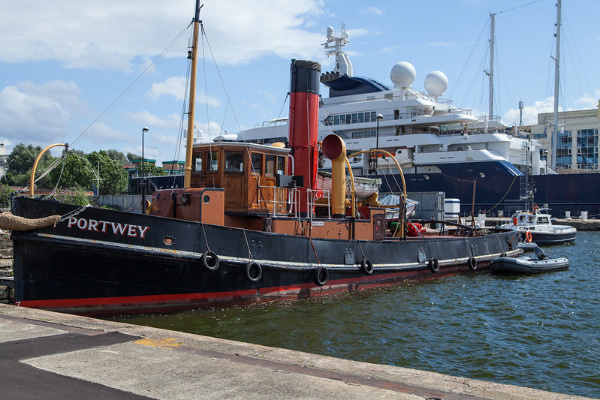
Ordered by the Portland & Weymouth Coaling Co Ltd, Portwey (the name comes from the company’s) was built by Harland & Wolff at Govan yard in Glasgow and launched on 10th August, 1927.
The 80 foot long vessel was based in Weymouth, Dorset, performed a range of tasks including carrying coal to steamers and being on call for any ship in distress requiring assistance or salvage. This included extinguishing a fire aboard the Danish timber-carrier Bodil in 1928, assisting ships like the cargo steamer Winslow (which had developed a list in heavy seas in 1932), and the Winchester Castle which had run aground in 1936, and even being involved in the search for a sunken submarine in 1932.
The Portwey was seconded by the Admiralty and moved to Dartmouth in Devon during World War II. Narrowly avoiding German bombs while in the harbour, during this time the tug was went to the assistance of ships attacked by the enemy. In 1944, she was assigned to US forces as they prepared for D-Day and her duties including clearing obstructions from the channel and supplying fresh water to naval vessels as well as, when a rehearsal for the landings went wrong at Slapton Sands, rescuing personnel and landing craft.
After the war, the Portwey resumed duties as a harbour tug including ferrying pilots and customs officers out into the Channel. In 1947, she helped put out a fire at the Queen’s Hotel in Dartmouth.
The Portwey was sold to the Falmouth Dock and Engineering Company in Cornwall in 1952. As well as rescuing the captain and first officer of the cargo ship Flying Enterprise, during this period she was involved in the construction of the Lizard Lifeboat Station in Cornwall, and a car ferry slipway at Holyhead in north Wales.
In 1967, with coal-fired steam tugs being replaced by diesel-engined ships, she was laid up to be scrapped. But it wasn’t the end for the Portwey, which was bought by Richard Dobson, the assistant harbour master at Dartmouth. Along with a group of friends, he returned her to working condition and during the 1960s and 1970s, she took part in many events on the River Dart and around Torbay.
In 1982, the Portwey joined the Maritime Trust’s Historic Ship Collection at St Katharine’s Dock where the newly formed Friends of Portwey continued with restoration and operation of the tug.
The Friends of Portwey became the Steam Tug Portwey Trust in 2000 and purchased the tug from the Maritime Trust, moving the vessel to West India Dock.
WHERE: Steam Tug Portwey, West India Dock (South Quay) (nearest DLR station is South Quay); WHEN: 2pm to 9pm Wednesdays; WEBSITE: www.stportwey.co.uk.
What’s in a name?…Canary Wharf
No, Canary Wharf is not so named because it was the centre of London’s lucrative trade in canaries.
 Rather it received its name from the fact that it was at a quay here that ships from the Spanish Canary Islands and the Mediterranean landed laden with cargos of fruit.
The wharf, part of the West India Docks on the Isle of Dogs, was built in 1936 by Fruit Lines Limited and a warehouse the following year.
The area where the wharf was once located was redeveloped under a massive regeneration project starting in the late 1980s and is now one of London’s key financial districts, filled with modern, multi-storey office towers and home to the second-tallest tower in the UK, One Canada Square (seen above with the pyramid-shaped roof).
LondonLife – The Ceremony of the Dues…
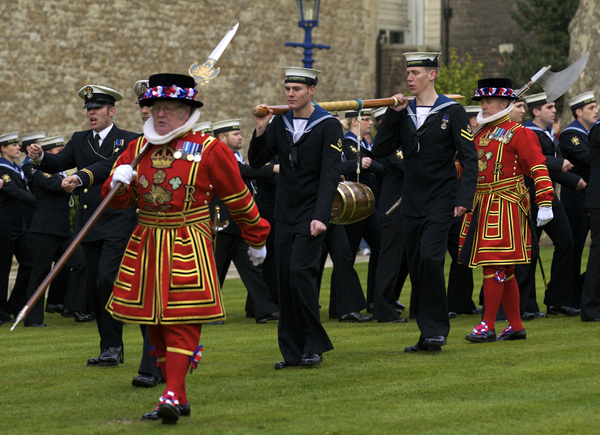 The Constable of the Tower of London, General Lord Richard Dannatt, was presented with a barrel of wine in the Ceremony of the Constable’s Dues by the commander and crew of the Royal Navy destroyer, the HMS Liverpool, last Saturday. The annual ceremony dates back to the 14th century and relates to the right of the tower’s constable to demand tolls from vessels on the Thames on behalf of the king. Previous offerings have included barrels of rum, oysters, mussels and cockles. The HMS Liverpool, commanded by Colin N O Williams, was berthed at West India Docks before the ceremony and the wine escorted to the Tower where, after being challenged by Yeoman Warders it was delivered to the constable at the Queen’s House. The ship is to be decommissioned in spring after 30 years of service in which it saw service in Iraq, the Caribbean and during the recent Libyan conflict. For more on the Tower of London, see www.hrp.org.uk/TowerOfLondon/
PICTURE: Courtesy of Historic Royal Palaces
 Exploring London