• An antique Chinese carpet which originally was part of furnishings at Eltham Palace has returned home after 80 years. The carpet, dyed in the “dynastic blue” of the Qing dynasty and featuring symbols including dragons, Buddhist emblems and masks, represents the demand for the Chinese decorative arts in the 1920s and 1930s and serves as a reminder of how Chinese art was produced, circulated, and displayed in Britain. The carpet, donated from the estate of Mrs M R Bernard – the niece of former palace owner Stephen Courtauld, has undergone extensive conservation work. It can be seen in what was Virginia Courtauld’s boudoir. Eccentric millionaires Stephen and Virginia Courtauld built a magnificent art deco mansion right next to the medieval Great Hall of Eltham Palace in 1936 but moved out in 1944 and passed the lease to the Army Educational Corps. Over the ensuing decades many of the original items in the palace were dispersed but English Heritage, which took over management of the palace in 1995, has been working to restore the interiors back to when the Courtaulds lived in them. Other original items which have returned to the palace in recent history including a gold telephone and a pair of Cartier brooches. Admission charge applies. For more, see www.english-heritage.org.uk/visit/places/eltham-palace-and-gardens/.
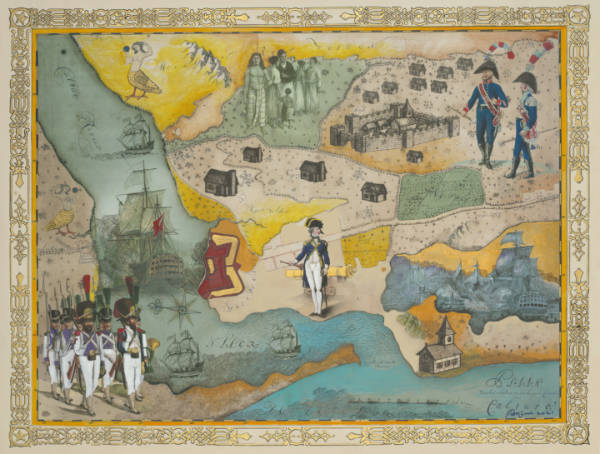
• The works of more than 40 artists from 25 countries across the Asia Pacific region are going on show at the V&A in South Kensington. Rising Voices: Contemporary Art from Asia, Australia and the Pacific, to be held in The Porter Gallery, is being held in partnership with Australia’s Queensland Art Gallery/Gallery of Modern Art. Highlights include: Mchael Parekōwhat’s life-sized sculpture of a Mãori security guard, Kapa Haka (Whero) (2003); Pala Pothupitiye’s Kalutara Fort (2020-21) – a reimagined map of an historic Sri Lanka military camp; Brenda Fajardo, Elisabet Kauage, Mathias Kauage and John Siune’s There is still a war going on in Bougainville (1995) which responds to Papua New Guinea’s Bougainville conflict between 1988-98; and, a series of porcelain busts by Ah Xian. The exhibition opens on Saturday and runs until 10th January. Admission charge applies. For more, see https://www.vam.ac.uk/.
• The role broadsides played in spreading news, advice and gossip in London from the 16th century onwards is the subject of a new exhibition at the Guildhall Library. Broadsides: Speaking to the People explores the history of broadsides and how they were used to speak to the general public, high and low alike. Free to see. Runs until 29th October. For more, see www.cityoflondon.gov.uk/events/exhibition-broadsides-speaking-to-the-people.
• Ground-breaking astronomer Cecilia Payne-Gaposchkin has been honoured with an English Heritage Blue Plaque at the home in Notting Hill where she lived as a teenager. The plaque at 70 Lansdowne Road marks where Payne-Gaposchkin’s journey towards expanding our understanding of space began. Payne-Gaposchkin earned a doctorate in astronomy from Harvard after moving to the US. Her groundbreaking 1925 thesis proposed that stars are composed primarily of hydrogen and helium, a discovery that fundamentally changed scientific understanding of the universe, and in 1927, she became the youngest astronomer ever to have a star of distinction next to her name in the publication American Men of Science. For more, see www.english-heritage.org.uk/visit/blue-plaques/.
Send all items for inclusion to exploringlondon@gmail.com.

