• A newly discovered gold signet ring bearing the signet of Queen Elizabeth I has gone on display this week at Hampton Court Palace. The ring was discovered by a metal detectorist at the site of a former royal hunting ground at Ampthill, Bedfordshire, and was purchased by Historic Royal Palaces under the terms of the Treasure Act 1996. Dated to the 1570s, it features an engraving of a phoenix rising from the flames. The phoenix emblem was first associated with Queen Anne Boleyn, the second wife of King Henry VIII, following the publication of a poem in 1575 by Ulpian Fulwell in which she is eulogised as being like a phoenix, with her daughter Elizabeth rising from the ashes as “a worthy Queen”. It was around this time that Queen Elizabeth I adopted the phoenix emblem for herself to honour her late mother. The emblem subsequently became associated with Anne Boleyn and courtiers had it incorporated in their clothing, jewels and paintings to show loyalty to the queen. It’s thought the ring may have been lost by a courtier or supporter of the Queen. Also on display at Hampton Court is the ‘Boleyn ring’ which, found close to the home of Anne Boleyn’s cousin, is engraved with a bull’s head and arrayed with sunbeams and stars of white enamel and features religious decoration of icons of the Virgin and Child and St Catherine of Alexandria. It has been speculated it belonged to Anne’s father or brother. On display in the Tudor World exhibition in the Wolsey Rooms at Hampton Court Palace and included in palace admission. For more, see https://www.hrp.org.uk/hampton-court-palace/.
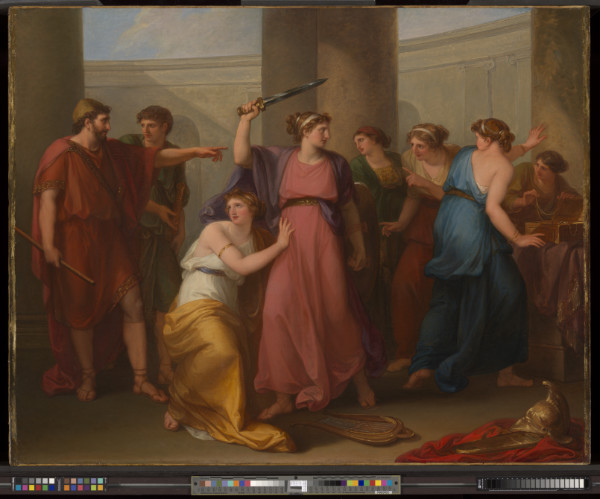
• Eighteenth century Swiss artist Angelica Kauffmann’s first history painting in oils – Achilles discovered among the Daughters of Lycomedes – has been gifted to the National Gallery. The painting is one of three by Swiss artists gifted to the gallery by Dallas-based collectors Richard and Luba Barrett. The other two include Portrait of Louis Montchal by Ferdinand Hodler (1853–1918) and a landscape – Gallery Four Large Trees – by Alexandre Calame (1810–64). Kaufmann’s painting – the first of hers to enter the National Gallery’s current collection – was produced in 1787 to 1778 at the height of her success in Europe. An unusually large and fully worked preparatory picture, it was created for a final painting commissioned by Catherine the Great that is now at the Scientific-Research Museum of the Academy of Arts of Russia in St Petersburg. Kauffmann’s work can be seen in Room 37, Hodler’s in Room 44 and Calame’s in Room 39. For more, see www.nationalgallery.org.uk
• The story of electric travel is being told at the London Transport Museum in Covent Garden from next Tuesday. Electric Pioneers features a programme of events for families to explore the story of how electricity has shaped transport in London. Activities include the chance to design your own traffic light, meet costumed characters in the museum’s galleries and discover how electricity is made. Runs until 2nd September. Admission charges apply. For more see ltmuseum.co.uk/whats-on/summer-holidays-electric-pioneers.
Send all items to exploringlondon@gmail.com

