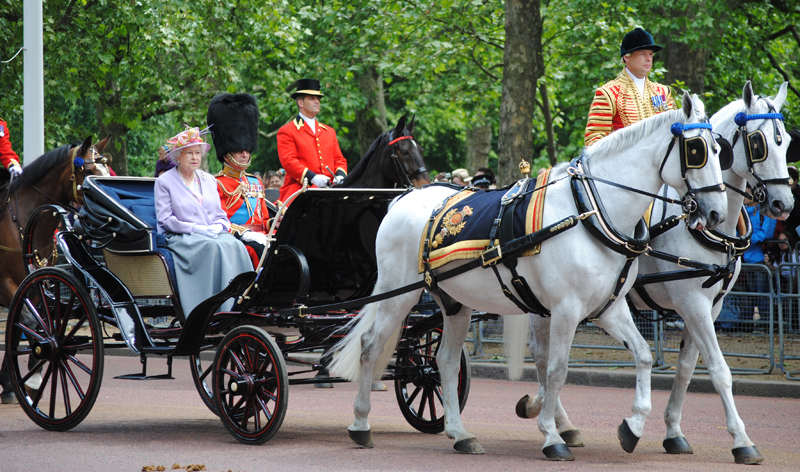
Last weekend saw thousands gather to celebrate Queen Elizabeth II’s birthday and watch the annual Trooping the Colour parade down The Mall to Horse Guards Parade in Whitehall. The tradition of Trooping the Colour began around the early eighteenth century when the ‘colours’ or flags of battalions were ‘trooped’ through the assembled ranks so they could be seen and recognised by the soldiers (important on the field of battle when the flags were used as a rallying point). Since 1748, the parade has doubled as a way of marking the King or Queen’s birthday (the current Queen’s birthday is actually 21st April). It has been an annual event since 1760 when George III succeeded to the throne and since the reign of Edward VII (1901-1910), the monarch has always been present at the parade. Up until 1986, the current Queen took the salute riding side-saddle on her horse, Burmese, but these days she rides as she did on Saturday with Prince Philip, the Duke of Edinburgh, in Queen Victoria’s 1842 phaeton, returning down the Mall to appear on the balcony of Buckingham Palace with the royal family where they watch an airforce flyby. WEBSITE www.royal.gov.uk/RoyalEventsandCeremonies/TroopingtheColour/TroopingtheColour.aspx
Author: exploringlondon
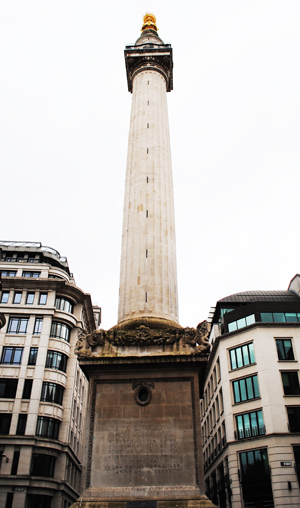
10 London sites you might not know about – 2. The Monument
It was a toss-up whether to include The Monument in this list but, surprisingly perhaps, there are still many visitors to London who overlook what is a unique site in the old city of London and a reminder of one of the key events which have shaped the city.
The tallest free-standing stone column in the world, it was built between 1671-77 to commemorate the Great Fire of London in 1666 and the subsequent rebuilding of the city. The fire broke out in a baker’s shop in nearby Pudding Lane on Sunday, 2nd September, 1666, and burned until the following Wednesday, destroying much of the city in the meantime (although, thankfully, there was actually little loss of life).
Sir Christopher Wren (architect of St Paul’s fame and then Surveyor-General to King Charles II) and Dr Robert Hooke (Surveyor to the City of London and Wren’s assistant) designed the memorial which is topped by a drum and copper urn from which flames are emerging and stands 61 metres above the ground and which, if toppled, reaches the point in Pudding Lane where the fire began.
A spiral stone staircase winds it way up the column’s middle to a platform where you can get come stunning views of the city (but be warned at 311 steps, it’s quite a climb, although at least since 1842 there’s been an iron railing around the platform).
The reliefs on the western side of the base shows Charles II in all his glory while inscriptions on the other three sides tell the story of the great fire (incidentally, the main inscription, was altered in 1681 to include the words “But Popish frenzy, which wrought such horrors, is not yet quenched” which were removed in 1831). The site is now owned by the City of London Corporation.
WHERE: Junction of Monument Street and Fish Street Hill (Nearest Tube station is Monument). WHEN: Daily (9.30am-5.30pm). COST: Adults £3/concessions £2/children £1. WEBSITE: www.themonument.info
10 London sites you may not know about – 1. Eltham Palace
London is a vast city and whether you’re a first-time visitor or a seasoned Londoner, there’s probably still many places you haven’t yet visited. So over the next few posts we’re running a list of 10 of the less well-known sites for your perusal…
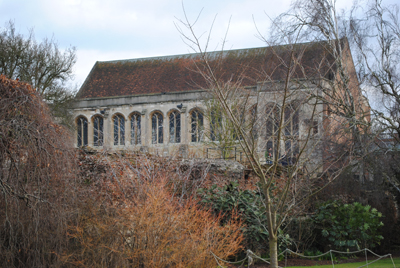
1. Eltham Palace. While Henry VIII’s final home, Hampton Court Palace, remains among London’s top 10 tourist sites, less well known is his childhood home, Eltham Palace. True, nowhere near as much of it remains from the Tudor and earlier medieval times, but with a later adjoined 1930s mansion housing some amazing Art Deco interiors, the medieval remains are just the start. 
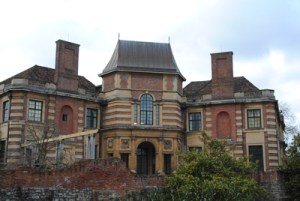
The palace’s history can be traced back to the Domesday survey of 1086. It passed into royal ownership in 1305 when then owner, Anthony Bek, Bishop of Durham, gave it to King Edward I.
Numerous kings and their families spent time at Eltham including Edward III, Henry IV, and Henry VI, and it was Edward IV who, between 1475 and 1480, ordered the Great Hall built – a treasure which still survives.
Henry VIII was the last English monarch to spend considerable time at Eltham – it was elipsed by Greenwich Palace as a royal residence – and, after falling into disrepair into the seventeenth century, it passed back into ‘non-royal’ hands.
Much of what stands at Eltham today dates from the 20th century when millionaire socialites Sir Stephen and Lady Virginia Courtauld oversaw the restoration of the medieval Great Hall and the construction of an adjoining mansion which is a masterpiece of 1930s style incorporating a combination of Art Deco, “ocean-liner style” and Swedish design. 
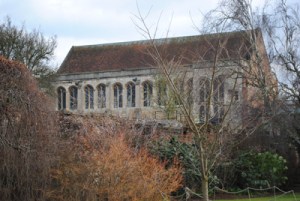
The Courtaulds left for a new life in Southern Rhodesia in 1944 and from then until the early 1990s the military occupied the property. English Heritage subsequently oversaw a major restoration and opened it to the public in 1999.
It’s well worth a visit to see the medieval Great Hall (which apparently boasts the third largest hammer-beam roof in England) and the 1930s property (aside from the stunning interiors – including Virginia’s gold-plated bathroom and warmed sleeping quarters for the Courtauld’s pet lemur – there’s also some great Courtauld family movies on show which give an amazing insight into the family which once lived there and an audio guide tour fittingly narrated by David ‘Poirot’ Suchet). There’s also 19 acres of gardens to explore, including a magnificent medieval bridge spanning what remains of the moat, and a cafe to while away the afternoon.
WHERE: Off Court Road, SE9. Half a mile from Eltham and Mottingham train stations. COST: £8.30 adult/£7.20 concession/£4.20 child (garden only tickets are available). English Heritage members free. WEBSITE: www.elthampalace.org.uk
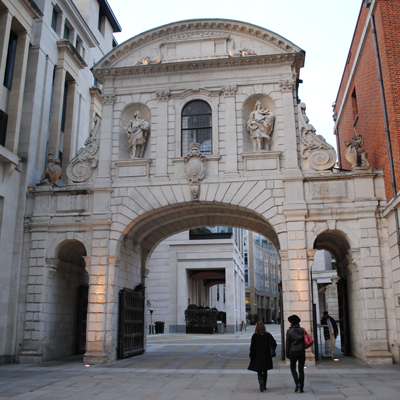
The return of the Temple Bar
It’s been a while since I was in London so I was delighted to find that the Temple Bar had been restored (not to its original site, but to the city as a whole!). The only surviving gateway into the city of London, it was constructed in 1672 to replace a crumbling wooden predecessor and was designed by Sir Christopher Wren (he of St Paul’s fame). The Temple Bar stood at the junction of Fleet Street and the Strand until 1878 when, to help traffic flow, it was removed. Apparently it was intended that it would be rebuilt somewhere else in the city, but time passed and no suitable site was found, so it eventually ended up on an estate in Hertfordshire. Where it remained until 2004 when – thanks to the work of the Temple Bar Trust – it was able to be returned to the city – it is now located between St Paul’s and Paternoster Square – for all to now enjoy.
WHERE: Between Paternoster Square and St Paul’s Cathedral. Nearest tube station is St Paul’s. COST: Free to see (actual building not open to public). WEBSITE: www.thetemplebar.info.
The Temple Bar isn’t the only ‘monument’, for want of a better word, which has been relocated in London. Another is the Wellington Arch, a magnificent structure which was originally finished (though not really completed) in 1830. Then known as the Green Park Arch, it stood parallel with the Hyde Park Screen (it was created to be seen in conjunction with it) and was later adorned with a huge – and controversial – statue of Wellington. But by the 1880s, traffic flow was again a problem and so it was decided to move the arch to its current location, perpendicular to the Hyde Park Screen. As a footnote, when the arch was moved in 1883, the statue of Wellington was not placed back on top but moved to a new site – Aldershot, where it is now.
WHERE: Grosvenor Place, Westminster, SW1X 7. Nearest tube station is Hyde Park Corner. COST: Adults £3.70/child £1.90 (English Heritage members free – there is a joint offer for others combined with Apsley House). WEBSITE: www.english-heritage.org.uk/daysout/properties/wellington-arch/.
Exploring London…
Welcome to Exploring London, a new blog concerned with uncovering some of the great city’s hidden past; to exploring its nooks and crannies; to delving into its secrets. It was noted resident Dr Johnson who famously said that to be bored with London is to be bored with life and indeed, this is a city that continues to surprise and amuse, no matter how long one spends here. I hope you enjoy the journey…