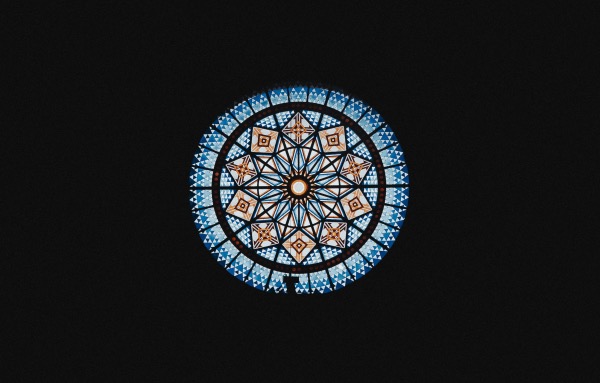
LondonLife – Alexandra Palace glasswork…
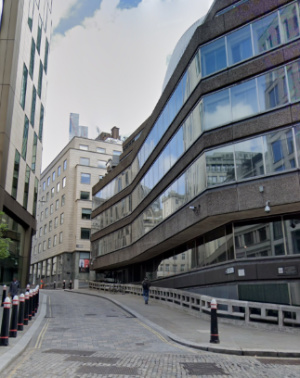
Famous for being the location of the bakery where the Great Fire of London started, Pudding Lane runs between Eastcheap and Lower Thames Street in the City of London.
While it has been claimed in the past that the name did come from desserts or puddings being sold here, it’s now generally believed that the name relates to the medieval word ‘pudding’ which meant offal – the guts or entrails of animals.
It was apparently down this lane that the butchers of the Eastcheap market (London’s primary meat market in medieval times, located at the northern end of the lane), having slaughtered an animal for consumption, would have the ‘puddings’ carried down the lane so they could be disposed of on waste barges (earlier on, the butchers were apparently permitted to toss the offal into the Thames when tide conditions were right).
The lane, which 16th century historian John Stow said was also known as Rother Lane (due to a Thames wharf called Rothersgate at its southern end) and Red Rose Lane (after a shop sign in the lane), also has the honour of being one of the world’s first designated one-way streets.
• A piece of the only surviving dress worn by Queen Elizabeth I, Charles Dickens’ court suit, an RSC robe worn by David Tennant as Richard II, and the coronation glove of Queen Elizabeth II are among highlights of a new exhibition at the Guildhall Art Gallery. Marking the 400th anniversary of the Worshipful Company of Gold and Silver Wyre Drawers, Treasures of Gold and Silver Wire features more than 200 objects related to royalty, the arts, military, and the church spanning the period stretching from the Middle Ages to today. Other highlights include a uniform of the State Trumpeter, The Jubilee Cope from St Paul’s Cathedral, a robe of Order of the Garter and the burse of the Great Seal of King Charles II. The exhibition, which opens on Friday, runs until 12th November. Admission charge applies. For more, see www.cityoflondon.gov.uk/events/treasures-of-gold-and-silver-wire-exhibition.
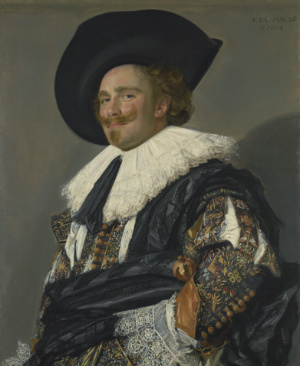
• The Laughing Cavalier serves as the centrepiece of a new exhibition of Frans Hals works at the National Gallery – the largest focused the 17th century Dutch painters’ works in more than 30 years. The Credit Suisse Exhibition: Frans Hals, which has been organised with the Rijksmuseum, Amsterdam features some 50 of the artists works gathered from across the globe. Alongside The Laughing Cavalier which is on loan from the Wallace Collection, highlights include Portrait of Isaac Massa (1626), Portrait of Pieter Dircksz. Tjarck (about 1635–38), The Rommel-Pot Player (1618–22) and Portrait of Tieleman Roosterman (1634). Admission charge applies. Runs until 21st January.
• A major exhibition on the work of Flemish artist Peter Paul Rubens (1577-1640) has opened at the Dulwich Picture Gallery. Rubens & Women features more than 40 paintings and drawings along with archival material and challenges the perception that the artist only painted one type of women as it explores his relationships with women and how they nourished his career and creativity. Highlights include Portrait of a Woman (c1625), Marchesa Maria Serra Pallavicino or Marchesa Veronica Spinola Doria (1606-07), The Virgin in Adoration of the Child (c1616), Looking Down (Study for head of St Apollonia) (1628), Ceres and Two Nymphs (1615-17), The Birth of the Milky Way (1636-1638), and Clara Serena Rubens, the Artist’s Daughter (c1620-23). The exhibition runs until 28th January. Admission charge applies. For more, see www.dulwichpicturegallery.org.uk.
• An interactive exhibition exploring email’s impact in our lives – how it shapes our work, relationships, cultures and economies – opens at The Design Museum today. Email is D̶e̶ad̶ ̶, being held in partnership with Intuit Mailchimp, charts the history of email, from its embryonic beginnings in the 1970s to what the email experience might be like in 2070. Admission is free. Runs until 22nd October. For more, see https://designmuseum.org.
Send all items to exploringlondon@gmail.com for inclusion.
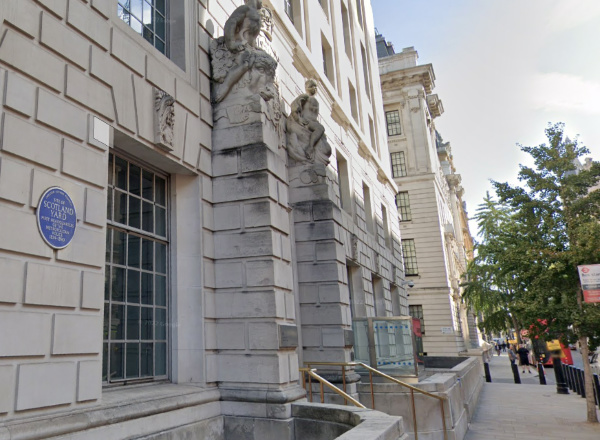
OK, so there’s not much left to see here – at least not from Wren’s time. But it was in Scotland Yard that Wren spent much of his time after being appointed Surveyor-General of the King’s Works.
The yard, which was located just north of the kitchens serving the Palace of Whitehall and to the south of aristocratic mansions built along the Strand, was the location of the Office of Works. It served as a workplace for Wren and was also the location of his main residence between 1669 and 1718 when he lived in a house built by his predecessor in the office, John Denham.
According to a recent lecture by Professor Simon Thurley at Gresham College, newly identified plans of the house show the ground floor contained a hall, with a kitchen and scullery to the rear while on the first floor was a great dining room, a smaller private dining room, bedroom and dressing room. A floor above contains quarters for servants and possibly the nursery for his children. There were cellars below, two yards and a long narrow walled garden (he also had a stable nearby for his horses and carriage). Most importantly, a door connected the house directly with the Office of Works next door.
Said Thurley: “Although slightly further [from] the royal lodgings than some apartments, Wren’s house was amongst the largest and best appointed of all the houses allocated to senior courtiers.”
Wren lived here with his two wives – his first wife Faith Coghill died of smallpox here in 1675 and his second wife Jane Fitzwilliam died of tuberculosis in 1680 as well as their children – Christopher, William and Elizabeth. Both William and Elizabeth never left their father’s care and died before him.
The origins of the name of Scotland Yard – which has since become synonymous with the Metropolitan Police (now based at New Scotland Yard) – apparently come from the fact the site contained lodgings where the Kings of Scotland stayed when visiting London (the last Scottish royal to stay here did so before Wren’s time, apparently in the reign of King Henry VIII).
From the Stuart period onward, the site was used for government offices – as well as Wren, other famous residents included Inigo Jones, one of Wren’s predecessors as Surveyor of Works, and, during the Commonwealth, John Milton, while serving as Latin Secretary to Oliver Cromwell.
The location of Scotland Yard is these days commemorated in the name of Great Scotland Street and Scotland Place, just off Whitehall. There’s also an English Heritage Blue Plaque marking the site in Whitehall Place, although Wren doesn’t get a mention on that (it’s entirely devoted to the former police presence).
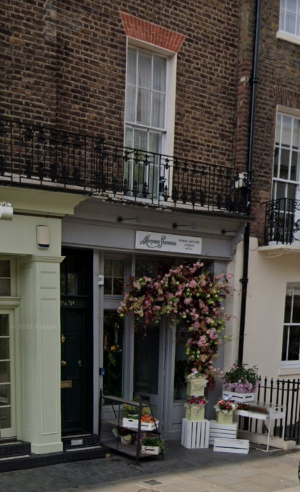
While flowers have been sold in London for centuries, the oldest surviving family florist is said to be Moyses Stevens.
The original shop was opened by Miss Moyses (who became Mrs Stevens) in Victoria Street, Belgravia. It was extended in the 1930s and a branch in Berkeley Square, Mayfair, followed in 1936.
The firm, a regular at the Chelsea Flower Show, held the royal warrant for Queen Elizabeth The Queen Mother and that for then-Prince Charles (we’re not clear on what this means now he’s King).
Known for their wedding arrangements, Moyses Stevens now operates out of locations across the city including one in the Selfridges Food Hall and, since 2019, a flower school in the former Battersea Power Station.
For more, see www.moysesflowers.co.uk
• English Heritage has unveiled its 1000th Blue Plaque in London. The plaque – located on a three storey building at number 1, Robert Street in Westminster – marks the former London headquarters of the suffragist organisation, the Women’s Freedom League. The league, which was formed in 1907, worked out of the building between 1908 and 1915 – its most active period. The blue plaques scheme has been running for more than 150 years and honours everyone from John Keats and Charles Dickens to Ada Lovelace and Alan Turing. For more, see www.english-heritage.org.uk/visit/blue-plaques/.
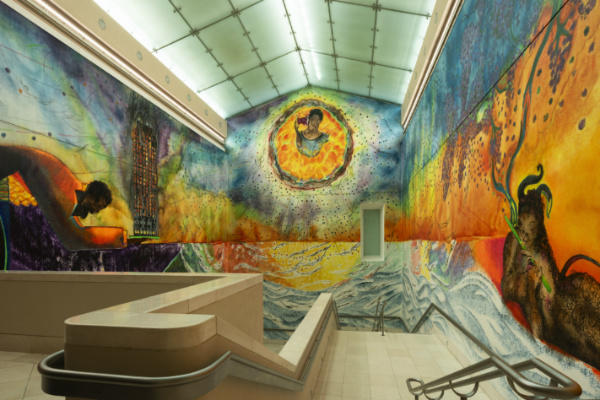
• A major new work by Chris Ofili commemorating fellow artist Khadija Saye and the tragedy of the Grenfell Tower fire in which Saye died, has gone on display at the Tate Britain in Millbank. Requiem, a site-specific work which is shown across three walls, is described as a “journey through an imagined landscape of giant skies with vast horizons and flowing water” which unfolds in three chapters. Ofili says that when making the work, he recalled the feelings he had when creating No Woman, No Cry in 1998 as a tribute to murdered Black teenager Stephen Lawrence and his mother Doreen. “That feeling of injustice has returned,” he said. “I wanted to make a work in tribute to Khadija Saye. Remembering the Grenfell Tower fire, I hope that the mural will continue to speak across time to our collective sadness.” For more, see tate.org.uk/visit/tate-britain.
• The Astronomy Photographer of the Year display has opened at the National Maritime Museum in Greenwich featuring the competition’s winning image, Andromeda. The picture, the work of Marcel Drechsler, Xavier Strottner and Yann Sainty, depicts a huge plasma arc next to the Andromeda Galaxy. Other winners include two 14-year-old boys from China – Runwei Xu and Binyu Wang – who won the Young Astronomy Photographer of the Year award for The Running Chicken Nebula as well as Argentinian Eduardo Schaberger Poupeau who won the ‘Our Sun’ category for A Sun Question which captures a huge filament in the shape of a question mark, China’s Angel An, who won the ‘Skyscapes’ category for Grand Cosmic Fireworks – a photograph of the extremely rare phenomenon of atmospheric luminescence, and the UK’s John White who won the Annie Maunder Prize for Image Innovation for Black Echo which used audio source material from NASA’s Chandra Sonification Project, to visually capture the sound of the black hole at the centre of the Perseus Galaxy. For more, see www.rmg.co.uk/astrophoto.
Send all items for inclusion to exploringlondon@gmail.com
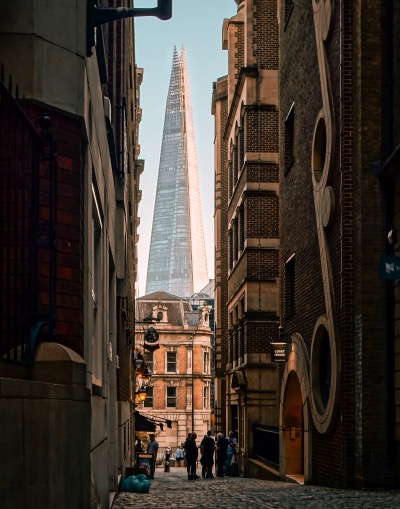
View of The Shard from Lovat Lane in the City of London.
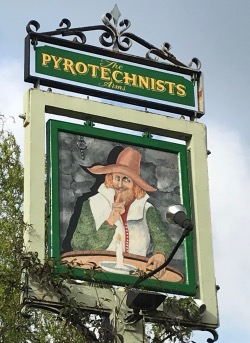
A rather unusual name for a pub, this Nunhead establishment owes its name to the past history of the area in which it’s built.
The pub’s name apparently comes from the fireworks factory, Brocks Fireworks, which was built nearby in 1868.
The pub’s sign features images of Guy Fawkes and other Gunpowder Plot conspirators – apparently some believe Fawkes imbibed at an establishment in the area (though clearly not this one given it’s relatively recent origins).
The building originally dates from 1874 and underwent a refit in the 1930s, of which many features – including the bar counters – still remain.
The ‘Pyro’ is located at 39 Nunhead Green. For more, see https://www.facebook.com/thepyronunhead.

• A rare charity pin badge like those sold by Indian princess and suffragette Sophia Duleep Singh to raise funds for the Indian Army has gone on show at Hampton Court Palace. It’s part of a new display which shares the stories of Indian soldiers who took up residence on the Hampton Court estate four times: for the coronations of King Edward VII in 1902, King George V in 1911 and King George VI in 1937, as well as for the World War I Victory Parade in London. The Indian Army at the Palace explores their experiences in the camp and in London more generally – everything from food and rationing to entertainment, travel and religious accommodations. Highlights of the display include objects from the Historic Royal Palaces’ collection – such as an official plan from one of the camps, press cuttings depicting the soldiers’ arrival at Hampton Court station, and Indian soldiers in and around the Palace grounds – as well as items on loan from the South Asian community, including a 32nd Sikh Pioneers Indian Army Officer’s tunic, medals and photos belonging to soldiers from the 1902 and 1911 contingents, original photographs of the Gurkha regiment in the 1919 parade and newspaper articles depicting the visits. The display can be seen until 3rd March next year and entry is included in general admission. For more, see www.hrp.org.uk/hampton-court-palace/.

• The first UK exhibition dedicated to the work of pioneering fashion designer Gabrielle ‘Coco’ Chanel opens at the V&A on Saturday. Gabrielle Chanel. Fashion Manifesto, which is being presented in partnership with Palais Galliera, Fashion Museum of the City of Paris, Paris Musées, charts the evolution of Chanel’s iconic design style and the establishment of the House of Chanel, from the opening of her first millinery boutique in Paris in 1910 to the showing of her final collection in 1971. The display’s 10 sections feature more than 200 “looks” as well as accessories, perfumes and jewellery. Highlights include one of the earliest surviving Chanel garments from 1916; original Chanel-designed costumes for the 1924 Ballets Russes production of Le Train Bleu; outfits created for Hollywood stars Lauren Bacall and Marlene Dietrich; an early example of Chanel’s ground-breaking evening trousers; and, ensembles from Chanel’s final collection of 1971. Runs until 25th February. Admission charge applies. For more, see vam.ac.uk/chanel.
• Six of Andrea Mantegna’s monumental paintings The Triumphs of Caesar go on display at The National Gallery from Monday. On loan from the Royal Collection, the Renaissance artist’s greatest masterpiece will be on show at the gallery for around two years, while their usual home, the Mantegna Gallery at Hampton Court Palace, is closed for maintenance. Mantegna painted a total of nine canvasses for the Gonzaga family in Mantua, between about 1485 and 1506. They were acquired by King Charles I in 1629 and taken to Hampton Court Palace soon after their arrival in England. The paintings, which are being displayed in specially made frames, will be able to be seen in Room 14, along with Peter Paul Rubens’ A Roman Triumph (about 1630) to show a later artistic response to the Triumphs. Other works by Mantegna from the National Gallery’s collection including The Introduction of the Cult of Cybele at Rome, Samson and Delilah, Two Exemplary Women of Antiquity and The Virgin and Child with the Magdalen and Saint John the Baptist are displayed nearby in Room 5 while Mantegna’s The Agony in the Garden can be seen in Room 29. Admission is free. For more, see www.nationalgallery.org.uk.
Send all items to exploringlondon@gmail.com
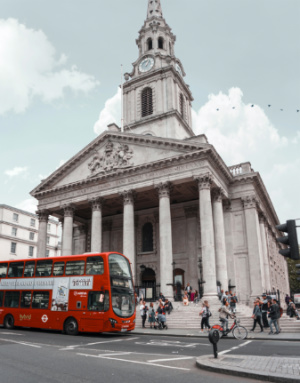
Not one of the many churches rebuilt by Wren after the Great Fire of 1666, St Martin-in-the-Fields, located just to the east of what is now Trafalgar Square, is special to the great architect for very personal reasons.
For it was in this church that his first wife Faith (nee Coghill) and his first son Gilbert were both buried, having died within a few years of each other, along with his second wife Jane (nee Fitzwilliam).
Wren married Faith Coghill, a childhood neighbour and daughter of Sir Thomas Coghill of Bletchingdon, at the age of 37 on 7th December, 1669, at the Temple Church (it’s been suggested it was his appointment that year as Surveyor of the King’s Works that may have provided him with the financial security he desired before marrying).
Their first child – Gilbert – was born in October, 1762. But he died at the age of just 18-months-old. A second child, Christopher (Wren the Younger), was born in February, 1675 (he would go on to live a full life and follow in his father’s footsteps as an architect).
Faith died of smallpox on 3rd September that same year. She was buried beneath the chancel of St Martin-in-the-Fields beside Gilbert.
On 24th February, 1677, Wren married again, this time to Jane Fitzwilliam, daughter of William FitzWilliam, 2nd Baron FitzWilliam, and Jane Perry, in a private ceremony believed to have been undertaken in the Chapel Royal at Whitehall. The couple had two children together – Jane in November that year and William in June, 1679.
Tragically, Jane also died after only a few years of marriage of tuberculosis on 4th October, 1680. She was buried alongside Wren’s first wife and child in St Martin-in-the-Fields.
Wren was not to marry again – and for his long 90 years of life, he was only in the end married for nine.
The medieval church of St Martins-in-the-Fields was altered several times during its lifetime – including being enlarged and beautified – but it’s this earlier church that Wren would have known. The current church was rebuilt to the designs of James Gibbs in the early 1720s and was completed in 1726 after Wren’s death in 1723.
Interestingly, the first wife of Wren’s son Christopher – Mary – was also buried in the church in 1712 and a monument to her can still be seen in the crypt.

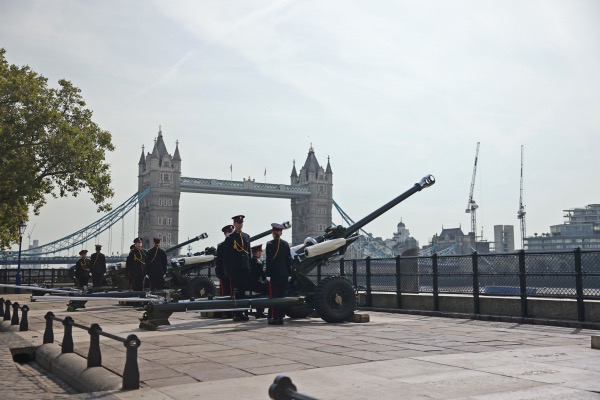
The King’s Troop Royal Horse Artillery fired 41 blank artillery rounds using six guns in Hyde Park to mark a year since the accession of King Charles III on 8th September. Below, the 105mm light artillery guns of the Honourable Artillery Company prepare to fire at The Tower of London in another salute on the same day. Both regiments taking part were responsible for firing the Death Gun salutes to mark the passing of Queen Elizabeth II one year ago, and the following day, the Proclamation salutes to mark the new reign.
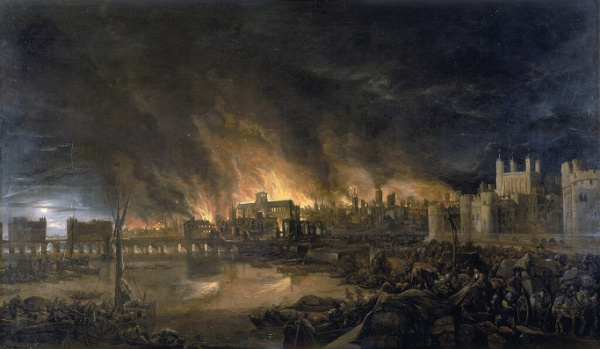
Thomas Dagger, a 17th century journeyman baker, only became famous rather recently when new research identified him as the first witness to one of the seminal events in London’s history – the Great Fire of 1666.
The research was undertaken by Professor Kate Loveman at the University of Leicester for the Museum of London and will be used to inform its gallery displays when it opens its new site at Smithfield in 2026.
Drawing on letters, pamphlets, legal and guild records, Professor Loveman put Dagger, who worked in Thomas Farriner’s bakery on Pudding Lane, at the centre of the the fire’s origin story.
It’s well-known that the fire began in Farriner’s bakery in the early hours of 2nd September, 1666, and went on to consume some 13,200 homes in the city, leaving some 65,000 people homeless. But reports differ as to who was in the bakery when the fire started.
Among accounts pointing to Dagger being present is a letter from MP Sir Edward Harley who wrote in a letter to his wife that Thomas Farriner’s “man” – a term referring to his servant or journeyman – was woken after in the early hours on 2nd September choking from smoke. He reported that Farriner, his daughter and “his man” then escaped out of an upper window, but his maid died.
Dagger’s name is also found grouped with other Farriner household members among witnesses on a subsequent indictment targeting Frenchman Robert Hubert who was convicted and hanged for starting the fire after making a somewhat dubious confession.
Professor Loveman concludes that, based on her research, Thomas Dagger was the first witness to the Great Fire of London, woken by choking smoke shortly before 2am on 2nd September. Aware of the fire, he then alerted other members of the household before, along with his boss Thomas Farriner, Farriner’s son Thomas Farriner, Jr, and Farriner’s daughter Hanna, escaping by climbing out of an window. An unnamed maid who was in the house did not escape with them and was killed.
Professor Loveman’s research further showed that Dagger arrived in London from Wiltshire in 1655 and was apprenticed to one Richard Sapp for nine years but ended up serving part of that time with Farriner. Soon after the fire, in 1667, he took his freedom and by January the following year had married and had a baby. He went on to establish his own bakery at Billingsgate.
Says Professor Loveman: “It was fascinating to find out more about what happened on that famous night. Although most of the evidence about the Farriners is well known to historians, Thomas Dagger’s role has gone unrecognised. Unlike the Farriners, his name didn’t become associated with the fire at the time. Soon after the disaster, he merges back into the usual records of Restoration life, having children and setting up his own bakery. His is a story about the fire, but also about how Londoners recovered.”
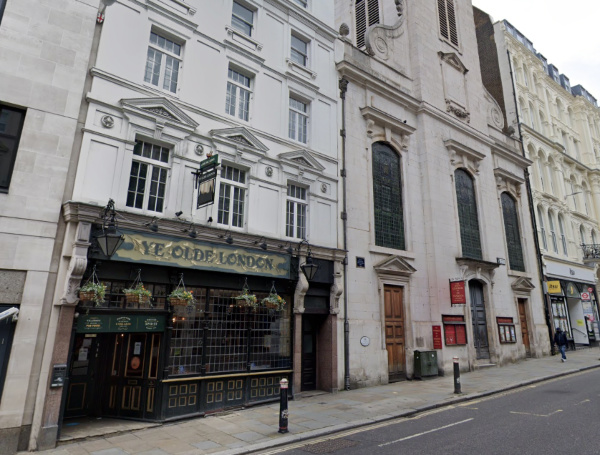
Established in the early 1730s on Ludgate Hill (next to St Martin Ludgate), the proprietor of this establishment was one James Ashley (hence the coffee house also being known as Ashley’s London Punch House – the punch was apparently particularly affordable).
It was known to have been frequented by the likes of Joseph Priestley and his friend, American Benjamin Franklin, while James Boswell described its customers as being primarily physicians, dissenting clergy and “masters of academies”.
Its location also meant it served as a place where Old Bailey juries which could not reach a decision were sequestered for the night.
Continued to be favoured by Americans, in 1851 philanthropist George Peabody gave a dinner here for those from the United States who were connected with the Great Exhibition being held in Hyde Park.
In 1806, a statue of Hercules and a hexagonal Roman altar, dedicated to Claudia Martina by her soldier husband, were found here. The coffee house has also been identified as the “Coffee House on Ludgate Hill” mentioned in Charles Dickens’ Little Dorritt.
It closed in 1867. The site is now occupied by a pub, The Ye Olde London.
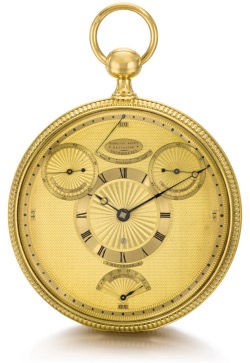
• A new display featuring timepieces by one of the greatest watchmakers of all time, Abraham-Louis Breguet, opens in Clockmakers’ Museum at the Science Museum on Tuesday. Marking the bicentenary of Breguet’s death on 17th September, 1823, Abraham-Louis Breguet: The English Connection features 25 items seldom seen in public before. They include an exceptionally rare gold four-minute tourbillon pocket watch made for George III in 1808, a ‘Simple à 2 aiguilles equation’ pocket watch made for politician Thomas Noel Hill, 2nd Baron Berwick of Attingham, and, a gilt bronze carriage clock ‘Pendule de voyage petite’ which originally belonged to Robert Henry Herbert, the 12th Earl Pembroke. The museum is located on level 2 of the Science Museum. Entry is free. For more, see www.sciencemuseum.org.uk/clocks.
• An electrical engineer whose ground-breaking work in engineering culminated in the creation of the world’s first ever large-scale programmable digital computer has been honoured with an English Heritage Blue Plaque. The plaque is located at the former workplace of Tommy Flowers at Chartwell Court, in Dollis Hill. Now flats, the property was the former Post Office Research Station where Flowers designed, built and tested the computer known as ‘Colossus’. Flowers, who spent a brief period at Bletchley Park working the code-breakers in 1941, successfully demonstrated Colossus at the research station in 1943 after just 11 months of work. For more, see www.english-heritage.org.uk/visit/blue-plaques/. Meanwhile, news this week that the UK Government, inspired by London’s Blue Plaques, is introducing a national blue plaques scheme. Historic England will work together with English Heritage, local partners, and current plaque schemes to develop and roll out the national programme.
• Artist Sara Shamma’s thought-provoking interpretations of works by artists including Rembrandt van Rijn, Peter Lely, Anthony van Dyck and Peter Paul Rubens go on display at Dulwich Picture Gallery from Saturday. With a focus on women, Bold Spirits addresses themes including identity, death, motherhood and unexpected beauty. Runs until 25th February. Admission charge applies. For more, see www.dulwichpicturegallery.org.uk.
Send all items to exploringlondon@gmail.com
This year marks the 300th anniversary of the death of Sir Christopher Wren (25th February, 1723), whose designs helped to transform post-Great Fire London.
In a new series we’re looking at 10 locations which help tell Wren’s story but while we’ve previously runs numerous articles focused on the many buildings he designed, in this series the focus is more on his personal life.
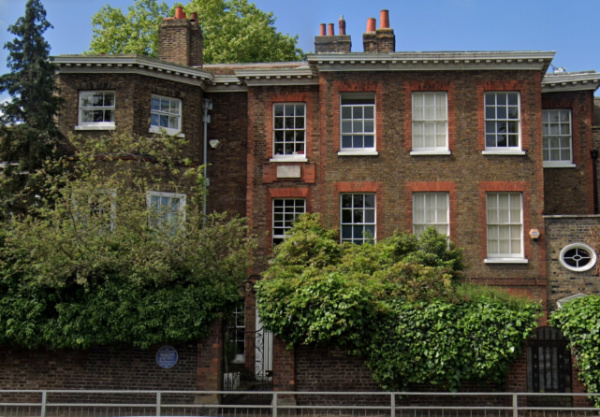
First up, it’s one of the most well-known properties related to Wren’s life – the home in which he spent the latter years after his life just outside Hampton Court Palace.
Known as the Old Court House, Wren first came to live in the house after he was appointed Surveyor-General to King Charles II in 1669. His post brought with it lodgings at the royal palaces and at Hampton Court Palace, it was the Old Court House (the property had been built for in 1536 as a wood and plaster house; Wren’s immediate predecessor in the office, Sir John Denham, had rebuilt it partly in brick).
Then in 1708, Queen Anne granted him a 50-year lease on the property, apparently at least partly in lieu of overdue fees he was owed for the building of St Paul’s Cathedral. It’s also believed that the Queen had granted the lease on condition that Wren repair or rebuilt the property.
Wren, who had hitherto only lived intermittently at the property (presumably while working on Hampton Court Palace on the orders of King William III and Queen Mary II), made some major alterations to the property from 1710 onwards (it’s suggested this was done to the designs of Wren’s assistant William Dickinson).
He came to live here on a more permanent basis after he retired from the Office of Works in 1718 and remained here until his death in 1723 (although he didn’t die here – more on that later).
It’s said Wren, whose time as the Royal Surveyor-General spanned the reigns of six monarchs, spent his time here “free from worldly affairs”, choosing to and pass his days ‘in contemplation and studies”.
It was subsequently the home of Wren’s son Christopher (1645-1747) and his grandson Stephen (b 1772). It remained a grace and favour house associated with Hampton Court Palace until 1958.
The Grade II* brown and red brick property, which was combined with the house next door in the early 19th century and them divided off in 1960, is now in private ownership and there’s an English Heritage Blue Plaque on the outside wall mentioning Wren’s residence.
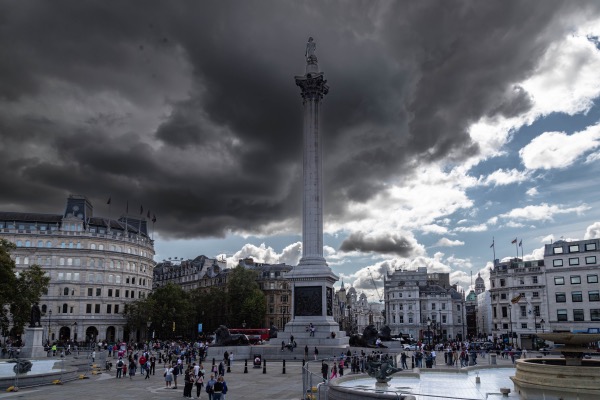
A stormy sky over Trafalgar Square.
• A recreation of Bartholomew Fair featuring more than 30 free events kicks off in the City of London today. The programme kicks off with RESURGAM, a vertical dance performance on St Paul’s Cathedral with other highlights including immersive theatrical circus performance Dinner for All, Follow Me Into by imitating the dog – a series of projections that weaves through the City, and, Carnesky’s Showwomxn Spectacular, a street show featuring a cast of circus, variety and rare skilled women performers. There’s also al fresco dining at locations across the City of London and creative workshops on Saturdays. The Bartholomew fair, which ran from the 12th century until 1855, started as a cloth market but evolved to become the City’s pre-eminent event, attracting people from across the country and beyond. The revival runs until 16th September. For the full programme of events, see www.thecityofldn.com/bartholomew-fair/

• Totally Thames, London’s month-long celebration of its river kicks off on Friday. Events this year include an exhibition at London Bridge Station celebrating London’s bridges by photographer Henry Reichhold and another looking at medieval artefacts recovered by mudlarks at St Paul’s Cathedral, walks exploring the history of everywhere from Rotherhithe to Twickenham and the Royal Docks (as a well as a walk on which you’ll meet six medieval women in Southwark), ‘Wren by River’ – a tour on Uber Boat By Clippers Thames featuring an introduction to Wren’s London legacy from the perspective of the river (be quick, this takes place on 1st September), and art installations including the Saltley Geyser, a 30 metre high plume of water in the Royal Docks created by David Cotterrell. And, of course, the St Katharine Docks Class Boat Festival on the weekend of 9th and 10th September and the The Great River Race on 16th September. For the full programme of events, see https://thamesfestivaltrust.org.
• Black on the Square, a new “showcase of Black culture and creativity”, takes place in Trafalgar Square this Saturday. The one day family-friendly festival will feature art, fashion and musical performances including jazz, spoken word, freestyle rap and soul as well as DJ sets from the likes of Touching Bass, Art Beyond the Shell, MOBO Unsung, Shortee Blitz, BXKS, The Spit Game UK. There will also be vendors representing a range of Black-owned businesses, including Caribbean and African food, as well as artisan goods ranging from customised accessories to handmade homeware and gifts. The festival kicks off at noon and runs until 6pm. For more, see https://www.london.gov.uk/events/black-square-2023.
• Art of London has launched its third annual season featuring everything from gallery late openings to photography exhibitions and public art displays. Events, which run though until October, include: ‘Art Reframed’ which, developed in partnership with the recently reopened National Portrait Gallery, showcases the gallery’s most iconic portraits of everyone from Olivia Colman to Elton John and William Shakespeare on 52 giant colourful cubes across Coventry Street and Irving Street; photographs by artist Ray Burmiston showcased on the Piccadilly Lights; and, ‘Art After Dark’ in which galleries across the West End open their doors for late night viewings. For the full programme, head to artoflondon.co.uk/seasons/season.
Send all items to exploringlondon@gmail.com
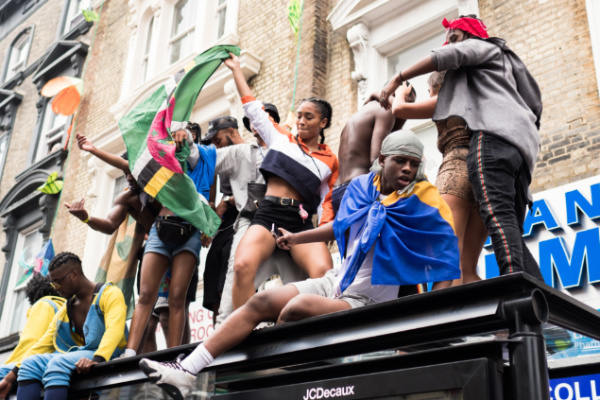
• It’s the Notting Hill Carnival weekend, three days of festivities celebrating Caribbean culture culminating in the main parade on Monday. Europe’s biggest street festival, which has been taking place since 1966 with a couple of exceptions, features music, street food and spectacular costumes. Saturday is Steel Band Competition Day, a ticketed event featuring the UK National Panorama Steel Band Competition, while Sunday is Families and Children’s Day featuring a children’s parade and carnival. On Monday, the main parade and carnival is held. For more information, see https://nhcarnival.org.
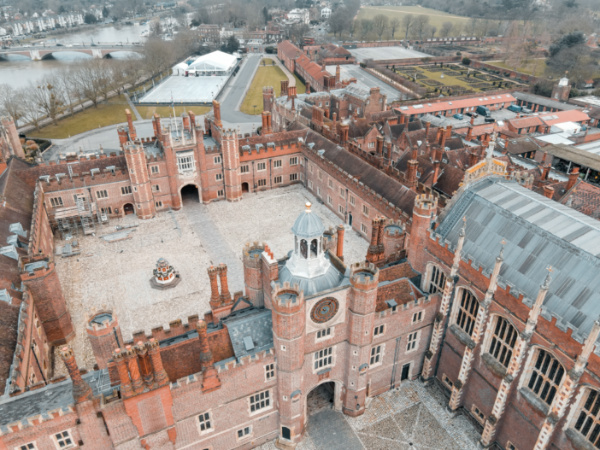
• Hampton Court Palace has launched a new ‘film and TV locations’ audio tour, taking visitors behind the scenes of everything from Pirates of the Caribbean to The Favourite and the recent Netflix series Bridgerton. The palace first appeared in a 1926 movie bearing its name which detailed the marriage of King Henry VIII and Catherine Howard and has since gone on to appear in numerous productions ranging from The Theory of Everything and A Little Chaos to Sherlock Holmes: A Games of Shadows and Mamma Mia: Here We Go Again!. The tour includes exclusive interviews with the director and executive producer of Bridgerton and also details the involvement of Historic Royal Palace staff who ensure the site remains protected during photo shoots. The ‘Film and TV Locations Tour’ is included in general admission. For more, head here.
• The Museum of London is calling for suggestions for signs to feature in ‘Hanging Out’, a permanent installation planned for the new London Museum, set to open in Smithfield’s General Market building in 2006. It’s intended the space will represent a broad range of London’s communities with the focus on the last 80 years. Signs could relate to everything from sports venues and cafes and pubs to nightclubs, music venues and theatres. People with suggestions for signs are asked to email ourtime@museumoflondon.org.uk.
Send all items to exploringlondon@gmail.com
 Exploring London
