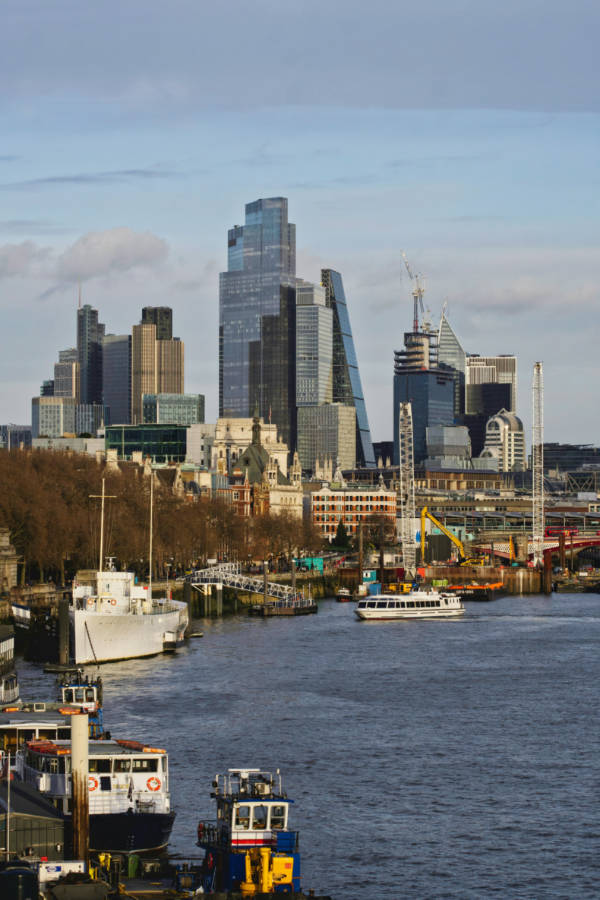
LondonLife – Busy Thames shore…
• British artist Luke Jerram’s monumental sculpture Mirror Moon has gone on display at the Royal Observatory Greenwich. Made of stainless steel and measuring two metres in diameter, the sculpture uses topographic data from NASA to map the textures of the Moon onto its mirrored surface. Visitors are able to run their fingers over the Earth’s surface – the craters, valleys, mountains and smooth lava field as well as the heavily cratered surface of the far side of the Moon. Mirror Moon can be found in the Meridian Courtyard, beside the Prime Meridian. Admission charge applies. For more, see rmg.co.uk/mirrormoon.
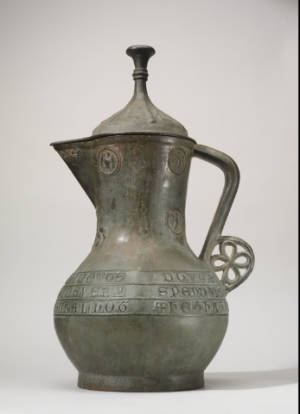
• A medieval jug known as the ‘Asante Ewer’ is at the heart of a new display which has opened at the British Museum. One of the finest examples of a bronze casting from the Middle Ages, it dates from between 1340 and 1405 and it just one of three ewers from medieval Europe to have travelled to Ghana where it eventually ended up in the royal palace of the king of the Asante people in Kumasi before being taken by British troops as military during during the Anglo-Asante War in 1896 (and subsequently being purchased by the museum). The ewer is displaced alongside another medieval ewer which also travelled to Ghana and comes with a replacement brass lid which was produced in West Africa as well as the Aya Kese brass basin which dates from 1500-1700 and was looted from its position outside the royal mausoleum at Bantama in Kumasi before it too was looted – this time by Robert Baden-Powell – during the 1896 Anglo-Asante War. The free exhibition, which follows on from a three year research project examining the connections between Western Europe and West Africa during the Middle and Early Modern ages, can be seen in Room 3 until the 7th June. For more, see www.britishmuseum.org/exhibitions/asante-ewer.
• On Now: Tracey Emin: A Second Life. The largest ever survey of the work of Dame Tracey Emin has opened at the Tate Modern. Spanning her 40 years of practice, the display brings together more than 100 works including paintings, videos, textiles, neon, sculptures and installations. It opens with works from her first solo exhibition at White Cube, such as My Major Retrospective (1982-93), reflects on her years in her hometown of Margate through works such as Mad Tracey From Margate: Everybody’s Been There (1997), includes deeply personal works such as the neon I could have Loved my Innocence (2007) and more recent works such as the bronze sculpture Ascension (2024) which explores Emin’s new relationship with her body following major surgery for bladder cancer. At the centre of the exhibition are two seminal installations – Exorcism of the Last Painting I Ever Made (1996) and My Bed (1998) – while outside can be found the monumental bronze I Followed You Until The End (2023). Runs until 31st August. Admission charge applies. For more, see www.tate.org.uk.
Send all items for inclusion to exploringlondon@gmail.com.
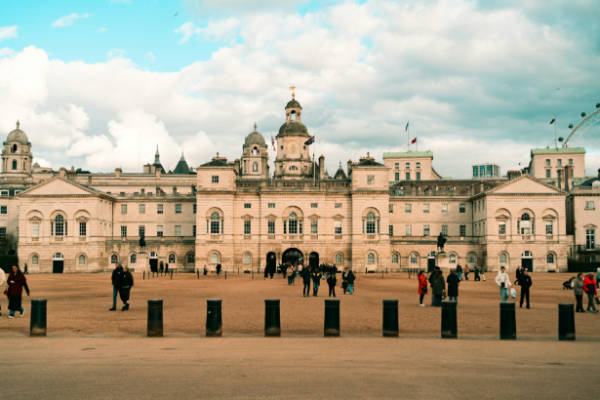
Containing a residence for the Bishop of London (although, it has to be said, certainly not traditionally a bishop’s palace), the Old Deanery is located in Dean’s Court, to the south-east of St Paul’s Cathedral.
The subject of a recent fund-raising campaign by the British Museum, the unique 24 carat gold heart-shaped pendant is linked to King Henry VIII and his first wife Queen Katherine of Aragon.
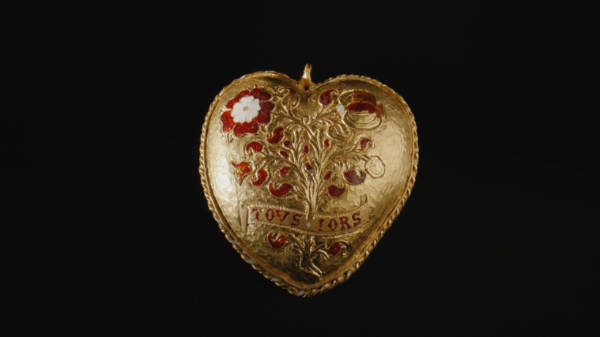
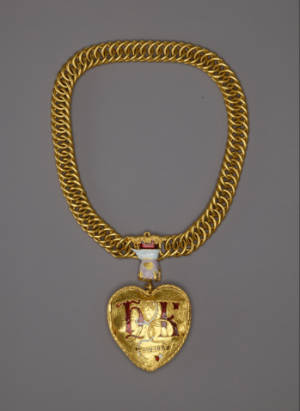
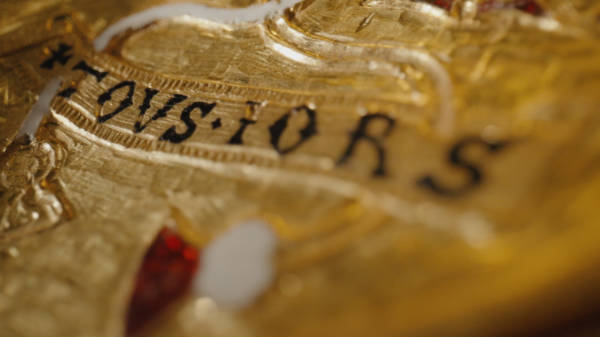
The pendant was discovered by a metal detectorist in Warwickshire in 2019. It features enamelled motifs depicting a Tudor rose intertwined with a pomegranate tree – the personal emblem of Katherine. Beneath them is a banner containing the word ‘touriors’, old French for ‘always’.
The obverse side is decorated with the initials ‘H’ and ‘K’ united by a tasselled cord and it also features a banner with the word ‘touriers’.
The jewel is attached to a 75 link gold chain by a clasp in the form of a hand emerging from a cloud.
The pendant is a rare surviving object celebrating Henry and Katherine’s marriage which was the longest of his life, lasting some 24 years before he ultimately had it annulled in 1533.
British Museum research has suggested that it may have been created for a tournament held in October, 1518, to mark the betrothal of the couple’s daughter, Princess Mary (late Queen Mary I), to the French heir. King Henry VIII was known to have frequently commissioned London goldsmiths to create jewellery peces for major celebrations and state occasions.
The museum announced that it had raised its target of £3.5 million to acquire the pendant on Valentine’s Day following a £1.75 million grant from the National Heritage Memorial Fund.
Other major donations made during the campaign, which was championed by actor Damian Lewis (who played King Henry VIII in the series Wolf Hall: The Mirror and The Light), included £500,000 from the Julia Rausing Trust, £400,000 from the Art Fund including a contribution from The Rought Fund, and £300,000 from the American Friends of the British Museum.
Meanwhile, more than 45,000 people gave individual donations to the campaign, totalling £380,000.
The pendant can be seen in the British Museum’s Collecting the world gallery.
• Jock McFadyen’s large-scale Tube paintings have come together in a new exhibition opening at the Guildhall Art Gallery on Friday. Jock McFadyen with Jem Finer: Underground (and Surface) revisits McFadyen’s Underground series from the late 1990s and also features a layered soundscape by The Pogues’ Jem Finer which were composed from field recordings on the Northern and Central lines. Admission is by Pay What You Can. Runs until 20th September, 2026. For more, see www.cityoflondon.gov.uk/events/underground-and-surface-exhibition.
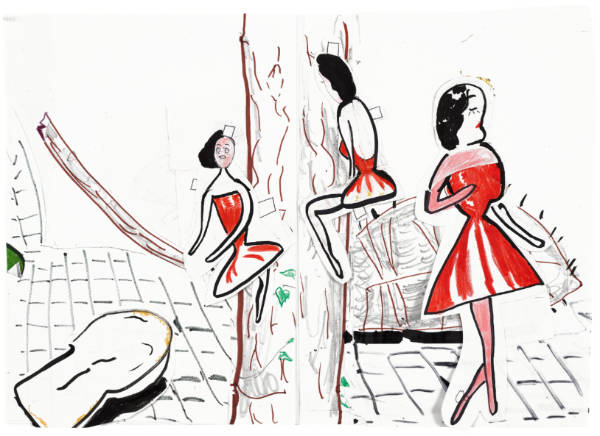
• The largest survey to date of celebrated British artist and Royal Academician Rose Wylie opens at the Royal Academy on Saturday. Rose Wylie: The Picture Comes First features more than 90 works, including Wylie’s most iconic, alongside new paintings and drawings. Works on show include those depicting memories of
family life and bombing raids in London during World War II such as Wing Tips and Blue Doodlebugs (2022/23), Room Project (2002-3) – Wylie’s first major series to receive significant critical acclaim, works on paper such as Bottom Teeth, Self-Portrait (2016), and works from the series Film Notes. It concludes with four large monochromatic paintings of animals in ginger, black, blue and red made directly by the artist onto the canvas using her hands. Runs in the Main Galleries until 19th April. Admission charge applies. For more, see www.royalacademy.org.uk/exhibition/rose-wylie.
• A life-sized wooden galleon has arrived in Kensington Gardens where it will become the centrepiece of the Diana, Princess of Wales Memorial Playground when it reopens this summer. The ship has been manufactured in Frasdorf, Germany, and is predominately made from mountain larch wood drawn from sustainably managed forests in the Bavarian Alps. It’s part of a £3 million renewal of the free-to-enter playground, which is inspired by the adventures of Peter Pan. For more, see www.royalparks.org.uk/visit/parks/kensington-gardens/diana-memorial-playground.
• Further Afield – Historic Duxford: Air Crew Room, Pilot’s Briefing Room and Pilots Locker Room. Three newly transformed historic rooms opened at IWM Duxford just south of Cambridge late last year, each of which contains newly acquired objects and interactive elements. The air crew room, located beside the Battle of Britain Hangar, tells the stories of the US 8th Air Force and RAF Bomber Command through personal objects belonging to former pilots and crew. They include false identity papers and the diary of American fighter pilot Lonnie Moseley of Duxford’s 78th Fighter Group who was forced to bail out of his P-47 Thunderbolt over France in 1944 and took shelter with a local French farmer’s family until returning to England. Nearby in the pilot’s briefing room, meanwhile, visitors can enjoy an audio-visual recreation of a real-life briefing given on D-Day in which they can sit among their ‘fellow pilots’. And in the pilot’s locker room, the everyday life of pilots who were stationed at Duxford in 1940 is explored including with interactive elements such as the opportunity to try on replica uniforms and see lockers containing recreated details of some of the pilots such as a conversation between 19 Squadron’s George ‘Grumpy’ Unwin and 302 (Polish) Squadron’s Julian Kowalski. The rooms can be visited with standard admission. For more, see www.iwm.org.uk/visits/iwm-duxford.
Send all items from inclusion to exploringlondon@gmail.com.
A former summer residence of the Archbishops of Canterbury for centuries, Croydon Palace has in more recent times been used as a school.
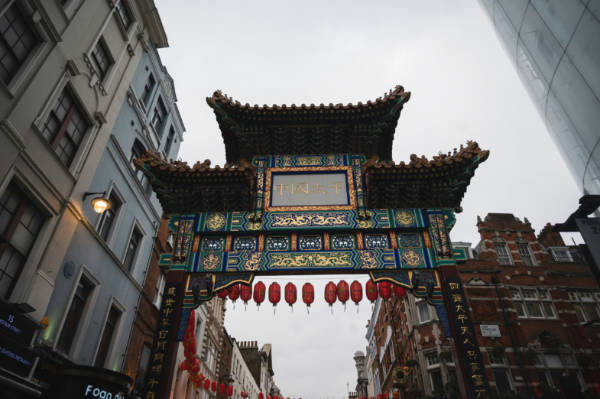
• Lunar New Year festivities will be held in Chinatown in central London this weekend including lion dances and the Chinese New Year Parade. Lion dances will be held throughout Chinatown on Saturday and Sunday while the parade kicks off at 10am on Sunday just east of Trafalgar Square reaching the square at 12 where an afternoon of festivities will be held. For more, see www.london.gov.uk/events/lunar-new-year-festival-spring-2026. Meanwhile, Lunar New Year celebrations will also be held in Greenwich on Saturday. The celebrations include lion dances, musical and dance performances, a martial arts demonstration, workshops including one on Tibetan dance and another on lantern making and the chance to sample Asian food. For more, see www.rmg.co.uk/lunarnewyear.
• A new exhibition at the Young V&A in Bethnal Green takes a look behind the scenes of stop-motion classics such as Wallace & Gromit, Chicken Run and Shaun the Sheep. Inside Aardman: Wallace & Gromit and Friends, created primarily for children and families and marking Aardman’s 50th annversary, features some 150 objects including never-seen-before models, sets and storyboards from Aardman’s archives as well as interactive activities ranging from designing characters and experimenting with lighting through to creating live action videos. Among the items on show are early sketches of Wallace & Gromit, a hand-drawn storyboard from The Wrong Trousers (1993) train chase, Wallace & Gromit’s motorbike and sidecar from Vengeance Most Fowl (2024), and the airship model from The Pirates! (2012). Admission charge applies. Runs until 15th November. For more, see vam.ac.uk/young.
• The women who influenced Charles Dickens are at the centre of a new exhibition at the Charles Dickens Museum. Extra/Ordinary Women features a portrait of Dickens’ daughters, Katey and Mamie, on display for the first time, Catherine Dickens’s cookbook, and a draft preface to an 1857 manual for educating working class children written by penned by Angela Burdett Coutts and including edits by Dickens in blue ink as well as items owned by Ellen Ternan, best known for her 12-year extra-marital relationship with Dickens. Admission charge applies. Runs until 6th September. For more, see https://dickensmuseum.com/blogs/all-events/extra-ordinary-women.
Send all items for inclusion to exploringlondon@gmail.com
Once a significant estate on the northern outskirts of London, the palace of the Bishops of Ely was used for some 500 years as their London residence.
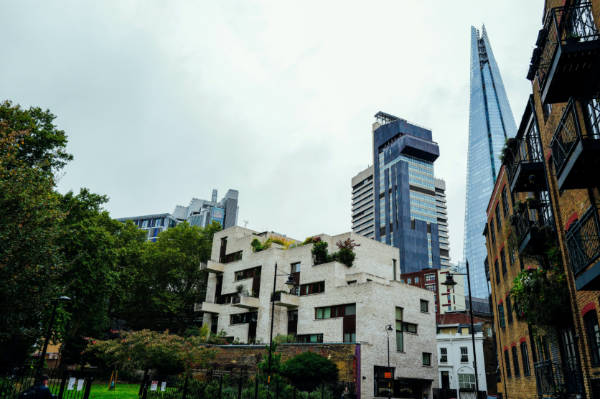
As London prepares to celebrate the Lunar New Year, all eyes naturally turn to London’s Chinatown, centred on Gerrard Street in Soho.
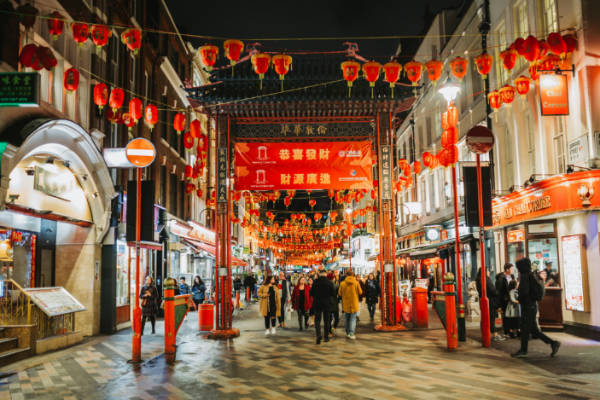
While the street dates back to the 17th century, by the first half of the 20th century it had become known for its nightlife, initially for nightclubs and then for a seedier side as striptease clubs opened.
The city’s first Chinatown had been established in Limehouse in the 18th century as Chinese immigrants and sailors frequented the area.
But after World War II, the damage in the Limehouse area and the comparatively cheap leases available around Gerrard Street, saw Chinese moved in during the 1950s and began opening restaurants and grocery shops.
Growing numbers of Chinese arrived from Hong Kong and by 1970, Gerrard Street has become a hub for the Chinese community in London. The London Chinese Chinatown Association formed in 1978.
It was in the late 1980s that Chinese gateways, a pagoda and street furniture were added. Gerrard Street and parts of Newport Place and Macclesfield Street became pedestrianised.
The first organised Chinese New Year celebrations took place in Gerrard Street in 1985.
This year’s Chinese New Year Parade – celebrating the Year of the Horse – will take place on Sunday, 22nd February. For more, see www.london.gov.uk/events/lunar-new-year-festival-spring-2026.
Archbishop’s House, located next to the Roman Catholic Cathedral of Westminster, is the official residence of the Catholic Archbishop of Westminster.
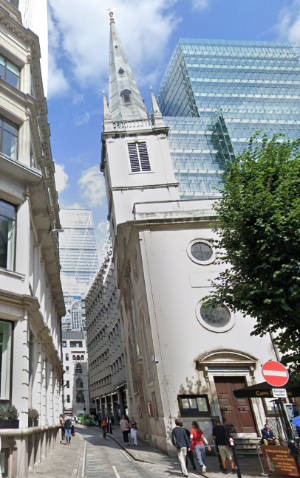
This name of this short City of London laneway which runs between Eastcheap and Fenchurch Street in the City of London has nothing to do with rudeness or lewdness (as you have no doubt guessed).
Rather it’s an ancient term for a crucifix, known in days past as a ‘rood’ or ‘rood cross’.
The laneway was originally known as St Margaret Pattens Lane, a church which, dating back as far as the 12th century, still stands on the corner of the laneway and Eastcheap.
It’s a crucifix which once stood in the churchyard gave the laneway its new name.
Historian John Stow wrote that on 23rd May, 1538, the crucifix was found smashed into pieces “by people unknown”.
• Love letters from some of the most famous – and infamous – love affairs have gone on show at the National Archives in Kew in the lead-up to Valentine’s Day. Love Letters features a note sent by Henry VIII’s fifth wife Catherine Howard to courtier Thomas Culpeper in 1541 – later used to prove they were having a treasonous affair, a never-before-seen love letter from the Cambridge Five spy ring’s “fifth man” John Cairncross to his 27-year-old girlfriend Gloria Barraclough, and, a letter Oscar Wilde’s lover Lord Alfred Douglas wrote to Queen Victoria on 25th June, 1895, begging her to exercise her “power of pardon” as Wilde began a two year sentence for gross indecency. Also included is a letter from Charles Kray in 1956, written to the courts on behalf of his son Ronnie, one of the notorious Kray twins, who was facing sentence for assault. The free display can be seen until 12th April. For more, see www.nationalarchives.gov.uk.
• More than 60 striking images showcasing the biodiversity of the Pantanal, a South American wetland, have gone on show at the Science Museum. Water Pantanal Fire features images by two of Brazil’s leading documentary photographers – Lala de Almeida and Luciano Candisani – which were taken between 2007 and 2024 and reveal a stark distinction between the teeming life seen in the region before fires and droughts ravaged the area, leaving a transformed barren landscape. The exhibition, which runs until the 31st May, is free to see. For more, see www.sciencemuseum.org.
• On Now: The Foundling Hospital Boys’ Band. This small display at The Foundling Museum in Bloomsbury looks at the history of the band from its founding in 1847 and explores how it shaped the boys’ lives with many of them graduating into professional military bands (in fact, by World War I, more than 80 per cent of the boys leaving the home went into military music. Admission charge applies. For more, see https://foundlingmuseum.org.uk/event/the-foundling-hospital-boys-band/.
Send all items for inclusion to exploringlondon@gmail.com.
The former residence of the Bishops of London for more than 1,300 years, Fulham Palace is today a museum surrounded by 13 acres of gardens on the north bank of the Thames.
It was 100 years ago last month that on a wet Tuesday evening in Soho, Scottish engineer and inventor John Logie Baird demonstrated an experimental prototype that provided live moving pictures – the precursor to what we now know as television.
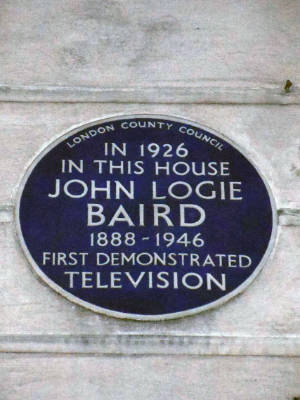
The successful, albeit rather low key, demonstration took place before some 40 members of the Royal Institution, all reportedly attired in evening dress, in an upper room which served as his laboratory at 22 Frith Street on 26th January, 1926.
According to a report in The Times on 28th January, the “transmitting machine” consisted of a “large wooden revolving disc containing lenses, behind which was a revolving shutter and a light sensitive cell”.
The first image to be transmitted was that of the head of a ventriloquist’s dummy but the image of a human face was transmitted later, “first on a receiver in the same room as the transmitter and then on a portable receiver in another room”.
“The image as transmitted was faint and often blurred, but substantiated a claim that through the ‘Televisor’, as Mr Baird has named his apparatus, it is possible to transmit and reproduce instantly the details of movement, and such things as the play of expression on the face,” The Times reported.
Present at the demonstration was William Edward Taynton, a 20-year-old office boy whose face Baird had transmitted in an experiment at the property the previous October.
Baird continued to refine his invention in the following months with the picture becoming clearer and was recognised in the years following for being the first to show television in colour,
In 1928 he completed a demonstration in which live images sent by radio from London were received in New York and the same year he demonstrated colour television. In 1929, the first television programmes were officially transmitted by the BBC using Baird’s system.
An English Heritage Blue Plaque todays marks the property where the demonstration took place (there’s also one at Baird’s former home at 3 Crescent Wood Road in Sydenham, where he lived from 1933 until 1945).
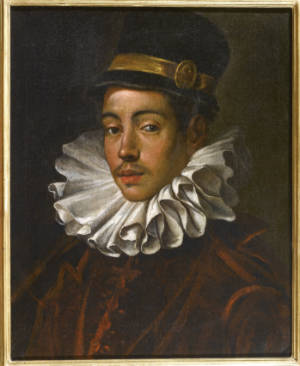
• The evolution of the samurai over the past 1,000 years is the subject of a new exhibition at The British Museum. Samurai brings together around 280 objects and digital media as it explores the role of samurai as warrior as well as the later roles they fulfilled, during a prolonged peace after 1615, as government officials, scholars and patrons of the arts with women making up half of the samurai class. On display will be a suit of samurai armour, complete with helmet and golden standard, which was recently acquired by the museum as well as a vermillion red woman’s firefighting jacket, a rare portrait of Itō Mancio, a 13-year-old samurai who led an embassy to the Vatican in 1582, by Domenico Tintoretto (pictured), and a portrait of Henry, Count of Bourbon, which portrays him as a samurai warrior and which was commissioned by him while visiting Japan in 1889. The exhibition, which opens on 3rd February, runs until 4th May in The Sainsbury Exhibitions Gallery. Admission charge applies. For more, see www.britishmuseum.org/exhibitions/samurai.
• Tickets are now on sale for the V&E East Museum’s first exhibition, The Music is Black: A British Story. The multi-sensory exhibition features more than 200 objects ranging from musical instruments to soundtracks,
artworks, fashion, and personal belongings of world-famed artists including Winifred Atwell’s piano, the Nintendo Jme used for early music experiments, fashion worn by Little Simz, Seal, Dame Shirley Bassey and Skin and newly acquired photographs of Kemistry and Storm, Mis-Teeq, and Skepta. The exhibition opens on 18th April. Admission charge applies. For more, see www.vam.ac.uk/exhibitions/the-music-is-black-a-british-story
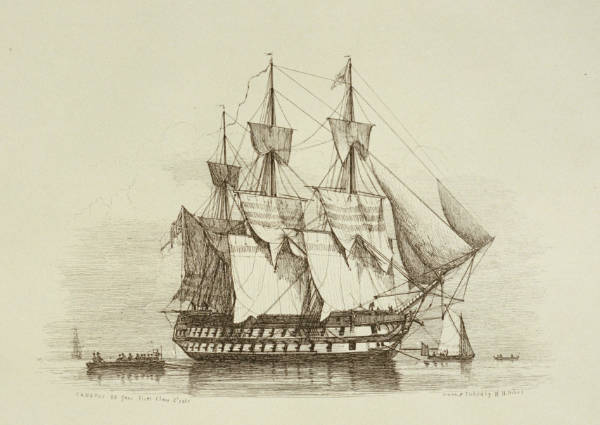
• On Now: Jane Austen and the Royal Navy. This display at the National Maritime Museum marks the 250th anniversary of Jane Austen’s birth and features manuscripts relating to her youngest brothers Francis and Charles Austen, both of whom had naval careers, and explores Jane’s connections to the Royal Navy and the influence her brothers had in her works. Francis – known as Frank (born in 1774) – entered the Royal Navy at the age of 12 and rose through the ranks to eventually captain the HMS Canopus during the Napoleonic Wars while Charles (born in 1779) also entered the Navy at age 12, was on board the Endymion when it captured the French ship Le Scipio, was captain of the Phoenix when it was wrecked at sea and ended his career as commander-in-chief of the East Indies and China Station. The display in the Caird Library can be seen until March. Admission is free. For more, see www.rmg.co.uk/national-maritime-museum.
Send all items to exploringlondon@gmail.com.
Now long gone, this central London property was once the residence of the, you guessed it, bishops of Durham.
 Exploring London