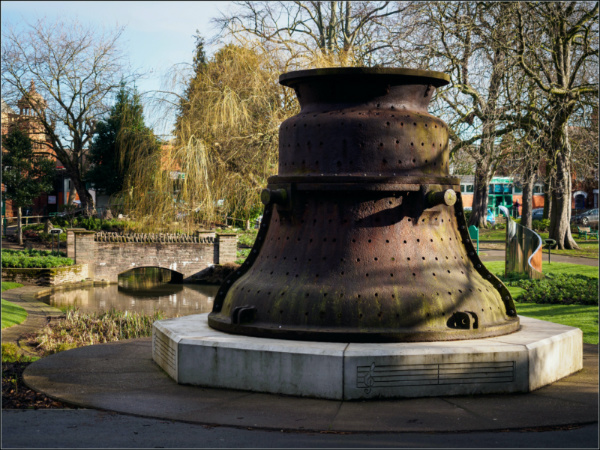
The bell casing used by Taylor’s Bell Foundry to cast Great Paul in Loughborough. PICTURE: Phil McIver (licensed under CC BY-NC 2.0)
Not the name of a person, Great Paul is in fact the name of the largest of four bells in south-west tower of St Paul’s Cathedral.
The south-west tower at St Paul’s Cathedral which contains Great Paul. PICTURE: jan buchholtz (licensed under CC BY-NC-ND 2.0)
The bronze bell was cast in 1881 by JW Taylor of Taylor’s bell foundry in Loughborough. With a diameter of some 11 metres, it weighs an impressive 16.8 tons (in fact, untilthe casting of the Olympic Bell for the 2012 London Olympics, it was the largest bell in the UK).
Brought to London from Loughborough on a train over a period of 11 days, Great Paul was hung in the tower in May, 1882.
The bell was traditionally sounded at 1pm every day but was silent for more than 40 years after its ringing apparatus broke in the 1970s.
Following a restoration, Great Paul started being rung again last year when it was rung during a festival of church bells to mark the easing of COVID-19 restrictions. Earlier this year, it led a bell ringing tribute marking Queen Elizabeth II’s Platinum Jubilee.
Previous historic occasions on which the bell was rung included Queen Victoria’s Diamond Jubilee in 1897 and the marriage of Prince Charles and Lady Diana Spencer at the cathedral in 1981.
The south-east tower of the cathedral is also home to the storied bell known as Great Tom – but we’ll deal with that in a future post.
• The Museum of London has launched a six-month programme of events celebrating its 45 year history ahead of its doors closing on 4th December in preparation for its move to West Smithfield. The programme includes a range of family activities – from Roman picnics to large LEGO builds – as well as behind the scenes access at the museum during Open House London and two festivals on the closing weekend celebrating the past 50 years of London’s history. For the full programme of events, head to www.museumoflondon.org.uk. Following its closure at the London Wall site, the new site at West Smithfield, to be named The London Museum, will open in 2026.
• An outdoor exhibition on the essential role of London’s parks and open spaces – which have served as everything from playgrounds and picnics to concerts and Sunday football kickabouts – opens inGuildhall Yardon Monday.Green City: A Visual History of London’s Parks and Open Spaces, which is curated by the City of London Corporation’s London Metropolitan Archives, celebrates the role open places have played in the capital since the 16th century and brings together 100 photographs and prints from the archives’ collections. The exhibition can be seen in Guildhall Yard until 1st August when it moves to Aldgate Square. On 15th August it will open at Hampstead Heath and then, from 1st September, spend two weeks at The View in Epping Forest’s Visitor Centre.
• Kenley Airfield – an integral part of London’s defence during World War II – has reopened following a £1.2 million restoration. The airfield, which sits in the Borough of Croydon, was a station for the Royal Flying Corps during World War I and the Royal Air Force during World War II. The restoration work has brought back to life eight deteriorating fighter blast pens, which protected RAF Spitfires and Hurricanes from attack. The site also includes The Kenley Tribute, a memorial to all who served there between 1917 and 1959, both on the ground and in the air. For more, including information on visiting the airfield and self-guided walks, see www.kenleyrevival.org.
• The work of 20th century American artist Milton Avery is the subject of a new exhibition opening at the Royal Academy of Arts on Friday. Milton Avery: American Colourist – which can be seen in The Gabrielle Jungels-Winkler Galleries in Piccadilly – features some 70 works including portraits and landscapes dating from 1910 until the 1960s. The exhibition is divided into four sections – ‘Early Work’, ‘Portraits’, ‘Innovation in Colour and Form’ and ‘Late Work’ – and highlights include Blossoming (1918), a portrait of Avery’s friends known as The Dessert (1939), two portraits of his daughter March – Seated Girl with Dog(1944) and March in Brown (1954), and, Black Sea (1959). Runs until 16th October. Admission charge applies. For more, see www.royalacademy.org.uk.
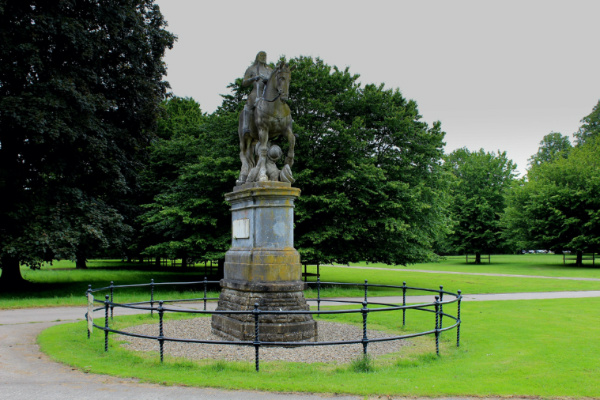
The statue at Newby Hall in North Yorkshire. PICTURE: Chris Heaton (licensed under CC BY-SA 2.0)
Originally installed at the Stocks Market in the City of London, this equestrian statue shows a figure atop a horse which is trampling over a prostrate figure lying on the ground.
The marble statue, which stands on a tall plinth, is believed to have been created in Italy by an unknown sculptor. It originally depicted Polish King John III Sobieski riding down a Turkish soldier. But it was bought to London by goldsmith and banker Sir Robert Vyner in the early 1670s.
A strong supporter of King Charles II, he had the sculpture’s head remodelled by Jasper Latham to depict the King (although the figure beneath was left largely untouched, meaning if it is supposed to represent Cromwell, he’s wearing a turban).
Sir Robert, who had been responsible for making the king’s new coronation regalia to replace items lost or destroyed during the Commonwealth, offered to have the statue installed at the Royal Exchange after it was rebuilt following the Great Fire of 1666. When that was rejected, he had the statue installed at the Stocks Market – originally named for being the only location of fixed stocks in the City – near Cornhill in 1675 (Sir Robert served as Lord Mayor around the same time).
The statue was removed in 1739 to make way for the Mansion House. But all was not lost – given back to Vyner’s grandnephew, also Robert Vyner, it reappeared some years later at the Vyner family estate at Gautby Hall. In 1883, it was relocated to Newby Hall in North Yorkshire (which had come into the family via an inheritance) and still remains there today, about 150 metres east of the hall. It received a Grade II listing in 1967.
• The Royal Parks are running a series of free sessions for bird-watching novices in all eight of its London parks during June and July. The sessions, for which binoculars will be provided, last up to two hours. Pete Lawrence, The Royal Parks’ biodiversity manager, says many people growing up in a city may not have had the “opportunity, the equipment or the know-how to take up this activity” before. “These free sessions aim to make bird watching more accessible, and, if they prove popular, we hope to repeat them in future years.” Author and TV naturalist David Lindo, aka ‘The Urban Birder’, will be leading some of the free bird watching sessions along with The Royal Parks’ conservation officer, Tony Duckett – a six decade veteran birdwatcher, and local bird enthusiast Julia Holland. To book a place, head to www.royalparks.org.uk/birdingtours. The Royal Parks is also hosting a bird watching photography competition with a top prize, binoculars worth £400. Entrants need to take a photo of one of the birds included on the parks’ bird spotter sheets and send it to competition@royalparks.org.uk or submit via The Royal Parks’ social media channels. Find out more here.
• The “music, people and places” central to the grime scene which first emerged in London in the early 2000s are the subject of a new exhibition at the Museum of London. Grime Stories: from the corner to the mainstream, which opens on Friday, is co-curated by Roony ‘Risky’ Keefe, one of grime’s early documentarians, and features a series of newly commissioned films that explore the community at the heart of grime’s success as well as a large-scale illustration from artist Willkay and personal artefacts from the MCs and producers who developed grime’s unique sound. Admission is free. For more, see www.museumoflondon.org.uk/museum-london/whats-on/exhibitions/grime-stories.
• The ideas of repair, care and healing are explored in a new exhibition which opened at Somerset House this week. Eternally Yours, which is being staged across three Terrace Rooms, showcases some diverse examples of creative reuse including transformed items salved in the aftermath of Japan’s 2011 earthquake, shoes worn by Syrian migrants which have stories of survival sewn into the soles and a jumper from Annemor Sundbø’s ragpile collection which has been transformed by Celia Pym. At the heart of the exhibition is ‘The Beasley Brothers’ Repair Shop’, a pop-up created by designer Carl Clerkin and modelled on traditional East End repair shops of old, which is hosting live workshops and demonstrations from artists and designers. The free exhibition and accompanying events runs until 18th September. For more, see www.somersethouse.org.uk.
Send all items for inclusion to exploringlondon@gmail.com.
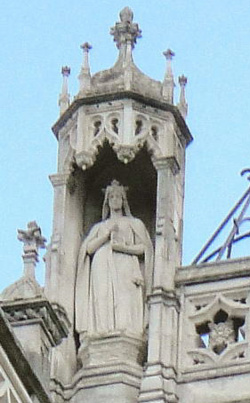
The neo-Gothic former Public Record Office (now the Maughan Library of King’s College) in Chancery Lane is adorned with statues of several kings and queens including two kings – King Edward III and King Henry III – as well as four queens.
The queens, which can be found at the top of the tower over the main entrance, include three who are represented with more famous statues elsewhere – Queen Elizabeth I (on the facade of St Dunstan-in-the West), Queen Anne (outside of St Paul’s Cathedral) and Queen Victoria (outside Buckingham Palace among others).
But one of those statues – that of the Empress Matilda – is something of an outlier – unlike the others, the Empress Matilda, while she claimed the title of Queen of England, was never actually crowned (her attempt to be crowned at Westminster failed when opposed by the London mob which supported her opponent, King Stephen).
Instead, Matilda (sometimes known as Maud) claimed the title ‘Lady of the English’ and while she was eventually driven out of England to Normandy where she died, her eldest son did take the crown in 1154 as King Henry II.
The statue, which stands on top of the east side of the tower (and is quite difficult to spot), stands 2.4 metres high and was made of Portland stone to adorn the 1850s, now Grade II* listed building (the gatehouse leading to Chancery Lane – which features the two kings – was an extension in the 1890s). It is said to be the work of sculptor Joseph Durham.
What’s a little puzzling is why the Empress was included as one of the four, particularly given other English queens and monarchs – Queen Mary I and II – were not.
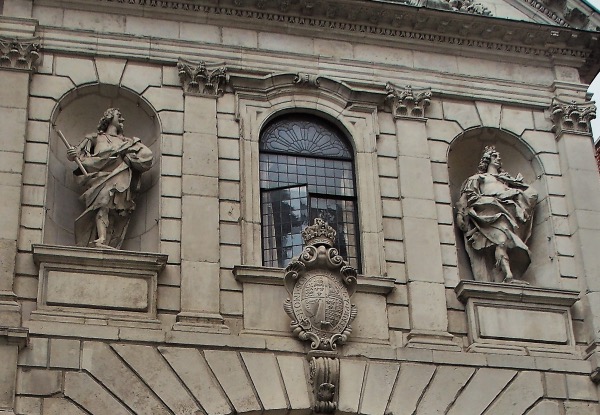
King Charles I (left) and his son King Charles II on what is now the south side of the gateway. PICTURE: haluk ermis (licensed under CC BY 2.0)
The equestrian statue of King Charles I at the top of Whitehall is one of London’s most well-known. But less well-known is the statue of the ill-fated King which can be found standing in a niche on the Temple Bar gateway, located at the entrance to Paternoster Square just outside of St Paul’s Cathedral.
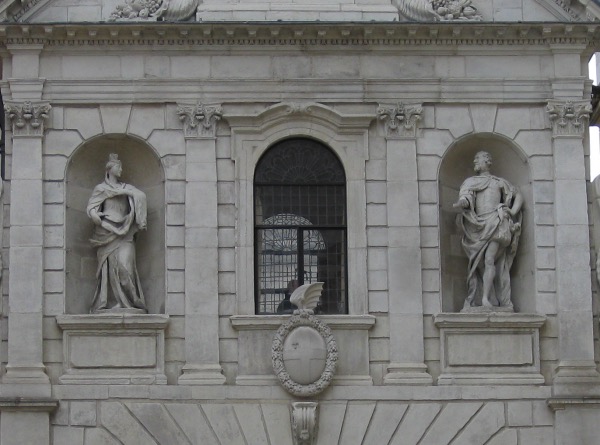
Charles is not alone. Part of the gateway’s purpose was as a dynastic statement in support of the Stuarts so the grand portal also features statues of Charles’ father King James I, his mother Queen Anne of Denmark, and his son King Charles II. King James and Queen Anne can be found on the north side of the gateway (originally the east side) and the two Charles’ on the south side (originally the west side).
The design of the gateway, which originally stood at the intersection of Fleet Street and the Strand as a ceremonial entrance into the City of London, is believed to be the work of Sir Christopher Wren who was acting on the orders of King Charles II after the Great Fire of London.
Queen Anne of Denmark and King James I on the north side of the gateway. PICTURE: lizsmith (licensed under CC BY-NC-ND 2.0)
The statues, which cost a third of the total £1,500 spent on the gateway, are said to have been sculpted by one John Bushnell. They are depicted in Roman attire rather than the dress they would have worn during the period.
They were removed when the gateway was dismantled in 1878 and stored in a yard of Farringdon Road and when the gateway was re-erected at Lady Meux’s Hertfordshire estate at Theobold’s Park, they were placed back in their original locations. And they also accompanied the gateway back to the city when it was positioned its current location in 2004.
• Marble Hill in London’s west reopens on Saturday following a restoration and the reinstatement of a lost pleasure garden. Once home to King George II’s mistress Henrietta Howard, Countess of Suffolk, Marble Hill is a rare example of a home built by and for a woman in Georgian England and is one of the last survivors of the many 18th century villas that once fronted the Thames in the area. Marble Hill was built as a country retreat from London’s crowds and among those entertained here were poet Alexander Pope, Horace Walpole, John Gay and Jonathan Swift. English Heritage has invested £3 million into a major transformation of the house and 66 acres of riverside parkland which also used a £5 million grant from The National Lottery Heritage Fund and The National Community Lottery Fund. This has included the reinstatement of a pleasure garden – an “Arcadian landscape” which was inspired by sketches made by Pope – with the opening up of previously inaccessible woodland areas, the reinstallation of paths and the replanting of avenues of trees that led from the house to the river. Howard’s ninepin bowling alley has been restored and an 18th-century garden grotto has been excavated and returned to its 18th-century appearance. Inside the house, English Heritage has re-instated the paint scheme that existed during Howard’s lifetime in several interior spaces, including the Great Room, conserved the fine collection of early Georgian paintings which includes portraits of Howard’s circle and re-created furniture including an intricate carved peacock motif table and luxurious crimson silk wall hangings in her dressing room. The new display has reframed Howar’s beyond being simply the King’s mistress by also exploring her abusive first marriage and the role deafness played in her life as well as her rise in Georgian society and the social circles she captivated. Entry to the house is free. For more, head to www.english-heritage.org.uk/visit/places/marble-hill-house/.
Harry Kane of England celebrates after scoring their side’s second goal during the UEFA Euro 2020 Championship Round of 16 match between England and Germany at Wembley Stadium on 29th June, 2021 in London, England. PICTURE: Catherine Ivill/Getty Images.
• England football captain Harry Kane is the subject of a new exhibition opening at the Museum of London on Saturday. Harry Kane: I want to play football features sporting memorabilia including the shirt Kane, who grew up in Chingford, East London, wore on his debut for England where he scored against Lithuania just 79 seconds after coming on the pitch, Kane’s MBE which was awarded to him in March 2019 for ‘services to sport’ and the 2018 World Cup Golden Boot (Kane being one of only two British players to receive a Golden Boot at a World Cup competition, where he was named Man of the Match three times) as well as family photos. The display also includes a changing room space where visitors can listen to Kane’s pre-match playlist and an interactive area where visitors can learn more about who has inspired Harry and share their own hopes and dreams. A programme of activities for families and children will run alongside the free display. Runs until December. For more, see www.museumoflondon.org.uk.
• The use of gold in embellishing and enhancing the written word across cultures, faiths and through time is the subject of a new exhibition opening at the British Library. Gold, which opens Friday, showcases some of the most luxurious illuminated manuscripts, gold-tooled books, sacred texts and scrolls from the British Library’s collection with objects on display including the Harley Golden Gospels, the Lotus Sutra and a treaty in Malayalam, beautifully inscribed on a long strip of gold itself. Admission charge applies. Runs until 2nd October. For more, see www.bl.uk.
City of London-managed open spacesEpping Forest, Burnham Beeches and Ashtead Common have been selected to be part of a nationwide network of 70 ancient woodlands to be dedicated to The Queen in celebration of the Platinum Jubilee. At almost 6,000 acres, Epping Forest is London and Essex’s largest green space and is known as the “green lungs” of London. Burnham Beeches, located in Buckinghamshire, is only a square mile in size but is described as a “New Forest in miniature” while Ashtead Common in Surrey’s 200 hectares of open public space is home to more 1,000 living ancient oak pollards. For more on The Queen’s Green Canopy initiative, see www.queensgreencanopy.org. For more on the City of London’s green spaces, see www.cityoflondon.gov.uk/things-to-do.
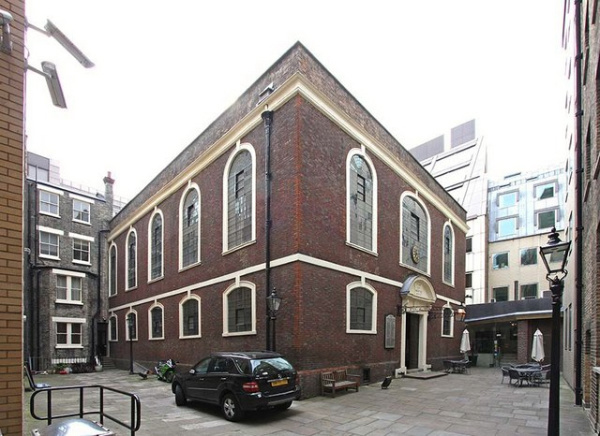
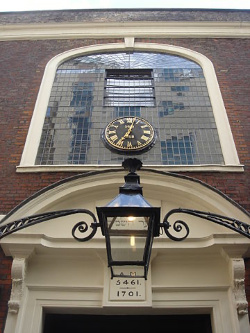
The synagogue has historical ties to the city’s Spanish and Portuguese Jewish community, known as Sephardic Jews, which first started meeting together in a small synagogue in Creechurch Lane in 1657 after it become possible for Jews to openly practice their religion under the rule of Lord Protector Oliver Cromwell.
Increasing numbers in the community soon meant a larger premises was required and a committee was formed which signed a contract with Quaker builder Joseph Avis in February, 1699, to build a larger premises (tradition holds that Avis returned the money he made on the job to the community, saying he would not profit from building a house of God). In June that same year, the community leased a tract of land at Plough Yard, Bevis Marks, on which the new building would be built. Construction commenced soon after.
The property’s design is said to emulate, at least in part, that of the 1675 Portuguese Synagogue of Amsterdam (it’s also thought the design was influenced by the works of Sir Christopher Wren). There’s also a story that the building included an oak beam from one of the Royal Navy’s ships presented by Queen Anne.
The rectangular building, which features three galleries inside, was eventually completed and dedicated in September, 1701.
The roof of the now Grade 1-listed building was replaced following a fire in 1738 and the synagogue only suffered minor damage during the Blitz. It also suffered some collateral damage from the IRA bombing in 1992 and the 1993 Bishopsgate bombing but remains mostly intact.
Sermons at Bevis Marks were in Portuguese until 1833 when they changed to English.
Features inside include an oak Renaissance-style ark containing the Torah scroll which, painted to resemble coloured Italian marble, is located at the centre of the eastern wall. There are also seven hanging brass candelabra which symbolise the seven days of the week. The largest, which hangs in the centre of the synagogue – represents the Sabbath and was donated by the community of the Great Synagogue of Amsterdam. There are also 10 large brass candlesticks representing the Ten Commandments. While the upright oak seats are said to “reflect the Puritanism of 17th century England”, the backless oak benches at the back are the original seats which were brought from the Creechurch Lane premises.
Twice Prime Minister Benjamin Disraeli’s 1804 birth is recorded in the register but after his father had a falling out with the synagogue officials, Disraeli was in 1817 baptised at St Andrew’s Holborn.
• A 5,000-year-old chalk sculpture – described as “the most important piece of prehistoric art to be found in Britain in the last 100 years” – has gone on show at The British Museum as part of its The world of Stonehenge exhibition. The sculpture was unearthed by members of Allen Archaeology during a routine excavation on a country estate near the village of Burton Agnes in East Yorkshire in 2015. Uncovered alongside the burial of three children (it had been placed near the head of the eldest child and included three hastily added holes possibly to represent the children), the sculpture is decorated with elaborate motifs that the museum said “reaffirms a British and Irish artistic style that flourished at exactly the same time as Stonehenge was built”. The sculpture is similar to three barrel-shaped cylinders made of solid chalk – dubbed the ‘Folkton drums’ due to their shape – which have been in the museum’s collection since they were unearthed in the excavation of a child burial in North Yorkshire in 1889. It is thought the items are works of sculptural art rather than intended to serve a practical purpose and were perhaps intended as talismans to protect the children they accompanied. Radiocarbon dating of the Burton Agnes child’s bones identifies the burial as from 3005–2890 BC. The world of Stonehenge can be seen until 17th July. Admission charge applies. For more, see www.britishmuseum.org/stonehenge.
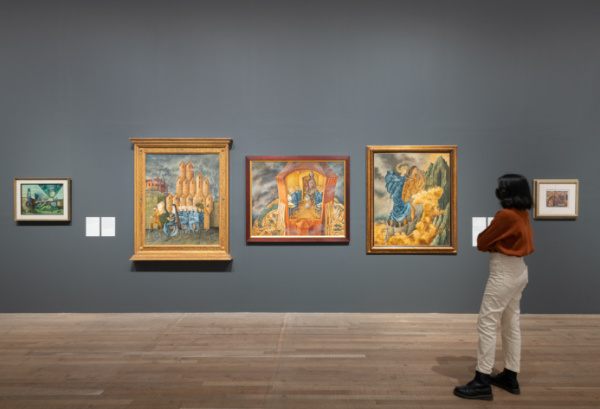
• Spanning 80 years and 50 countries, a new exhibition opening at the Tate Modern today takes an in-depth look at how Surrealism has inspired and united artists around the globe. Surrealism Beyond Borders, running at the Tate in partnership with New York’s Metropolitan Museum of Art, features more than 150 works ranging from painting and photography to sculpture and film, many of which have never been seen in the UK before. Among the highlights Cecilia Porras and Enrique Grau’s photographs, which defied the conservative social conventions of 1950s Colombia, and paintings by exiled Spanish artist Eugenio Granell, whose radical political commitments made him a target for censorship and persecution. There’s also iconic works such as Max Ernst’s Two Children are Threatened by a Nightingale (1924) and lesser known, but significant, pieces such as Antonio Berni’s Landru in the Hotel, Paris (1932), and Toshiko Okanoue’s Yobi-goe (The Call) (1954). Runs until 29th August in the Eyal Ofer Galleries. Admission charge applies. For more, see www.tate.org.uk/whats-on/tate-modern/exhibition/surrealism-beyond-borders.
• A “bold” new artwork by Nigerian-born artist, Victor Ehikhamenor, has gone on display in the crypt of St Paul’s Cathedral. The specially-commissioned mixed-media work is part of 50 Monuments in 50 Voices, a partnership between St Paul’s Cathedral and the Department of History of Art at the University of York which involves inviting contemporary artists, poets, musicians, theologians, performers and academics to respond to 50 historic monuments across the cathedral. Still Standing combines rosary beads and Benin bronze hip ornament masks to depict an Oba (King) of Benin and was made in response to a 1913 brass memorial panel commemorating Admiral Sir Harry Holdsworth Rawson (1843-1910) which is in the Nelson Chamber of the Cathedral’s Crypt. Rawson had a long career in the Royal Navy which culminated in his commanding the Benin Expedition of 1897. The work is on show until 14th May. Admission charge applies. For more, head to https://pantheons-st-pauls.york.ac.uk/50-monuments-in-50-voices/.
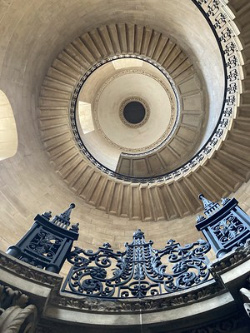
Known more formally as the Dean’s Staircase, this spiral staircase was designed by none other than Sir Christopher Wren and provides access to the triforium in St Paul’s Cathedral.
The staircase – each step of which is embedded into the wall – was built between 1675 and 1710 in the cathedral’s south-west tower by William Kempster. The ironwork is by famed French metal worker Jean Tijou.
Located in the south-west bell tower, the stair’s 88 Portland stone steps rise some 50 feet.
The staircase, which can be seen on the cathedral’s guided tours including triforium tours, has become famous in recent years thanks to its appearance in the 2004 Harry Potter film, The Prisoner of Azkaban, as well as Guy Ritchie’s 2009 film Sherlock Holmes.
The staircase has also been the site of art installations including Antony Gormley’s Flare II – which featured a falling figure within a cloud of wire.
WHERE: St Paul’s Cathedral (nearest Tube stations are St Paul’s, Mansion House and Blackfriars); WHEN: 8.30am to 4.30pm Monday to Saturday; COST: £21 adults/£18.50 concessions/£9 children/£36 family (these are walk-up rates – online advanced and group rates are discounted); WEBSITE: www.stpauls.co.uk (for tours, head to www.stpauls.co.uk/visits/visits/guided-tours)
• Artworks from some of Beatrix Potter’s most famous storybooks and sketches of the real-life animals, places, art and literature that inspired them are at the heart of a new exhibition opening at the V&A in South Kensington on Saturday. Beatrix Potter: Drawn to Nature, which is being run in partnership with the National Trust, features more than 240 personal objects which also include rarely seen personal letters, family photographs, early sketchbooks, manuscripts and scientific drawings in a family friendly display exploring Potter’s passion for animals and the natural world. The display is spread across four sections: ‘Town and Country’ which provides the backdrop to her childhood in South Kensington in London; ‘Under the Microscope’ which highlights Potter’s interest in natural science; ‘A Natural Storyteller’ which reveals her “almost accidental journey to becoming a best-selling author”; and, ‘Living Nature’ which follows Potter to the Lake District and celebrates her profound impact on the natural landscape. The exhibition can be seen until 8th January next year. Admission charge applies. For more, see vam.ac.uk/exhibitions/beatrix-potter-drawn-to-nature.
• A rare copy of renowned theoretical physicist Stephen Hawking’s PhD thesis (one of only five known copies), his Permobil F3 modelwheelchair and a blackboard which hung on his office wall have gone on show at the Science Museum as part of a new exhibition on his working life.Stephen Hawking at Work also features his spectacles which were adapted to aid communication, a photograph from the set of Star Trek: The Next Generation where Hawking made a guest appearance, the insignia given to him on becoming a member of the Pontifical Academy of Sciences in 1986, and an invitation to a time travellers’ party Hawking hosted. The blackboard, one of Hawking’s most treasured possessions, came from a 1980 conference – Superspace and Supergravity – at which delegates covered it in equations, cartoons and jokes about each other. Hawking’s subsequently had the blackboard framed and hung in his office. The free display can be seen until 12th June. For more, see www.sciencemuseum.org.uk/stephen-hawking.
• Free immersive outdoor light installations and pop-up performances can be seen in the city’s centre over this half-term as part of the Mayor of London’s ongoing ‘Let’s Do London’ campaign. The events include ‘City Lights’ – an illuminated light trail in the City of London by internationally renowned artists including Colour by Light which invites people to use their smartphones to turn the city into a colourful canvas (11th to 20th February), free pop-up performances in the streets of central London including storytelling, puppetry, dance, and music (17th to 20th February) as well as discounts to West End shows and dining out. For other events and more information, head to www.visitlondon.com/things-to-do/lets-do-london.
Send all items for inclusion to exploringlondon@gmail.com.
The Tower of London is one of the palaces under the care of Historic Royal Palaces. PICTURE: Nick Fewings/Unsplash
Visitors to several of London’s landmark royal properties will across an organisation known as Historic Royal Palaces.
HRP, as its sometimes shortened to, is a self-funding charity charged with the management of palaces which are owned by the Crown (technically by Queen Elizabeth II ‘in Right of Crown’ meaning she holds them in trust for the next monarch and by law cannot sell or lease them). The palaces are generally no longer used as royal residences.
These include the Tower of London, Hampton Court Palace, Kensington Palace, Kew Palace and the Banqueting House (once part of the Palace of Whitehall). Buckingham Palace, which remains the official London residence of Queen Elizabeth II and a working royal palace, is not one of them nor is St James’s Palace, home to several members of the Royal Family and their households.
All five of the properties in London which are under the care of Historic Royal Palaces ceased being regularly used by the Royal Court in the 19th century and were opened up to the public. The government became responsible for their care under the Crown Lands Act 1851.
In 1989, the government established Historic Royal Palaces as part of the Department of the Environment to oversee care of the five palaces. Six years later it became part of the Department of National Heritage(now known as the Department for Culture, Media & Sport).
In April, 1998, Historic Royal Palaces became an independent charity by Royal Charter. It is governed by a board of trustees who include the director of the Royal Collection Trust and the Keeper of the Privy Purse from the Royal Household as well as the Constable of the Tower of London.
Historic Royal Palaces now oversees management of the palaces under a contract with the Secretary of State for Culture, Media & Sport (as well as the five London properties, since 2014, it has also been responsible for the care of Hillsborough Castle in Northern Ireland).
Perhaps the most well-known faces of Historic Royal Palaces are joint curators – Tudor historian Tracy Borman, and architectural and social historian Lucy Worsley.
HRP collects revenues through entries to the palaces but also offer an annual membership through which you can have unlimited entry.
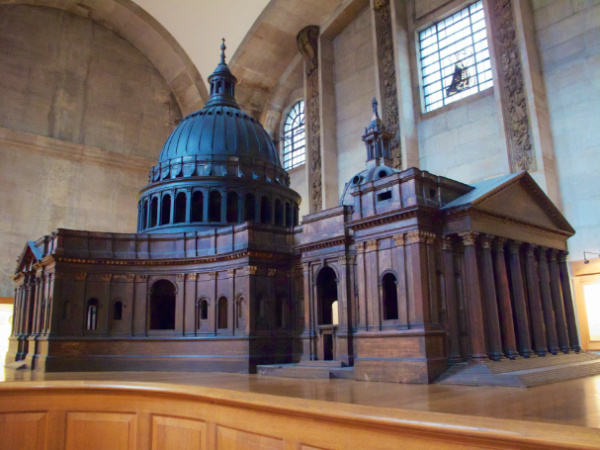
Housed now in the building it depicts, the Great Model of St Paul’s Cathedral was created by architect Sir Christopher Wren to show King Charles II what his proposed grand new English Baroque cathedral would look like (following the destruction of the medieval cathedral in the Great Fire of 1666).
Made of oak, plaster and lime wood, the model was made by William Cleere to Wren’s design in between September, 1673, and October, 1674, at a scale of 1:25. It measures 6.27 metres long, 3.68 metres wide and more than four metres tall, making it one of the largest in the UK.
The model, which cost about £600 to make – an extraordinary sum which could apparently buy a good London house, was designed to be “walked through” at eye level and, as well as being a useful way to show the King what the proposed building would look like, was also something of an insurance policy in case something happened to Wren.
It was based on drawings made by Wren and his assistant Edward Woodroofe on a large table in the cathedral’s convocation or chapter house (later demolished in the early 1690s) and was originally painted white to represent Portland stone with a blue-grey dome and gilded details.
There are some differences between the model and the finished cathedral – among them was a substantial extension of the quire, double-height portico on the west front, and, of course, the bell towers on the west front which were made in place of the cupola which was located halfway down the nave on the model.
Part of an earlier wooden model from 1671 also survives – it was apparently lost for many years and rediscovered in 1935.
The Great Model can be seen on tours of the Triforium.
WHERE: St Paul’s Cathedral (nearest Tube stations are St Paul’s, Mansion House and Blackfriars); WHEN: 8.30am to 4.30pm Monday to Saturday; COST: £21 adults/£18.50 concessions/£9 children/£36 family (these are walk-up rates – online advanced and group rates are discounted); WEBSITE: www.stpauls.co.uk (for tours, head to www.stpauls.co.uk/visits/visits/guided-tours)
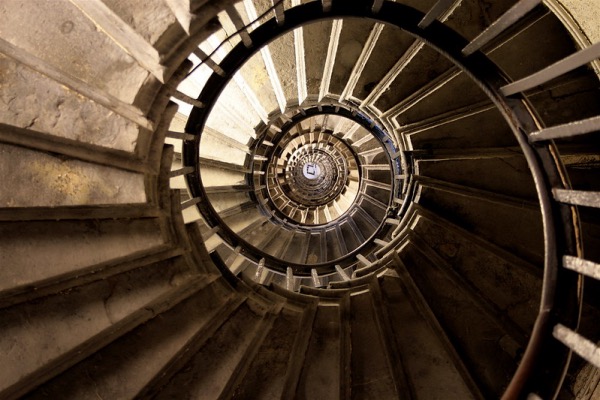
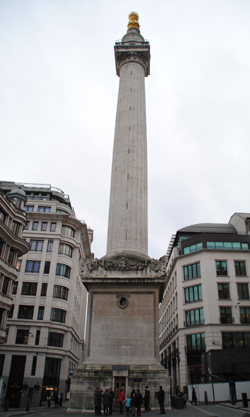
Running up the centre of the tallest free-standing stone column in the world, this 311 step stairway takes the visitor straight to the top of the Monument erected to commemorate the Great Fire of 1666.
The Monument
The Monument – actually a Doric column – was built close to Pudding Lane in the City – where the fire is believed to have started – between 1671 and 1677. It was designed by Sir Christopher Wren in collaboration with City Surveyor Sir Robert Hooke.
The cantilevered stairway – each step of which measures exactly six inches high – leads up to a viewing platform which provides panoramic views of the City. Above the platform stands is a large sculpture featuring a stone drum topped with a gilt copper urn from which flames emerge as a symbol of the fire (King Charles II apparently squashed the idea of an equestrian statue of himself lest people think he was responsible for the fire).
Interestingly, the circular space in the centre of the stairway was designed for use as a zenith telescope (a telescope which points straight up). There is a small hatch right at the top which can be opened up to reveal the sky beyond and a subterranean lab below (reached through a hatch in the floor of the ticket both) where it was envisaged the scientist could take measurements using a special eyepiece (two lenses would be set into the actual telescope). But it wasn’t successful (reasons for this could have been vibrations caused by passing traffic or the movement of the column in the wind).
Hooke also apparently attempted to use the staircase drop for some other experiences – including measuring differences in air pressure.
Among those who have climbed the stairs was writer James Boswell who visited the Monument and climbed the stairs in 1763. He suffered a panic attack halfway up but was able to complete the climb.
WHERE: The Monument, junction of Fish Street Hill and Monument Street (nearest Tube station is Monument); WHEN: Check website; COST: £5.40 adults/£2.70 children (aged five to 15)/£4.10 seniors (joint tickets with Tower Bridge available); WEBSITE: www.themonument.org.uk
• The largest collection of Spitfires gathered under one roof can be seen at the Imperial War Museum Duxford’s AirSpace hall. Twelve of the iconic planes have been gathered at the airfield, often referred to as the “home of the Spitfire”. Spitfire: Evolution of an Icon, which is being accompanied by a programme of tours, talks, events and family activities, shows how the plane evolved throughout World War II in order to keep pace with German aircraft development. As well as the IWM’s iconic Mk Ia Spitfire, the display also features Mk V, Mk IX and Mk XIV models. The Spitfires be seen until 20th February. Admission charge applies. For more including details of events, head to www.iwm.org.uk/events/spitfire-evolution-of-an-icon.
• A new exhibition focused on photographs of iconic 70s and early 80s band The Jam opens at the City of London Corporation’s Barbican Music Library tomorrow.True is the Dream features the photography of Derek D’Souza who has captured the band and frontman Paul Weller, who went on to found The Style Council, on film over several decades. D’Souza’s work include a career-defining shoot of the band at Chiswick House. The display is free to see until 16th May. For more, see www.barbican.org.uk/whats-on/2022/event/true-is-the-dream.
• The Waterloo & City line has reopened following a brief closure over Christmas. The London Underground line, which connects Waterloo to Bank, was temporarily closed by Transport for London in late December following increasing COVID cases in the capital and the impact on staff absence. Meanwhile, the Bank branch of the Northern line (between Moorgate and Kennington) for 17 weeks from 15th January to allow for upgrade works.
Buckingham Palace is among the sites across London which will be hosting events to mark Queen Elizabeth II’s Platinum Jubilee this June. The Queen’s 70th year on the throne will be marked with four days of celebrations across the June bank holiday weekend which will include the Queen’s Birthday Parade (known as Trooping the Colour), the lighting of Platinum Jubilee Beacons – including the principal beacon at Buckingham Palace, a Service of Thanksgiving at St Paul’s Cathedral, the ‘Platinum Party at the Palace’ – a celebration concert in the gardens of Buckingham Palace, The Big Jubilee Lunch in communities across the city, and a special Platinum Jubilee Pageant, part of which will see a moving river of flags rippling down The Mall. For more information, head to www.royal.uk/platinum-jubilee-central-weekend.
It’s 260 years ago this month that a supposed poltergeist known as the ‘Cock Lane Ghost’ was at the centre of an infamous scandal.
There had been several reports of strange sounds and spectral appearances at the property prior to January, 1762, but it was the events which took place that month which were to elevate the hauntings to the national stage.
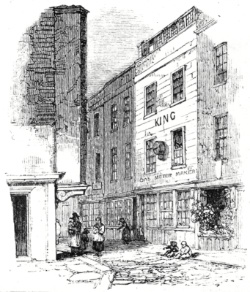
Cock Lane, shown in Charles Mackay’s 1852 work ‘Haunted Houses’. PICTURE: Via Wikipedia
It was in that month that Elizabeth Parsons, the 11-year-old daughter of Richard Parsons, the officiating clerk at St Sepulchre Church, reported hearing knockings and scratchings while she was lying in bed. Her father, Richard Parsons, the officiating clerk at nearby St Sepulchre, enlisted the aid of John Moore, assistant preacher at St Sepulchre and a Methodist, to find their cause and the two concluded that the spirit haunting the house was that of Fanny Lynes, who had formerly lived in the property before apparently dying of smallpox in early February, 1760.
The two men devised a system for communicating with the spirit based on knocks and based on the answers they received, concluded that Lynes had not died of smallpox but actually been poisoned with arsenic by her lover (and brother-in-law) William Kent.
Kent had been married to Fanny’s sister Elizabeth and after her death, he had lived with Lynes as man and wife despite prohibitions on them being married due to their status as in-laws. Parsons, who was their landlord at the time, had taken a loan from Kent while they were living at the property but subsequently refused to pay it back leading Kent to successfully sue him for its recovery.
It was against that backdrop – and earlier reports that the ghost of Fanny’s sister Elizabeth had haunted the property after her death – that the story of ‘Scratching Fanny’ began to spread and led to crowds gathering in Cock Lane to witness the phenomena. Writer Horace Walpole was among them – he attended along with Prince Edward, the Duke of York and Albany, and, apart from not hearing the ghost (he was told it would appear the next morning at 7am), noted that the local alehouses were doing a great trade.
Such was the case’s fame that the Lord Mayor of London, Sir Samuel Fludyer, ordered an investigation – among those who was involved was famed lexicographer Samuel Johnson. They concluded that the girl had been making the noises herself (Dr Johnson went on to write an account of it which was published in The Gentlemen’s Magazine). Further investigations were held – Fanny’s body even exhumed – and Elizabeth was later seen concealing a small piece of wood (apparently to make the sounds), subsequently confessing that her father had put her up to it.
Kent, however, was determined to clear his name and Moore, along with Parsons, Parson’s wife Elizabeth, Mary Frazer, a relative of Parsons, and a tradesman Richard James, were all subsequently charged with conspiracy to take Kent’s life by alleging he had murdered Frances. The trial, which took place at Guildhall before Lord Chief Justice William Murray, on 10th July, 1762, saw guilty verdicts returned for all five defendants. Moore and Richards agreed to pay Kent a sum of more than £500 but the others refused and so in February the following year they were sentenced – Parsons to three turns in the pillory and two years imprisonment, his wife Elizabeth to a year in prison and Frazer to six months hard labour in Bridewell.
The case, which also caused controversy between the new Methodists and Anglicans over the issue of ghosts, was widely referred to in literature of the time including by satirical poet Charles Churchill in his work The Ghost. It was also referenced by William Hogarth in his prints and Victorian author Charles Dickens even alluded to the story in A Tale of Two Cities.
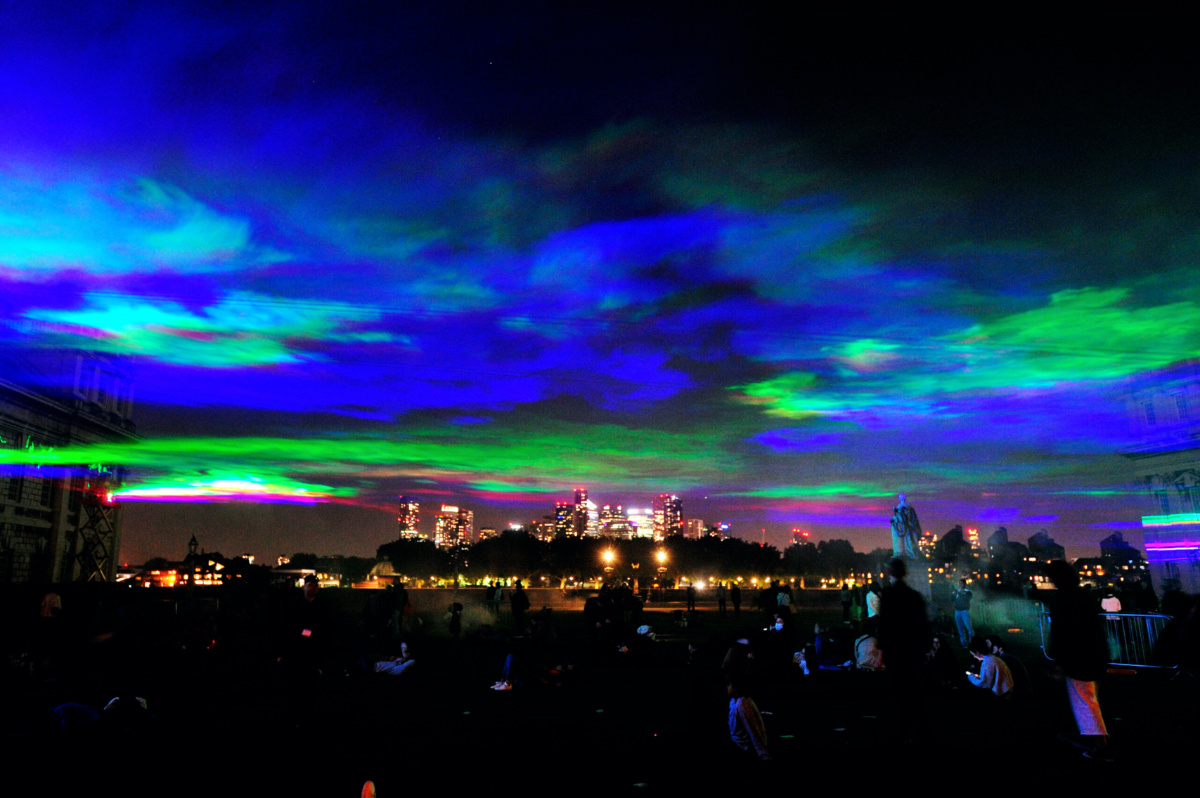
• A dazzling light show inspired by the Northern Lights – one of the seven natural wonders of the world – can be seen in the Guildhall Yard this December. Borealis – which can be seen between 11th and 22nd December – is the work of artist Dan Acher and is one of a number of light displays which is illuminating London this winter as part of Mayor Sadiq Khan’s ‘Winter Lights’ campaign. Others include an animal-themed display bringing to life the beasts that once lived at the Tower of London, an outdoor programme of installations and video art projections illuminating the Southbank Centre’s site, the ‘Illuminated River’ display lighting up nine of London’s bridges in what is be the longest public art project in the world, and a free Canary Wharf ‘Winter Lights Spectacular’ in January which will feature 20 new light commissions by some of the most innovative artists across the globe. In Grosvenor Square, Mayfair, thousands of illuminated white roses will form an ‘Ever After Garden’ designed by fashion designer Anya Hindmarch while traditional favourites like the Hyde Park Winter Wonderland as well as winter markets and ice rinks at locations like the Natural History Museum and Somerset House are also once again returning to the city. London’s red buses are an easy way to see the Christmas lights this year with routes 12, 94, 98, 139 and 390 all travelling through Oxford Circus. Free tickets to Borealis can be booked at www.visitlondon.com/Borealis while, for more on the best bus routes, see https://londonblog.tfl.gov.uk/festive-bus-routes/. For more information on all the light shows and events (some of which are already underway), see visitlondon.com .
• Costumes worn by then Princess Elizabeth and her sister Princess Margaret in wartime-era pantomimes are at the heart of a new display at Windsor Castle this Christmas. The princesses spent much of their time at Windsor during World War II – away from the Blitz in London – and, between 1941 and 1944, they performed in and helped to stage a series of pantomimes to raise money for the Royal Household Wool Fund which supplied knitting wool to make comforters for soldiers fighting at the front. Six of the costumes they wore have been brought together for the first time and are being displayed in the castle’s Waterloo Chamber where the pantos were originally performed. The costumes on show were worn in the last two pantos – Aladdin, which was performed in 1943, and Old Mother Red Riding Boots which was performed in 1944. Also on show are 16 large scale pictures of fairy-tale characters that were pasted around the walls to create the space for the performances. Visitors to Windsor this Christmas will also see State Apartments decorated for the festive season and a 20 foot high Christmas tree in St George’s Hall. The Semi-State Rooms, created for King George IV and now used for official entertaining, are also now open to visitors. The costumes can be seen until 31st January. Admission charges apply. For more on the Christmas activities at Windsor, including a ‘Mary, Queen of Scots at Christmas Family Activity Day’ on 18th December, see www.rct.uk/whatson/. Meanwhile, Buckingham Palace is offering guided tours of the State Rooms over winter with special family guided tours available for the first time. The tours run until 30th January. Admission charge applies. For more on the guided tours, head here and for more on the family tours, head here.
• The ancient Greeks’ pursuit of knowledge is the subject of a new exhibition which has opened at the Science Museum in South Kensington. Ancient Greeks: Science and Wisdom takes visitors on a journey in which they will sail the perilous seas with a statue of Hermes that was discovered on a shipwreck off the island of Antikythera, experience the lost music of the aulos instrument through interactive displays and an exclusive video that reimagines its ancient sounds, and gaze at the starry cosmos through ancient Greek eyes via a beautiful and rare silver globe depicting the known constellations and a Byzantine sundial-calendar – the second oldest known geared mechanism in the world. The free display can be seen until 5th June. Tickets are required – to book head to sciencemuseum.org.uk/ancient-greeks.
Send all items for inclusion to exploringlondon@gmail.com.