8. 10 historic stairways in London – 2. Queen Mary’s Steps, Whitehall…
7. 10 historic stairways in London – 3. The Monument stairs…
Charles Dickens’ A Christmas Carol is forever linked to Christmas in London. So, with Christmas almost upon us, here’s a quick look at five locations mentioned or alluded to in the famous book…
1. 16 Bayham Street, Camden Town. Bob Cratchit’s house is described as being in Camden Town but what’s interesting is that as a child Dickins’ himself lived here at this property. So whether or not it’s the actual address Dickens had in mind for Cratchit’s property, it’s certainly in the vicinity.

2. The Royal Exchange. Referenced in regard to Ebenezer Scrooge who did business there. The current building was still being completed when Dickens wrote A Christmas Carol in 1843 following a fire at the premises several years before. It was opened in 1844.
3. Simpsons Tavern. Scrooge is said to have taken his “melancholy dinner in his usual melancholy tavern” which has been suggested could refers to Simpsons. Located in Ball Court, the current premises opened in 1757. The George & Vulture in Michael’s Alley is also mentioned as a possibility.
4. Newman’s Court. Located near Cornhill (which is mentioned in the book as the site where Bob Cratchit goes on a slide after leaving Scrooge’s office), it’s been suggested more than once that while the location of Scrooge’s counting house is not specified in the text, a location in Newman’s Court would fit the bill.
5. Leadenhall Market. Following Scrooge’s transformation, he sends a boy out to buy a turkey- commentators suggest the poulterer the boy attends was located in Leadenhall Market which would have been a predecessor to the current building which dates from 1881.
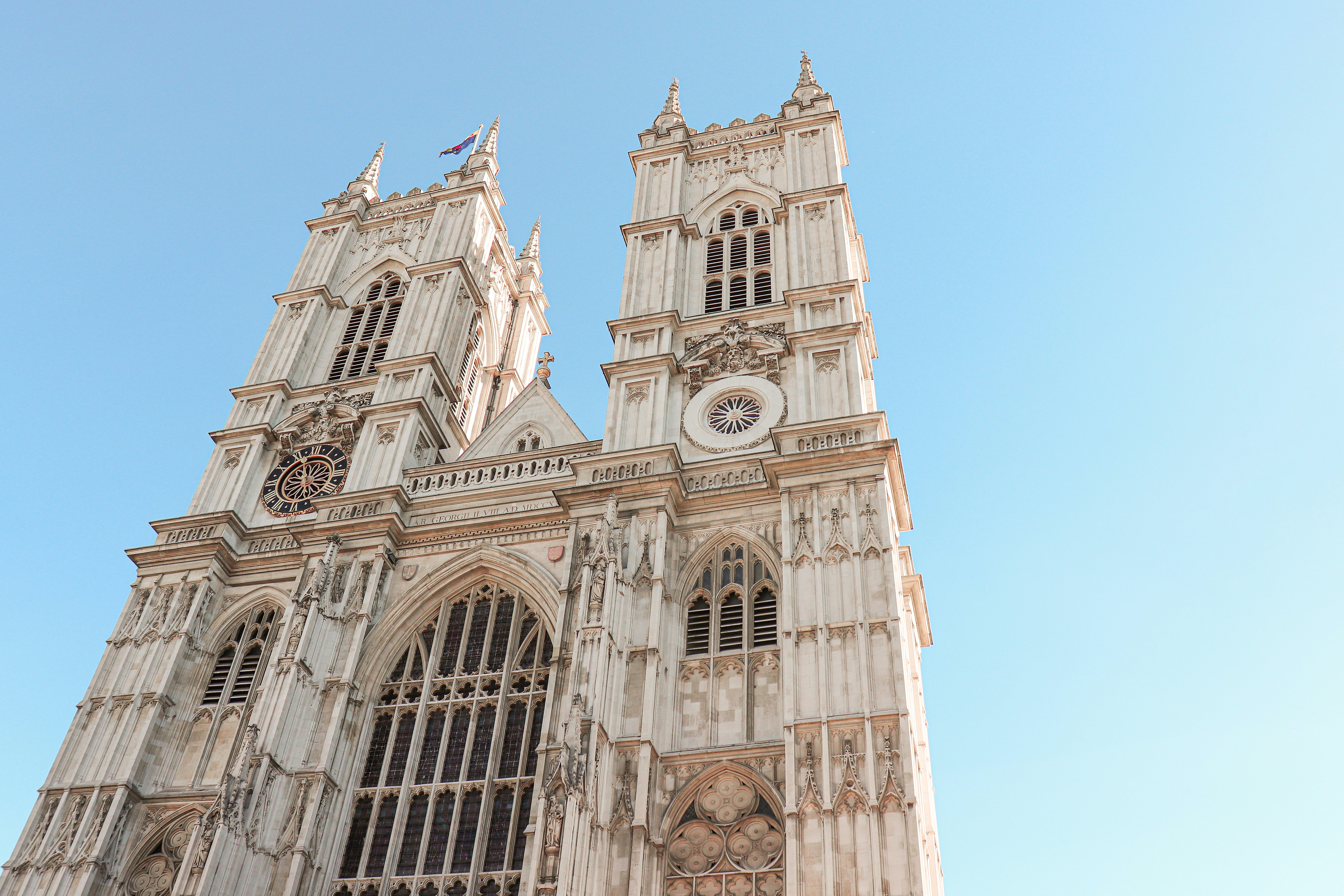
• The Princess of Wales will host a Christmas carol service at Westminster Abbey today. The service, which will be attended by members of the Royal Family, will recognise the selfless efforts of individuals, families and communities across the UK as well as paying tribute to Queen Elizabeth II and the values she demonstrated at Christmas and throughout her life, including empathy, compassion and support for others. The service will be broadcast on ITV One in the UK on Christmas Eve. Meanwhile, a special Christmas episode of Westminster Abbey: Behind Closed Doors will be shown on Channel 5 next Wednesday, 21st December. For more, see My5: Westminster Abbey: Behind Closed Doors.
• An exhibition show-casing the work of photographer Peter Marlow, who has photographed all 42 Church of England cathedrals, can be seen at St Paul’s Cathedral. Commissioned in 2008 by Royal Mail to photograph six cathedrals – images of which were used on commemorative stamps marking the 300th anniversary of the completion of St Paul’s Cathedral, Marlow went on to continue taking pictures of cathedrals using just natural light. The display, which is touring all 42 cathedrals, can be found in the South Nave aisle until 26th January. Included in admission charge. For more, see www.stpauls.co.uk/whats-on/exhibition-peter-marlows-english-cathedral.
• On Now: Making Modernism. The first major UK exhibition devoted to women artists working in Germany in the early 20th century, this exhibition at the Royal Academy’s Gabrielle Jungels-Winkler Galleries includes 67 paintings and works on paper. The artists featured include Paula Modersohn-Becker, Käthe Kollwitz, Gabriele Münter and Marianne Werefkin, with additional works by Erma Bossi, Ottilie Reylaender and Jacoba van Heemskerck. Runs until 12th February. Admission charge applies. For more, see www.royalacademy.org.uk.
Send all items to exploringlondon@gmail.com
Before kicking off a new series, here’s a recap of our last…
3. St Edward’s Chapel, Westminster Abbey…
5. Henry VII’s Lady Chapel, Westminster Abbey…
• The Tower of London is getting into the festive spirit with a celebration of the Twelve Days of Christmas. Twelve installations have been installed at the Tower, each representing as different aspect of the fortress’s unique history – from nine wreaths representing “nine rowdy ravens” to five gold coins representing the Mint once housed there. There’s also the six Queens of King Henry VIII and three “lordly lions” – a reference to a gift presented to King Henry III and housed in a Lion Pit at the tower. Visitors will have the chance to collect a map at the start of their visit and follow a trail to find the installations at they explore the Tower. Christmas at the Tower of London runs daily until 3rd January. Admission charge applies. For more, see www.hrp.org.uk/tower-of-london/.
• The Museum of London is preparing to close its doors at its London Wall site as it moves to its new location in Smithfield and to celebrate it’s holding two free weekend festivals. The first, to be held this weekend, will feature family-friendly activities including arts and crafts, dance, face painting and theatrical performances while the second, to be held on the weekend of 3rd and 4th December (after which the museum will close), will feature a celebration of London’s music scene from the 70s to the present day with a DJ sets, a late night film festival and museum’s first ever 24 hour opening. Visitors on both weekends can also take part in London Biggest Table Football competition for a chance to win an England shirt signed by Harry Kane and to see the museum’s collection in a new light thanks to an illuminated display. For more on the festivals, see www.museumoflondon.org.uk/museum-london.
• Now On: Blood and Battle: Dissecting the life of William Beatty. The life and work of renowned 19th-century naval surgeon and physician, Sir William Beatty, is explored in this exhibition at the Old Royal Naval College in Greenwich. The display – which marks 200 years since Beatty, who had served as ship’s surgeon on HMS Victory during the Battle of Trafalgar (and who wore the musket ball that killed Nelson in a locket on his watch chain for the rest of his life afterwards) – took up the post of Physician to the Royal Hospital for Seamen – explores Beatty’s work as a ship’s surgeon, his time at Greenwich Hospital and how he was honoured by being knighted and appointed Physician Extraordinary to George IV and the Duke of Clarence (later William IV) as well as his outside interests including his involvement in developing the London – Greenwich Railway. Admission charge applies. For more, see https://ornc.org.
Send all items for inclusion to exploringlondon@gmail.com.
Simply put, this is the name London was given during Roman times (and perhaps derives from an earlier Celtic word – although this remains the matter of much speculation).
There’s no substantial evidence of a settlement where London now stands until after the arrival of the Romans in 43 AD. The location was selected for the ease with which the Thames could be bridged and two hills which stand in what is now the city of London – Ludgate Hill on which St Paul’s cathedral stands and Cornhill – which could be fortified as a military stronghold.

The fledging settlement was destroyed during the revolt of Queen Boudicca of the Iceni in 60 AD but rebuilt centred on Cornhill and the Walbrook stream. By the 70s AD, the main public buildings of the forum and basilica were placed on high ground east of the Walbrook and by the end of of the first century AD further grand buildings – the governor’s palace, amphitheatre and baths – had been added. Waterfront infrastructure for shipping – including quays and warehouses – stretched along the northern side of the river.
A fort was added and public buildings renovated before the visit of the Emperor Hadrian in 122 AD. Another fire destroyed much of the city but it was again rebuilt and late in the 2nd century walls were built around it, partially encircling a site of some 330 acres. Buildings subsequently constructed in the 3rd century included the Temple of Mithras and a monumental arch.
There were known to have been “suburbs” including at both Southwark and to the west around Trafalgar Square and cemeteries were built outside the walls.
The city’s population had already contracted somewhat by the time the legions were recalled to Rome in 410 AD. While the walls still offered the inhabitants some protection 50 years after the withdrawal of the legions, there’s scant evidence for how much longer it remained inhabited with the Anglo-Saxons known to have viewed the ruins of the Roman buildings with some trepidation.
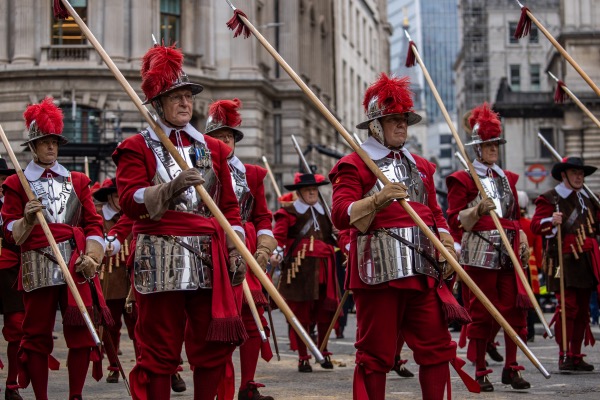
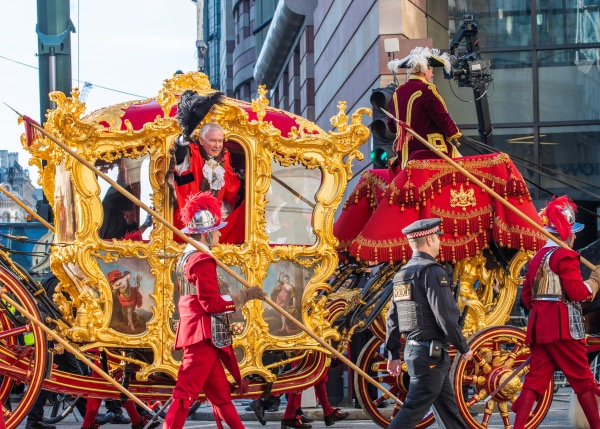
• The Lord Mayor’s Show will be held this Saturday, 12th November, welcoming the 694th Lord Mayor of London, Alderman Nicholas Lyons, into office. The Show, which dates back to the early 13th century, features more than 6,500 people, 250 horses and more than 130 floats as well as the golden State Coach which has been used to carry the Lord Mayors since as far back as 1757 and is said to be the oldest ceremonial vehicle still in regular use anywhere in the world. The three mile long procession will start passing by Mansion House at 11am and make its way to St Paul’s Cathedral and then head on to the Royal Courts of Justice where the Mayor will swear an oath of allegiance to the monarch, before returning along the Embankment and Victoria Street to Mansion House. For more on the history of the Show and details about the best places to stand, head to https://lordmayorsshow.london.
• The original headquarters of Mass-Observation, a pioneering social research organisation, has been marked with an English Heritage Blue Plaque. The organisation started its worked at the property 6 Grotes Buildings in Blackheath from 1937 until 1939 – by the end of its first year there were around 600 ‘mass observers’ involved in the work, one of the key aims of which was to gauge public opinion on a range of issues to help enable the writing of “a democratic people’s history from below”. During World War II, Mass-Observation worked on behalf of the government and morphed into a market research company in 1949, Mass Observation Ltd, before being incorporated into the British Market Research Bureau. The project was restarted in 1981 at the University of Sussex and continues to this day. For more on English Heritage Blue Plaques, see www.english-heritage.org.uk/visit/blue-plaques/.
• A collection of about 100 modern and contemporary artworks on paper have gone on show at the British Museum, part of a larger gift of works donated by London-based art collector Hamish Parker. Art on paper since 1960: the Hamish Parker collection features works by works by the likes of British artist Lucian Freud, French-Israeli artist Avigdor Arikha, American artist Richard Serra and Pakistani artist Imran Qureshi. There are also two “artist in focus” sections which take a more in-depth look at the work of American artists Carroll Dunham and Al Taylor. Runs until 5th March in Gallery 90. For more, see www.britishmuseum.org.
Send all items for inclusion to exploringlondon@gmail.com
We’ll return to Westminster Abbey shortly but first we’re heading into the City of London.
Christ Church Greyfriars, also known as Christ Church Newgate Street, was the burial site of several queens in the medieval era.
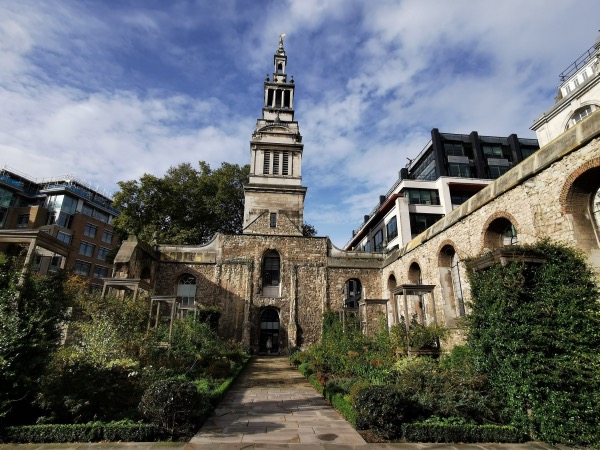
These include the second wife of King Edward I, Queen Marguerite, who partly financed construction of the church which commenced in the 1290s and finished well after her death in the 1360s.
Marguerite, who was the first uncrowned queen since the Norman Conquest (apparently due to the expense), was only 26 when she was widowed in 1307 (having married the king in 1299 when he was at least 40 years her senior).
She died on 14th February, 1318, while at her castle at Marlborough but her remains were brought to London where she was buried in Greyfriars wearing a Francisan habit. Her tomb, sadly, was destroyed during the Reformation.
Also buried in Greyfriars was Queen Isabella, the widow (and adversary) of the ill-fated King Edward II. Isabella, who was also known as the ‘She-wolf of France’, is said to have been buried in the clothes she wore at her wedding to the King 50 years earlier. Despite rumours to the contrary, her lover, Roger Mortimer, was not buried with her (although Isabella’s daughter – Joan of the Tower, who was the wife of King David II of Scotland – was).
While their predecessor as Queen, Eleanor of Provence, wife of King Henry III, was buried at Amesbury Priory in Wiltshire where she had died (the grave is unmarked), her heart was brought to London and buried in Greyfriars.
Others buried in the church include King Henry III and Eleanor’s daughter, Beatrice of England, and King Edward III’s daughter Isabella, Countess of Bedford.
There’s not much left of Greyfriars these days – the medieval church, one of the largest then in London, burned in the Great Fire of London of 1666 and following a rebuild under Sir Christopher Wren’s supervision, it was again all but destroyed during the Blitz in World War II.
It was decided not to rebuild and what remained of the church – some of the outer walls and tower – were designated a Grade I-listed building in 1950. Plantings inside are laid out to resemble the pews of the church in plan.
WHERE: Christ Church Greyfriars, King Edward Street (nearest Tube station is St Paul’s); WHEN: Anytime; COST: Free; WEBSITE: www.cityoflondon.gov.uk/things-to-do/city-gardens/find-a-garden/christchurch-greyfriars-church-garden
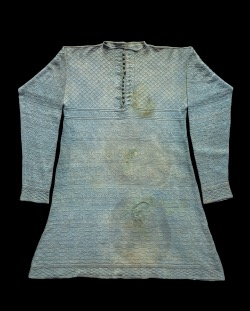
• The history of public executions in London – spanning a period of some 700 years – is the subject of a landmark new exhibition at the Museum of London Docklands in West India Quay. Executions explores how capital punishment became embedded in the city’s landscape – from the first recorded public execution in 1196 to the last in 1868 – and looks at the rarely told and often tragic human stories behind them. Items on display include an intricately woven silk vest said to have been worn by King Charles I at his execution outside the Banqueting House (pictured), a 300-year-old bedsheet embroidered with a love note in human hair and personal items which once belonged to prison reformer Elizabeth Fry. Visitors can also stand in front of the Newgate Prison door, marking the last steps for prisoners heading to the scaffold, and see a dramatic recreation of the Tyburn “Triple Tree” gallows. Visitors will also learn about the 200 offences that became punishable by death and the spectacle and rituals of execution days as well as what led celebrity criminals to the gallows. Admission charge applies. Runs until 16th April next year. For more, see https://www.museumoflondon.org.uk/museum-london/whats-on/exhibitions/executions.
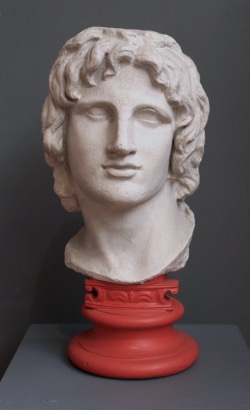
• The first exhibition exploring the rich history of story-telling around one of the most famous figures of the ancient world – Alexander the Great – opens at the British Library tomorrow. Alexander the Great: The Making of a Myth features almost 140 exhibits from 25 countries including astrological clay tablets, ancient papyri and medieval manuscripts as well as comics, films and video games. It reveals how Alexander’s character has been adapted and appropriated by different cultures and religions, with conflicting interpretations. Runs until 19th February. Admission charge applies. A season of in-person and online events accompanies the exhibition. For more, see www.bl.uk/events/alexander-the-great-the-making-of-a-myth.
• Portraits of the Euro 2020 England men’s football squad and its manager, Gareth Southgate, will be shown at the City of London Corporation’s Guildhall Art Gallery from today. The free exhibition, This is England, features the most successful men’s national team – finalists in Euro 2020 – since the winners of the World Cup in 1966, from Harry Kane and Jude Bellingham to Bukayo Saka and Raheem Sterling. The paintings are the work of artist Matt Small and were commissioned by the FA and exhibited at the St George training ground during the Euro 2020 finals. The paintings can be seen until 19th February. For more, see www.cityoflondon.gov.uk/events/this-is-england.
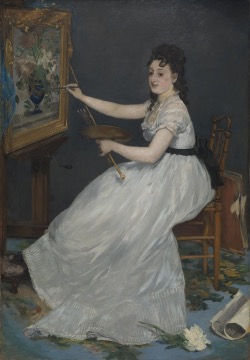
• Édouard Manet’s 1870 portrait of Eva Gonzalès is the subject of a new exhibition at The National Gallery opening on Friday. The painting was considered by the early 20th century to be the most famous modern French painting in the UK and Ireland. The exhibition, the first in a new series of ‘Discover’ exhibitions to be staged in the Sunley Room with the aim of exploring well-known paintings in the collection through a contemporary lens, examines the lifelong artistic dialogue and the complexities of the friendship and mentorship between Manet and Gonzalès, his only formal pupil. It also looks at the broader context of female self portraits from the 18th to early 20th centuries, alongside portraits of women artists by male friends, husbands, and teachers The free exhibition includes works by Eva Gonzalès, Elisabeth Louise Vigée Le Brun, Edouard Manet, Berthe Morisot, Alfred Stevens and Laura Knight. Runs until 15th January. For more, see www.nationalgallery.org.uk/exhibitions/discover-manet-eva-gonzalès.
Send all items for inclusion to exploringlondon@gmail.com.
Following the laying to rest of Queen Elizabeth II in St George’s Chapel, Windsor, we’re taking a look at where some royal burials have taken place within London.
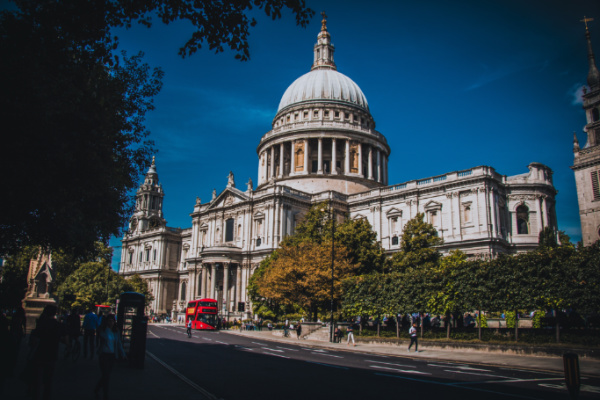
We start our new series with Old St Paul’s Cathedral which believed to have been the burial site of two Anglo-Saxon kings before it was destroyed in the Great Fire of 1666.
Aethelred (Ethelred) the Unready, who ruled from 978 until 1013 (and then again from 1014 until his death on 23rd April, 1016) was known to have been buried in the quire of the old cathedral (it’s marked on Wenceslaus Hollar’s 1658 plan of the cathedral as being on the northern side of the quire, just past the north transept) but his tomb was lost in the fire.
His memorial is among those which were lost in the Great Fire mentioned on a modern plaque in the crypt of the St Paul’s of today.
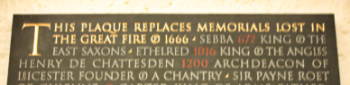
While his was the last royal burial to take place in St Paul’s, Aethelred wasn’t the only Anglo-Saxon king who was interred there.
Sæbbi, a king of the East Saxons who ruled from 664 to 694 (and is also known as Sebba or Sebbi), is also listed as being buried there (Aethelred was apparently buried close to him) and his grave also lost in the great fire.
There’s a story that when Sæbbi was about to be buried in a stone coffin, it was found it was too short for his body to lie at full length. Various solutions were proposed – including burying him with bent legs, but when they put the body back in the stone coffin this time, miraculously, it did fit.
Following an earlier fire in St Paul’s – in 1087 – Sæbbi body was transferred to a black marble sarcophagus in the mid-1100s and it’s that which was lost in the Great Fire.

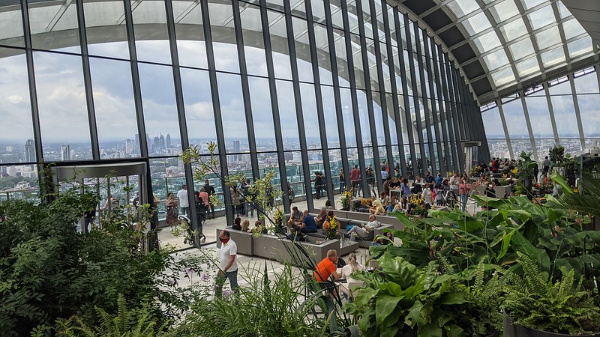
While recent years have seen the creation of a number of roof gardens across London, the Sky Garden – located atop the controversial ‘Walkie Talkie’ building (otherwise known as 20 Fenchurch Street) – has the honour of being the highest public garden in the city.
The three floor garden, which was designed by landscape architecture practice Gillespie’s, opened in January, 2015.
Located on the 36th to 38th floors, it was designed to provide 360 degree views across London and features landscaped gardens, observation decks, an open air terrace (named for the late architectural townscape advisor Francis Golding) and five bars and restaurants.
The gardens include flowering plants such as the African Lily (Agapanthus), Red Hot Poker (Kniphofia) and Bird of Paradise (Strelitzia reginae) as well as fragrant herbs such as French Lavender.
WHERE: Sky Garden (via 1 Sky Garden Walk) (nearest Tube station is Monument); WHEN: 10am to 6pm weekdays; 11am to 9pm weekends; COST: Free (but rebooking required); WEBSITE: https://skygarden.london.
• The Museum of London is celebrating its final 100 days at London Wall on Friday with free ice creams and “goody bags” for visitors. The museum will be giving away 500 Lewis of London ice creams from 11:30am, while visitors will also enjoy a performance by Grand Union Orchestra at midday. The first 100 visitors through the doors will also receive a gift bag featuring Museum of London memorabilia, including a Museum of London guidebook, a pack of playing cards displaying iconic images from the museum’s collections, a greeting card featuring a print by artist Willkay, and a special gift of either a tea towel, a Vauxhall Pleasure Gardens mug, a sketch notebook, an A3 print of London or a soft toy. Meanwhile, from Friday, digital screens will display a countdown clock to mark the days left before the London Wall site closes to the public on 4th December, in preparation for the museum’s move to a new home at West Smithfield. Friday’s event is part of a six-month long programme of activities leading up to the closure of the site. For more, see www.museumoflondon.org.uk.

• The tabla – twin hand drums – used by legendary Indian musician Ustad Alla Rakha during his European tours of the early 1980s is going on display at the British Museum in a world first. Ustad Alla Rakha was one of the most important and respected tabla players of his generation, working with the All India Radio in the 1930s, composing music for the film industry in the 40s, and regularly playing with world-renowned sitar player Ravi Shankar. The tabla will be on display in the Hotung Gallery until early 2023 after which they will go on loan to the Manchester Museum South Asia Gallery. For more, see www.britishmuseum.org.
• Now on: Lucian Freud: The Painter and His Family. The first exhibition of Lucian Freud’s work at the Freud Museum, the home of his grandfather, Sigmund Freud, and aunt, Anna Freud, this display explores Lucian Freud’s childhood, family and friends and celebrates some lesser known aspects of his life including his love of reading and lifelong fascination with horses as well as his relationships with the former occupants of the building. Alongside paintings and drawings, the exhibition includes illustrated childhood letters, books Freud owned and book covers he designed. His sole surviving sculpture, Three-legged Horse (1937) and early painting, Palm Tree (1944), is also being displayed. The display is being accompanied by a programme of events. For more, see www.freud.org.uk.
Send all items for inclusion to exploringlondon@gmail.com.
The City of London is dotted with halls for the city’s livery companies. But ever wondered what they are?
There are 110 livery companies in the City, representing ancient and more modern trade associations and guilds, including everything from grocers to saddlers, ironmongers to musicians. The newest livery company is the Worshipful Company of Arts Scholars which was created in 2014.
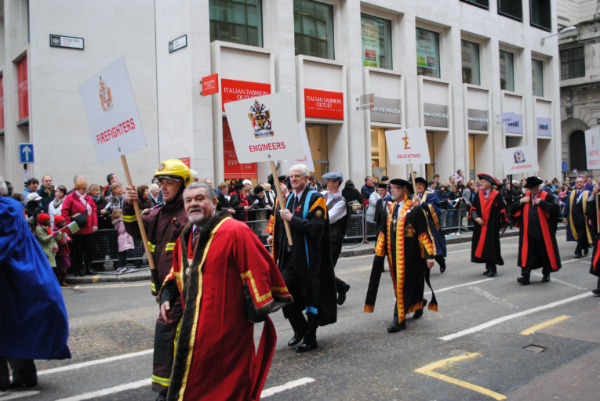
Many of today’s livery companies have their origins in the city’s medieval guilds which were responsible for such things as regulating wages and conditions and setting industry standards (while many of these responsibilities have since passed to other bodies, some – such as the Worshipful Company of Gunmakers and the Worshipful Company of Goldsmiths – still play important roles in quality control).
These days the companies are also known for their support of the industries they represent and their philanthropic work.
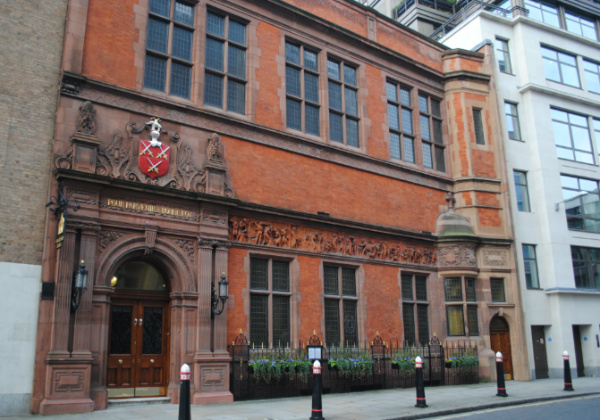
Livery companies – many of which also traditionally had religious links – built halls as central meeting places – about 40 companies today still own or have a share in a hall.
Members of the livery companies (known as liverymen after the distinctive clothing or uniform they wore) – who are awarded the Freedom of the City of London – have the right to vote for senior offices in the City such as the Lord Mayor of London and sheriffs.
The livery companies of the City of London are listed in an “order of precedence” which was settled in 1515 for the 48 then in existence based on their political and economic power (the Worshipful Company of Mercers comes in at number one). All the companies created since then are ranked according to their date of creation.
The 12 highest ranked companies are known as the Twelve Great City Livery Companies. Among them in the Worshipful Company of Merchant Taylors which disputes its position at number seven and so once a year at Easter swaps places with the Worshipful Company of Skinners at number six.
The oldest livery company is said to be the Worshipful Company of Weavers while the oldest livery company hall is that of the Worshipful Company of Apothecaries.
• A series of free art trails featuring globe sculptures that aim to increase understanding of the Transatlantic slave trade and its impacts have gone on show in several parts of central London. A national art project which spans seven UK cities, The World Reimagined is designed to bring to life the reality and impact of the slave trade in a bid to help make racial justice a reality. Among the artists involved in London are the project’s founding artist British-Nigerian Yinka Shonibare (who also chose the form of the sculptures), Nicola Green and Winston Branch and each has created a work responding to themes ranging from ‘Mother Africa’ and ‘The Reality of Being Enslaved’ to ‘Still We Rise’ and ‘Expanding Soul’. There are four trails in London, including in the City in London, Camden-Westminster, Hackney-Newham and Southwark-Lambeth. More than 100 artists are involved in the project overall. For more including details on where to find the trails, see www.theworldreimagined.org.
• Dadabhai Naoroji, an Indian Nationalist and the first Indian to win a popular election to Parliament in the UK, has been honoured with an English Heritage Blue Plaque at his former home in Penge. Known as the “grand old man of India” and described in his Times obituary as “the father of Indian Nationalism” following his death in 1917, Naoroji made seven trips to England and spent over three decades of his life in London, including at the red-bricked semi-detached house in Penge, south London, that was his home around the turn of the twentieth century and where the plaque is located. The plaque was unveiled last week ahead of the 75th anniversary celebrations of India’s independence. For more, see www.english-heritage.org.uk/visit/blue-plaques/.
Send all items for inclusion to exploringlondon@gmail.com
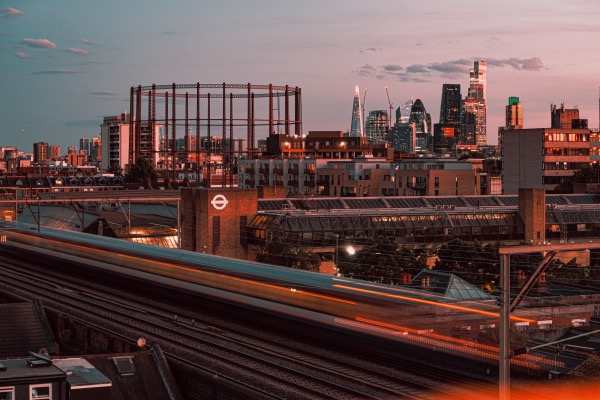
Think of fire in relation to London and the events of 1666 no doubt spring to mind. But London has had several other large fires in its history (with a much higher loss of life), including during the reign of King John in July, 1212.
The fire started in Southwark around 10th July and the blaze destroyed most of the buildings lining Borough High Street along with the church of St Mary Overie (also known as Our Lady of the Canons and now the site of Southwark Cathedral) before reaching London Bridge.

The wind carried embers across the river and ignited buildings on the northern end before the fire spread into the City of London itself (building on the bridge had been authorised by King John so the rents could be used to help pay for the bridge’s maintenance).
Many people died on the bridge after they – and those making their way south across the bridge to aid people in Southwark (or perhaps just to gawk) – were caught between the fires at either end, with some having apparently drowned after jumping off the bridge into the Thames (indeed, it’s said that some of the crews of boats sent to rescue them ended up drowning themselves after the vessels were overwhelmed).
Antiquarian John Stow, writing in the early 17th century, stated that more than 3,000 people died in the fire – leading some later writers to describe the disaster as “arguably the greatest tragedy London has ever seen”.
But many believe this figure is far too high for a population then estimated at some 50,000. The oldest surviving account of the fire – Liber de Antiquis Legibus (“Book of Ancient Laws”) which was written in 1274 and mentions the burning of St Mary Overie and the bridge, as well as the Chapel of St Thomas á Becket built upon it – doesn’t mention a death toll.
London Bridge itself survived the fire thanks to its recent stone construction but for some years afterward it was only partly usable. King John then raised additional taxes to help rebuild destroyed structures while the City’s first mayor, Henry Fitz Ailwyn, subsequently apparently joined with other officials in creating some regulations surrounding construction with fire safety in mind.
The cause of the fire remains unknown.