Treasures of London – Harrison’s timekeepers

A series of four marine timekeepers which eventually solved the ‘problem’ of longitude – revolutionising sea travel by allowing mariners to accurately locate their position – are housed at the Royal Observatory in Greenwich.

The three clocks and one watch were designed by John Harrison, a working class joiner from Lincolnshire who made it his life’s mission to design a device which would keep accurate time at sea.

Calculating longitude – an east-west position on the earth – is relatively simple. Because time moves forward one hour for every 15 degrees one travels in an eastward direction (or back an hour for every 15 degrees one travels westward), it’s possible to calculate a position by simply knowing the local time at two different places on earth.

The problem was that the pendulum clocks of the 1600s were affected by changes in temperature and humidity  and couldn’t keep accurate time on board a ship meaning that while a mariner might know the local time, he could not get an accurate measurement of time elsewhere to compare it to.

While mariners could use the ‘lunar distance method’ to measure longitude – this involved measuring the motion of the moon relative to the stars – it relied on clear skies and was not very accurate. So in 1714 the British Government announced it would award a prize of £20,000 to anyone who could come up with a solution to longitude which was accurate to within half a degree (or two minutes).

Clockmaker John Harrison was among those who took up the challenge (his somewhat tragic story is told in great detail in Dava Sobel’s terrific 1995 book Longitude: The True Story of a Lone Genius Who Solved the Greatest Scientific Problem of His Time). His first effort, known simply as H1, was constructed between 1730 to 1735 and, using a counterbalanced spring mechanism making it independent of gravity, was successfully tested on a voyage to Lisbon.

But Harrison wasn’t satisfied and began work on H2 in 1737 before, after realising its shortcomings three years later, starting work on another clock, H3, in 1740. He worked on this for 19 years but it failed to meet the accuracy requirements of the Board of Longitude which was charged with looking overseeing the awarding of the £20,000.

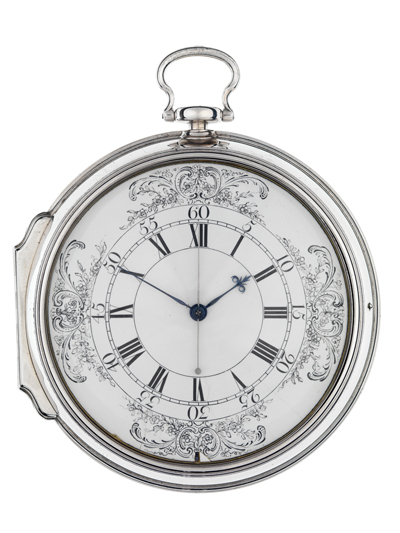
In 1753, Harrison asked a London watchmaker John Jefferys to create a watch to his designs, initially for his own personal use. But he soon discovered that with a few improvements, H4 – which looks like a large pocketwatch (see picture), could be the answer he was looking for.

In 1761 and 1764, Harrison’s son William took the watch on two voyages to the West Indies, yet, despite the fact that its accuracy was well within the requirements of the Board of Longitude, the board initially refused to pay up. After much wrangling Harrison was finally paid £10,000 but told that to obtain the other half of the money, he would have to create at least two more copies of H4.

Harrison went on to make one copy – H5 – while watchmaker Larcum Kendall, made another, K1, at the direction of the Longitude Board. When Harrison suggested that Kendall’s K1 could be considered the second of the two copies he was required to make, the board rejected the idea. Harrison then appealed directly to the king, George III, and finally to parliament before he was eventually awarded a further £8,750 in 1773.

Kendall’s watch, meanwhile, was taken by Captain James Cook on a three year voyage as far afield as Antarctica. It was a test which proved beyond all doubt the accuracy of the timekeepers. A year after Cook’s return in 1775, John Harrison died in his house in Red Lion Square on 24th March, 1776. It is not known whether he knew of the success of the timekeeper taken on Cook’s voyage.

Harrison’s four timekeepers are now housed at the Royal Observatory where the intriguing story of their creation is told.

WHERE: Royal Observatory, Blackheath Avenue, Greenwich (nearest DLR stations are that of Greenwich and Cutty Sark and it can also be reached by river – stop at Greenwich Pier); WHEN: 10am to 5pm (last admission 4.30pm) daily; COST: £7 adult/£5 concessions/free for children 15 and under (annual passes available – £10 an adult/£7.50 concessions) ; WEBSITE: www.nmm.ac.uk/places/royal-observatory/

PICTURE: Courtesy of the Royal Observatory, Greenwich

Around London – Open House London; Magna Carta on display; Fashion Week photography; and, Henry Moore returns to Greenwich…

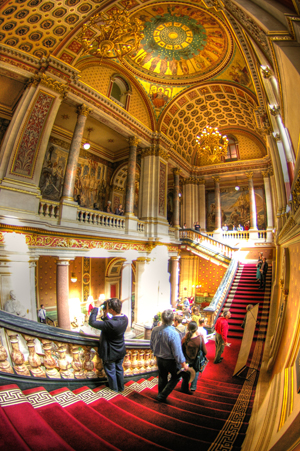
It’s Open House London weekend again and there’s scores of properties across the city which will be opening their doors to allow the curious a rare glimpse inside. The properties which will be open include architect’s homes and cutting edge housing as well as historic city landmarks, landscape projects and government buildings (including the Foreign Office & India Office – pictured). Other highlights of this year’s event – conducted under the theme of ‘The Liveable City’ –  include a night hike, a festival aimed at kids and families, talks, walks and cycle tours and competitions. Among the buildings flinging their doors wide are Lambeth Palace, home of the Archbishop of Canterbury, livery company halls, the newly reopened St Pancras Renaissance Hotel and the Bevis Marks Synagogue in the City. Most properties can simply be visited on a first come, first in basis but some do require advance booking so check before you go. Open House London was first started 19 years ago and has since spread to many other cities around the world including New York, Jerusalem and Helsinki. For more information and to purchase an online guide, see www.londonopenhouse.org. PICTURE: (c) Nick Woodford.

• King Edward I’s Magna Carta will go on show at the Guildhall Art Gallery in the City this weekend, presenting a rare opportunity to see this pivotal document. The City of London Corporations 1297 Magna Carta – regarded as one of the finest 13th century copies – will be on display in the Roman Amphitheatre during Open House London. The document features King Edward I’s seal and the original writ to the Sheriffs of London ordered that the charter be promulgated within the City. Admission over the weekend is free. For more see, www.guildhallartgallery.cityoflondon.gov.uk/gag/


The Museum of London has launched an online collection of early Twentieth century fashion photographs to coincide with London Fashion Week. The more than 3,000 glass negative plates come from the collection of Bassano Limited, founded by Italian-born Alexander B. Bassano, and were taken between 1912 and 1945. They record a wide range of fashions as well as designers and retailers and can be accessed via the Museum’s Collections online web portal. Meanwhile, the museum is hosting it’s first ever professional catwalk show on Friday night. It features the works of Christopher Raeburn. For more, see www.museumoflondon.org.uk.

A Henry Moore sculpture, Large Standing Figure: Knife Edge, has been returned to Greenwich Park, more than four years after it was removed. The almost five metres tall sculpture, made by Moore in 1976, was originally placed in the park in 1979 but was removed for conservation in early 2007 before joining a Moore exhibition at Kew Gardens and then forming part of the Henry Moore display at the Yorkshire Sculpture Park. The bronze, on loan from The Henry Moore Foundation for two years, has now been returned to its original location between The Avenue and Croom’s Hill Gate.

Where is It? #3

This is the third in our series in which we ask you to identify where in London this picture was taken and what it’s of. If you reckon you know the answer, leave a comment below. We’ll reveal the answer early next week. Good luck!

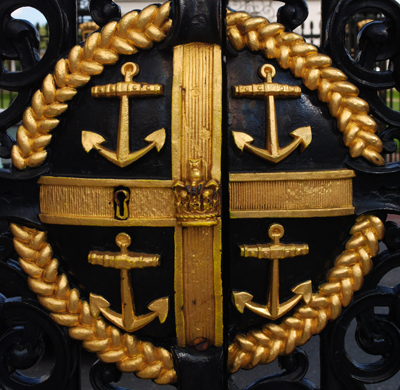
Apologies for the delay in getting this answer to you (Exploring London has been on a summer break!). But if you’ve been wondering, the answer is that the picture shows a lock detail from one of the gates leading into the old Royal Naval College at Greenwich – the anchors were a clue! Congrats to Ian who guessed the location was near the Queen’s House (contained within the former Royal Naval College). Click here if you’re interested in reading our previous entry about the former Royal Naval College and Sir Christopher Wren’s role in its design.

Around London – National Maritime Museum expands; new galleries proposed for British Museum; Festival of British Archaeology in London; and, the London Street Photography Festival…

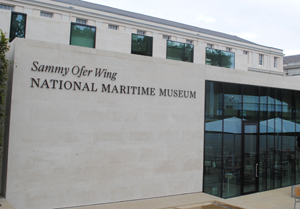
The National Maritime Museum in Greenwich opened the doors of its new £36.5 million Sammy Ofer Wing today. The new, architecturally slick extension – which is being touted as bringing with it a change of direction in the way the museum operates – features a new permanent gallery known as Voyages as well as a temporary exhibition space, library and archive. There’s also a lounge, cafe and brasserie – the latter boasting views out over Greenwich Park. The Voyages gallery has been designed as an introduction to the museum and features a 30 metre long thematic ‘object wall’ hosting more than 200 objects – everything from a letter written by Horatio Nelson to his mistress Emma Hamilton while he was on board the Victory in 1803 through to a watch belonging to Robert Douglas Norman – among those who perished on the Titanic, and a somewhat battered Punch puppet. The special exhibition space initially hosts High Arctic which uses technology to create an “immersive environment” exploring the Arctic world from the perspective of the future. The museum is also introducing the Compass Card scheme, a new initiative which will eventually be rolled out across the museum. Visitors are presented with a unique card with which, by inserting it into special units placed in galleries, they can flag their interest in receiving further information on a specified subject. The card can then be used to call up related archival information in the museum’s Compass Lounge or using the visitor’s home computer. For more information, see www.nmm.ac.uk.

The British Museum has announced funding has been secured for two new gallery spaces. These will include a new gallery looking at the history of world money from 2000 BC to present day. Known as the Citi Money Gallery, it will be opened in 2012. A donation from Paul and Jill Ruddock, meanwhile, means the museum will also be working on a major redisplay of Room 41 which covers the Mediterranean and Europe from 300 to 1,100 AD. The artefacts in the room include treasures taken from Sutton Hoo and the Vale of York Viking Hoard. The gallery will open in 2013/14. For more, see www.britishmuseum.org.

Now On: Festival of British Archaeology. Coordinated by the Council for British Archaeology, the 21st festival (formerly known as National Archaeology Week) kicks off this weekend and runs until the end of July. It boasts more than 800 events across Britain including in London where they include guided tours of the Rose Theatre, a range of Roman themed events and activities – including a gladiator show – at the Museum of London, gallery talks at the Bank of England Museum and British Museum, the chance to visit the Billingsgate Roman House and Baths, and a guided walk of Londinium (Roman London) organised by All Hallows by the Tower. For a complete events listing, see http://festival.britarch.ac.uk/.

Now OnThe London Street Photography Festival is running until the end of the month with a series of exhibitions, talks, walks and workshops, the majority of which are taking place in and around King’s Cross. Key events include Street Markets of London in the 1940s – Walter Joseph featuring never before seen images at the British Library, Vivien Maier: A Life Uncovered at the German Gymnasium, and Seen/Unseen – George Georgiou and Mimi Mollica at the Collective Gallery. For more information, see www.londonstreetphotographyfestival.org.

Treasures of London – Admiral Lord Nelson’s coat

It was roughly two hours into the Battle of Trafalgar on 21st October, 1805, about 1.15pm, that Great Britain’s most famous seaman, Admiral Horatio Lord Nelson, was fatally struck by a musket ball.

Fired by a marksmen in the rigging of the French ship Redoubtable, the musket ball struck him in the left shoulder as he stood on the deck of his flagship, HMS Victory.

Having fallen to his knees, he was spotted by the Victory‘s captain, Thomas Hardy, before he collapsed. Carried below the decks to the ship’s cockpit, it was there that he died (the Victory can still be visited at Portsmouth).

His damaged coat, meanwhile, was placed under the head of Midshipman George Augustus Westphal, who was being treated for his injuries nearby. Blood from the midshipman (late himself an admiral) stuck his hair to one of the epaulettes, part of which was was cut away and retained by his family as a memento.

The “undress jacket” was later returned to Nelson’s mistress, Emma Lady Hamilton, in accordance with his wishes. She later gave it to Joshua Jonathan Smith, Lord Mayor of London in 1810-1811, to as payment of a debt just prior to retiring to France in 1814. It was Prince Albert, the consort of Queen Victoria, who later purchased the coat for £150 from Smith’s widow and presented it to Greenwich Hospital in 1845.

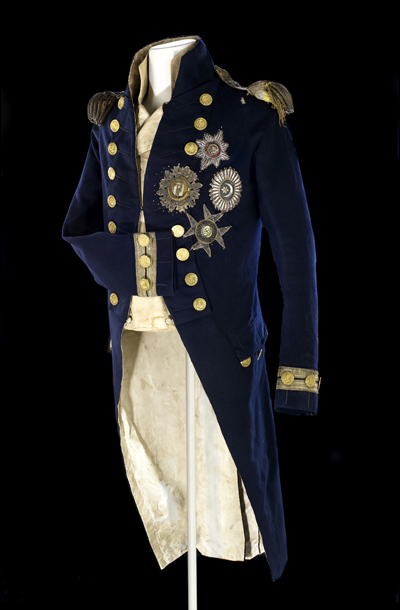
The jacket can now be found in the National Maritime Museum in Greenwich (housed in a section of the former Naval College). Along with the fatal musket ball hole on the left shoulder, the tails and left sleeve of the jacket are stained with the blood of John Scott, Nelson’s secretary, who had died in the early moments of the battle on the spot where Nelson was later shot. It’s also possible to see where the epaulette was damaged during the treatment of Midshipman Westphal.

The front of the coat also features embroidered versions of the four orders of chivalry awarded to Nelson – these are the star of the Order of the Bath, the Order of the Crescent awarded by the Sultan of Turkey, the Order of St Ferdinand and of Merit awarded by Ferdinand IV of Naples, and the German Order of St Joachim. According to the National Maritime Museum, “Nelson habitually wore them on all his uniform coats”.

The coat’s right sleeve is positioned as Nelson would have worn it – in 1797 he had lost his right arm at the Battle of Santa Cruz de Tenerife.

PICTURE: Vice-admiral’s undress coat worn by Nelson (1758-1805) at the Battle of Trafalgar. There is a bullet hole on the left shoulder, close to the epaulette. (c) National Maritime Museum, Greenwich, London, Greenwich Hospital Collection.

WHERE: National Maritime Museum, Romney Road, Greenwich, (nearest DLR station is Cutty Sark or Greenwich mainline station); WHEN: Open 10am to 5pm daily; COST: Free; WEBSITE: www.nmm.ac.uk.

King James I’s London – 6. The Queen’s House, Greenwich

Long an admired landmark of Greenwich, the origins of the Queen’s House go back to the reign of King James I.

It was the Queen, Anne of Denmark, who commissioned the building of The Queen’s House in 1616 and gave it the name by which it is still known. Sadly, however, she died before it was completed.

King James I was said to have been a frequent visitor to the Tudor Palace of Greenwich (the building had earlier been known as the Palace of Placentia and was the birthplace of King Henry VIII in 1491).

King James  is traditionally said to have awarded the Manor of Greenwich to Queen Anne as an apology after he had publicly sworn at her when she had accidentally shot one of his favorite hunting dogs.

In 1616, Queen Anne decided to build a new property on the site as both a private retreat and a place where she could entertain and it was to the rising star Inigo Jones that she turned to for the design (in recognition of his growing status, he was appointed Surveyor of the King’s Works the following year).

The house was Jones’ most important job to date and the design he came up – based on a H with the two sides joined by a bridge over the Greenwich to Woolwich road – with is said to be the first Classical building in England.

Among the original features which survive to this day are the striking black and white geometrically patterned marble floor of the Great Hall (the room having been designed as a perfect cube), the painted ceiling of the Queen’s Presence Chamber and the iron balustrade the Tulip Stairs – said to be the first “geometric self-supporting spiral stair in Britain”.

Queen Anne became ill in 1618 and died the following year without seeing the end result of her commission. The work subsequently was shelved and only restarted (and completed in 1638) after King Charles I gave it to his wife, Queen Henrietta Maria.

She only had possession for a short time before Parliamentary forces seized it during the Civil War. After the Restoration, the Queen’s House was returned briefly to her by her son King Charles II (it was at this time that the original H-shape of the house was altered to a square) before part of it as later used as studio for painters and then as grace and favor apartments.

With the Old Royal Naval College now occupying the surrounding site, in 1805, King George III gave the property to the Royal Naval Asylum – a charity caring for the orphan children of seamen – and it later became part of the Royal Hospital School.

The National Maritime Museum took possession in 1934 and the building now houses the National Martime Museum’s collection of fine art. As an interesting aside, there have been several reported sightings of ghosts in the house, the latest as recently as 2002.

WHERE: The Queen’s House, National Maritime Museum, Greenwich (nearest DLR station is Cutty Sark); WHEN: 10am to 5pm daily (check website for closures); COST: Free; WEBSITE: www.nmm.ac.uk/places/queens-house

King James I’s London – 3. Golf on Blackheath

When King James I came south to take up the throne England, he is known to have brought that peculiarly Scottish game of golf with him and it is believed that it was at Blackheath, above the then Royal Palace of Placentia in Greenwich, that his courtiers first played the game.

According to the Royal Blackheath Golf Club, now located some way to the south of Blackheath in Eltham (the club moved there is 1923), documentary evidence shows the earliest players included James I’s son Henry Frederick, Prince of Wales, who is known to have gone golfing in 1606. The club itself notes that while it is generally accepted it was established in 1608, no documentary evidence to support this has yet been unearthed (records prior to 1787 are missing).

The first course at Blackheath – which has played a significant role in several events including as a rallying point during the Peasant’s Revolt of 1381 –  apparently consisted of five holes, each of which was played three times.

Favourite Places – The Museum of London’s Lynne Connell revisits Greenwich

In the first of a new series looking at some of the favorite historical places of Londoners, Lynne Connell, a host at the Museum of London, nominates Greenwich…

“When I was a child my grandparents took me to Greenwich for the day.  I remember being very impressed with Admiral Nelson’s uniform (complete with blood stains) and the haunted tulip staircase in the Queen’s house. While we sat and ate cheese and onion crisps in front of the Cutty Sark, my Grandmother (who was a little eccentric) told me ‘there is so much history here you can feel it’.

“So what can you see in Greenwich today?

“You can visit the Greenwich Observatory, stand on the Meridian line and know you are in the centre of the world! Admission is free there, as well as the National Maritime Museum and the Queen’s House. You can also see the magnificent Wernher collection at Ranger’s House (free to members of English Heritage) and don’t forget the tiny Fan Museum.

“A favourite lazy Sunday morning, includes a stroll in the Royal Park to visit the deer enclosure, a leisurely coffee in one of the two cafes and a visit to the craft market.

“The remains of a Roman villa can be seen in the park and you can visit Princess Caroline’s bath. Don’t miss Queen Elizabeth’s oak, Henry VIII is reputed to have courted Anne Boleyn under the boughs of his ancient hollow tree. It fell during high winds in the 1990’s and is now slowly rotting away.

“Look down from the Observatory Gardens upon the magnificent Royal Naval College and go to visit the beautiful painted hall. Remember, beneath the college lie the remains of the Royal Palace of Placentia, birth place of Henry VIII and Elizabeth I.

“It is easy to get to Greenwich by over ground train, DLR or (to really pick up the atmosphere) by river boat.

“It is more than 40 years since my introduction to the history of Greenwich, and perhaps I am becoming a little eccentric myself, but my grandmother was right, you really can ‘feel the history’.”

PICTURE: Greenwich Park, © Anne Marie Briscombe (Royal Parks)

Wren’s London – 3. The Royal Observatory, Greenwich
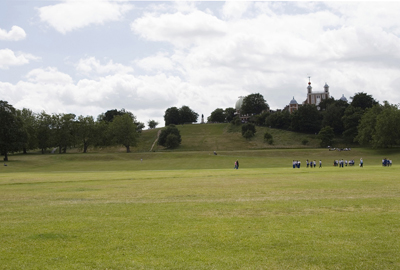
Leaving Wren’s churches momentarily, we turn this week to another of Wren’s designs, that of the Royal Observatory in Greenwich in London’s east.

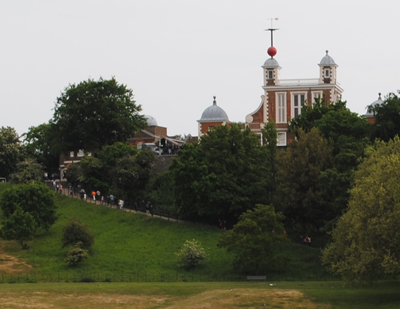
Commissioned in 1675 by King Charles II, the first part of the observatory – Flamsteed House, named for the first Astronomer Royal, John Flamsteed – was designed by Wren with, it is believed, the assistance of architect and scientist Robert Hooke.

Built using second-hand materials including stone brought from a Tudor fort at Tilbury, Flamsteed House was located on the former site of Greenwich Castle which had been previously used as a guest house and hunting lodge by Henry VIII. It is said to be the first purpose-built scientific research facility in the country.

The turreted building includes the Octagon Room from which Flamsteed made observations of events in the skies (although its position meant its use for this was somewhat limited), as well as living quarters for the astronomer. On top of the house is a red time ball which, since it was first used in 1833, has marked the time by falling at 1pm each day.

These days part of the National Maritime Museum and a UNESCO World Heritage Site since 1997, the site also hosts the Prime Meridian and is the place from where Greenwich Mean Time, since 1884 the basis for all world time, is calculated.

WHERE: Blackheath Avenue, Greenwich (nearest DLR station is Cutty Sark); WHEN: 10am to 5pm Monday to Sunday; COST: Entry is free; WEBSITE: www.nmm.ac.uk/places/royal-observatory/