LondonLife – The Old Bailey and the notorious case of Dr Crippen…

Image

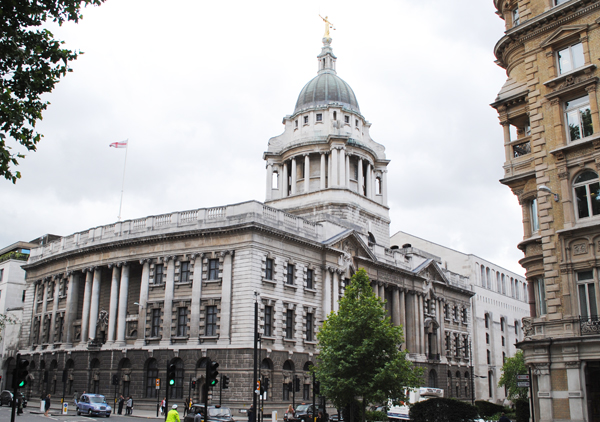
As well as being relevant to our recent focus on author Charles Dickens (as well as featuring in his works, some suggest he worked here as a court reporter), the Old Bailey (home of the Central Criminal Court) has been in the news recently for its role in the conviction of the  infamous murderer Dr Hawley Crippen. An American, Dr Crippen was tried and found guilty at the court of poisoning his first wife Cora and then of cutting her up (he was found to have hidden the body parts in the cellar of their home in Hilldrop Crescent, Holloway). He was hanged in 1910, having been arrested while fleeing on a ship to Canada with his mistress Ethel Le Neve. Now reportedly come plans to hold a posthumous retrial of the case in front of a judge at the Islington Museum. The event, which will be held later this year, is being organised by Archway-based human rights solicitor Greg Foxsmith and will see John Cooper, QC, defending Dr Crippen. The move comes follows an earlier investigation by US scientists who concluded from DNA evidence that the victim may have in fact been male. For a great read on the case of Dr Crippen – and the important role the new invention of the wireless telegraph played in his capture – have a look at Erik Larsen’s Thunderstruck.

Lost London: Gates Special – Cripplegate

Originally the northern gate of the Roman fort constructed in about 120 AD, Cripplegate was rebuilt several times during the medieval period before finally being demolished in 1760 as part of road widening measures.

The origins of the gate’s name are shrouded by the mists of time but it has been suggested that it was named for the beggars or cripples that once begged there or that it could come from an Anglo-Saxon word crepel which means a covered walkway.

The name may even be associated with an event which took place there in 1100 when, fearful of marauding Danes, Bishop Alwyn ordered the body of Edmund the Martyr, a sainted former Anglo-Saxon king, to be tranferred from its usual home in Bury St Edmunds to St Gregory’s Church near St Paul’s in London so that it could be kept safe. It was said that when the body passed through the gate, many of the cripples there were miraculously healed.

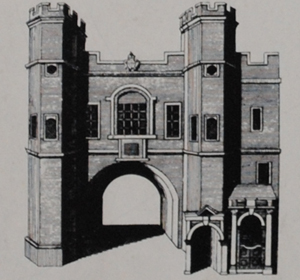
The gate (pictured here in an 18th century etching as it would have looked in 1663 in an image taken from a London Wall Walk plaque), which gave access in medieval times to what was then the village of Islington, was associated with the Brewer’s Company and was used for some time as a prison.

It was defensive works, known as a barbican, built on the northern side of the gate in the Middle Ages which are apparently responsible for the post World War II adoption of the name Barbican for that area of London which once stood outside the gate’s northern facade (the gates stood at what is now the intersection of Wood Street and St Alphage Garden).

The gate’s name now adorns the street known as Cripplegate as well as the name of the church St Giles Cripplegate, which originally stood outside the city walls. It is also the name of one of the 25 wards of the City of London. The original site of the gate is marked with a blue plaque.

Around London – Apsley House’s State Dining Room reopens; St Pancras Renaissance Hotel restored; Sir Basil Spence honored; and, your chance to lift Tower Bridge…

The State Dining Room at Apsley House, the Duke of Wellington’s former London residence, reopened to the public last weekend after a make-over. The revitalisation works included repairing and cleaning the ceiling and chandelier as well as the Portuguese silver centre piece, which was presented to Wellington by the Portuguese Council of Regency to commemorate his victories over Napoleon in the Peninsular War. The house, which bears the landmark address of Number One London, was given to the nation in 1947 by the 7th Duke of Wellington, whose family continues to occupy private rooms in the premises. See www.english-heritage.org.uk/daysout/properties/apsley-house/.

Seventy-six years after it last hosted a guest, the former Midland Grand Hotel at London’s St Pancras station reopened its doors quietly earlier this month following a 10 year, £150 million restoration project. The Grade I-listed Victorian Gothic building, designed by Sir George Gilbert Scott (he also designed the Albert Memorial), originally opened in 1873. It closed in 1935 but was saved from demolition in the 1960s after a campaign led by poet laureate Sir John Betjeman. Among the highlights of the recent project is the restoration of the Sir George Gilbert Scott suite to look like it did in the Victorian era. The hotel, rebranded the St Pancras Renaissance Hotel,  will be officially opened on 5th May, exactly 138 years after it first opened. See www.marriott.com/hotels/travel/lonpr-st-pancras-renaissance-london-hotel/.

Architect Sir Basil Spence (1907-1976) has been honored with an English Heritage blue plaque outside his former home and office in Islington. The architect, best known for his redesign of Coventry Cathedral after it was bombed by the Luftwaffe during World War II, lived and worked at 1 Canonbury Place from 1956 until the mid-1960s. He and his family then moved next door while he continued to use the property as his offices (it remained in use as architectural offices long after his death). Other commissions for which Sir Basil is known include Kensington and Chelsea Town Hall, the controversial Knightsbridge Barracks and the Swiss Cottage Library. Internationally, his works included the unusual ‘beehive’ extension to the Parliament Building in Wellington, New Zealand.

• Now On: Your chance to lift the two 1,100 tonne bascules at Tower Bridge. The City of London Corporation this week launched their annual competition to find a “guest bridge driver”. Enter by going to Tower Bridge’s website (www.towerbridge.co.uk) and answering a question about the bridge or the Square Mile. The winner will be drawn next month and as well as using the controls to lift and lower the bridge, will receive a commemorative certificate in the control cabin, a tour of the Tower Bridge Exhibition and the chance to visit the underground bascule chamber and fifth-level turrets, neither of which are normally open to the public. They’ll also be presented with a bottle of champagne.
LondonLife – A squirrel plays among the tombstones of Bunhill Fields

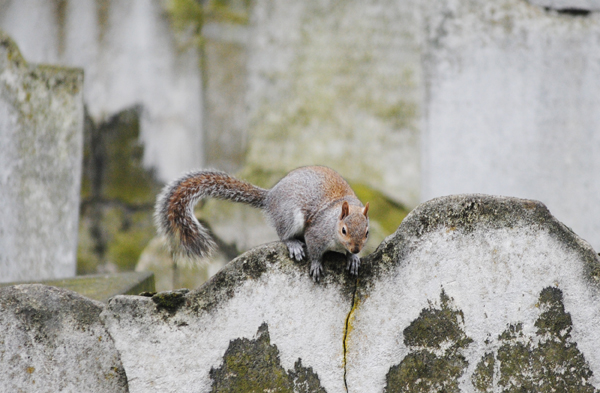
A squirrel spotted playing among the tombstones of Bunhill Fields Cemetery in the Borough of Islington. The Dissenters’ graveyard – burial place of the likes of writers John Bunyan and Daniel Defoe, artist and poet William Blake and Susanna Wesley, mother of Methodist founders John and Charles Wesley – was recently given a Grade I listing on the national Register of Parks and Gardens. For more information on the cemetery, see our previous post here.