10 of London’s greatest Victorian projects – 3. The Palm House, Kew Gardens…

We head back before the creation of the grand buildings of Albertopolis for this week’s entry to the construction of the Palm House at Kew Gardens – widely considered the world’s most important surviving Victorian-era glass and iron structure.

Palm-House,-KewDesigned by the great architect Decimus Burton (his other works include Wellington Arch), the now Grade I-listed Palm House was built under the supervision of leading Irish glasshouse designer Richard Turner between 1844 and 1848 as a home for Kew’s collection of exotic palms. Turner borrowed from the ship-building industry to build the structure, which contains 16,000 panes of glass, with the design essentially that of an upturned ship’s hull.

Due to the fact that the palms needed a warm environment in which to live, coal-fed boilers were located in a basement below the Palm House which heated water pipes running throughout the building (the smoke from the boilers was diverted to the Italianate Campanile located a short distance away which acted as a smoke stack).

The Palm House (the earliest known picture is shown above) has been restored several times – first in the 1950s when the boilers were converted to run on oil and moved to a site behind the Campanile, and again in the 1980s, a complete overhaul which involved almost completely emptying the structure of its resident palms, dismantling and rebuilding the structure itself. It was officially reopened by Queen Elizabeth, the Queen Mother, in 1990.

Among the many exotic plants inside the glasshouse – which rises to a height of 19 metres – highlights include the rare triangle palm (Dypsis decaryi) from Madagascar, a Mexican yam (Dioscorea macrostachya), used apparently in the development of the contraceptive pill, a double coconut palm (Lodoicea maldivica) which bears the largest seed in the world, and a cycad (Encephalartos altensteinii) which has been described as the “world’s oldest pot plant” and was brought to Kew from South Africa in 1775.

WHERE: The Palm House, Kew Gardens (nearest Tube station is Kew Gardens); WHEN: 9.30am to 3.45pm except Tuesday when it closes at 2pm (closing times change with the seasons); COST: £14.50 adults/£12.50 concessions/children 16 and under free; WEBSITE: www.kew.org.

PICTURE: Royal Botanic Gardens Kew

Around London – Christmas at the Tower and Kew Gardens; Old Flo on display; African Diaspora on show at MoL Docklands; and, Mariko Mori at the Royal Academy…

Victorian-Christmas The Tower of London is going Victorian this Christmas with visitors able to experience some of what the Yuletide celebrations in the foreboding, much storied buildings were like in the mid-to-late 1800s. Visitors will be shown how many of the Christmas customs we now participate in each year – like writing cards, pulling crackers and the setting up of family Christmas trees – owe their origins to the Victorian era. The Yeoman Warders will be receiving a Victorian makeover and writer of the age – Charles Dickens – will be reciting some of his works before joining in a “raucous” lunch party with some of his fellow writers, artists and benefactors. It’s even rumoured that Queen Victoria and Prince Albert themselves may make an appearance (take that as a given). Bah! Humbug! A Very Merry Victorian Christmas runs from 27th until 31st December. The festivities will all be included in the usual admission price. For more, see www.hrp.org.uk. PICTURE: Nick Wilkinson/NewsTeam.

Kew Gardens are celebrating Christmas with a host of events including a “Twelve trees of Christmas” family trail. The trail, a map of which can be picked up as you enter, includes facts about trees along the route. Volunteer guides are also leading free tours of seasonal highlights and the Kew Christmas tree can be seen at Victoria Gate. Other festive treats at Kew include the chance to see Father Christmas in his grotto (until Sunday only) and a vintage carousel on the Kew Palace Lawn. Many of the Christmas-related events end on 6th January. See www.kew.org for more.

A display focusing on the history of Henry Moore’s sculpture, Draped Seated Woman (better known as Old Flo), has opened at the Museum of London Docklands. Henry Moore and the East End provides a glimpse into 1950s East London and looks at why public art was considered important at the time. It features some of the maquettes (scale models) Moore used in creating the piece. The exhibition was opened following a decision by the Mayor of Tower Hamlets, Lutfur Rahman, to sell Old Flo (now at the Yorkshire Sculpture Park) rather than display the artwork in a public space. The move is being contested by the Museum of London Docklands who have offered to put the work on public display. An online exhibition can be seen at www.museumoflondon.org.uk/oldflo and a ‘pop-up exhibition’ on Old Flo will be launched in January. The museum is also encouraging people to tweet their views about the selling of the sculpture under the hashtag #saveoldflo.

On Now: Take Another Look. Still at the Museum of London Docklands, this exhibition focuses on the visual representation of people from the African Diaspora who were living and working in Britain in the late 18th and early 19th century. The display of 17 exhibits in the London, Sugar and Slavery gallery features prints by artists including Thomas Rowlandson and George Cruikshank as well as newspaper cuttings, mostly dating from 1780-1833, which show black Britons in perhaps what were unexpected roles – soldiers, musicians and sportsmen – during what was the period in which the abolition of slavery occurred. There are a series of events planned around the exhibition which runs until 4th August. Entry is free. For more see www.museumoflondon.org.uk/Docklands/.

On Now: Mariko Mori: Rebirth. The first major museum exhibition of the New York-based Japanese artist Mariko Mori in London since 1998 has opened at the Royal Academy of Arts in Piccadilly. The exhibition features some of the artist’s most acclaimed works from the last 11 years, many of which have never before been seen in the UK, as well as works created just for the exhibition. Highlights include Tom Na H-iu, a five metre high glass monolith lit by hundreds of LED lights and connected back to the Institute for Cosmic Ray Research at the University of Tokyo; Transcircle, described as a “modern day Stonehenge”; and, Flatstone, an installation of “22 ceramic stones assembled to recreate an ancient shrine”. Runs until 17th February. Admission charge applies. For more, see www.royalacademy.org.uk.

Famous Londoners – Sir Peter Lely…

One of the most famous painters of his age, Dutchman Sir Peter Lely – currently the subject of an exhibition at London’s Courtauld Gallery – rose to become the foremost portrait painter at the English Court during the latter half of the 17th century.

Born to Dutch parents on 14th September, 1618, in Westphalia (now part of Germany) where his father was serving as an infantry captain, Peter – originally named Pieter van der Faes – studied art as an apprentice in Haarlem in what is now The Netherlands. While there he is believed to have changed his name to Lely based on a heraldic lily which appeared on the gable of the house where his father was born in The Hague.

Lely appeared in London in the early 1640s and, while he initially devoted himself to the sort of narrative-style paintings inspired by classical mythology, the Bible and literature he had been working on in Haarlem but having found no great success there, soon turned his hand to portraiture.

The death of court portraitist Anthony van Dyck in 1641 had left a vacuum he stepped into the gap, soon becoming the most in-demand portrait painter at the Royal Court, his sitters including none other than King Charles I himself.

However, Lely, who was made a freeman of the Painter-Stainers Company in London in 1647, managed to straddle the political divide and after the beheading of King Charles I and the end of the English Civil War in 1651, was able to continue painting portraits of the most powerful people in the land including Oliver Cromwell – whom he painted “warts and all” as per the Lord Protector’s request – and his Cromwell’s brother Richard.

Already renowned as the best artist in the country, following the Restoration in 1660, Lely became Principal Painter of King Charles II, placed on an annual stipend as van Dyck had been before him during the reign of King Charles I.

Lely’s workshop was large and its output prolific, with his students and employees – who at one stage apparently included scientist and architect Robert Hooke – often completing his paintings after he sketched out some details, only painting the sitter’s face in any great detail.

Among his most famous works are a series of 10 portraits known as the Windsor Beauties (currently at Hampton Court Palace), a series of portraits of senior naval officers who served in the Second Anglo-Dutch War, known as the Flagmen of Lowestoft (most of the works at are the National Maritime Museum in Greenwich) and Susannah and the Elders (currently at Burghley House in Cambridgeshire) as well as some of the paintings in the current Courtauld exhibition including Nymphs by a Fountain (usually found at the Dulwich Picture Gallery) and Boy as a Shepherd (also the Dulwich Picture Gallery).

Lely was also known as an avid collector of art and is credited as being the first artist in England to do so in any serious manner – among his purchases were works which formerly formed part of King Charles I’s collection. At the time of his death, he is said to have owned more than 500 paintings, although more than half of these were works of his or his studio.

Sir Peter, who never married but had two children who survived him with a common-law wife Ursula, lived at a house in the north-east corner of Covent Garden from about 1650 until his death in 1680 (some sources have him knighted in this year, others in 1679) but also had a house at Kew and owned property outside of London including in Lincolnshire and The Hague.

He was apparently working at his easel in the studio of his Covent Garden house when he died on 30th November, 1680. He was buried at St Paul’s Church, Covent Garden. The monument to him, the work of Grinling Gibbons, was destroyed by fire in 1795.

Peter Lely: A Lyrical Vision – which focuses on some of his early non-portrait works – runs at The Courtauld Gallery until 13th January. For more on the exhibition, visit www.courtauld.ac.uk/gallery/exhibitions/2012/peter-lely/index.shtml. Running alongside the exhibition is a display of some of the drawings from Sir Peter’s own collection, Peter Lely: The Draughtsman and His Collection.

Treasures of London – The Royal Kitchens, Kew…

Given this week’s release of English Heritage’s The London List 2011 – which lists all properties given a new or upgraded heritage listing last year, we thought it was only appropriate to look at one of the properties listed, in this case the Royal Kitchens in Kew Gardens.

Upgraded to a Grade I listing in 2011, the kitchens were opened to the public for the first time in May this year following a £1 million restoration. The origins of the kitchens go back to the 1730s when they were built to the designs of William Kent to serve the White House, the grand mansion of Frederick, Prince of Wales (eldest son and heir of King George II).

While the White House was demolished in 1802, the Georgian kitchens – built in a separate building to mitigate the risk of fire – were kept to serve the nearby premises of Kew Palace (formerly known as the “Dutch House”, it had been originally built in 1631 for a Flemish merchant).

But after the death of Queen Charlotte (wife of King George III) in 1818, members of the Royal family only stayed occasionally and so the kitchen fell into disuse. While the upper floors were given over to accommodation, the lower floor remained untouched, allowing it to survive in a considerable degree of intactness.

The kitchens centre on the double storey ‘Great Kitchen’ featuring three charcoal stoves as well as a rare cooking range with “smoke jack” and fan. Other rooms include a scullery, a bakery, larders and stores for silver and spices while among the surviving furnishings is a preparation table or dresser, cupboards, shelves and baking ovens. Upstairs, the office of the clerk who oversaw the feeding of the Royal Household has been restored.

Historic Royal Palaces, who look after the kitchens, have installed a new permanent exhibition at the site which focuses life on the 6th February, 1789, the date when King George III, having suffered his first bout of ‘madness’ (believed to be porphyria), was given back his knife and fork. William Wybrow was the Master Cook at this time and William Gorton the Clerk of the Kitchen.

WHERE: The Royal Kitchens, Kew Gardens, Kew (nearest Tube Station is Kew Gardens); WHEN: 11am to 5pm daily until 30th September, then Thursday to Sunday until 28th October, then daily again until 4th November; COST: Kew Gardens tickets must be purchased – £16 adults/£14 concessions/children under 16 free – and then tickets to Kew Palace – £6 adults/£4.50 concessions/children under 16 free (or free with annual Historic Royal Palaces membership); WEBSITE: www.hrp.org.uk/kewpalace/stories/palacehighlights/royalkewkitchens.

PICTURE: Forster/HRP

For more on Kew Palace, check out Kew Palace: The Official Illustrated History.

Olympics Special – The Olympic Torch Relay, part II…

We take a break from our regular series this week to bring you some images from the second half of the Olympic Torch Relay as it made it’s way around London toward tonight’s Opening Ceremony…


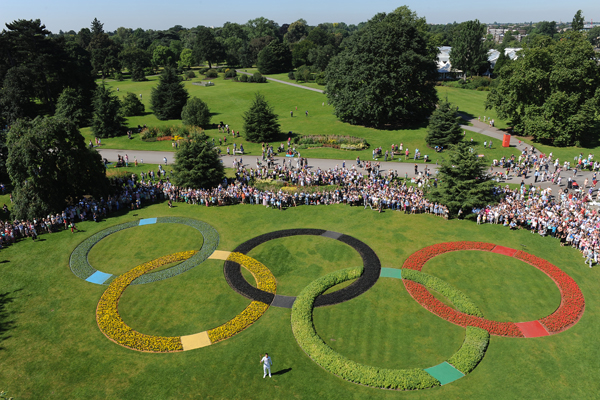
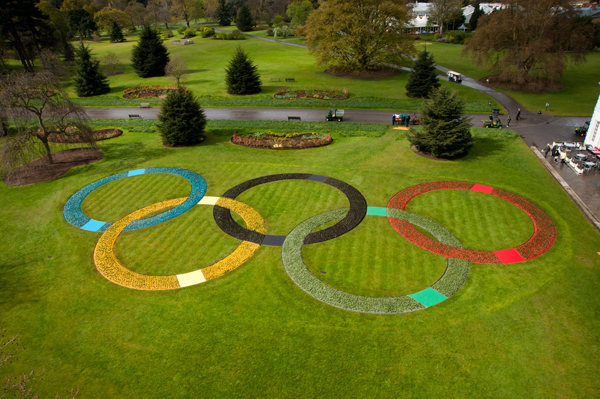
Day 67 (24th July): Tennis player Oliver Golding holds the Olympic Flame in between the Olympic Rings at Kew Gardens, London.

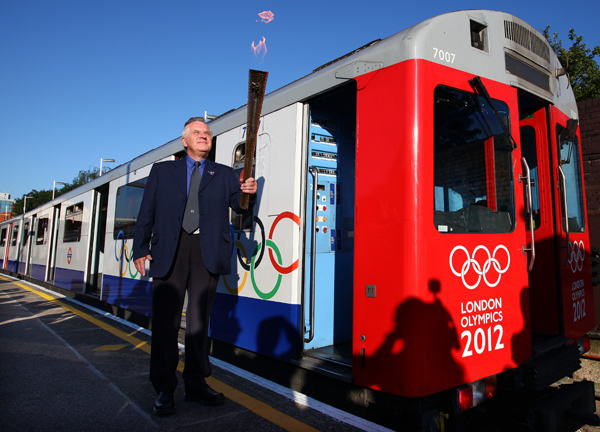
London Underground employee John Light carries the Olympic Flame onto an underground train at Wimbledon Station.

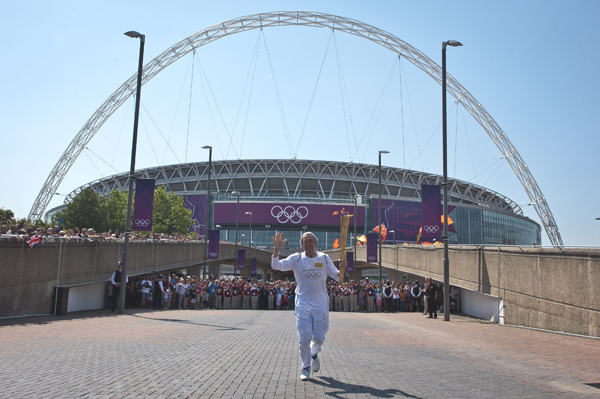
Day 68 (25th July): Former World Cup winning footballer Gordon Banks carries the Olympic Flame down Wembley Way, at Wembley Stadium.


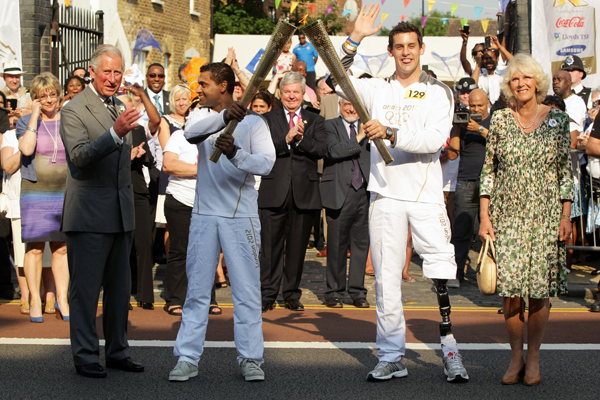
Prince Charles, Duke of Cornwall, and Camilla, Duchess of Cornwall, pose with  young entrepreneur Jay Kamiraz and Paralympian Scott Moorhouse as they kiss together Olympic torches in Tottenham.

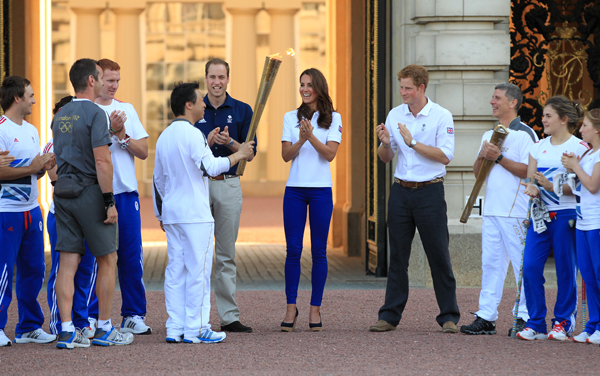
Day 69 (26th July): Disaster mapping charity volunteer Wai-Ming Lee passes the Olympic Flame to mountain rescue team leader John Hulse in front of Buckingham Palace in the presence of Prince William, Kate, Duchess of Cambridge and Prince Harry.

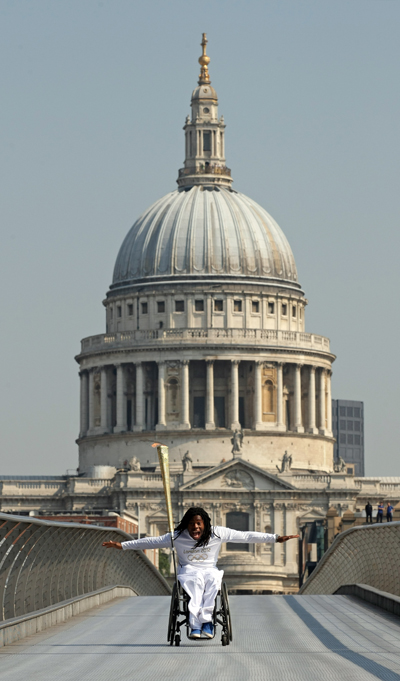
Wheelchair basketballer Ade Adepitan carries the Olympic Flame on Millennium Bridge.

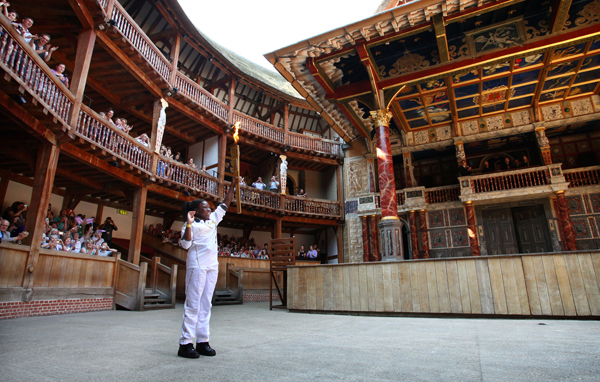
Student Ifeyinwa Egesi holds the Olympic Flame inside the Globe Theatre.

For more on the Torch Relay, see www.london2012.com/torch-relay/

ALL PICTURES: LOCOG.

LondonLife – Olympic flower power at Kew Gardens…

There’s less than a month to go to the Opening Ceremony of the Olympic Games so we thought it only appropriate to take a look at Kew Gardens’ floral Olympic Rings. Located next to The Orangery, the rings are 50 metres long and made of 20,000 plants including Viola ‘Light Blue’, Viola ‘Clear Yellow’, Viola ‘Black Delight’, apple mint (Mentha suaveolens) and Viola ‘Red Blotch’ plants. Able to be seen from planes on the Heathrow flight path, they were unveiled in April and will be at the gardens until September. For more information on visiting Kew Gardens, see www.kew.org. PICTURE: Courtesy Kew Gardens