This Week in London – John Singer Sargent’s American portraits; Story Explorers at the British Library; and, narrative, humour and nostalgia at the Heath Robinson Museum…

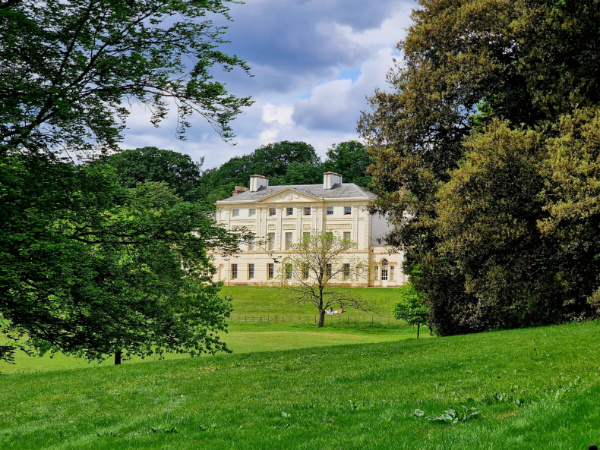
Kenwood House. PICTURE: Krisztina Anna Berecz/Unsplash

An exhibition marking the centenary of the death of painter John Singer Sargent
(1856-1925)
opens at Kenwood House tomorrow. Heiress: Sargent’s American Portraits focuses on a series of portraits of women who married into British and European aristocracy and who were once dismissively referred to as the “Dollar Princesses’. They include a war-time nurse, a helicopter pilot and the first sitting female MP. Among the works on show are Kenwood House’s portrait of Daisy Leiter, a Chicago heiress who married the Earl of Suffolk and Berkshire; a portrait of Edith, Lady Playfair, from the Museum of Fine Art, Boston; and a portrait of Mrs Joseph Chamberlain from the National Gallery of Art in Washington, DC. Runs until 5th October. Admission charge applies. For more, see https://www.english-heritage.org.uk/visit/whats-on/kenwood-heiress-exhibition-16-may–5-oct-2025/.

A new experiential space to help children and their families journey through the British Library’s collection opens tomorrow. Story Explorers takes children on a journey, directed by Daisy the library cat, through four distinct environments – a library, the far reaches of outer space, a jungle and the bottom of the ocean floor – and features sound recordings, artworks, prints and books from across the world. Among the objects they’ll encounter are Victorian record from the Library’s Sound Archive featuring animal sounds, one of the first photographs taken of the Moon, an Arabic astrological and astronomical handbook from the Middle Ages and one of the earliest printed Japanese works that captures the anatomy of a whale. The free space is open for children aged two to nine and their families until 18th January. Booking is essential. For more, see https://events.bl.uk/exhibitions/story-explorers.

Narrative, humour and nostalgia are explored into a new display at the Heath Robinson Museum in Pinner. Ways of seeing; Narrative-Humour-Nostalgia, which opens on Saturday, features painting, sculpture, video, soundscapes, and augmented reality to show how artists continue to use storytelling, satire, and memory to “provoke thought, entertain, and challenge perceptions”. Artists represented include Glenn Baxter, Sir Peter Blake, Chila Burman, Peter Coyte, Adam Dant, David van Eyssen, Nicky Hirst, Patrick Hughes, John Humphreys, Harland Miller, Heath Robinson, Richard Wilson, and Ronnie Wood. Runs until 19th July. Admission charge applies. For more, see https://www.heathrobinsonmuseum.org/whats-on/ways-of-seeing-narrative-humour-nostalgia/

Send all items for inclusion to exploringlondon@gmail.com
This Week in London – Portraits from ‘The Face’; jazz and classical music at the London Transport Museum; and, Ralph Steadman at the Heath Robinson Museum…

Iconic portraits which featured in the trail-blazing magazine, The Face, have gone on show from today at the National Portrait Gallery off Trafalgar Square. The Face Magazine: Culture Shift features more than 200 prints by more than 80 photographers including Sheila Rock, Stéphane Sednaoui, David LaChappelle, Corinne Day, Elaine Constantine, Juergen Teller and Sølve Sundsbø. The display explores how the cult magazine, which ran from 1980 to 2004 before being relaunched in 2019, impacted culture in the Eighties, Nineties and Noughties and in particular how it shaped the tastes of Britain’s youth. Runs until 18th May. Admission charges apply. For more, see www.npg.org.uk.

Visitors to the London Transport Museum are being treated to live performances from some of London’s most promising classical and jazz musicians under a new initiative which kicked off earlier this month. The young musicians, from the Guildhall School of Music and Drama, Royal Academy of Music, Royal College of Music, or Trinity Laban, are performing in a programme designed to equip them with real-world performance experience. The music is being performed over various dates until 24th October. For more details, see www.ltmuseum.co.uk/whats-on/music-museum.

A new exhibition celebrating the work of illustrator Ralph Steadman has opened at the Heath Robinson Museum in Pinner. Ralph Steadman: INKling spans the 70 years of Steadman’s career and covers his literary illustrations, including Steadman’s interpretations of Alice in WonderlandAnimal Farm, and Treasure Island, his illustrations for children’s books such as From Fly Away Peter (1963) and The Ralphabet (2023), and the “Gonzo art” he created in collaboration with Hunter S Thompson. Runs until 10th May. Admission charges apply. For more, see www.heathrobinsonmuseum.org/#whatson.

Send all items to exploringlondon@gmail.com.

This Week in London – Natural History Museum scientists name new species; Ketna Patel at the Heath Robinson Museum; and, David Hoffman’s images of the East End…

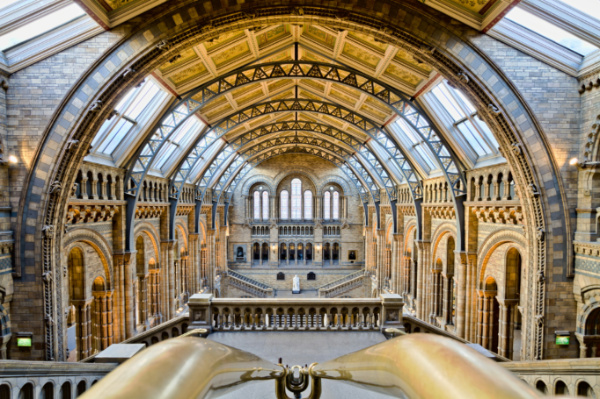
Interior of the Natural History Museum in South Kensington. PICTURE: Michael D Beckwith/Unsplash

A snake named after actor Leonardo DiCaprio, fossilised dung named after the author of Winnie the Pooh and a piranha named after Sauron, the evil Lord of the Rings figure, are among 190 new species named by London’s Natural History Museum scientists in 2024. The Anguiculus dicaprioi, or DiCaprio’s Himalayan snake, was named after DiCaprio while Alococopros milnei is a fossilised dung named after AA Milne in recognition of Winnie the Pooh (get it?) and a vegetarian piranha, or pacu, was named Myloplus sauron due to its resemblance to JRR Tolkien’s Eye of Sauron. Other newly named species included a new dinosaur from the Isle of Wight, now known as Comptonatus chasei, which was named for fossil hunter, Nick Chase, and a new species of pterosaur which was named Ceoptera evansae. For more on the museum, see www.nhm.ac.uk.

The work of British-Indian artist Ketna Patel is the subject of a new exhibition at the Heath Robinson Museum. REMIXOLOGY: The Art of Cultural Storytelling by Ketna Patel invites audiences to
“reflect on how identity is shaped – by ourselves and by society” and celebrates what is described as her “signature approach” to her work which involves remixing diverse cultural influences into something new. The display can be seen at the Pinner museum until 8th February. Museum admission charge applies. For more, see www.heathrobinsonmuseum.org.

Now on: Endurance & Joy in the East End: The photography of David Hoffman. This exhibition, hosted by the Museum of the Home, features the work of one of the leading “photographers of protest” in the UK and spans a 10 year period starting in 1973 when Hoffman lived in a squat in Fieldgate Mansions and documented issues seen in Whitechapel including homelessness, racism and the rise of protest. Running until 30th March, it can be seen in the Undercroft at 136 Kingsland Road. For more, see www.museumofthehome.org.uk/whats-on/exhibitions-and-installations/endurance-and-joy-david-hoffman/

Send all items for inclusion to exploringlondon@gmail.com.

This Week in London – ‘Silk Roads’ at the British Museum; ‘War and the Mind’; and, the art of Sidney H Sime at the Heath Robinson Museum…

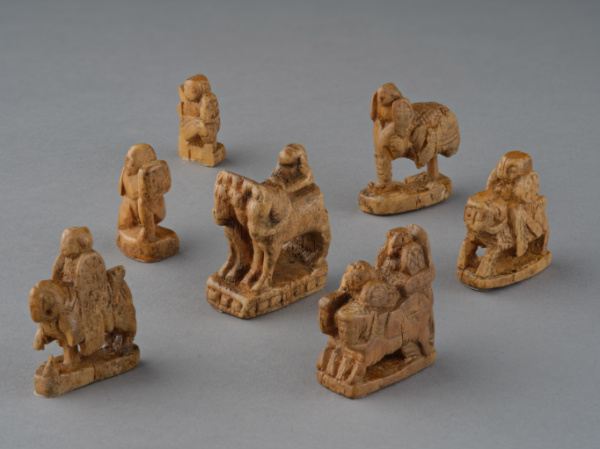
Ivory chess pieces © ACDF of Uzbekistan, Samarkand State Museum Reserve. PICTURE: Andrey Arakelyan

The popular concept of the ‘Silk Road’ as a simple history of trade between East and West is challenged in a new exhibition which opens at the British Museum today. Silk Roads, which spans the period from about 500 AD to 1,000 AD, explores the overlapping networks which linked communities ranging from the UK to Japan and Scandinavia to Madagascar through a display organised into five geographic zones. The exhibition features more than 300 objects which include the oldest group of chess pieces ever found (pictured), a six metre long wall painting from the ‘Hall of the Ambassadors’ in what is now Samarkand in Uzbekistan, a glass drinking horn from Italy dating from between 550 and 600 AD, and, a map of the world from al-Idrisi’s Nuzhat al-mushtaq fi ikh0raq al-afaq (Pleasure of He who Longs to Cross the Horizons) from a 1533 manuscript which drew on a 1154 original. Visitors will also encounter the stories of people whose stories intertwined with the Silk Roads including Willibald, a balsam smuggler from England, and a legendary Chinese princess her shared the secrets of silk farming with her new kingdom. The display in the Sainsbury Exhibitions Gallery can be seen until 23rd February. Admission charge applies. For more, see britishmuseum.org/silkroads.

The psychological dimensions of war are explored in a major new temporary exhibition at the Imperial War Museum in Lambeth. War and the Mind features more 150 objects spanning the period from World War I through to the War in Afghanistan. Among them are a letter from Winnie the Pooh author AA Milne which speaks of how dedicated pacifists have changed their mind in the face of direct threat, amphetamine tablets issued to Allied soldiers to help them overcome the psychological effects of fatigue, a newly-acquired mitten belonging to the baby son of an Avro Lancaster bomber rear gunner who carried it for comfort while carrying out operations during the World War II, and a Protect and Survive booklet issued in the UK in 1980 as part of the government’s response to the fear of nuclear weapons during the Cold War. The exhibition, which opens on Friday, is free to visit. For more, see iwm.org.uk/events/war-and-the-mind.

The artwork of painter, illustrator and caricaturist Sidney Sime is the subject of a new exhibition at the Heath Robinson Museum in Pinner. Sime, who was born in Manchester in 1865, trained at the Liverpool school of art before heading to London where he worked for magazines including Pick-Me-Up, drawing theatrical caricatures and other humorous drawings. He later struck up a friendship with Lord Dunsany and illustrated his first book, The Gods of Pegana, in a collaboration which continued until the 1930s. He also formed friendships with Lord Howard de Walden and composer Joseph Holbrooke, making set and costume designs for their theatrical and operatic productions. After World War I, Sime made a number of large oil paintings, many of which are shown in the display. The Art of Sidney H Sime, Master of Fantasy, which opens on Saturday, can be seen until 5th January. For more, see www.heathrobinsonmuseum.org/whats-on/sidney-sime-artist-and-philosopher/.

Send all items for inclusion to exploringlondon@gmail.com.

This Week in London – Celebrating Tower Bridge’s 130th; Dame Peggy Ashcroft and Iris Murdoch honoured; modern art in Ukraine; and, Michael Rosen’ illustrators…

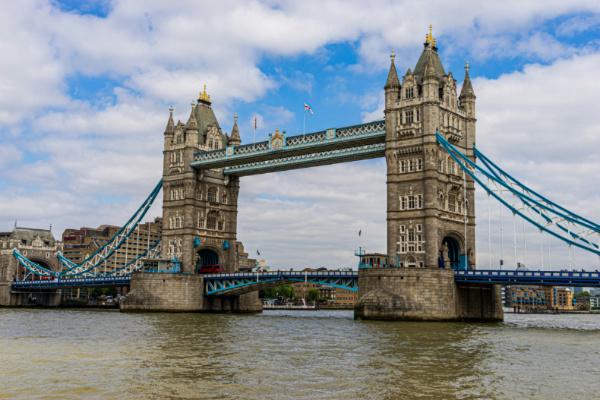
PICTURE: Sung Shin/Unsplash

Tower Bridge marks its 130th birthday this year and to mark the event, the London Metropolitan Archives are hosting a free exhibition charting its history at the City of London’s Heritage Gallery. Designed by Horace Jones, the bridge opened on 30th June, 1894, and the display reflects on the splendour of that royal event as well as examining how and why the bridge was built, the engineering involved and how the bridge played a role in defending London during World War I. The exhibition runs until 19th September at the gallery, located in the Guildhall Art Gallery. Booking tickets is recommended. For more, see https://www.cityoflondon.gov.uk/events/tower-bridge-at-the-heritage-gallery.

Actor Dame Peggy Ashcroft and Dublin-born novelist Iris Murdoch have been honoured with English Heritage Blue Plaques. A leading figure in 20th century theatre, Dame Peggy has been remembered with a plaque on her childhood home in South Croydon. It was in what was then a “leafy market town” that at the age of 13 Peggy first dreamt of performing on the stage while standing outside the local grocers on George Street and to which she returned in 1962 to open a theatre named after her. The plaque honouring Murdoch, meanwhile, has been placed on 29 Cornwall Gardens, part of a Italianate stucco-fronted mid-Victorian terrace in Kensington where she occupied a top floor flat. Murdoch lived in London for more than 25 years and during that time would spend three days a week in the flat. For more, see www.english-heritage.org.uk/visit/blue-plaques/

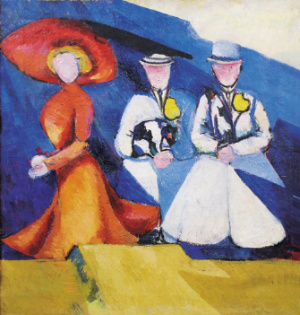
Alexandra Exter, ‘Three Female Figures’, 1909-10Oil on canvas, 63 x 60 cmNational Art Museum of Ukraine

The most comprehensive UK exhibition to date of modern art in Ukraine opens at the Royal Academy on Saturday. In the Eye of the Storm: Modernism in Ukraine, 1900–1930s, features some 65 works, many on loan from the National Art Museum of Ukraine and the Museum of Theatre, Music and Cinema of Ukraine. Artists represented in the display, which is divided into six sections, include such renowned names as Alexander Archipenko, Sonia Delaunay, Alexandra Exter and Kazymyr Malevych as well as lesser-known artists such as Mykhailo Boichuk, Oleksandr Bohomazov and Vasyl Yermilov. Runs in the The Gabrielle Jungels-Winkler Galleries until 13th October. Admission charge applies. For more, see www.royalacademy.org.uk.

The work of artists who have illustrated Michael Rosen’s many books for children are the subject of a new exhibition at the Heath Robinson Museum. Michael Rosen: The Illustrators explores Rosen’s books and the many artists who illustrated them over his 50 year career including the likes of Quentin Blake, Helen Oxenbury, Chris Riddell and Korky Paul. Among the works on show are original drawings for titles including We’re Going on a Bear HuntMichael Rosen’s Sad Book and Michael Rosen’s Book of Nonsense! Runs until 22nd September. Admission charge applies. For more, see https://www.heathrobinsonmuseum.org/.

Send all items for inclusion to exploringlondon@gmail.com.

This Week in London – New section of London’s Wall revealed; ‘Summer on the Square’; and, Heath Robinson’s fairy tale illustrations…

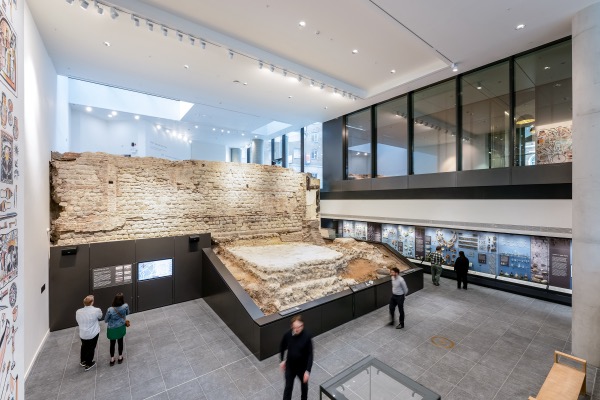
PICTURES: Courtesy of Urbanest.

A large section of London’s Roman wall had gone on show to the public thanks to an innovative collaboration between Urbanest, the City of London Corporation, Historic England, and the Museum of London. A new free display – The City Wall at Vine Street – has been created by Urbanest as part of a redevelopment of the site. At its heart is a segment of London’s Roman wall, including the foundations of a bastion or tower. Alongside the wall is a permanent display of artefacts from the Museum of London ranging from a tile marked with a cat’s paw print to Roman coins and ceramics. Completed between AD 190 and 230, the Roman wall was between two and three metres thick and faced with blocks of Kentish ragstone. This section of the wall was first rediscovered in 1905 when a new building – Roman Wall House – was constructed on the site and the inner face of the wall was exposed and preserved in the basement. In 1979, the outer face of the wall and the bastian foundations were also uncovered – but the wall was still left largely forgotten in the building’s basement. The site was acquired by Urbanest in 2016 and during the subsequent construction of Urbanest City in 2018, the wall was protected by a timber enclosure. Tickets to The City Wall at Vine Street, located at 12 Jewry Street in the City of London, can be booked for free. For more head to https://citywallvinestreet.org.

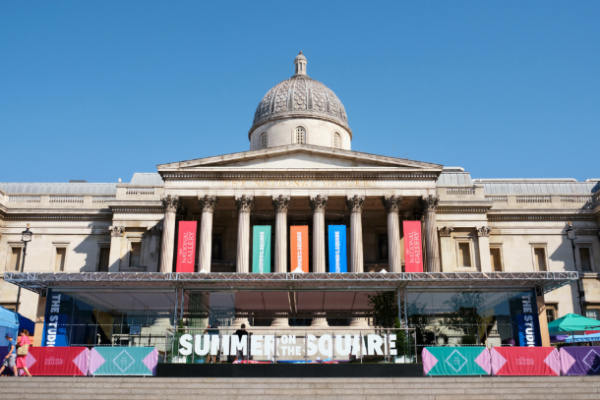
Summer on the Square PICTURE: © James Ross, courtesy The National Gallery, London

‘Summer on the Square’ has returned to The National Gallery’s North Terrace with a series of workshops aimed at inspiring the local community and visitors to engage with themes around the gallery’s collection. The programme sees the gallery work with a variety of artists and creative practitioners in a shared focus of creating child-led art, design and play activities. The workshops – which range from a session on discovering what you can do with bamboo to discovering movement and shapes in the National Gallery paintings – are free, drop-in and open to all ages and abilities. Summer on the Square, which runs until 28th August, is supported by and part of Westminster City Council’s Inside Out Programme. For the full programme, see www.nationalgallery.org.uk/whats-on/summer-on-the-square.

On Now: Happily Ever After? Illustrating Andersen & Perrault. This exhibition at the Heath Robinson Museum in Pinner focuses on works Heath Robinson created for the fairy tale collections of Hans Christian Andersen, which he illustrated three times, and Charles Perrault’s Old Time Stories published in 1921. The display, which also features works on the same subjects by Michael Foreman, shows how Heath Robinson was able to explore subjects and characters which ranged from sleeping princesses to adventurers and monsters in some of his lesser known works. Runs until 17th September. Admission charge applies. For more, see www.heathrobinsonmuseum.org.

This Week in London – ‘After Impressionism’; a new woodland for Richmond Park; and, a new exhibition at the Heath Robinson…

Paintings and sculptures by artists including Cézanne, Van Gogh, Rodin, Picasso, Matisse, Klimt, Kandinsky and Mondrian opens at The National Gallery on Saturday. After Impressionism: Inventing Modern Art features more than 100 paintings and sculptures from museums and private collections around the world spanning the period between 1886 and 1914. Highlights include André Derain’s La Danse, Edgar Degas’s Dancers in the Foyer, Paul Cézanne’s Grandes Baigneuses, Edvard Munch’s The Death Bed, Paul Gauguin’s Vision of the Sermon, Camille Claudel’s Imploration / l’Implorante, and Lovis Corinth’s Nana, Female Nude. Admission charge applies. Runs until 13th August. For more, see www.nationalgallery.org.uk/exhibitions/after-impressionism-inventing-modern-art.

Sir David Attenborough has planted an English oak tree to officially open the Platinum Jubilee Woodland, a new woodland in Richmond Park. The woodland has been created as part of The Queen’s Green Canopy initiative to celebrate and honour the late Queen Elizabeth II’s lifetime of service. Some 70 young trees have been planted in the woodland, including oak, Dutch elm-disease-resistant elm, small-leaved lime, and sweet chestnut trees, planted around a focal point which will later incorporate a seating area. Sir David’s tree is one of the last to be planted as part of The Queen’s Green Canopy initiative which concludes on 31st March. The project invited people from across the nation to plant trees in honour of Queen Elizabeth II to mark the Platinum Jubilee and benefit future generations. For more on the park, see www.royalparks.org.uk/parks/richmond-park.

Illustrative works by William Heath Robinson, Charles Robinson and Thomas Health Robinson, many of which have not be exhibited before, are on show in a new exhibition at the Heath Robinson Museum in Pinner. The works, which come from the collection of Martin and Joanne Verden, include original drawings for Railway Ribaldry and William Heath Robinson’s How to… series of books. Admission charge applies. Runs until 21st May. For more, see www.heathrobinsonmuseum.org.

Send all items for inclusion to exploringlondon@gmail.com.

This Week in London – The ‘Concert of Antient Music’ recalled; National Portrait Gallery announces reopening date; and, Heath Robinson’s Shakespeare illustrations…

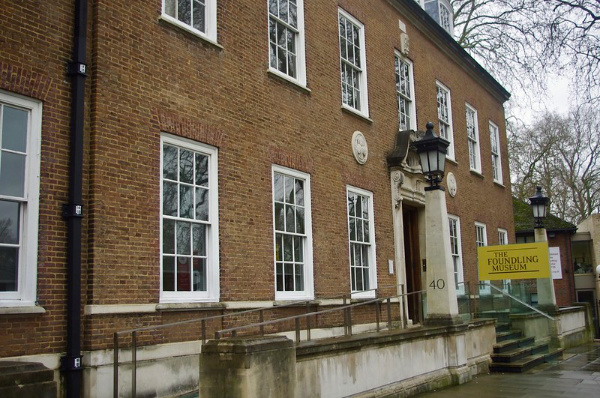
The Foundling Museum. PICTURE: dvdbramhall/Flickr (licensed under CC-BY-NC-ND 2.0)

The 18th and 19th century concert series – ‘Concert of Antient Music’ – is explored in a new display at the Foundling Museum in Bloomsbury. Located in the Handel Gallery, Music for the King: The Concert of Antient Music looks at the story behind the establishment of this concert series which were held at various locations in London annually from 1776 to 1848 and which only featured works composed at least 20 years prior. The concerts attracted patronage from the likes of King George III and members of the nobility – in fact, the King was such an admirer of Handel’s music that he instructed an extra concert – a performance of Handel’s Messiah – be given annually for the benefit of the Royal Society of Musicians. The display includes portraits of composers including Handel, Geminiani and Corelli as well as those of singers and other performers along with the index of performances and payment records for performers, letters, tickets and programmes of the concerts. Admission charge applies. Runs until 8th October. For more, see https://foundlingmuseum.org.uk/event/music-for-the-king-the-concert-of-antient-music/.

The National Portrait Gallery has announced it will reopen its doors for the first time since 2020 on 22nd June this year. The reopening will follow a major redevelopment project, ‘Inspiring People’, which includes a comprehensive redisplay of the gallery’s collection, spanning from the Tudor period to today, as well as the restoration of Grade I-listed buildings and historic features. The new design – the work of Jamie Fobert Architects working in partnership with Purcell – will incorporate the Blavatnik Wing, the entire first floor encompassing nine galleries, which will explore society and culture in the 19th and early 20th centuries. It will also see the return of the gallery’s East Wing to public use as the Weston Wing, restore original gallery spaces and create new retail and catering facilities.

On Now: Heath Robinson’s Shakespeare Illustrations. This exhibition at the Heath Robinson Museum in Pinner features Robinson’s illustrations from works including Lamb’s Tales from Shakespeare (1902), Twelfth Night (1908) and A Midsummer Night’s Dream (1914) as well as some of the illustrations he created for a never published complete works of Shakespeare commissioned by the publishing house of Jonathan Cape. The exhibition can be seen until 19th March. Admission charge applies. For more, see www.heathrobinsonmuseum.org/whats-on/heath-robinsons-shakespeare-illustrations/.

Send items to exploringlondon@gmail.com
This Week in London – Open House Festival; Winslow Homer at The National Gallery; and, a celebration of wood engravings…

An image from the Open House Festival 2020 PICTURE: Phineas Harper/Courtesy Open House Festival
An image from the Open House Festival 2020 PICTURE: Sophie Cunningham/Courtesy Open House Festival

The Open House Festival, a two week-long celebration of buildings and neighbourhoods in London, kicks off today. Now in its 30th year, highlights from this year’s programme include the introduction of nine “headline neighbourhoods” – among them Aldgate, Somers Town, Battersea, and the Greenwich Peninsula, each of which will feature a specially-curated programme of free events. Buildings open for tour include the Bank of England, the recently refurbished Leathersellers’ Hall, and ROOM, an inhabitable sculpture by Anthony Gormley forming part of Mayfair’s Beaumont Hotel as well as pioneering homes such as the David Adjaye-designed ‘Fog House’ in Clerkenwell, the Khan Bonshek-designed ‘Two-up Two-down House’ in Stratford, and Richard and Su Rogers’ high-tech house in Wimbledon. There are also tours of housing estates including Dawson’s Heights designed by Kate Macintosh for Lambeth and infrastructure demonstrations including the new Rolling Bridge designed by Tom Randall-Page at Cody Dock in Canning Town as well as walks, talks and other event. The festival runs until 21st September. For the full programme, see https://open-city.org.uk/open-house-festival.

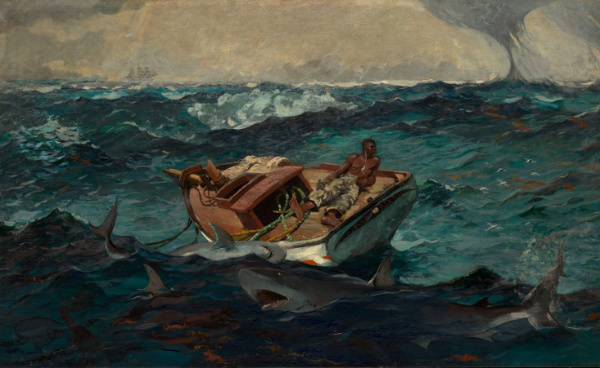
Winslow Homer ‘The Gulf Stream’, 1899 (reworked by 1906)
The Metropolitan Museum of Art, New York Catharine Lorillard Wolfe Collection, Wolfe Fund, 1906 © The Metropolitan Museum of Art, New York

• The first in-depth exhibition in the UK of the work of late 19th and early 20th century American painter Winslow Homer has opened at The National Gallery. Winslow Homer: Force of Nature features more than 50 paintings and watercolours from public and private collections spanning over 40 years of the artist’s career. Highlights include his paintings from the front lines of the American Civil War such as Prisoners from the Front (1866), those depicting the lives of African Americans during the period known as Reconstruction such as A Visit from the Old Mistress and The Cotton Pickers (both 1876), paintings from his travels to England and the Caribbean such as Inside the Bar (1883), A Garden in Nassau (1885), and The Gulf Stream (1899, reworked by 1906), and works created in the final years of his life such as Driftwood (1909). The exhibition can be seen in the Ground Floor Galleries until 8th January. Admission charge applies. For more, see www.nationalgallery.org.uk/exhibitions/winslow-homer-force-of-nature

• A celebration of some of finest wood engravings of the past 100 years and those who made them opens at the Heath Robinson Museum in Pinner on Saturday. Scene Through Wood, which comes from the University of Oxford’s Ashmolean Museum, celebrates the founding centenary of the British Society of Wood Engravers. It traces wood engraving from its origins – objects on show include an early woodcut by Albert Dürer (1471-1528), its subsequent development by 18th and 19th century naturalist Thomas Bewick and the establishment of the SWE in 1920. Included is the work of notable 20th century artists such as Robert Gibbings, Eric Ravilious and Gertrude Hermes as well as more recent figures such as Monica Poole, Edwina Ellis, Simon Brett and Anne Desmet. Admission charge applies. Runs until 11th December. For more, see www.heathrobinsonmuseum.org/whats-on/scene-through-wood/.

Send all items for inclusion to exploringlondon@gmail.com.

This Week in London – ‘The Blue Boy’ returns; Heath Robinson’s children’s stories; and, architectural wonders…

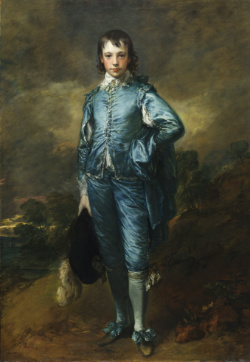
‘The Blue Boy’, Thomas Gainsborough PICTURE: © Courtesy of the Huntington Library, Art Museum, and Botanical Gardens, San Marino, California

A century after it last appeared in the UK, Thomas Gainsborough’s The Blue Boy returns to the National Gallery off Trafalgar Square from next Wednesday. The showing of the painting, which left for the United States in 1921 after it was purchased by rail and property businessman Henry E Huntington, marks the first (and possibly the last) time it has ever been lent out since that date. The full-length portrait, which was created in 1770 by Gainsborough during a period he spent in Bath, can usually be found at the Huntington Library, Art Museum, and Botanical Gardens in San Marino, California. The painting is being shown alongside four other works that, among other things, demonstrate Gainsborough’s interest in Flemish artist Sir Anthony van Dyck’s work from 100 years earlier. They include Van Dyck’s George Villiers, 2nd Duke of Buckingham and Lord Francis Villiers (1635) and Lord John Stuart and his Brother, Lord Bernard Stuart (about 1638) as Gainsborough’s works Elizabeth and Mary Linley (about 1772) and Mrs Siddons (1785). The display can be seen for free in Room 46 from 25th January until 15th May. For more, see nationalgallery.org.uk.

An exhibition showcasing artwork from Heath Robinson’s children’s stories opened at the Heath Robinson Museum in Pinner last Saturday. Heath Robinson’s Children’s Stories features works from books including The Adventures of Uncle Lubin (1902), The Child’s Arabian Nights (1903), Bill the Minder (1912) and Peter Quip in Search of a Friend (1922). Entry is included in general admission charge. Runs until 15th May. For more, see www.heathrobinsonmuseum.org.

Shortlisted and winning entries from The Architecture Drawing Prize 2020 and 2021 have gone on show at Sir John Soane’s Museum in Lincoln’s Inn Fields. The competition, run in partnership with Make Architects and the World Architecture Festival, is now in its fifth year with awards made across three categories – digital, hand-drawn and hybrid. Entry is free (pre booking required). Runs until 20th February. For more, see www.soane.org/exhibitions/architecture-drawing-prize-2021.

Send all items for inclusion to exploringlondon@gmail.com.

10 of London’s most curious (and historic) graves – 3. William and Agnes Loudon…

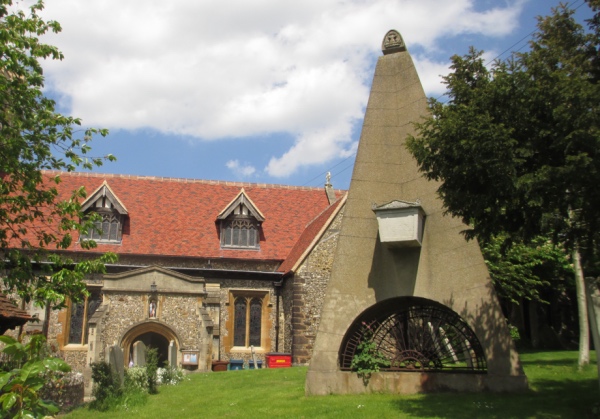
One of the more eccentric grave monuments in London, this massive triangular shaped memorial in a Pinner churchyard was erected by landscape gardener and horticultural writer John Claudius Loudon for his parents.

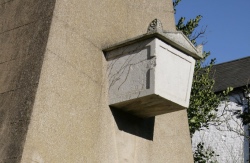
Located in the churchyard of St John the Baptist, the massive Grade II-listed monument is shaped like an inverted V with an arch piercing the base and features what appears to be a stone coffin stuck through it about halfway up the structure.

On one end, it bears an inscription to Scottish merchant William Loudon, who died on 29th December, 1809, and, on the other end, another to his wife Agnes, who died on 14th October, 1841.

It’s been suggested – and the words on the ornamental ironwork in the arch, ‘I Byde My Time’, are seen as supporting this theory –  that the reason for the odd design lies in the terms of a will which stipulated Loudon and his wife would only inherit a sum of money if their bodies stayed above ground.

That theory kind of falls apart, however, given that they are actually both buried below the monument. Another theory suggests the monument was deliberately designed to show that the couple were socially above – or perhaps closer to God – than the rest of those buried in the graveyard.

John Claudius Loudon, who died in 1843 – just a couple of years after the monument was erected, is buried at Kensal Green.

WHERE: St John the Baptist Church, Church Lane, Pinner (nearest Tube station is Pinner); WHEN: Reasonable hours; COST: free; WEBSITE: www.pinnerparishchurch.org.uk

PICTURE: Top – Matt Brown (licensed under CC BY 2.0/cropped); Right – Peter Reed (licensed under CC BY-NC 2.0/cropped)

This Week in London – Princess Eugenie’s wedding dress on show; Dorothea Manning; and, the impact of photographic reproductions explored…

The wedding dress and tiara worn by Princess Eugenie at her wedding in October last year has gone on display in a new exhibition at Windsor Castle, just to the west of London. A Royal Wedding: HRH Princess Eugenie and Mr Jack Brooksbank also features groom Jack Brooksbank’s morning suit and the maid-of-honour outfit worn by Princess Beatrice of York. But the star is the wedding dress, designed by Peter Pilotto and Christopher De Vos, which features fabric interwoven with symbols including the White Rose of York. The exhibition also includes the Greville Emerald Kokoshnik Tiara, lent by Queen Elizabeth II and on public display for the first time, Princess Eugenie’s diamond and emerald drop earrings – a wedding gift from the groom, a replica of the bridal bouquet, and the Zac Posen-designed evening gown worn by the princess for the reception. The display can be seen as part of visits to Windsor Castle until 22nd April. Admission charge applies. For more see www.rct.uk. PICTURE: Royal Collection Trust / © All Rights Reserved.

The work of pioneering artist Dorothea Manning is the subject of a new exhibition at the Tate Modern on South Bank. Opened last week, Dorothea Tanning is organised in collaboration with the Museo Nacional Centro de Arte Reina Sofía in Madrid and is the first large scale exhibition of her work for 25 years. It brings together some 100 works, a third of which are being shown in the UK for the first time, including ballet designs, stuffed textile sculptures, installations and large scale pieces. Highlights include the self-portrait Birthday (1942), Children’s Games (1942), Insomnias (1953), Etreinte (1969),Tango Lives (1970) and the room-sized installation Chambre 202, Hôtel du Pavot (1970-73). Runs until 9th June. Admission charge applies. For more see www.tate.org.uk.

A new exhibition on the impact photographic reproduction had on illustrative art at the end of the 19th century has opened at the Heath Robinson Museum in Pinner. The Beardsley Generation looks at how a new generation of artists versed in process engraving replaced the craft wood engravers of the past and how the new technology led to an expansion in the production of illustrated books and periodicals. The work of Aubrey Beardsley, Charles Ricketts, Laurence Housman and the Robinson brothers will be on display in the form of original drawings, books and periodicals drawn from public and private collections. Runs until 19th May. Admission charge applies. For more, see www.heathrobinsonmuseum.org.

Send all items for inclusion to exploringlondon@gmail.com.

This Week in London – Kew gets all Christmassy; Thomas Gainsborough’s family; and, William Heath Robinson and home life…

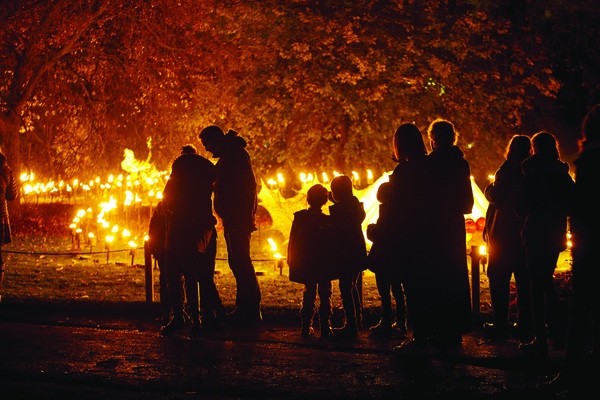
Christmas at Kew kicks off tonight with the garden landscape once again transformed into a spectacular light and sound show. Highlights from this year’s display include a ‘Field of Light’ by Brighton based artists Ithaca which reaches across the landscape towards the newly restored Great Pagoda, a laser garden by Australian studio Mandylights, 300 illuminated origami boats floating on Kew’s lake in an installation by Italian artists Asther & Hemera, ‘Firework Trees’ lit up by explosions of coloured light, a seven metre tall Cathedral of Light, a fire garden and “enchanted walkway” of giant glowing peonies and papyrus by French artists TILT and, of course, the famous Palm House finale which brings the giant glasshouse to life with a show featuring criss-crossing laser beans, jumping jets of light and kaleidoscopic projections playing across a giant water screen. Santa and his helpers can be found along the trail and there is a festival fairground with a Victorian carousel as well as food and drink at a range of stalls in Victoria Plaza. Runs from 5pm on select dates until 5th January. Admission charge applies. For more, head to www.kew.org/christmas. PICTURE – Below: The Fire Garden/Raymond Gubbay Ltd (RBG Kew).

All 12 surviving portraits of celebrated 18th century artist Thomas Gainsborough’s daughters have been brought together for the first time in a major new exhibition at the National Portrait Gallery. Gainsborough’s Family Album depicts the development of the Gainsborough girls from playful young children to fashionable adults with highlights including The Artist’s Daughters chasing a Butterfly (c1756) and The Artist’s Daughters with a Cat (c1760-1) as well as the little seen double full-length of Mary and Margaret Gainsborough as young women (c1774). More than 50 works are included in the display and a number have never been seen in the UK before. The latter include an early portrait of the artist’s father John Gainsborough (c 1746-8) and a drawing of Thomas and his wife Margaret’s pet dogs, Tristram and Fox. The display traces the career of the artist (1727-88) who, despite his passion for landscapes, painted more portraits of his family members than any other artist of the time or earlier. Together they form an “unusually comprehensive” visual record of an 18th century British kinship network, with several of its key players shown more than once at different stages of their lives. The exhibition runs until 3rd February. Admission charge applies. For more, see www.npg.org.uk.

Artist William Heath Robinson and his fascination with domestic life is the subject of a new exhibition opening at the Heath Robinson Museum in Pinner on Saturday. Heath Robinson’s Home Life centres on the fact that from about 1930 onwards, the artist’s humour was centred on domestic life including the construction of his house, ‘The Gadgets’, at the Ideal Home Exhibition of 1934 and the release, from 1936, of the first of his ‘How to’ books, How to Live in a Flat. The display features an early series of “Ideal Home” cartoons published in 1933 and rare photographs of ‘The Gadgets’ under construction at the Ideal Home Exhibition. There’s also original artwork from How to Live in a Flat and examples of a set of nursery china that he designed for a Knightsbridge department store in 1927. Runs until 17th February. Admission charge applies. For more see www.heathrobinsonmuseum.org.

Send all items for inclusion to exploringlondon@gmail.com