
LondonLife – Rush hour, Poplar…
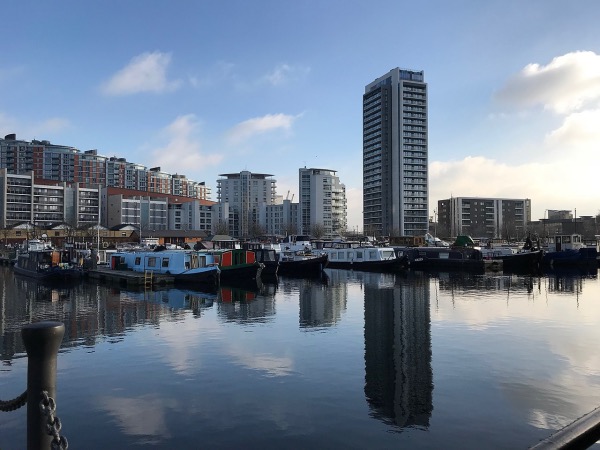
Though they no longer in evidence, this Thames-side East London district takes its name from the Black Poplar trees which were once abundant in the area.
The area was apparently fertile ground for the poplars thanks to the proximity of the Lea and Thames Rivers which created the moist soil the tree needs. There was still a poplar tree in the area until the mid-1980s.
The name goes back to the 14th century but Poplar wasn’t an independent parish until the 19th century (before which it was a hamlet of Stepney). Poplar is now part of the Borough of Tower Hamlets.
The medieval village of Poplar was centred on Poplar High Street and the East India Company, which built ships in Blackwall Yard, established a chapel and almshouses in Poplar.
The area expanded rapidly in the early 19th century thanks to the maritime industries that grew up here but by late that century this had diversified into other manufacturing and transport-related industries.
The area has long had a maritime association with ship fitting taking place in the area from the 15th century. Poplar was impacted by bombings during World War I and then devastated during the Blitz with about half the houses in the area damaged and the population dropping significantly as a result.
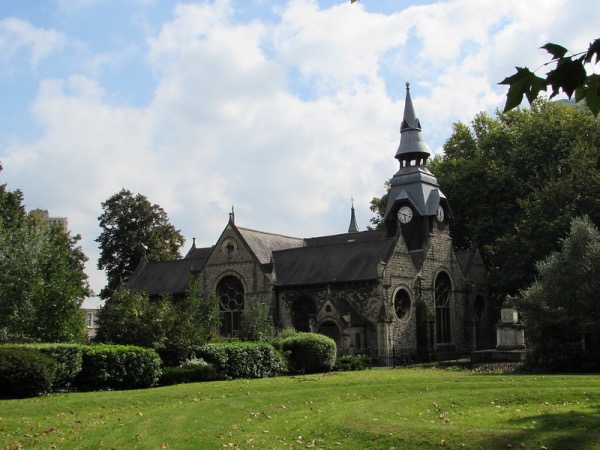
Landmark buildings include the old Poplar Town Hall, now a hotel, the Grade II*-listed St Matthias Old Church (originally the chapel built by the East India Company in 1654 and now a community centre), the Grade II-listed All Saints Church, dating from 1821-23, and the Museum of London Docklands at West India Quay.
The area also features considerable post-war housing including the Brutalist-style 26 storey Balfron Tower. In more recent years, with the development of the Docklands and the linking of the area to the city by the Docklands Light Railway, the area has continued to undergo regeneration.

This red-painted vessel once served as a beacon at South Goodwin Sands off the Kentish coast but, now permanently moored at Trinity Buoy Wharf, has been converted into a recording studio.
The 550 tonne ship was built in 1939 by Philip and Sons of Dartmouth for Trinity House, a company established during the reign of King Henry VIII initially to regulate pilotage on the River Thames. It later established lighthouses and floating lightships and took over responsibility for all buoys in England. It currently maintains 65 automated lighthouses.
The steel-hulled vessel, one of three built to the same design (one, converted into a home, is now at Victoria Dock in Silvertown – and currently for sale with an asking price of £595,000 – and another in Rotterdam, The Netherlands), features a central light tower and originally had crew quarters.
It was mostly used to mark South Goodwin Sands but was also deployed to other locations including Inner Dowsing off the coast of Norfolk.
In the 1990s, it became the first light vessel in the UK to be converted to solar power to enable unmanned operation and underwent a complete refit in 1999.

It was taken out of service in 2003 and subsequently sold at auction by Trinity House. Initially bought by the Port Werburgh Marina on the Medway, it was later onsold to Ben Phillips who converted it to a floating music recording studio. Since 2008, it has been based at Trinity Buoy Wharf.
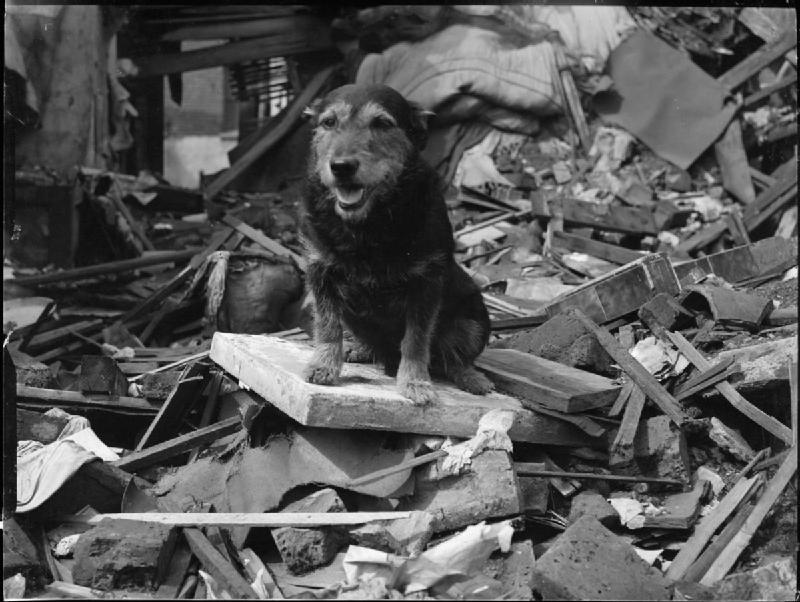
A hero of the Blitz during World War II, Rip was a stray dog who was adopted by the Southill Street Air Raid Patrol in Poplar, east London.
Found in the aftermath of a bombing by Air Raid Warden E King, he became the mascot of the air raid patrol and an unofficial rescue dog.
The mongrel terrier’s task was to help locate people and animals buried in rubble after an air raid and despite his lack of formal training, he is reported to have saved more than 100 lives as well as recovered many bodies.
In fact, such was his success that it was partially responsible for prompting authorities to start officially training dogs to find casualties in debris towards the end of the war.
Rip survived the war and was awarded a PDSA Dickin Medal in July, 1945. Created in 1943, the award is described as Victoria Cross for animals.
Rip apparently wore on his collar until his death 1946 and was buried in the PDSA cemetery in Ilford, Essex.
In 2009 his medal was sold at auction for £24,250, well above expectations of £10,000.
PICTURE: © IWM (D 5937)
Located at the western end of West India Quay in Docklands, the Hibbert Gate is a smaller scale replica of an original gate that stood at the main entrance to the quay for more than 130 years.
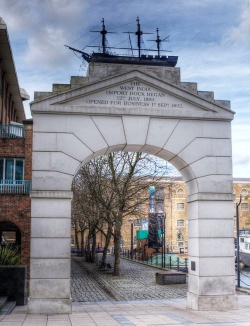 The gate was originally installed in 1803 and was topped with a model representing an East Indiaman, the Hibbert, which was named for George Hibbert, one of the principals of the West India Dock Company (and who apparently had a financial interest in the slave trade). The ship ran between London and the West Indies before later being used to transport convicts to Australia.
The gate, which became the emblem for West India Docks and was even incorporated into the Poplar Borough Council’s coat-of-arms, was removed in 1932 due to traffic measures. The model was initially preserved and moved to the Poplar Recreation Ground but vandalism and bomb damage saw it eventually fall apart.
The replica gate, commissioned by the Canary Wharf Group and topped with a replica model by artist Leo Stevenson, was installed in the year 2000, marking 200 years since the construction of the quay.
It was unveiled on 12th July by then Mayor of London, Ken Livingstone. Part of the signage accompanying the gate reads that it was meant to be “memorial to the man – the replica in no way represents support for slavery”.
PICTURE: Prioryman (Licensed under CC BY-SA 4.0/image cropped)
 Exploring London