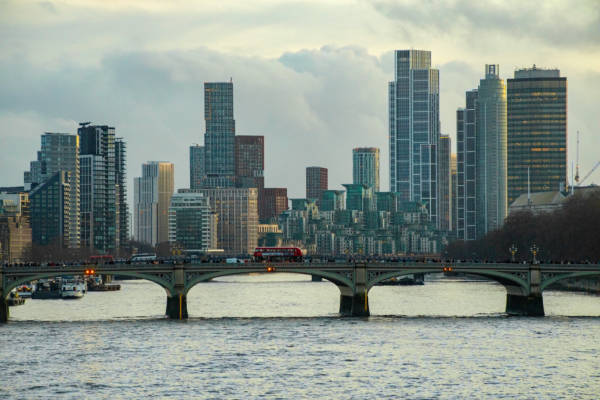
LondonLife – Vauxhall view…
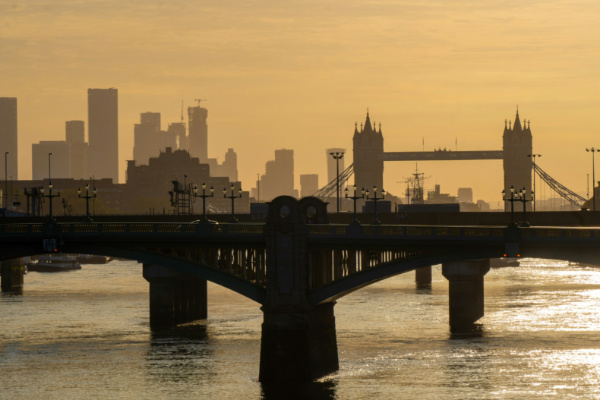
Wishing you a safe and happy Christmas and New Year.
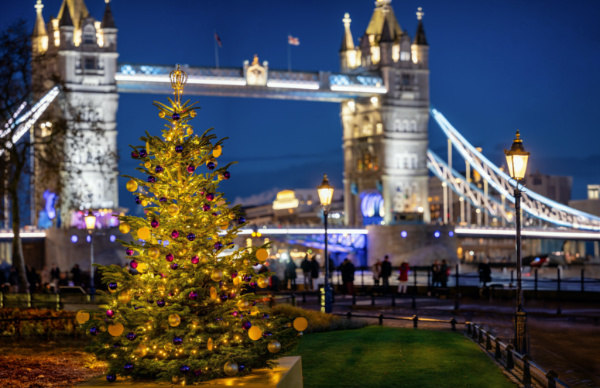
Keep an eye out for our annual countdown of the most popular posts for 2023 next week!
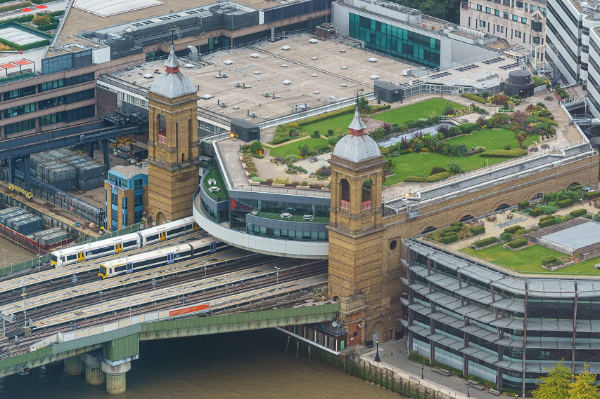
This establishment in the Cannon Street Station in the City of London is a modern take on the pub but thanks to the name and location comes with built-in history.
Sir John Hawkshaw (1811-1891) was a railway engineer who, importantly given this pub’s location, is recognised for his work on the original Cannon Street railway station – which he designed with JW Barry – as well as the adjoining Cannon Street Railway Bridge over the Thames (it was originally named ‘Alexandra Bridge’ in honour of Princess Alexandra of Denmark, wife of Edward, the Prince of Wales)
The original Cannon Street station, which opened on 1st September, 1866, featured two “Wren-style” towers which stand 135 feet high and faced the Thames (these two towers, now Grade II listed, are still there today). They helped support the station’s single arched iron and glass roof which stretched some 700 feet in length to cover the railway platforms (an adjoining Italianate-style hotel and forecourt designed by Barry opened the following year).
While Hawkshaw’s two towers remain (and it should be noted that the engineer was also famous for his work on other projects including, among others, the Severn Tunnel and Suez Canal), the current Cannon Street Station is a much more modern structure dating originally from the 1980s with some works being completed in the last decade or so.
The site’s known history, meanwhile, goes back much further, however. Prior to Hawkshaw’s station, since 1690 the site had been occupied by the livery hall of the Worshipful Company of Plumbers. Prior to that it was the site of the Steelyard and, much further back in time, the remains of a Roman palace have been found beneath the site which date from the 1st century.
The modern pub, located in the station, is part of the JD Wetherspoon chain.
For more on the pub, see https://www.jdwetherspoon.com/pub-histories/england/london/the-sir-john-hawkshaw-cannon-street.
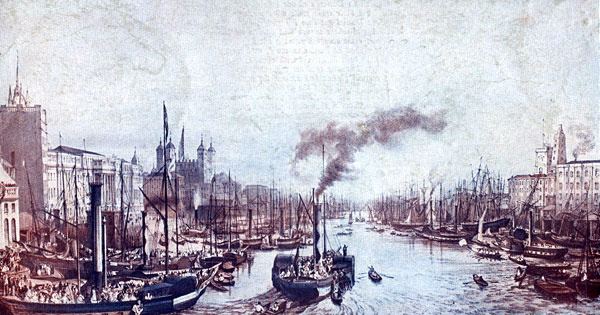
A stretch of the River Thames which spans the area from London Bridge to below Limehouse, the Pool of London was the highest part of the river navigable by tall-masted ships (thanks to the them not being able to pass under London Bridge).
The term originally referred to the stretch of the river at Billingsgate in the City of London which was where all imports had to be delivered for inspection by customs officers (hence these wharves were given the name ‘legal quays’).
But as trade expanded and reached its peak in the 18th and 19th centuries, so too did the stretch referred to as the “Pool of London”. It came to be divided into two sections – the Upper Pool, which stretches from London Bridge to Cherry Garden Pier in Bermondsey (and is bisected by Tower Bridge), and the Lower Pool, which stretched from the latter pier to Limekiln Creek.
The Upper Pool’s north bank includes the Tower of London, the old Billingsgate Market and the entrance to St Katharine’s Dock while the south bank features Hay’s Wharf and the HMS Belfast. The Lower Pool’s north bank includes the entrance to Limehouse Cut as well as Regent’s Canal and Execution Docks while below it runs the Thames and Rotherhithe Tunnels.

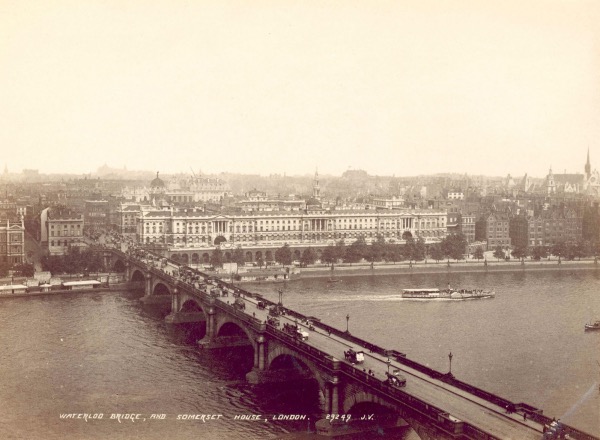
Built between 1813 and 1817, the first Waterloo Bridge was designed by Scottish civil engineer John Rennie and featured nine elliptical arches, pairs of Doric columns at the piers and a flat roadway.
Originally known as The Strand Bridge, the name was changed by an Act of Parliament in 1816 and commemorated the victory over Napoleon Boneparte at the Battle of Waterloo in 1815.
It was opened by the Prince Regent, accompanied by the Duke of Wellington, on 18th June, 1817 – the second anniversary of the battle.
The bridge originally featured toll booths – the toll was removed in 1877.
In the early 20th century, piers from the bridge settled into the riverbed and created a dip, possibly due to the increasing traffic using it. A temporary steel bridge was placed alongside it and, despite opposition, it was eventually demolished in 1936.
The current bridge, designed by Sir Giles Gilbert Scott, was built over the years 1937 to 1942 (although it wasn’t fully completed until 1945).
Old Waterloo Bridge was famously depicted in a series of works by Claude Monet painted between 1900 and 1904 while he stayed at the Savoy Hotel and by John Constable who created a famous painting of its opening (it’s actually his largest work). The bridge also lends its name to the 1940 American film, Waterloo Bridge, which was adapted from a 1930 play.
Interestingly, granite blocks from the original bridge were sent to Australia and New Zealand while timbers from the bridge were used for shelves and wall panels in the library at Anglesey Abbey in Cambridgeshire (where the famous Constable painting hangs). Some of the original blocks were also incorporated into the foundations and approaches of the new bridge.
The keystone from the original bridge, recovered when it was demolished, is located at the Institution of Civil Engineers in Great George Street.
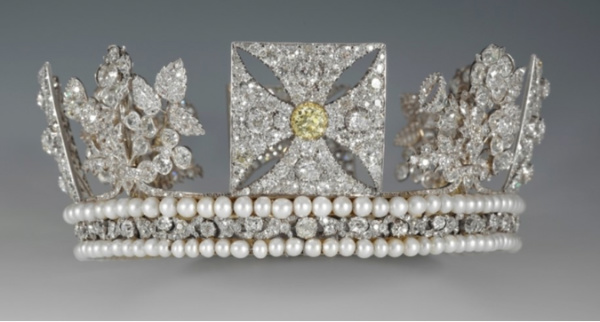
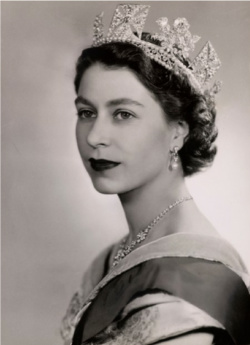
• Key items of Queen Elizabeth II’s jewellery including the Diamond Diadem and the Delhi Durbar necklace go on display in Buckingham Palace’s State Rooms from tomorrow as part of the palace’s Summer Opening. Created for the coronation of King George IV in 1821, the Diamond Diadem is set with 1,333 brilliant-cut diamonds, some of which are set in the form of a rose, a thistle and two shamrocks, the national emblems of England, Scotland and Ireland. The diadem, which was inherited by Queen Victoria in 1837 and passed down to the current Queen, will be displayed alongside the official portraits of the Queen taken by photographer Dorothy Wilding just weeks after the Accession (the portraits were later were used as the basis of the Queen’s image on postage stamps from 1953 until 1971, as well as providing the official portrait of Her Majesty sent to every British embassy throughout the world). The Delhi Durbar necklace, meanwhile, incorporates nine emeralds originally owned by Queen Mary’s grandmother, the Duchess of Cambridge, as well as an 8.8 carat diamond pendant cut from the Cullinan diamond – the largest diamond ever found. It was made for Queen Mary as part of a suite of jewellery created for the Delhi Durbar in 1911. The Queen inherited the necklace in 1953 and wore it in a portrait sitting for Dorothy Wilding in 1956 – thought to have been their last sitting together before Wilding’s retirement in 1958. The jewellery, a special display to mark the Platinum Jubilee, can be seen at the Summer Opening of the State Rooms at Buckingham Palace, the first time the palace has been open to the public in three years, until 2nd October. Admission charge applies. For more, see www.rct.uk.
• An exhibition exploring how design can enhance our experience of ageing has opened at the Design Museum. The Future of Aging includes a selection of prototypes, sketches and research from projects that are being developed by Design Age Institute and its partners. They include a self-balancing, two-wheeled personal electric vehicle known as ‘The Centaur’, a hands-free cargo-carrying robot called Gita, and a digital ‘audioscape’ app that uses the sound of birdsong to engage visitors with their hearing health. The free display also includes a long-term participatory project that explores opportunities for an intergenerational garden at the museum and two new film commissions which showcase stories and experiences of later life. Runs until 25th September. For more, see https://designmuseum.org/exhibitions/the-future-of-ageing.
• On Now: Painting ‘A Bridge with a View’. Until the end of August, English artist Melissa Scott-Miller is painting the views she spies from Tower Bridge’s West Walkway. Visitors are able to observe her at work and take part in related public workshops and family activities. Admission charge applies. For more including the dates for activities, see www.towerbridge.org.uk/see-bridge-view.
Send items to exploringlondon@gmail.com
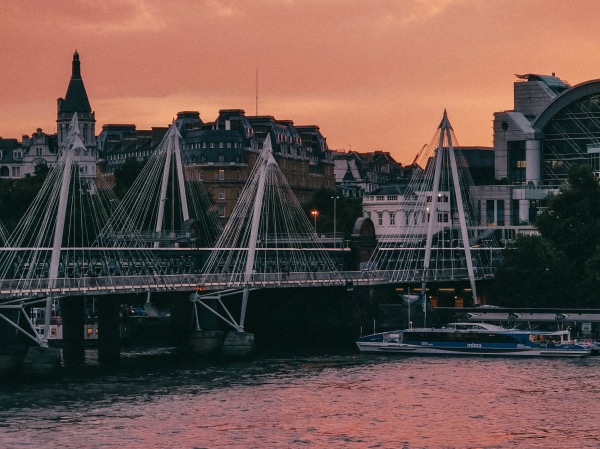
The Hungerford Bridge, flanked by the two Golden Jubilee Bridges, and the north-west bank of the Thames.
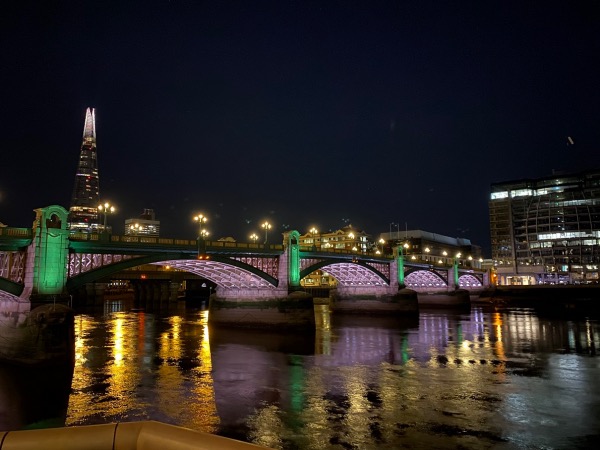
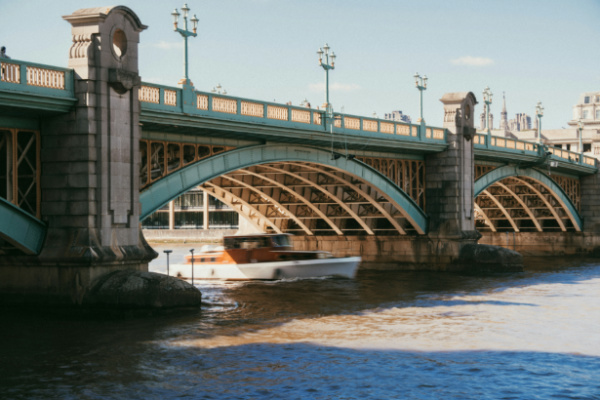
Southwark Bridge celebrated its 100th birthday earlier this month so we thought it a good time to have a quick look at the bridge’s history.
The bridge was a replacement for an earlier three-arch iron bridge built by John Rennie which had opened in 1819.
Known by the nickname, the “Iron Bridge”, it was mentioned in Charles Dickens’ Our Mutual Friend and Little Dorrit. But the bridge had problems – its narrow approaches and steep gradient led it to become labelled “the curse of the carman [cart drivers] and the ruin of his horses”.
Increasing traffic meant a replacement became necessary and a new bridge, which featured five arches and was made of steel, was designed by architect Sir Ernest George and engineer Sir Basil Mott.
Work on the new bridge – which was to cost £375,000 and was paid for by the City of London Corporation’s Bridge House Estates which was originally founded in 1097 to maintain London Bridge and expanded to care for others – began in 1913 but its completion was delayed thanks to the outbreak of World War I.
The 800 foot long bridge was finally officially opened on 6th June, 1921, by King George V who used a golden key to open its gates. He and Queen Mary then rode over the bridge in a carriage.
The bridge, now Grade II-listed, was significantly damaged in a 1941 air raid and was temporarily repaired before it was properly restored in 1955. More recently, the bridge was given a facelift in 2011 when £2.5 million was spent cleaning and repainting the metalwork in its original colours – yellow and ‘Southwark Green’.
The current bridge has appeared in numerous films including 1964’s Mary Poppins and, in more recent times, 2007’s Harry Potter and the Order of the Phoenix.
 Exploring London