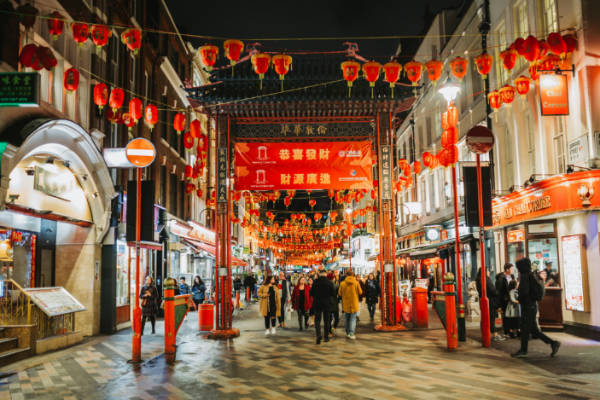
While the street dates back to the 17th century, by the first half of the 20th century it had become known for its nightlife, initially for nightclubs and then for a seedier side as striptease clubs opened.
The city’s first Chinatown had been established in Limehouse in the 18th century as Chinese immigrants and sailors frequented the area.
But after World War II, the damage in the Limehouse area and the comparatively cheap leases available around Gerrard Street, saw Chinese moved in during the 1950s and began opening restaurants and grocery shops.
Growing numbers of Chinese arrived from Hong Kong and by 1970, Gerrard Street has become a hub for the Chinese community in London. The London Chinese Chinatown Association formed in 1978.
It was in the late 1980s that Chinese gateways, a pagoda and street furniture were added. Gerrard Street and parts of Newport Place and Macclesfield Street became pedestrianised.
The first organised Chinese New Year celebrations took place in Gerrard Street in 1985.
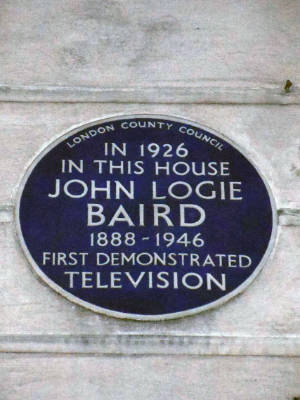
It was 100 years ago last month that on a wet Tuesday evening in Soho, Scottish engineer and inventor John Logie Baird demonstrated an experimental prototype that provided live moving pictures – the precursor to what we now know as television.
The successful, albeit rather low key, demonstration took place before some 40 members of the Royal Institution, all reportedly attired in evening dress, in an upper room which served as his laboratory at 22 Frith Street on 26th January, 1926.
According to a report in The Times on 28th January, the “transmitting machine” consisted of a “large wooden revolving disc containing lenses, behind which was a revolving shutter and a light sensitive cell”.
The first image to be transmitted was that of the head of a ventriloquist’s dummy but the image of a human face was transmitted later, “first on a receiver in the same room as the transmitter and then on a portable receiver in another room”.
“The image as transmitted was faint and often blurred, but substantiated a claim that through the ‘Televisor’, as Mr Baird has named his apparatus, it is possible to transmit and reproduce instantly the details of movement, and such things as the play of expression on the face,” TheTimes reported.
Present at the demonstration was William Edward Taynton, a 20-year-old office boy whose face Baird had transmitted in an experiment at the property the previous October.
Baird continued to refine his invention in the following months with the picture becoming clearer and was recognised in the years following for being the first to show television in colour,
In 1928 he completed a demonstration in which live images sent by radio from London were received in New York and the same year he demonstrated colour television. In 1929, the first television programmes were officially transmitted by the BBC using Baird’s system.
An English Heritage Blue Plaque todays marks the property where the demonstration took place (there’s also one at Baird’s former home at 3 Crescent Wood Road in Sydenham, where he lived from 1933 until 1945).
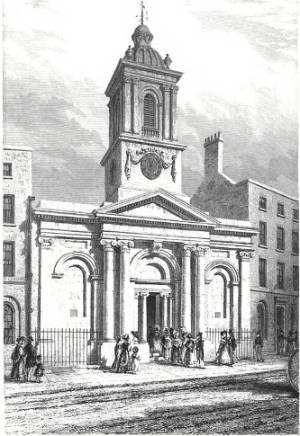
The church, which originally dated from before 1181 (when it was first mentioned) and was also referred to as St Peter le Poor, may have been so-named because of the poor parish in which it was located or for its connections to the monastery of St Augustine at Austin Friars, whose monks took vows of poverty.
Whatever the reason for its name (and it has been suggested the ‘le Poer’ wasn’t added to it until the 16th century), the church was rebuilt in 1540 and then enlarged in 1615 with a new steeple and west gallery added in the following decade or so.
The church survived the Great Fire of London in 1666 but just over a 100 years later has fallen into such a state of disrepair that parishioners obtained an Act of Parliament to demolish and rebuild it.
The new church, which was designed by Jesse Gibson and moved back off Broad Street further into the churchyard, was consecrated on 19th November, 1792. Its design featured a circular nave topped by a lantern (the curved design was not visible from the street) and placed the altar directly opposite the doorway on the north-west side of the church.
The church had acquired a new organ in 1884 but the declining population in the surrounding area led to its been deemed surplus to requirements. It was demolished in 1907 and the parish united with that of St Michael Cornhill.
Proceeds of the sale were used to build a new church, St Peter Le Poer in Friern Barnet. The new church, which was consecrated on 28th June, 1910, by the Bishop of London, the Rt Rev Arthur Foley Winnington-Ingram, also received the demolished church’s font, pulpit and panelling.
This district in the Borough of Lambeth in south London was formerly a rural manor located on the southern edge of London.
The name, variants of which date back to at least the late 12th century, is said to relate to the Old English words for a tree trunk – ‘stoc’ – and a well or spring, ‘wella’, and has been interpreted as meaning the well or spring by a tree stump, tree truck or perhaps a wood (there was apparently a Stockwell Wood which has long since disappeared).
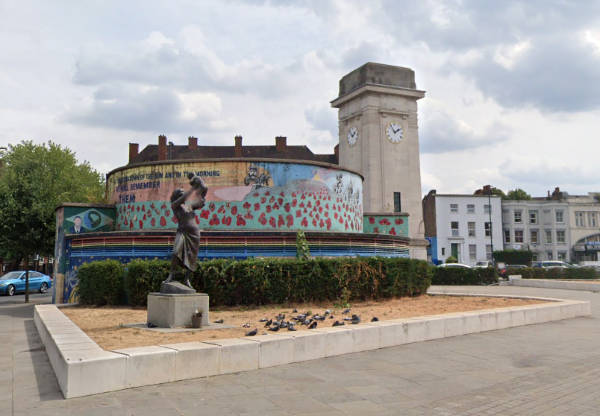
The War Memorial and mural painted on a ventiliation house in Stockwell. PICTURE: Courtesy of Google Maps
The manor of Stockwell was formed at the end of the 13th century when King Edward I acquired the manor of South Lambeth and divided it into two, creating the manors of Stockwell and Vauxhall (the manor house itself, parts of which survived until the 19th century, stood on the north side of Stockwell Road).
The area become known for its market gardens and was transformed into an urban landscape until the mid-19th century. Remnants of the 19th century housing stock can still be found in areas including the Stockwell Park Conservation Area in the west of the district.
The area around Stockwell Tube station, which first opened in 1890 and has since been rebuilt a couple times, was heavily bombed during World War II and rebuilt following the war. New developments included a number of social housing estates.
Today, Stockwell and nearby South Lambeth host the district known as Little Portugal which, centred on South Lambeth Road, is home to one of the UK’s largest Portuguese communities. The area is also home to several other immigrant communities.
Local landmarks include the oldest surviving building in the area – St Andrew’s Church, Stockwell Green (built in 1767), the Stockwell Congregational Church (1798) and the Stockwell War Memorial.
The latter – a white stone tower – is located on a site first laid out in the 1920s and features a mural on an adjoining ventilation shelter commemorating French Resistance fighter Violette Szabo (there’s a Blue Plaque on her former home in Burnley Road) and other Stockwell residents who died in war. There is also the ‘Bronze Woman’ statue which was unveiled in 2008 as a tribute to Black Caribbean women.
Residents of Stockwell have included artist Arthur Rackham and pioneering theatre director Joan Littlewood as well as musician David Bowie (born in Stansfield Road), actors Joanna Lumley (who still lives there) and Roger Moore (born in Aldebert Terrace).
Tragically, Stockwell Tube station was where Brazilian man Jean Charles de Menezes was fatally shot by police on 22nd July, 2005, after being misidentified as one of four suicide bombers who were on the run after their devices had failed to detonate the previous day (the attempts had come just two weeks after the 7th July bombings in which more than 50 people had been killed).
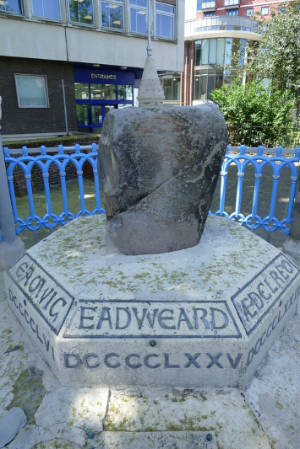
The Coronation Stone in Kingston-upon-Thames. PICTURE: Loz Pycock (licensed under CC BY-SA 2.0)
This month marks the 1,100th anniversary of the coronation of the Saxon King Aethelstan, so we thought it fitting to recall the place of his coronation, believed to be the Coronation Stone at the heart of the south-west London Royal Borough of Kingston upon Thames.
Located outside the Guildhall, the now Grade I-listed stone is an ancient block of sarsen stone which was originally at a chapel, believed to have been wooden, on the edge of the town’s market place (close to the site of All Saints Church which originally dates from the 12th century).
Subscribe to access all of Exploring London’s content for just £3 a month.
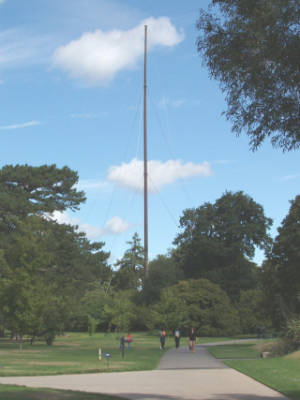
Once the tallest wooden flagpole in the world at 68 (225 feet) tall, the Kew Gardens flagpole stood for almost 50 years before it was dismantled in 2007.
The flagpole, a Douglas fir from Copper Canyon on Vancouver Island, was erected on 5th November, 1959, as a gift from the the British Columbia Loggers Association in Canada to mark both the centenary of the Canadian province of British Columbia (1958) and the bicentenary of Kew Gardens (1959).
The tree, which was around 370-years-old when cut, had originally weighed 37 tonnes, but after it was floated up the Thames to Kew and there underwent shaping, this was reduced to 15 tonnes.
Sadly, in 2006, it unfortunately failed its safety inspection – thanks to decay and woodpeckers – and was taken down the following year.
The flagpole was apparently the third (strictly the fourth) erected on the same site at the gardens which had originally been occupied by the ‘Temple of Victory’, a structure which had been built on the orders of King George III to commemorate the Anglo-German victory over the French at the 1759 Battle of Minden during the Seven Years’ War and which was removed in the mid 19th century.
The first flagpole on the site, which stood more than 31 metres (100 feet) tall. was erected in 1861. It had also come from Vancouver Island in British Columbia and replaced one which had snapped when it was in the process of being erected.
The pole was finally taken down in 1913 after being found to be suffering from dry rot.
A replacement, again from British Columbia, was erected in 1919 (its raising having been somewhat delayed by factors related to World War I). It was removed some time before 1959.
After the third giant flagpole was removed (the concrete footing can still be seen), the gardens decided not to erect another as that would mean cutting down another large tree. While far less of a spectacle, there is now a lesser flagpole near Victoria Gate where the flag is flown on special occasions.
This evocative memorial, which stands on the north bank of the River Thames at Wapping, is designed to show the figure (or rather the absence of the figure) of a dove.
Subscribe for just £3 a month to access all of Exploring London’s content – and support our work…
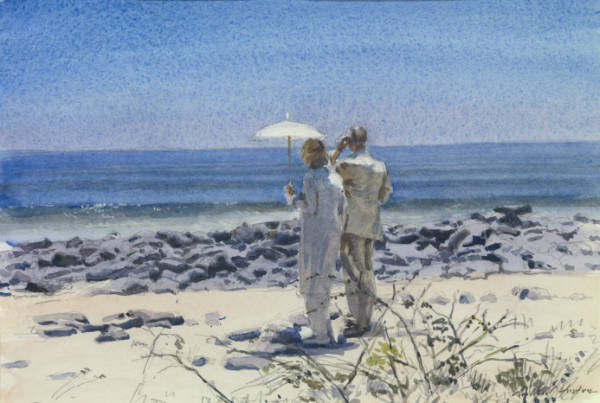
• More than 70 works of art from the King’s private collection – many of which have never been shown publicly before – go on show from today as part of the summer opening of Buckingham Palace’s State Rooms. The King’s Tour Artists, which can be seen in the ballroom, features works by 43 artists who have travelled with the King and Queen during the past 40 years. They include the earliest work on show – From the Afterdeck of HMY Britannia by John Ward, the inaugural tour artist – as well as Basilica of San Vitale, created by Fraser Scarfe who became the first tour artist to create digital artwork on an iPad when he accompanied the King and Queen on a State Visit to Italy. Other works include a pair of portraits of the King and Queen when Prince of Wales and Duchess of Cornwall which were painted by James Hart Dyke following a tour to the Gulf States in 2007, a drawing by Claudette Johnson made after the first official royal visit to Rwanda in 2022, and a terracotta head by Marcus Cornish, the only sculptor ever to have been chosen as a tour artist, which depicts a war veteran met by the royal party during a visit to Slovakia in 2000. Other highlights of the summer opening include the chance to see the recently installed Coronation State Portraits of the King and Queen in their permanent home. Runs until 28th September. Admission charge applies. To book, head to www.rct.uk.
• Artworks for octopii and an immersive seaweed installation are among artworks in a new exhibition at the Design Museum focusing on a growing movement of ‘more-than-human’ design. More than Human brings together more than 140 works spanning contemporary and traditional practices, fine art, product design, architecture and interactive installations – the work of more than 50 artists, architects and designers. As well as the artworks for octopuses by Japanese artist Shimabuku and the seaweed installation by artist Julia Lohmann, other highlights include a vast new tapestry that explores the perspectives of pollinators by Alexandra Daisy Ginsberg and an eight metre long mural by MOTH (More Than Human Life Project), depicting the growing movement to award legal rights to waterways around the world. Runs until 5th October. Admission charge applies. For more, see https://designmuseum.org/exhibitions/more-than-human.
• On Now: Saving St Paul’s: The Watch and the Second World War. This free outdoor exhibition – part of St Paul’s Cathedral’s commemorations around the 80th anniversary of World War II, honours the volunteers known as the St Paul’s Watch and their efforts to protect the cathedral during the Blitz. That included during the two direct hits to the cathedral – in October, 1940, and April, 1941. A short film accompanies the display which can be seen in the cathedral garden. The exhibition can be seen until October, 2025. For more, see www.stpauls.co.uk.
Once the biggest hotel in Europe, the opulent Hotel Cecil opened in 1896 on a prominent site overlooking the Thames. But it only survived for little more than three decades.
Subscribe for just £3 a month to support our work and access all of our articles.
Weeks after the start of the Blitz, on 13th October, 1940, a bomb struck a residential housing block and the air raid shelter located in Stoke Newington.
Subscribe for just £3 a month to access all of our coverage and support our work.
While no official death toll was announced at the time, it’s now believed that 104 people died in the bombing. Forty-eight bodies were recovered and buried in Streatham Cemetery while the remainder still lie under the park.
The majority of those killed were women and children with the youngest just three-months-old. The oldest known victim was 75.
While Lambeth’s civilian dead are commemorated in a memorial at Lambeth Cemetery dedicated in 1952, in early 2000s the Friends of Kennington Park raised funds for a permanent memorial to those killed in the tragedy in the park.
The memorial, which was designed by Richard Kindersley and is located in the South Field close to the Tinworth Fountain Gate, is an upright stab of Caithness stone brought from Scotland standing 2.6 metres tall.
It is inscribed with a quote from poet Maya Angelou – “History despite its wrenching pain cannot be unlived but if faced with courage need not be lived again.”
While another inscription around the edge of the stone commemorates the more than “50 men, women and children” who died during the bombing, a nearby interpretation board puts the toll at more than 100.
WHERE: Kennington Park, inside the Tinworth Fountain Gate, Kennington Park Road, Lambeth (nearest Tube station is Oval); WHEN: Usually 7.30am until 15 minutes before sunset; COST: Free; WEBSITE: www.lambeth.gov.uk/parks/kennington-park
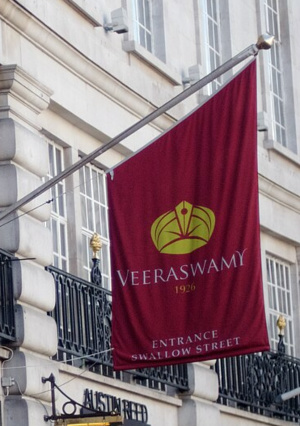
The restaurant was opened by Edward Palmer, the great-grandson of General William Palmer, who was secretary to Warren Hastings, the first Governor General of India and the Moghul Princess Faisan Nissa Begum.
It’s name is said to have come from his mother’s family and Palmer is said to have been greatly influenced by the princess in the creation of the menu.
The restaurant – located in Victory House and entered from Swallow Street – was taken over by the MP William Steward in 1934. He sold it in 1967 and the restaurant later passed through several hands.
The current owners – Namita Panjabi & Ranjit Mathrani of MW Eat – bought it in 1996. They have since modernised the menu and interiors.
Over the years, the restaurant has attracted a star-studded clientele which included royalty including Edward, Prince of Wales (later King Edward VIII), King Abdullah of Jordan, and the Maharajah of Cooch-Behar as well as Winston Churchill, actor Marlon Brando and Princess Anne.
In 2016, the restaurant was awarded a Michelin star.
The restaurant, which is located on the Crown Estate, is currently collecting signatures for a petition asking King Charles III to intercede with the Crown Commissioners, asking them to renew its lease after the commissioner served a notice to vacate. The matter is currently before the courts.
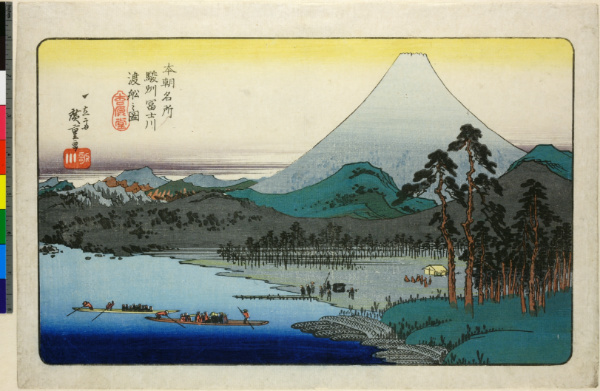
• An exhibition exploring the art and legacy of Japanese artist Hiroshige opens at the British Museum today.Hiroshige: artist of the open road takes visitors on a “lyrical journey” through Edo-period Japan, exploring both natural landscapes and urban life as well as considering Utagawa Hiroshige’s (1797– 1858) lasting influence on modern and contemporary art. The display marks the major gift of 35 Hiroshige prints to the American Friends of the British Museum from the collection of Alan Medaugh, a leading US collector of the artist’s work with these works being shown alongside 82 Hiroshige prints loaned by Medaugh and other works. Among them are the series Fifty-three Stations of the Tōkaidō Highway (1833–35), One Hundred Famous Views of Edo (1856–58) and Eight Views of Stations along the Main and Secondary Roads (about 1839) as well as examples of his famous bird-and-flower prints Runs in the Joseph Hotung Great Court Gallery (Room 35) until 7th September. Admission charge applies. For more, see britishmuseum.org/hiroshige.
• The 80th anniversary of World War II is being marked with a new display of ceramic poppies in the Tower of London. Almost 30,000 poppies, previously seen in Paul Cummins’ 2014 artwork, Blood Swept Lands and Seas of Red, are being used in the new installation designed by Tom Piper. Opens on 6th May in advance of the 80th anniversary of VE Day, marking the official end of the World War II in Europe, on 8th May. Included in admission with a small section visible from the public footpath. For more, see www.hrp.org.uk/tower-of-london/whats-on/tower-remembers-2025.
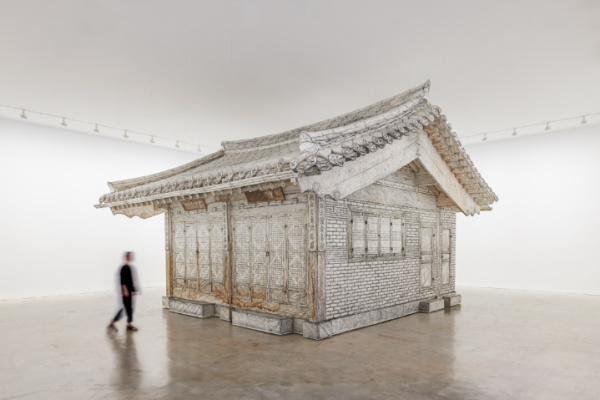
• The large-scale installations, sculptures, videos and drawings of artist Do Ho Suh are going on show at the Tate Modern from today. The Genesis Exhibition: Do Ho Suh: Walk the House, the title of which comes from a Korean expression referring to the hanok – a house that could theoretically be disassembled, transported and reassembled at a new site, includes works from across three decades. They include the new installation Nest/s (2024) and Perfect Home: London, Horsham, New York, Berlin, Providence, Seoul (2024), Who Am We? (2000_ – a mosaic of tens of thousands of tiny portrait photographs collected from sources including school yearbooks, and his major Rubbing/Loving Project: Seoul Home (2013-22) project. Runs at the Bankside institution until 19th October. Admission charge applies. For more, see tate.org.uk.
Send all items for inclusion to exploringlondon@gmail.com
This series of three inter-connected docks in London’s east were once the largest enclosed docks in the world (they’re still the largest enclosed docks in the UK).
Subcribe for just £3 a month to access all of Exploring London’s content…
CCambridge took the honours over Oxford in both the men’s and women’s races as well as both reserve races and the lightweight men’s and women’s races in the annual rowing event on the River Thames in west Londonon Sunday.
The Cambridge women’s team, wearing the light “duck egg” blue, celebrate their win over the Dark-Blues (Oxford). ALL PICTURES: Courtesy of Row360
The Light-Blues won the men’s race by five-and-a-half lengths – their sixth victory in seven years, while the women won by two-and-a-half lengths in their eighth consecutive win.
Cambridge celebrations.
There was controversy when the women’s race had to be restarted – the first time its happened on the Championship Course (the women’s race moved there in 2015 having earlier been held at Henley-on-Thames and before 1977 on the River Isis in Oxford and the Cam in Cambridge – and history was also made in the men’s race with Sarah Winckless the first female umpire.
The crowd along the River Thames shoreline at Barnes.
The first men’s race was held in 1829 and the first women’s in 1927. It takes place over what is known as the Championship Course which covers 4.25 miles between Putney and Mortlake.



 Exploring London


