Treasures of London – St Lawrence and Mary Magdalene Drinking Fountain…

Now located just outside St Paul’s Cathedral at the eastern end of Carter Lane Gardens, this Gothic Victorian drinking fountain once stood near the Church of St Lawrence Jewry close by Guildhall. 

Designed by architect John Robinson and featuring bronze sculptural work by Joseph Durham, the now Grade II-listed fountain was paid for jointly by the parishes and St Lawrence and St Mary Magdalene.

One of many fountains erected from the 1850s onwards to provide free, clean water to the city’s residents, it features statues of both St Lawrence – holding the grid iron on which tradition holds he was martyred – and of St Mary Magdalene – holding a cross with a skull at her feet – set in two of four niches in an elaborate canopy. The remaining two niches, now empty, are believed to have once held the names of past benefactors of the churches.

Below the canopy is another niche, from the back of which water streams out into a dish when a button is pushed. The water stream brings an extra dimension to a relief carving depicting a scene from the Biblical book of Exodus in which Moses is striking a rock at Horeb to bring forth water while, beside him, a woman holds a cup to the lips of her child.

The fountain was originally installed to the north of St Lawrence Jewry in Church Passage in 1866 and remained there for more than a century until, in 1970, the redevelopment of Guildhall Yard meant it had to be moved. It was dismantled into about 150 pieces and put into storage in a barn in Epping with the idea that it would be re-erected.

But it wasn’t until 2010 that it underwent an extensive restoration and was placed in its current location.

PICTURE: Top – Another Believer (image cropped); Right – Jordiferrer. Both licensed under CC BY-SA 4.0

Famous Londoners – Millicent Garrett Fawcett…

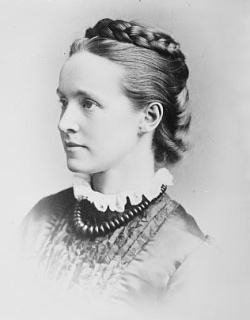
Women’s suffrage advocate Millicent Garrett Fawcett will become the first woman to be honoured with a statue in Westminster’s Parliament Square next month to mark the 100th anniversary of the passing of the 1918 act which gave women the vote for the first time. But who exactly was she?

Born in Aldeburgh, Suffolk, on 11th June, 1847, Millicent Garrett was the daughter of Newson Garrett, a merchant and shipowner, and his wife Louisa – the eighth of their 10 children.

At the age of 12, in 1858, she went to London with her older sister Elizabeth (who would go on to become Britain’s first female doctor) to study at a private boarding school in Blackheath. A key moment came seven years later in 1865 when she went to hear a speech by radical MP John Stuart Mills who spoke of equal rights for women.

Fawcett was deeply impacted and became actively involved in his campaign. When she was just 18, Millicent was introduced via Mills to Henry Fawcett, MP for Brighton and women’s rights activist and the two became close friends before, despite an age difference of 14 years, marrying on 23rd April, 1867. As well as caring for her husband who had been blinded in a shooting accident some 10 years before they were wed, Millicent took up a role as his secretary.

In 1868, Millicent gave birth to their only child, Philippa, and the family spent their time between two households – one in London (at 51 The Lawn on the site of what is now Vauxhall Park) and the other in Cambridge (where she later became a co-founder of Newnham College).

Meanwhile, with her husband’s encouragement, she was also pursuing her own writing career, penning the popular short book, Political Economy for Beginners, which was published in 1870, as well as becoming a well-known public speaker on a range of issues including women’s rights.

While when her husband – then Postmaster General – died of pleurisy on 6th November, 1884, Millicent temporarily withdrew from public life (it was after Henry’s death that, as per his wishes, Vauxhall Park was created on the site of his former home). But the years following saw her become increasingly engaged in activities in support of women’s suffrage.

She was involved in the formation of the National Union of Women’s Suffrage Societies (NUWSS) in 1897 – it went on to become the largest group of its kind with 50,000 members by 1913 – and would later become its president, a post she would hold until after World War I.

Fawcett’s interests, however, also saw her involved in campaigns to curb child abuse, to end child marriage and the “white slave trade” as well as the formation of a relief fund for South African women and children affected by the Boer War (in 1901 she visited South Africa as head of a commission charged with reporting on conditions in concentration camps).

When some groups advocating for women’s suffrage started to take more violent action – which included breaking windows and hunger strikes when jailed, Fawcett argued against such militancy and remained among the moderates, convinced that women would eventually win the vote as a result of the changes taking place in society.

Suffrage activism was interrupted thanks to World War I but the role women played in support of the war effort saw opinion shift enough for, in 1918, the passing of the Representation of the People Act, which gave women aged over 30 voting rights.

In 1919, Fawcett retired from active engagement in politics. She was appointed a Dame Grand Cross of the Order of the British Empire in 1925.

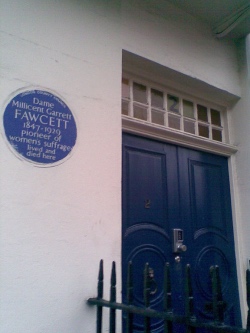
Fawcett witnessed the passing of an act to give women equal voting rights to men in 1928 – 10 years after the first act – before dying, at the age of 82, at her home at 2 Gower Street in Bloomsbury, London, on 5th August, 1929 (there’s a Blue Plaque on the property where she had lived for more than 45 years – pictured above). She was cremated at Golders Green but there is a memorial to both her and her husband in Westminster Abbey.

The Fawcett Society, which has carried her name since 1953, continues to fight sexism and gender inequality in the UK, campaigning on issues such as closing the gender pay gap.

Treasures of London – Caryatids at St Pancras…

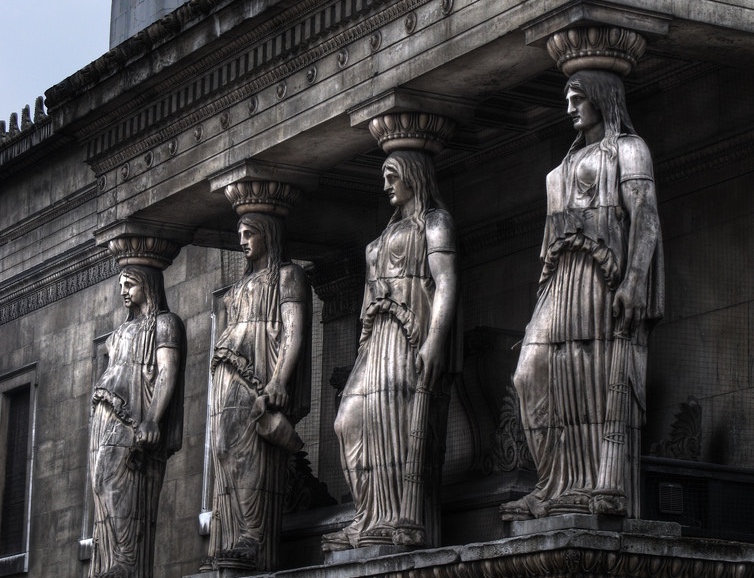
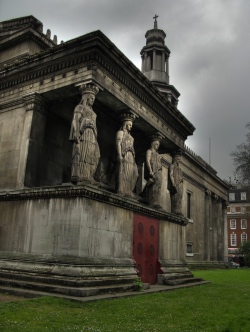
An intriguing feature at St Pancras Church are the eight female figures known as caryatids employed to support the rooves of two pavilions standing above the north and south entrances to the crypt.

The caryatids are modelled on those on the Erechtheum on the Acropolis in Athens – Henry William Inwood, who designed the church with his father William Inwood, apparently brought plaster casts of the original back to England to help with their plans for the building.

The caryatids, which were modelled by John Charles Felix Rossi, are made of terracotta constructed around cast iron cores. An original from Athens can be seen in the British Museum.

Unlike the caryatids on the Athens’ structure, however, each of the Inwoods’ statues carries an extinguished torch or empty jug, a reference to their position over the entrance to the crypt – a place of the dead.

The entire building, which is also known as St Pancras New Church to distinguish it the original St Pancras Church which is located to the north, was built between 1819-1822 and is an early example of the Greek Revival style. Other features of the church which also reference this style include its octagonal tower, modelled on the Tower of the Winds in Athens.

The church (we’ll take a more in-depth look at the building as whole in an upcoming post) now has a Grade I listing.

WHERE: St Pancras Church, Euston Road (nearest Tube stations are Kings Cross/St Pancras and Euston Square); WHEN: 8am to 6pm, Monday to Thursday (see website for Sunday times); COST: Free; WEBSITE: http://stpancraschurch.org

PICTURE: Tony Moorey (licensed under CC BY 2.0) Top image cropped. 

This Week in London – Victorian portraits; celebrating life at the Tate; Haiti’s slave revolution; and, saving paintings during wartime…

Portraits by four of the most celebrated figures in early art photography – Lewis Carroll, Julia Margaret Cameron, Oscar Rejlander and Clementine Hawarden – have gone on show in a new exhibition which opened at the National Portrait Gallery today. Victorian Giants: The Birth of Art Photography is the first exhibition in London to feature the work of Swede Rejlander since his death and includes the finest surviving print of his famous work Two Ways of Life (1856-57) which used his pioneering technique to combine several different negatives in creating a single final image. Also on show is an album of Rejlander’s photographs purchased by the gallery after it was prohibited from being sold outside of the UK in 2015 and works by Lewis Carroll depicting his famous muse Alice Liddell including lesser known photographs taken when she was a woman. Alfred, Lord Tennyson, Charles Darwin and actress Ellen Terry are among the subjects shown in the exhibition which runs until 20th May. Admission charge applies. For more, see www.npg.ork.uk/victoriangiants. PICTURE: Mountain Nymph, Sweet Liberty by Julia Margaret Cameron, 1866. © Wilson Centre for Photography 

A Francis Bacon portrait of Lucian Freud is being shown for the first time since 1965 in a new exhibition at Tate Britain celebrating human life in painted works. All Too Human: Bacon, Freud and a Century of Painting Life features around 100 works by artists including Walter Sickert, Stanley Spencer, Michael Andrews, Frank Auerbach, RB Kitaj, Leon Kossoff, Paula Rego, Jenny Saville, Lynette Yiadom-Boakye and others, as well as groups of major and rarely seen works by Freud and Bacon. Among the works by the latter are Freud’s Frank Auerbach (1975-76) and Sleeping by the Lion Carpet (1996) and Bacon’s Portrait of Isabel Rawsthorne (1966) and Study After Velazquez (1950). Runs until 27th August. Admission charge applies. For more, see www.tate.org.uk.

The legacy of the world’s first slave revolution – the Haitian Revolution – is explored in an exhibition at The British Museum. A revolutionary legacy: Haiti and Toussaint Louverture charts how the revolution led to the abolition of slavery and the formation of Haiti as an independent republic in 1804 and features a selection of objects commemorating the man who emerged as the revolution’s foremost leader, Toussaint Louverture. Among them is a screenprint, specially acquired for this exhibition, showing Louverture in military uniform by the African American artist Jacob Lawrence. There’s also a Haitian Vodou boula drum dating from the early 1900s, a Haitian banknote commemorating the nation’s bicentenary in 2004, a Senegalese coin commemorating the abolition of slavery and the cover of CLR James’ account of the revolution, Black Jacobins, written in 1938 and reissued during the civil rights movement in 1963. Haitian-born poet Gina Ulysee will perform a specially commissioned work which responds to the display on 16th March. Part of The Asahi Shimbun Displays, it runs until 22nd April in Room 3. Free entry. For more, including associated events, see www.britishmuseum.org.

A series of photographs recalling the removal of The National Gallery’s paintings to a disused slate mine in Snowdonia during World War II will go on show at the gallery on Monday. The 24 images document the dispersal of the paintings to Manod with five additional images by photographer Robin Friend showing the quarry as it looks today. There’s also a 30 minute film directed by Friend, Winged Bull in the Elephant Case, which follows the journey of a National Gallery painting that has taken human form as it tries to save its friends and get back to London (it can be seen on Saturday on BBC2 at 10pm). The free display – Manod: The Nation’s Treasure Caves – can be found in the Annenberg Court until 8th April. For more, see www.nationalgallery.org.uk.

Send all items for inclusion to exploringlondon@gmail.com.


Lost London – The Imperial Institute…


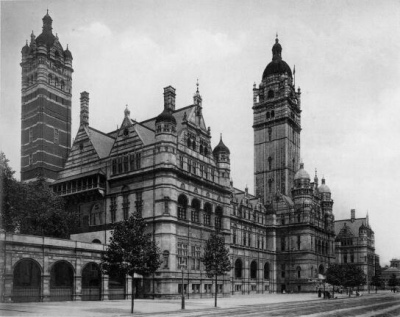
An ornate turreted building in South Kensington, construction of the Imperial Institute began in 1887 – the year of Queen Victoria’s Golden Jubilee.

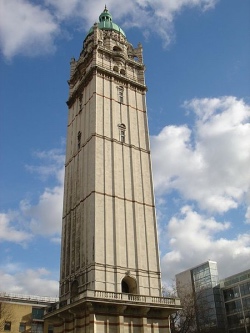
Designed by Thomas Edward Collcutt and paid for almost entirely by public subscription, the huge 213 metre long building featured three “Renaissance-style” towers with copper covered domes. Foremost among them was the 87 metre high Queen’s Tower (initially known as the Collcutt Tower after the architect).

Officially opened by Queen Victoria in 1893 (although the building was apparently never completed), the building – which was built to mark the Queen’s Golden Jubilee – was intended as an exhibition space to showcase the Empire’s industrial and commercial resources and also as a location for research and meetings.

The idea for a permanent exhibition space for colonial “produce” had apparently been enthusiastically backed by the Prince of Wales (and the Queen herself) following a series of exhibitions showcasing the wares of India and the colonies in preceding years.

But the enthusiasm for the institute, said to have cost more than £350,000, quickly waned (perhaps because of a vagueness over its purpose) and despite efforts to encourage people to use it through introducing “attractions” like a billiards room, the financial position of the institute became somewhat straitened.

Help came from the University of London which took over half of the building just six years later in 1899 and other tenants followed in attempt to keep money for maintenance flowing. Various government departments took on responsibility for the building in the following years.

With its purpose increasingly questioned by the middle of the 20th century, when Imperial College needed to expand, it was decided to demolish the building. Demolition started in 1957 and ran into the mid-1960s. Thanks to public protests led by Poet Laureate Sir John Betjeman, the Queen’s Tower, however, was preserved and is now part of Imperial College.

The tower, which once had a public viewing gallery (now closed) contains 10 bells, known as the Alexandra Peal, which are hung about halfway up the tower. They given by a Mrs Elizabeth A Miller, of Melbourne, Australia, in 1892 as a gift and are named after Queen Victoria, the then Prince and Princess of Wales, and other children and grandchildren of the Queen. They are rung on important college occasions.

Meanwhile, the institute, renamed the Commonwealth Institute, relocated to Kensington High Street. It later went into liquidation. That site now houses the recently unveiled Design Museum.

PICTURE: Top – Imperial Institute during the Edwardian era (public domain); Below –  The Queen’s Tower is all that now remains of the institute (licensed under CC BY-SA 3.0

Lost London – Poet’s Fountain…

This rather large fountain once stood in Mayfair as a tribute to literary greats Geoffrey Chaucer, William Shakespeare and John Milton.

Designed by Thomas Thorneycroft (and apparently funded from wealth of a lady who died intestate but who had apparently always advocated for the location of a fountain on the site), the fountain stood on the centre of what is now a roundabout at the intersection of Old Park Lane and Hamilton Place.

Unveiled in July, 1875, it featured the three poets standing on various sides of a central pillar (Shakespeare taking pride of place looking towards Hyde Park). Below them sat three muses and above them, on top of a central column, stood a figure representing fame, blowing a trumpet.

The fountain,  and survived until World War II during which it sustained damaged. It was dismantled in 1948 and only the figure of ‘Fame’ is believed to have survived.


London Pub Signs – The French House…

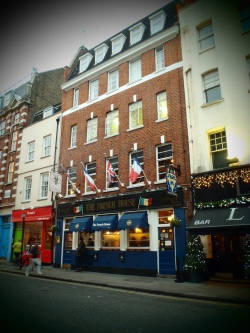
Opened in 1891 (albeit under a different name), this Soho institution was apparently founded by a German couple named Schmitt who ran it until the outbreak of World War I.

It was then sold to Belgian chef Victor Berlemont and it’s at this point that some say the name, previously said to have been the Wine House, was changed to the York Minister (although there seems to be a bit of confusion about when the name changed).

Its French associations, meanwhile. were given a big boost during World War II when General Charles de Gaulle and Free French Army officers, in London following the fall of France, made it their HQ. In fact, some say that it was in this pub that de Gaulle wrote his famous speech against the Vichy settlement.

While it was often informally called the “French pub” thereafter, the name didn’t officially change until it reopened after a fire in 1984.

M Berlemont’s son Gaston, meanwhile, had succeeded his father in running the pub many years earlier – there’s a story that when he walked into the pub after World War II, still dressed in his uniform, his father handed over the keys and left him to it. A well-loved Soho identity, the moustachioed Gaston remained at the helm until 1989 when the pub passed into the hands of some French House regulars.

Located at 49 Dean Street, The French House is known for its Bohemian links, particularly with the literary and artistic set. Dylan Thomas is said to have accidentally left his handwritten manuscript Under Milk Wood here while others associated with the pub include Irish poet and playwright Brendan Behan, artists Francis Bacon and Lucian Freud, writer John Mortimer (of Rumpole fame) and actor Tom Baker (of Dr Who fame).

For more, see www.frenchhousesoho.com.

PICTURE: Tom (licensed under CC BY-NC 2.0)

This Week in London – Charles I’s ‘Royal Collection’ on show; John Constable; and, 18th century satire…

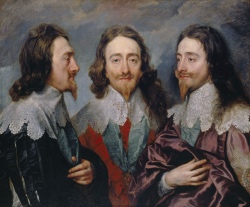
Anthony van Dyck, Charles I, 1635-6, Oil on canvas, 84.4 x 99.4 cm, RCIN 404420 Royal Collection Trust/© Her Majesty Queen Elizabeth II 2017

A landmark exhibition which reunites one of the most extraordinary art collections ever assembled opens in the main galleries of the Royal Academy of Arts in Piccadilly this Saturday. Presented in partnership with the Royal Collection Trust, Charles I: King and Collector features about 150 of the most important of the works collected by King Charles I during his reign, spanning the period from 1600 to 1649. They are among 1,500 paintings and 500 sculptures he collected  prior to his execution in 1649, after which the collection was offered for sale and dispersed across Europe. Many of the works were retrieved by King Charles II during the Restoration but others now form the core of collections at institutions such as the Musée du Louvre and the Museo Nacional del Prado. Among those on show in this exhibition, which includes more than 90 works borrowed from the Royal Collection, are several monumental portraits of the king and his family by Anthony van Dyck as well as the artist’s most celebrated portrait of the king, Charles I (‘Le Roi a la chasse’) (pictured), which returns to England for the first time since the 17th century. Other works include Peter Paul Rubens’ Minerva Protects Pax From Mars (‘Peace and War’) – this was commissioned by Charles and painted between 1629-30, Andrea Mantegna’s series, The Triumph of Caesar (c1484-92), and Titian’s Supper at Emmaus (c1530) while artists including Correggio, Tintoretto, Paolo Veronese, Albrecht Durer, Hans Holbein the Younger and Pieter Bruegel the Elder are also represented. The exhibition also shows off the celebrated Mortlake tapestries depicting Raphael’s Acts of the Apostles (c1631-40) and paintings, statuettes, miniatures and drawings once kept in the Cabinet at Whitehall Palace. Runs until 15th April. Admission charge applies. For more, see www.royalacademy.org.uk.

• John Constable’s oil sketch, Salisbury Cathedral from the Meadows, 1829–31, is one of 10 works which have gone on display at the Guildhall Art Gallery as part of its Victorian Landscapes exhibition. The painting takes centre-stage in the display in the gallery’s Temple Room; other works on show include John Brett’s Echoes of a Far-Off Storm (1890); Edward William Cooke’s Triassic Cliffs, Blue Anchor, North Somerset (1866), and Benjamin Williams Leader’s The Church at Betwys-y-Coed (1863). The paintings can be seen until early May. For more, follow this link.

Eighteenth century satire portrayed on ceramics and prints is the subject of a new free display at the British Museum. Pots with Attitude: British Satire on Ceramics, 1760-1830 features some 80 objects, some of which have not been on show for decades, including mugs and jugs (which make up the bulk of the items on show) as well as items like a cotton handkerchief printed with the “Peterloo Massacre” of 1819 and a rather grisly folding fan showing hidden profiles of executed French sovereigns (1794). Other objects show off copies of prints by satirists such as James Gillray and Charles Williams, with one of the latter’s showing a colossal Napoleon about to cross the Channel into England but prevented from doing so by a pint-sized, sword-carrying John Bull, who has sliced off his toes and is telling him, ‘Paws off, Pompey’ – the comment a reference to a lap-dog known as Pompey the Little who was the hero of a popular novel at the time. The display can be seen in Room 90a, Prints and Drawings Gallery, until 13th March. For more, see www.britishmuseum.org.

Send all items for inclusion to exploringlondon@gmail.com.

Where’s London’s oldest…umbrella shop?

Established back in the early nineteenth century, James Smith & Sons Umbrellas is a West End institution in London and is certainly among the oldest, if not the oldest, surviving business established to sell umbrellas.

The original shop was founded by James Smith in Foubert’s Place, off Regent Street, in 1830 with the umbrellas made in a rear workshop and then sold at the front. The shop then moved to Saville Place but when this building had to be knocked down to make way for road widening, it moved to Burlington Street near Piccadilly Circus.

Business boomed following the invention of Samuel Fox’s lightweight steel frame umbrellas in 1851 and in 1867, a second shop was opened at 53 New Oxford Street (in Hazelwood House, where it remains today). The Burlington Street branch, meanwhile, continued to be operational until it was destroyed by a bomb in World War II, leaving just the shop in New Oxford Street.

The New Oxford Street shop still sells a plethora of types of umbrellas as well as made-to-measure walking sticks. Some of the umbrellas – which include antique and more contemporary models – are reportedly assembled on site.

In the shop you’ll also find a portrait of Jonas Hanway, said to be the first man who owned an umbrella in London. Being an early adopter of this imported fashion trend from France, he apparently attracted the ridicule of London society as well as that of coach drivers who saw the threat to their trade he represented. But history was on Hanway’s side and while the umbrella has survived the past couple of centuries, the coach as a means of transportation has not.

PICTURE: Top –  Jorge Royan/licensed under CC BY-SA 3.0/ Right – Ewan Munro/licensed under CC BY-SA 2.0

Lost London – The first Blackfriars Railway Bridge…


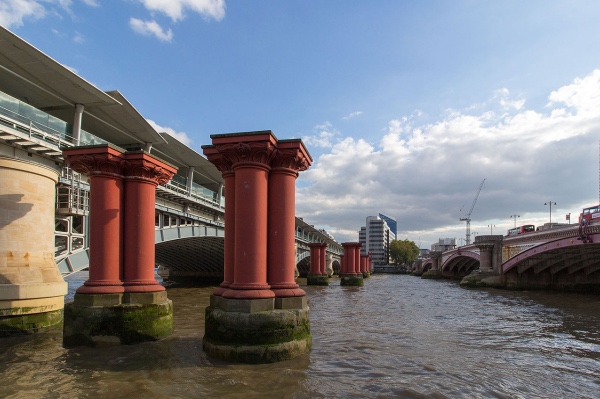
Two Blackfriars Bridges – a vehicle and pedestrian bridge, and a railway bridge – still span the River Thames from the City of London on the north bank to South Bank. But just beside the railway bridge stand some large red pylons – the remains of the first Blackfriars Railway Bridge. 

This bridge was built in 1864 to accommodate the London, Chatham and Dover Railway (LCDR) when it was extended north across the river to what was then named St Paul’s Station (at least until 1937 when it became Blackfriars Station).

The ornate bridge was designed by Joseph Cubitt but within 20 years of its being built, the second, still existing, railway bridge was constructed alongside it to provide more space for trains (the original bridge apparently only had four tracks).

The ornately decorated first bridge was supported on three rows of pylons – the third was incorporated into the second bridge (which is why we now only see two rows).

After 1923, when train services began to terminate at Waterloo Station on the south side of the river, the bridge was rarely used but it wasn’t until many years later, in 1985, that it was declared too weak to support the current crop of trains and removed.

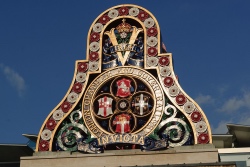
As well as the pylons, on the south side of the river can be seen a massive abutment of Portland stone featuring the ornate cast iron insignia of the former LCDR (above right). Grade II-listed, it was restored in about 1990.

PICTURES: Top – The wub/licensed under The wub; Right – SyndVer/licensed under CC BY-SA 4.0

What’s in a name?…St Pancras…

This name – now only usually used in reference to several buildings and landmarks around the Kings Cross area including churches, a road, hotel and railway stations – was originally that of a separate village.

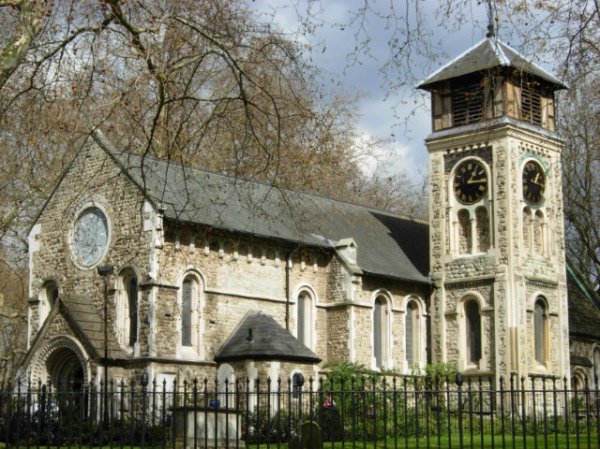
The village was named for the church in its midst which had been dedicated to St Pancras. The church – which has been dated back to at least the Norman era – is said to have been built on one of the earliest sites of Christian worship in the UK and was dedicated to a Roman-era boy martyr, St Pancras (in Latin, St Pancratius).

Tradition holds that St Pancras was a citizen of Rome who converted to Christianity and was beheaded for his faith during the Diocletian persecution in the early 4th century when aged just 14. When Pope Gregory the Great sent St Augustine on his mission to England in the late 6th century, he sent relics of the saint with him, hence why many English churches are dedicated to St Pancras.

The village which had been based around the church was apparently largely abandoned in the Middle Ages – possibly due to flooding – and the area was only resettled in the late 18th century with the development of Camden Town and Somers Town.

While the church – now known as St Pancras Old Church – was restored in the mid-19th century, a new parish church – known as St Pancras New Church – which built about a kilometre away on Euston Road.

PICTURE: Stephen McKay/licensed under CC BY-SA 2.0.

London Pub Signs – The Victoria, Paddington…

No prizes here for guessing that this pub owes its name to the long serving 19th century monarch, Queen Victoria.

There’s apparently a story that the Queen stopped off here on her way to Paddington Station and that, as a result, the pub was named in her honour.

Whatever the truth of that, the now Grade II-listed pub – located at 10a Strathearn Place (on the corner with Surrey Place) – was apparently built in 1838 – the first year if Victoria’s reign (and possibly a more valid reason for its name) and remodelled around the turn of the 20th century.

It features a luxuriously decorated interior with fireplaces, mirrors, and an original counter as well as paintings of the Queen, Prince Albert and their family.

The upstairs Theatre Bar features decorative elements taken from the former Gaiety Theatre which were installed in the late 1950s.

The pub, which was apparently patronised by the likes of author Charles Dickens (he is said to have written some of Our Mutual Friend here), Sir Winston Churchill and Charlie Chaplin as well as David Bowie – who did a live performance when launching an EP here in the 1960s.

It’s also been associated with more recent celebs like musicians Ronnie Wood and Liam Gallagher, artist Damien First and actor Keira Knightley.

There’s also a story that in 1960s one of the paintings on the walls was found to be a valuable portrait of a member of the Royal Family. It’s now apparently in the Royal Collection.

The pub is now part of the Fuller’s group – and has twice won their ‘Pub of the Year’ award. For more, see www.victoriapaddington.co.uk.

PICTURE: Ewan Munro (licensed under CC BY-SA 2.0)

Famous Londoners – Ebenezer Scrooge…

OK, so infamous may be a better label but the journey of Scrooge – the star of Charles Dickens’ A Christmas Carol, is one of redemption.

Christmas is almost upon us so we thought he was an appropriate figure to look at for our Famous Londoners series this week (and yes, we know he’s a fictional figure!)

Scrooge, who first appeared in 1843 when Dickens’ novel was published, runs a London-based counting-house and subjects his clerk, the hapless Bob Cratchit, to a gruelling workload on low pay (even complaining about him having Christmas Day off).

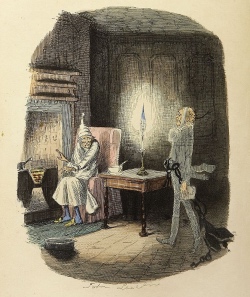
Refusing to give anything for the relief of the poor, the incorrigible Scrooge retires for Christmas Eve and is subsequently visited by the ghost of his former business partner, Jacob Marley, who thanks to his own greed and lack of charity is damned to wander the Earth for eternity. Marley then warns Scrooge that he risks the same fate and that, in a final chance for redemption, he will be visited by three spirits of Christmas – past, present and yet-to-come.

It’s not giving too much away to say that Scrooge, then experiencing these visions, repents and becomes a model of love and generosity, offering his help and support to Bob Cratchit and his family – particularly his ailing son, Tiny Tim (one of the best versions of the story is that of The Muppet Christmas Carol!)

There’s been much speculation over the years who was Dickens’ inspiration for the character with possible subjects including Edinburgh banker Ebenezer Lennox Scroggie, the theory being that while in the Scottish city to deliver a lecture on 1841,  Dickens misread Scroggie’s gravestone as being a “mean man” instead of a “meal man” (corn merchant).

Another theory says the character was based on John Elwes, born as John Meggot in 1714, who was noted for his miserliness. He apparently preferred, despite inheriting a fortune, to spend his nights in the kitchen with the servants so he didn’t have to light a fire in another room (although perhaps he just preferred their company), refused to pay for the maintenance on his house, dressed in ragged clothes and ate rotten food. Such was his thriftiness that Elwes, who was elected MP for Berkshire in 1772, apparently left some £500,000 to his two sons when he died in 1789.

As to where Scrooge’s counting house was located? The book never precisely locates it but there’s a few clues including that Bob Cratchit went on an ice slide in Cornhill, in the City of London, when making his way from work to his home in Camden and that Scrooge’s business was near a church tower. These two pieces of evidence have led some to place it alongside the church of St Michael’s, Cornhill, in Newman’s Court. Scrooge’s house, meanwhile, lies not too far away and is also close to a church leading some to place it at 45 Lime Street (now the home of Lloyds).

PICTURE: Marley’s ghost visits Scrooge in an original illustration by John Leech.


Lost London – Lowther Arcade…

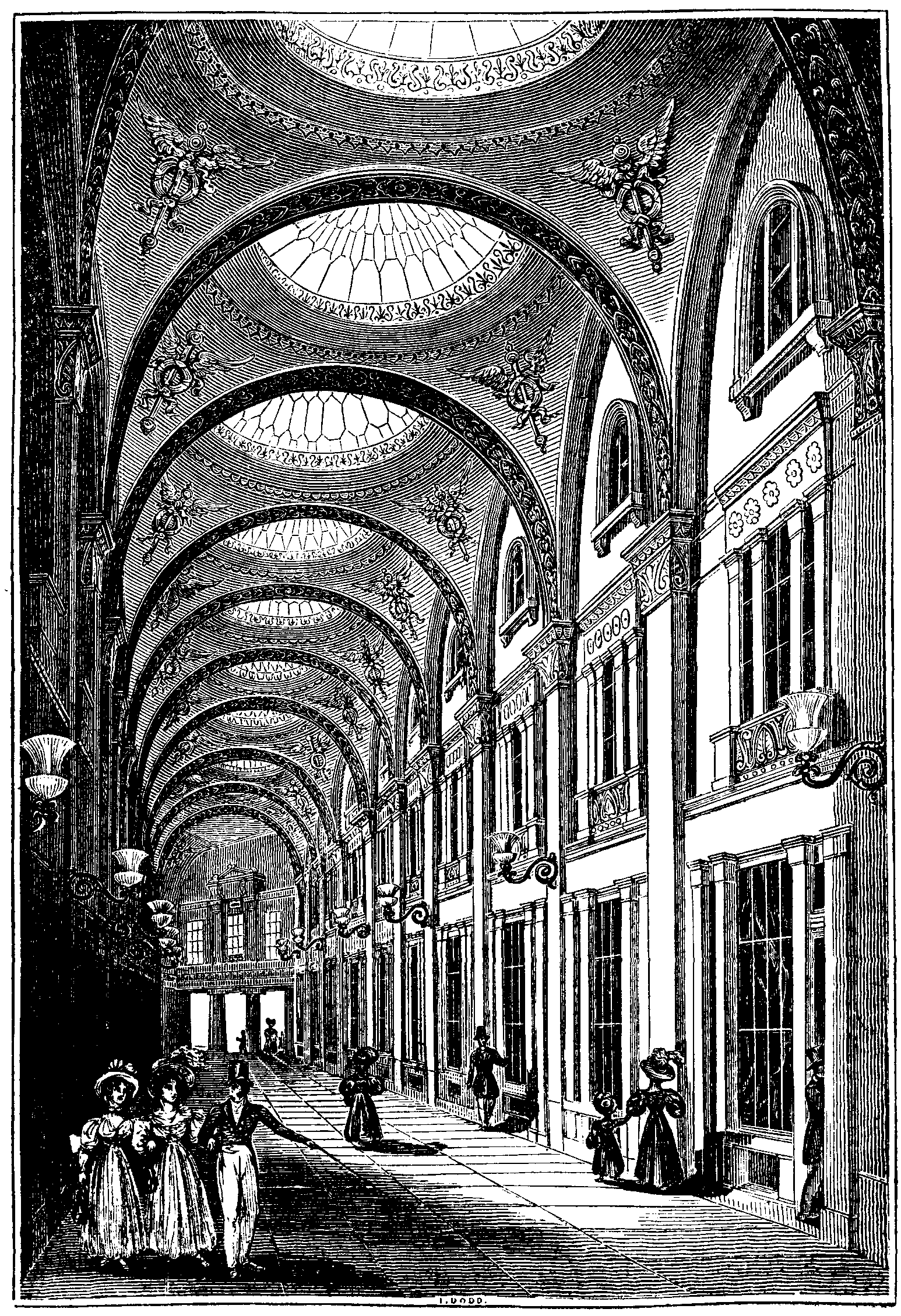
Designed by Witherdon Young, this 24 metre long arcade on the Strand was built in 1830 and was famously topped with glass domes. 

Named after Lord Lowther, Chief Commissioner of the Woods and Forests, when this section of the Strand was improved, the arcade’s 24 small shops initially sold luxury goods and various items but by the mid 19th century they were nearly all toyshops, making this a popular place for children (and particularly so, one might assume, at Christmas time!).

The northern part of the arcade was initially home to the Adelaide Gallery, described as a “National Gallery of Practical Science, Blending Instructions with Amusements” – this part of the building later became an amusement hall and then a puppet theatre.

The arcade was demolished in 1904 to make way for the construction of Coutts Bank.

PICTURE: Lowther Arcade as seen in an engraving published in a periodical in 1832.

This Week in London – The Royal Collection and Charles II; convicts lives explored; and, ‘Gold’ at the National Gallery…

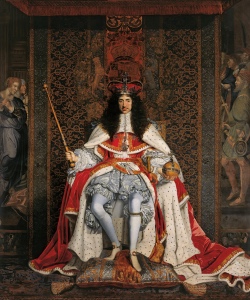
A new exhibition celebrating the role of the court of King Charles II in promoting the arts in England has opened at The Queen’s Gallery in Buckingham Palace. Charles II: Art and Power highlights the key role Charles II played in developing the Royal Collection following the Restoration in 1660 as a means of decorating royal apartments and, perhaps more importantly, of glorifying the restored monarchy and helping it to take its place back on the European stage. The display features works ranging from John Michael Wright’s monumental portrait of the king in coronation robes (pictured) to Henry Greenway’s silver-gilt dish that adorned the high altar of Westminster Abbey and Wenceslaus Hollar’s The Coronation of King Charles the II in Westminster Abby the 23 of April 1661. Other paintings on show include Titian’s Madonna and Child in a Landscape with Tobias and the Angel (c1535-40), Antonio Verrio’s The Sea Triumph of Charles II (c1674), Pieter Brugel the Elder’s The Massacre of the Innocents (c1565-67), and Sir Peter Lely’s Barbara Villiers, Duchess of Cleveland (c 1665) as well as tapestries and silver-gilt furnishings. The exhibition, which will be accompanied by a major exhibition in the Royal Academy of Arts in January and a series of documentaries on various BBC channels under the banner of a BBC Royal Collection Season, runs until 13th May. Admission charge applies. For more, see www.royalcollection.org.uk. PICTURE: John Michael Wright, Charles II, c.1676 Royal Collection Trust/© Her Majesty Queen Elizabeth II 2017.

The lives of convicts in 18th and 19th century London are the subject of a new exhibition opening at the London Metropolitan Archives. Criminal Lives, 1780-1925: Punishing Old Bailey Convicts includes original documents from the Old Bailey archives and items such as a policeman’s truncheon, a reproduction Millbank Prison uniform and convicts’ photographs drawn from collections in Britain and Australia to provide insights into the lives of offenders, from the time of the Gordan Riots in 1760 to the early 20th century. Among those whose lives are featured are prostitute and pickpocket Charlotte Walker, notorious receiver of stolen goods Ikey Solomons and serial thief Thomas Limpus. The exhibition, created in collaboration with the Arts and Humanities Research Council Digital Panopticon Project, opens on Monday and runs until 16th May. Admission is free. There is an accompanying programme of events. For more, see www.cityoflondon.gov.uk/lma.

The National Gallery is running a season of events aimed at exploring the theme of ‘gold’ in its collection in the run-up to Christmas. Running until 1st January, the programme includes free lunchtime talks, a life drawing session this Friday, a workshop on the traditional intaglio printmaking technique of drypoint, drawing sessions and a series of films. For the full season of events, check out www.nationalgallery.org.uk/whats-on/christmas-at-the-gallery/christmas-events.

Send all items for inclusion to exploringlondon@gmail.com.

10 subterranean sites in London – 6. Guildhall crypts…

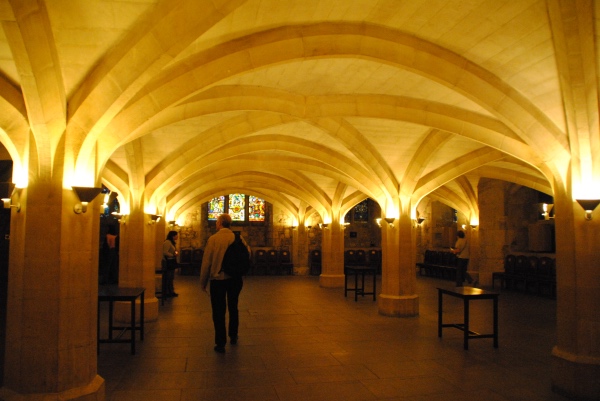
Located beneath Guildhall’s Great Hall is the oldest surviving part of the structure, the largest of London’s medieval crypts.

Dating from the reign of King Edward the Confessor in the 11th century, the vaulted East Crypt is considered to be one of the finest examples of its kind in England with a ceiling featuring a series of carved bosses depicting heads, shields and flowers.

It features a series of stained glass windows depicting five famous Londoners – Geoffrey Chaucer, William Caxton, Sir Thomas More, Sir Christopher Wren and Samuel Pepys.

The pillars holding up the roof, meanwhile – once located at ground level – show signs of where horses were once tied up while their riders went about their business.

The West Crypt, which is believed to date from the 13th century, was sealed off after collapsing under the weight of the roof of the Great Hall which fell down during the Great Fire of London in 1666. It was reopened in 1973.

The windows of the West Crypt represent some of the City of London’s livery companies (pictured above, right).

One of the most famous incidents took place in the crypts on 9th July, 1851, when Queen Victoria attended a banquet here during a state visit.

The crypts today are available to hire for atmospheric events.

WHERE: Guildhall, Guildhall Yard, City of London (nearest Tube stations are Bank, Mansion House and Moorgate); WHEN: 10am to 4.30pm daily (when not being used for events); COST: Free; WEBSITE: www.cityoflondon.gov.uk/things-to-do/visit-the-city/attractions/guildhall-galleries/Pages/guildhall.aspx.

10 subterranean sites in London – 5. Whitefriars Priory crypt…

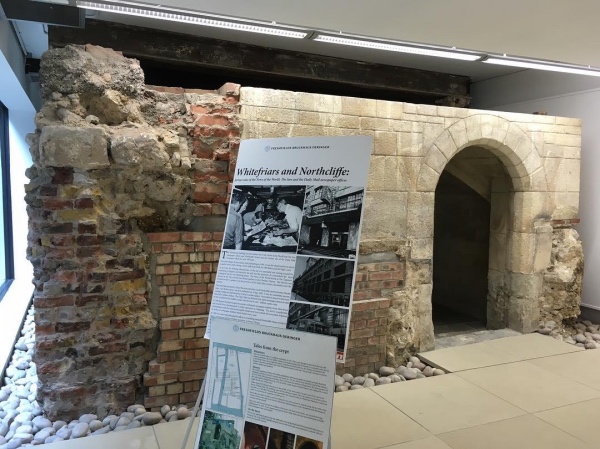
Located in the basement of a modern office building (and visible through glass) are the remains of a 700-year-old crypt that once lay beneath Whitefriars Priory.

Reached via Magpie Alley (off Bouverie Street which runs south from Fleet Street), the remains are all that is visibly left of the priory, founded here in the 13th century.

Known as ‘White Friars’ because of the white mantle they wore over their brown habits, the Carmelites (their proper name) were founded in what is now Israel in the mid-12th century. After the region fell to the Saracens in the mid-13th century, some members of the order made their way to England with the aid of Richard, Earl of Cornwall, brother of King Henry III. In  1241, Sir Richard Grey of Codnor founded the Priory of Our Lady of Mount Carmel on this site.

The priory – which counted towering medieval figure John of Gaunt among its patrons – once stretched from Fleet Street to the Thames and to the Temple in the west and what is now Whitefriars Street in the east. It included a church – enlarged in the 14th century – as well as cloisters, a garden and cemetery.

The priory survived until the Dissolution after which King Henry VIII granted various buildings to the King’s Physician and the King’s Armourer and the great hall become the famous Whitefriars Playhouse.

Whitefriars became part of the rather infamous slum known as Alsatia, a ‘liberty’ seen as a place of sanctuary for those fleeing the law. The priory was gradually subsumed into the slum – there’s a suggestion that the crypt may have been used as a coal cellar.

The remains of the 14th century vaulted crypt, which had been located beneath the prior’s house on the east side of the former priory site, were apparently found in the late 19th century and restored in the 1920s when the now defunct newspaper News of the World was expanding. During a redevelopment in the 1980s (which came after News International moved out to Wapping), the remains were moved to their current location.

WHERE: Whitefriars Crypt, Ashentree Court, City of London (nearest Tube stations are Temple and Blackfriars); WHEN: Daily; COST: Free; WEBSITE: None.

PICTURE: The crypt at seen at this year’s Open House London event. (Andrea Vail licensed under CC BY-ND 2.0.)

This Week in London – The Lord Mayor’s Show; Cézanne’s portraits; venom and its uses; and, Russia’s visual revolution…

The Lord Mayor’s Show takes place this Saturday as the new Lord Mayor of London, Charles Bowman, takes office with the event once again culminating in a spectacular fireworks display over the Thames. The Lord Mayor will arrive in the City at 9am via a flotilla which includes the QRB Gloriana and other traditional Thames barges. Riding in the splendid State Coach, the Lord Mayor then joins in the world famous procession which sets off from Mansion House at 11am, pausing at the Royal Courts where he swears allegiance to the monarch before returning via Victoria Embankment at 1pm. The fireworks display will start at 5.15pm from a barge moored between Blackfriars and Waterloo Bridges. For more details, head to https://lordmayorsshow.london. Meanwhile, on Sunday, annual Remembrance Sunday services will be held around the country centred on the Cenotaph in Whitehall where, in a break with tradition, Prince Charles is expected to lay a wreath on behalf of the Queen who, along with Prince Philip, will be watching from the balcony of the Foreign and Commonwealth Office building.

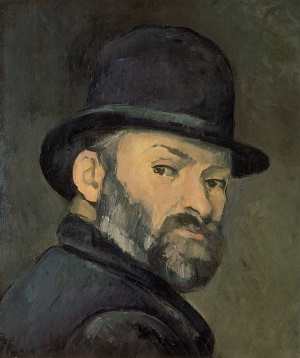
More than 50 portraits by Paul Cézanne have gone on show in a landmark exhibition at the National Portrait Gallery. Cézanne Portraits features works previously unseen in the UK including three self-portraits – one of which is Self Portrait in a Bowler Hat (1885-86) –  and two portraits of his wife –  Madame Cézanne Sewing (1877) and Madame Cézanne (1886–7) – as well as Boy in a Red Waistcoat (1888-90) and Madame Cézanne in a Yellow Chair, both of which haven’t been seen in London since the 1930s. The exhibition, which includes paintings spanning the period from the 1860s until shortly before Cézanne’s death in 1906, explores the special pictorial and thematic characteristics of the artist’s portraiture work such as his use of complementary pairs and his creation of multiple versions of works featuring the same subject. The exhibition, which has already been on show at the Musée d’Orsay and will be at the National Gallery of Art in Washington DC from late March next year, runs until 11th February. Admission charge applies. For more, see www.npg.org.uk. PICTURE: Self-Portrait with Bowler Hat by Paul Cézanne, 1885-6, © Private Collection 

The use of venom as the ultimate natural weapon is the subject of a new exhibition opening at the Natural History Museum on Friday. Venom: Killer and Cure explores how the use and effects of venom, the different biological roles it plays and how humans have attempted to harness and neutralise its power, with the former including some remarkable medical innovations. Specimens on show include everything from snakes to spiders, wasps, scorpions and the duck-billed platypus as well as live example of a venomous creature. Highlights include a gaboon viper head – a snake species with the largest known venom fangs, an emperor scorpion which engages in unusual mating behaviour known as “sexual stingings”, a flower urchin which can inject venom that causes muscular paralysis in humans for up to six hours, a tarantula hawk wasp which has one of the most painful venomous stings, and a box jellyfish, larger specimens of which can cause death in humans in two to five minutes. Admission charge applies. For more, see www.nhm.ac.uk.

Coinciding with the centenary of the Russian Revolution comes a new exhibition at the Tate Modern which offers a visual history of Russia and the Soviet Union. Red Star Over Russia: A Revolution in Visual Culture 1905-55 is based around the collection of late graphic designer David King (1943-2016) and charts how seismic events such as the overthrow of the last Tsar, the revolutionary risings of 1917 and Stalin’s campaign of terror inspired a wave of art and graphic design across the country. The display includes more than 250 posters, paintings, photographs, books and other ephemera by artists such as El Lissitzky, Aleksandr Rodchenko and Nina Vatolina. Runs until 18th February. Admission charge applies. For more, see www.tate.org.uk.

Send all items for inclusion to exploringlondon@gmail.com.

10 subterranean sites in London – 3. The Banqueting House undercroft…

Located beneath the Banqueting House – a remnant of the Palace of Whitehall, the undercroft was originally designed by Inigo Jones (who designed the building as a whole) as a private drinking den for King James I.

French landscaper and architect Isaac de Caus was commissioned to decorate one end of the vaulted undercroft as a shell grotto where the king could relax with his friends. In 1623, it received a dedication from Ben Jonson:

“Since Bacchus, thou art father
Of wines, to thee the rather
We dedicate this Cellar
Where now, thou art made Dweller.”

Following the Restoration, during the reign of King Charles II, the basement was used to hold lotteries – John Evelyn describes one such event taking place in 1664 in his famed diary, although soon after this was moved into a purpose-built facility nearby.

The undercroft was subsequently used for storage including during the reign of King James II when it was apparently used to store furnishings from the Privy and Council Chambers of Whitehall Palace while they were being rebuilt.

From the late 1890s until the 1960s, it became part of the museum of the Royal United Services Institute (which also used the hall upstairs) but following a restoration in 1992, is now open to the public and also used for special events at the building.

WHERE: Undercroft, Banqueting House, Whitehall (nearest Tube is Westminster or Charing Cross); WHEN: 10am to 5pm daily (check if there is a private function); COST: £5.50 adults (16+)/children under 16 free/Historic Royal Palaces members free; WEBSITE: www.hrp.org.uk/banqueting-house/

PICTURE: alh1/Licensed under CC BY-NC-ND 2.0

Where’s London’s oldest…hatters?

Hatters they are, but mad they most definitely are not (more on that connection later). Lock & Co Hatters, which describes itself not only as London’s oldest hat shop but the world’s oldest, has been serving the city’s hat needs since James Lock first opened the doors at number six, St James’s Street, in 1765.

Lock took over the premises after completing an apprenticeship as a hatter with Charles Davis, son of Robert Davis who had opened a hatters in St James’s Street in 1676. Lock had married Charles’ sister Mary in 1759 and, along with his new bride, had inherited his father-in-law’s business. In 1765, they and their growing family moved across the road from that premises to No 6, previously a coffee house.

The shop soon established itself with the city’s elite and its client list grew to include the likes of Lord Grenville, Prime Minister between 1806-07, and, most famously, Admiral Lord Nelson, who first visited the shop in 1800 to order his signature bicorne – a “cocked hat and cockade” – with a specially built-in eye shade (Nelson had lost his eye at the Battle of Calvi). Nelson’s final visit, incidentally, would take place in September, 1805, when he settled his bill before setting sailing to Spain where, wearing one of Lock’s hats, he would lose his life – and become part of a legend – in the Battle of Trafalgar.

But back to the Locks. James Lock died in 1806 and it was his illegitimate son, George James Lock (aka James Lock II), who inherited the business which continued to flourish (clients around this time include the Georgian dandy Beau Brummell). George’s son, James Lock III and his younger brother George took over in 1821, and in 1849, they were commissioned by Edward Coke to create a hard-domed hat for his gamekeepers – the result was the iconic Coke hat (known to some as the Bowler hat, a name which came from Southwark-based Thomas and William Bowler whom Lock had commissioned to make the hat) .

The Lock & Co hat business continued to pass down through the family and the list of the famous who purchased hats in the store continued to grow – Oscar Wilde bought a black fedora there to wear on his US lecture tour (and due to his later incarceration was unable to pay his bill which was settled more than 100 years later by one of his fans after this news was included in an article in The Times) while Sir Winston Churchill wore a Lock silk top hat on his wedding day and also purchased his trademark Cambridge and Homburg hats there.

In 1932, film star Douglas Fairbanks, Jr, moved in above the shop (and naturally bought some monogrammed hats which were sold in 2011 as part of his estate) while Charlie Chaplin purchased hats there in the 1950s and, impressively, in 1953, Lock worked with jewellers Garrard and Co to design the “fitments” for Queen Elizabeth II’s coronation crown.

A warrant from the Duke of Edinburgh, Prince Philip, followed (in 1993, Lock & Co received its second Royal Warrant, this time from the Prince of Wales.

Others among Lock’s more high profile clientele over the years have included Jacqueline Kennedy, wife of US President John F Kennedy, and Lock’s Coke hat even made a famed appearance on the silver screen as the headwear of the Bond villain Oddjob in Goldfinger.

The firm, meanwhile, has continued to grow, acquiring Piccadilly hatters Scott & Co in the 1970s.

Lock’s association with Lord Nelson was remembered in 2012 when it designed a hat for his statue atop Nelson’s Column in Trafalgar Square which featured a full-sized Olympic torch and which, due to popular demand, was left on the admiral for the duration of the Olympics.

Interestingly, it is also claimed that James Benning, a member of the Lock family and a servant of Charles Lutwidge Dodgson (aka Lewis Carroll) – writer of Alice in Wonderland, was the inspiration behind the ‘Mad Hatter’.

PICTURES: Top – Jeremy T. Hetzel; Right – Matt Brown – both licensed under CC BY 2.0.