Wren’s London – 5. Royal Hospital Chelsea

Known as the home of the scarlet-coated ‘Chelsea Pensioners’, the Royal Hospital Chelsea’s origins go back to December 1681 when King Charles II issued a Royal Warrant authorising the building of a royal hospital to care for old and maimed soldiers.

Sir Christopher Wren, then Charles II’s Surveyor-General of Works, was subsequently commissioned to design and construct the new buildings on a site next to the River Thames in Chelsea. Sir Stephen Fox, a commissioner of the Treasury, had the unenviable task of finding enough money to fund it – a task he managed through tapping a range of different sources.

Charles II didn’t live to see the completed project (although he did inspect the partially complete work just before his death in 1685) which was finally finished in 1692. The first pensioners were admitted in February that year.

Wren’s initial design comprised a single quadrangle with accommodation blocks for more than 400 veterans and their officers on the sides, and a chapel and great hall in a colonnaded building at the northern end while the southern end is open to the river (the picture above shows the ‘rear’ of the Hospital as seen from Royal Hospital Road). Known as Figure Court, it was named after a 7′ tall statue of Charles II which stands within it and which depicts the king as a Roman general.

Before the work was complete, however, Wren had realised that the design would not be large enough and added a two further quadrangles – one on each side of the original, they are known as Light Horse and College Courts – to the design.

There are some 300 ‘in-pensioners’ who still live in the hospital’s ‘berths’. When inside, they are encouraged to wear the Royal Hospital’s blue uniform while their famous scarlet coats with tricorne hats are worn on ceremonial occasions including Founder’s Day.

Held on a day close to 29th May – Charles II’s birthday and the date of his restoration – Founder’s Day commemorates his escape after the Battle of Worcester in 1651 and is known as Oak Apple Day in remembrance of the story that the fleeing Charles had to hide in an oak tree to avoid capture by parliamentary forces.

Women were first admitted to the hospital in 2009.

WHERE: Royal Hospital Road, Chelsea (nearest tube station is Sloane Square); WHEN: Entry to the courts, chapel and Great Hall is from 10am to 12pm, 2pm to 4pm; the museum is open Monday to Saturday, 10am to noon, 2pm to 4pm and Sundays 2pm to 4pm (closed Sundays from October to March); COST: Free; WEBSITE: www.chelsea-pensioners.co.uk

Famous Londoners – Samuel Pepys

A navy administrator and an MP who lived in London for much for the 17th century, it is for his remarkable diary – filled with reflections on great events and the intimate goings on of daily life – that Samuel Pepys is renowned around the world.

Born the son of a tailor in Salisbury Court, Fleet Street (the site is now marked with a plaque), on 23rd February, 1633, Pepys (pronounced ‘peeps’) attended St Paul’s School before moving on to Cambridge University. After graduation, he entered the household of one of his father’s cousins, Sir Edward Montagu, as a secretary around 1655 – the same year he married Elisabeth de St Michel.

Under the patronage of Sir Edward – after he became the Earl of Sandwich – Pepys was appointed Clerk of the Acts to the Navy Board – a task which saw him playing a key role in shaping the English fleet which fought (unsuccessfully) in the Second Anglo-Dutch War (1665-1667).

In 1673, he became Secretary to the Admiralty and the same year was elected an MP for Castle Rising in Norfolk (he later became an MP for Harwich). Pepys also served as president of the Royal Society from 1684-1686, and even visited Tangier where he was involved in the evacuation of the short-lived English colony there. He was imprisoned twice in later years – at least once on suspicion of supporting the Jacobites – but the charges were dropped and he retired at the age of 57 in 1690.

In 1701 he moved out to a house in Clapham and lived there until his death on 26th May, 1703 (his wife Elisabeth had died many years earlier in 1669 and they’d had no children). His extensive library – including his six volume diary – were bequeathed to Magdalene College at Cambridge.

Despite an illustrious public career, it is his diary for which Pepys is most celebrated. Covering the years from 1660 to 1669 (he only stopped writing for fear he would go blind), it records his reactions to such monumental events as Charles II’s coronation (he was present as a youth at the beheading of Charles I), the Great Plague of London in 1665 and the Great Fire of London the following year as well as intimate details from his personal life including how he spent his leisure time, his various illnesses and his sexual liaisons. Written originally in a form of shorthand, it was first published in 1825 – and only fully published in 1976 – and has since gone on to enthral and entertain millions around the world.

Among places in London which still hold a Pepys connection are St Bride’s Church (he was baptised there), All Hallows by the Tower (it was in the tower from which Pepys watched the Great Fire), St Olave’s on Seething Lane (pictured above) where Pepys and his wife are buried (he was living in Seething Lane when he started the diary and St Olave’s served as his parish church between 1660 and 1674). Further down Seething Lane, there is a bust of Pepys in the gardens which now cover the Navy Office where Pepys once lived and worked.

There is also an exhibition on Pepy’s in Prince Henry’s Room at 17 Fleet Street (the building dates from around 1610 and was a pub when Pepys was alive), although it is currently closed.  An online version of Pepys’ diary can be found at the website Pepys’ Diary. For more on Pepys’ life, we do recommend Claire Tomalin’s best-selling biography Samuel Pepys: The Unequalled Self.

Wren’s London – 3. The Royal Observatory, Greenwich

Leaving Wren’s churches momentarily, we turn this week to another of Wren’s designs, that of the Royal Observatory in Greenwich in London’s east.

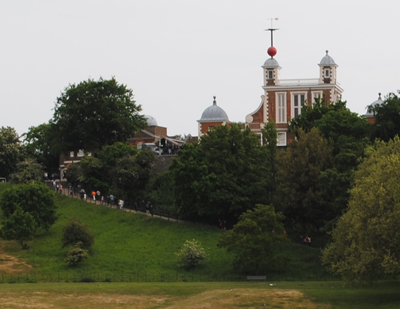
Commissioned in 1675 by King Charles II, the first part of the observatory – Flamsteed House, named for the first Astronomer Royal, John Flamsteed – was designed by Wren with, it is believed, the assistance of architect and scientist Robert Hooke.

Built using second-hand materials including stone brought from a Tudor fort at Tilbury, Flamsteed House was located on the former site of Greenwich Castle which had been previously used as a guest house and hunting lodge by Henry VIII. It is said to be the first purpose-built scientific research facility in the country.

The turreted building includes the Octagon Room from which Flamsteed made observations of events in the skies (although its position meant its use for this was somewhat limited), as well as living quarters for the astronomer. On top of the house is a red time ball which, since it was first used in 1833, has marked the time by falling at 1pm each day.

These days part of the National Maritime Museum and a UNESCO World Heritage Site since 1997, the site also hosts the Prime Meridian and is the place from where Greenwich Mean Time, since 1884 the basis for all world time, is calculated.

WHERE: Blackheath Avenue, Greenwich (nearest DLR station is Cutty Sark); WHEN: 10am to 5pm Monday to Sunday; COST: Entry is free; WEBSITE: www.nmm.ac.uk/places/royal-observatory/