London Pub Signs – The London Apprentice

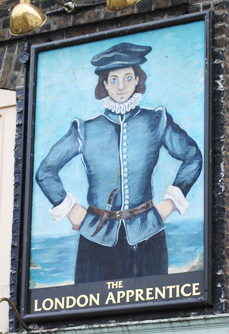
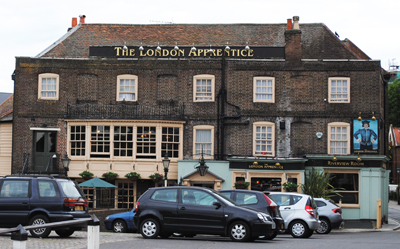
Sitting on the bank of the Thames at Old Isleworth in the city’s west stands The London Apprentice public house.

The pub’s licence dates back to at least 1731 and it has been associated with the likes of such luminaries as King Henry VIII (it’s suggested he met Catherine Howard here – she was later imprisoned in nearby Syon House), King Charles I and King Charles II (the latter apparently cavorted with his mistress, actress Nell Gwynne, here), as well as the ill-fated Lady Jane Grey and Lord Protector Oliver Cromwell.

Others whose names come up in reference to the pub include the ever-present author Charles Dickens (this is said to have been one his favorite pubs) and notorious highwayman Dick Turpin.

While there remain some doubts over its origins, the name of the pub – which stands opposite the small isle known as the Isleworth Ait – is said to stem from the fact that it was here that London apprentices, having faithfully served their masters, came to while away the hours in their downtime. They are said to have entertained themselves by playing about in decorated barges on the river.

There is said to be a tunnel, now blocked, which links the pub with the nearby All Saint’s Church – the story goes that this was used by smugglers to get their contraband into the pub’s cellars.

For more information or to pay a visit, see www.thelondonapprentice.co.uk.

The Royal Parks – 4. St James’s Park

The fourth in a line of parks stretching from Kensington Palace to Westminster, St James’s Park largely owes its foundation to King James I. 

Given its early history is covered in our earlier post, we’ll skip forward to the time of King Charles II when, under to instruction of Frenchman Andre Mollet, the park was redesigned with new landscaping including wide lawns, avenues of trees and a wide, centrally positioned canal. It was King Charles II who also opened the park up to the public (he even mingled with them there along with his mistress Nell Gwynn). Interestingly the first pelicans were also introduced to the park around this time when the Russian ambassador presented a pair of pelicans to the king.

In the 18th century, Horse Guards Parade was added to the park by filling in one end of the park’s canal and was later used for parades. The ceremonies of Beating Retreat and Trooping the Colour are still held there today.

The next major changes came in the 19th century when in 1827-28, architect John Nash oversaw a more romantically inspired renovation, including the transformation of the canal into a natural looking lake and the addition of winding paths, as part of his grand scheme which still shapes much of London today.

It was also at this time that The Mall (which like Pall Mall takes it name from the game of Pelle Melle – see our earlier post) was transformed into a grand processional route (it was opened to traffic later, in 1887). The park, bounded to the west by Buckingham Palace, also takes in the Queen Victoria Memorial – completed in 1914 to replace the Marble Arch which was moved to its current location at the corner of Oxford Street and Park Lane in 1851 – and flower beds which are planted annually with 12,000 geraniums, the color of which is chosen to match the guardsmen’s tunics.

Meanwhile, in 1837, the Ornothological Society of London erected a cottage for the birdkeeper (the thatched cottage can still be seen there today and the post of birdkeeper still exists). The first bridge was placed across the lake in 1851 (and replaced in 1951 with the one that now stands there).

Little has changed in the 23 hectare (58 acre) park since Nash’s day. Newer facilities include a restaurant and a playground at the western end.

WHERE: St James’s Park (nearest tube station is St James’s Park); WHEN: 5am to midnight daily; COST: Free entry; WEBSITE: www.royalparks.gov.uk/St-Jamess-Park.aspx 

PICTURE: © Anne Marie Briscombe  (courtesy Royal Parks)

The Royal Parks – 3. Green Park

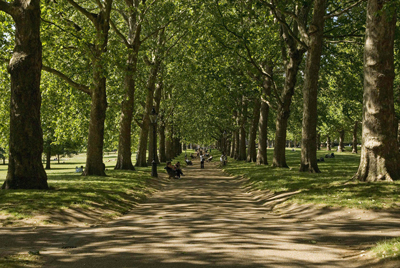
Perhaps the most overlooked and least celebrated of central London’s Royal Parks, Green Park (officially The Green Park) is a peaceful oasis of leafy trees between the bustle of Piccadilly and traffic of Constitution Hill and part of an unending swathe of green which connects Kensington Gardens with, eventually, St James’ Park.

Originally meadowland used for hunting, the earliest known mention of the area where the park now stands was apparently in 1554 when it was believed to be a staging point for Thomas Wyatt (the younger) who led a group of rebels protesting against the marriage of Queen Mary I to King Philip II of Spain. The unfortunate – and unsuccessful (in terms of his rebellion at least) – Wyatt was later beheaded for treason.

In 1668, King Charles II had the park enclosed with a brick wall and stocked with deer, as well as having a ranger’s lodge and icehouse built (to keep his drinks cool when entertaining in summer). While it was initially known as Upper St James’s Park, by 1746 Green Park had its own name. It’s not really known what prompted the name change but the unofficial story is that Queen Catherine of Braganza, wife of King Charles II, found out that her philandering husband had picked some flowers there for another woman – a milkmaid. In revenge, she had every flower in the park pulled up with orders they were not to be replanted. To this day, while some 250,000 daffodils bloom here in spring, there remain no formal flowerbeds in the park.

The 47 acre (19 hectare) park, which was also used on occasion as a duelling ground, underwent further development at the beginning of the following century with the creation of the ornamental Tyburn Pool near the centre of the park.

Queen Caroline, the wife of King George II, meanwhile, had a reservoir built to supply water to St James’s Palace and Buckingham Palace (it was known as the Queen’s Basin) as well as a library and the Queen’s Walk. Planted in 1730, this runs along the eastern side of the park and helped to turn it into a fashionable place in which to be seen (and led to the building of many a mansion in nearby Piccadilly).

Other buildings in the park have included two temporary ‘temples’ – the Temple of Peace (erected in 1749 to mark the end of the War of Austrian Succession) and the Temple of Concord (erected in 1814 to mark 100 years of the rule of the Hanoverian dynasty). Both of these, believe it or not, burnt down during the celebrations they were built for.

The park, which underwent a redesign in which the first trees were planted in the 1820s as part of architect John Nash’s grand plans for St James’s Park, was opened to the general public in 1826 but by then many of its earlier features – including the ranger’s house, Tyburn Pool and the Queen’s Basin – were already gone.

In more recent times, war memorials have been added to the park – the maple-leaf daubed, Pierre Granche-designed memorial to Canadian soldiers in 1994 (Canada is also remembered in Canada Gate on the park’s south side, installed in 1908 to mark the nation’s contribution to the Empire), and a set of memorial gates on Constitutional Hill at the park’s western end which is dedicated to the five million people from the Indian Sub-Continent, Africa and the Caribbean who served in World War II in 2004. The park also features the ‘Diana fountain’, installed in 1952 by the Constance Fund (and currently undergoing restoration).

On 14th June, a 41 royal gun salute is fired here to mark the Queen’s birthday. Salutes are also fired here for the State Opening of Parliament in November or December, Remembrance Sunday, and for State Visits.

WHERE: Green Park (nearest tube station is Green Park and Hyde Park Corner); WHEN: daily; COST: free; WEBSITE: http://www.royalparks.gov.uk/Green-Park.aspx

PICTURE: Courtesy of Royal Parks. © Anne Marie Briscombe 

The Royal Parks – 2. Kensington Gardens

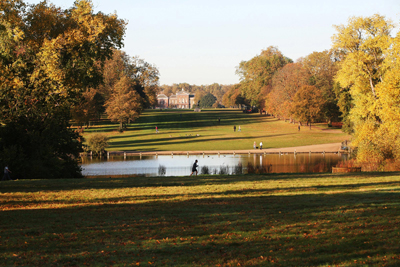
Once the western part of King Henry VIII’s hunting ground, the 111 hectare Kensington Gardens is now primarily associated with the palace which sits at its heart.

The origins of the gardens go back to 1689 when King William III and Queen Mary II decided to make Kensington Palace (which, as we mentioned last week, was formerly known as Nottingham House) their home. Queen Mary oversaw the creation of a formal, Dutch-style garden featuring hedges and flower beds.

Queen Anne expanded the gardens after King William III’s death and commissioned landscape designers Henry Wise and George Loudon to create an English-style garden. She also ordered the construction of the Orangery which still stands to the north of the palace complex today (and houses a fine restaurant).

But it’s to Queen Caroline, wife of King George II, to whom Kensington Gardens owe its current form for it was she who in 1728, scythed off 300 acres of Hyde Park and employed Charles Bridgeman to create a new garden. His designs included damming the Westbourne stream to create the Long Water and the adjoining Serpentine in Hyde Park. He was also responsible for the creation of the Round Pond in front of the palace and, a landscape-history making move, used a ditch known as a ha-ha to separate the gardens from Hyde Park.

By the reign of King Charles II, the gardens had become fashionable for the elite to stroll in with the Broad Walk a popular promenade. But the gardens gradually fell from favour – a move exacerbated when Queen Victoria, who was born in Kensington Palace, moved to live at Buckingham Palace.

There were some changes made during the era, however. They included the creation of the ornamental Italian water gardens at the northern end of the Long Water and the Albert Memorial (see our previous story here) on the southern edge of the gardens.

Other highlights there today include the Peter Pan statue (see our earlier story on this), the Serpentine Gallery (with, in summer, a temporary pavilion), the Peter Pan-themed Diana, Princess of Wales Memorial Playground (opened in 2000), and the Elfin Oak, a stump which originally came from Richmond Park and is carved with tiny figures of woodland animals and fairies.

There’s also a statue of Queen Victoria directly outside of Kensington Palace which, interestingly, was sculpted by her daughter Princess Louise in celebration 50 years of her reign, as well as statues of Edward Jenner, creator of the small pox vaccine, and John Hanning Speke, discoverer of the Nile.

Other facilities include a cafe and, next to the magazine, an allotment.

WHERE: Kensington Gardens (nearest tube stations are that of Queensway, Bayswater, Lancaster Gate, South Kensington, Gloucester Road and Kensington High Street); WHEN: 6am to dusk; COST: Free; WEBSITE: http://www.royalparks.gov.uk/Kensington-Gardens.aspx

PICTURE: Courtesy of Royal Parks. © Giles Barnard

Daytripper – Oxford

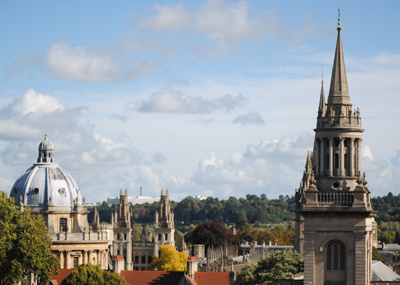
The “city of dreaming spires”, Oxford is a delight for the student of historic architecture, boasting an impressive array of medieval and later, classically-inspired, buildings.

Only about an hour from London by train (leave from Paddington Station), Oxford was established as a town in the 9th century and rose to prominence during the medieval period as the location of a prestigious university, an institution which remains synonymous with the city today.

Major development followed the Norman Conquest the castle was constructed, the remains of which were included in a £40 million redevelopment several years ago of the area in which it stands and which now houses the Oxford Castle Unlocked exhibition which looks at some of the key figures in the castle’s past (you can also climb St George’s Tower for some great views over the city).

The university first appears in the 1100s and gradually expanded over the ensuing centuries gradually evolved to encompass the many medieval colleges which can still be seen there today.

Something of a hotbed of activity during the Reformation, Oxford saw the burning of three bishops – Hugh Latimer, Nicholas Ridley and Archbishop of Canterbury Thomas Cranmer at a site marked by a memorial in Magdalen Street. Constructed in the 1840s, it was designed by Sir George Gilbert Scott who drew inspiration from the Eleanor Crosses King Edward I had erected in honor of his deceased wife, Eleanor of Castile, following her death in 1290.

Oxford was also the site of the headquarters of King Charles I during the English Civil War after the king was forced to leave London (the town eventually yielded to parliamentarian forces after a siege in 1646) and was later home to the court of King Charles II after he fled London during the Great Plague of 1665-66.

Canals arrived in the late 18th century and the railways followed. Industrialisation came – in particular, in the 20th century, in the form of a large car manufacturing plant at the suburb of Cowley – and with it an increasingly cosmopolitan population. But at its heart Oxford remains a student city and it’s the students that continue to provide the lively atmosphere in the city centre.

Look for Carfax Tower to get your bearings – formerly the tower of a 14th century church, this lies at the heart of the town and can be climbed for some great views over the surrounding streets. Some of the colleges are also open to the public (see noticeboards outside the colleges for times) – particularly worth visiting is Christ Church which dates from 1524 and, founded by Cardinal Wolsey, was initially known as Cardinal’s College. It features the Tom Tower, home of the bell Great Tom, which was designed by former student Sir Christopher Wren. The college, which is unique in that the college chapel is also a cathedral, is also home to the Christ Church Picture Gallery.

Other colleges of note include the beautiful Magdalen (pronounced Maudlin, it was founded in 1458 – alumni have included writers John Betjeman, CS Lewis and Oscar Wilde), All Souls (founded in 1438 with King Henry VI its co-founder), and Merton College (the oldest of Oxford’s colleges, it was founded in 1264 and is home to Mob Quadrangle, the oldest quadrangle in the university).

Other university buildings which are a must include the Radcliffe Camera – now the reading room of the Bodleian Library, this Baroque rotunda dates from 1748 and was built as a memorial to 18th century physician Dr John Radcliffe, the Sheldonian Theatre – another of Wren’s designs, it was built in the 1660s as the university’s principal assembly room, and St Mary the Virgin Church – the official church of the university, the present building partly dates from the 13th century and boasts terrific views from the tower.

Make sure you also take the time to wander through the water meadows along the River Cherwell (there are also punt rides) and walk along the River Thames, known as the Isis as it passes through Oxford. Keep an eye out also for the ‘Bridge of Sighs’, similar in design to the Venetian landmark, it spans New College Lane and joins two sections of Hertford College.

Other sites in Oxford include the Ashmolean Museum of Art and Archaeology. Considered of the UK’s best, the original Ashmolean was the first purpose built museum in England, opening in 1683. It now houses treasures include art and antiquities with the late ninth century Alfred Jewel, said to have been made for King Alfred the Great, among its prized objects. Other museums include the Pitt Rivers Museum which cares for the university’s collection of anthropology and world archaeology and includes exhibits brought back to Britain by explorer Captain James Cook.

Take the time also to wander through the covered market off high street which has some interesting shops selling everything from clothes to fresh food and flowers and gifts. Fans of Inspector Morse, meanwhile, may also enjoy seeing some of the sites of particular significance in the TV series – there’s an interactive online map here.

A vibrant city redolent with history, Oxford remains of England’s jewels. Perfect as a day-trip destination from London.

Daytripper – Brighton

It’s summer and that means, fingers crossed that the weather holds, Londoners start looking for the beach. One of the easiest to access coastal resorts – just an hour on the train – is the East Sussex town of Brighton.
Its history dates back to before the Doomsday Book and by medieval times, the town – previously known as Brighthelmstone – was prosperous enough to become a target to French raiders who burnt it down during a raid in 1514.

Yet much of what we now know as Brighton dates from the late 18th century when the town was transformed into a fashionable seaside resort. But before we get to that, there’s a couple of notable survivors from earlier days worth mentioning.

First up is the  14th century St Nicholas’ Church which, although considerably altered in later years, still contains a Norman font and has several graves of interest in the churchyard including that of Captain Nicholas Tattersall who carried King Charles II to France in his boat in 1651, as well as those of Phoebe Hessel, famed for having served 17 years in the army during the 1700s disguised as a man, Sake Dene Mohomed who first brought Turkish baths to Brighton and Amon Wilds, a famed Regency architect and builder.

And for a feel of what the medieval streetscape may have been like, head to the central shopping area known as The Lanes which still follows the medieval street pattern (although the shops date from later period) and which, boasting a range of interesting shops, is well worth spending some time poking about in.

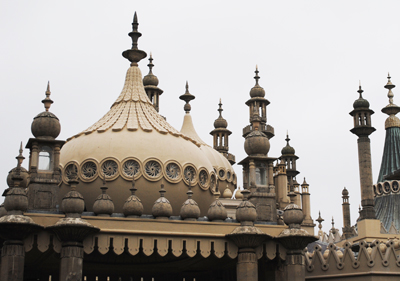
While Brighton had gradually been establishing a reputation as a sea bathing resort in the years prior to 1783, in that year the town’s profile received a valuable boost when the Prince Regent (later King George IV) visited the town. So taken with it was he that not only did he make repeat visits, he also constructed the magnificently opulent Royal Pavilion (pictured) – completed in 1822 and designed by John Nash – which still stands as one of the town’s foremost attractions.

The property, which Queen Victoria sold to the town in 1850 for the grand price of £53,000, boasts a series of exquisitely decorated chambers inspired by exotic ‘oriental’ themes. A 10 year, £10 million restoration project was completed in 1991.

Other properties in the town dating from a similar era include the Brighton Dome, which, completed in 1808, was originally the stables for the Prince Regent (back in the day when the Royal Pavilion was simply a farmhouse – in fact, it’s said that it was that fact people commented that the Prince’s horses were better accommodated than the man himself which helped spur him to build the Royal Pavilion). These days it’s the town’s main landmark entertainment venue and contains a concert hall and theatre.

Another property of the era is the Western Pavilion which feature a large Indian dome in reference to those of the Royal Pavilion and was built by Amon Henry Wilds, son of the architect Amon Wilds and a partner in his architectural practice, in 1831 as a residence. It stands next to the Gothic house built by his father, and another architect, Charles Busby, in the 1820s.

The arrival of the railway in 1841 further opened up the town to Londoners which in itself led to the construction of numerous waterfront hotels (the most famous of which is the Grand Hotel, built in 1864 and the scene of a 1984 IRA bombing aimed at killing then PM Margaret Thatcher).

The boom also saw three piers built running out off the foreshore – the Chain Pier (built in 1823 and destroyed by a storm in 1896), the West Pier (constructed in 1866, the derelict remains of which stand starkly in the waters off the town today after it was closed in 1975), and the Palace Pier (constructed in 1899, it is now hosts a lively funfair and, since 2000, has been formally known as Brighton Pier).

The late 1800s also saw the founding the Booth Museum (1874) by naturalist and collector Edward Thomas Booth (located in Dyke Road, it is now known as the Booth Museum of Natural History) and Volk’s Electric Railway which opened in 1883 and is now the ‘world’s oldest operating electric railway’, still running daily trains between Brighton Pier and Black Rock near the Marina.

Brighton, now part of the City of Brighton & Hove, remains a popular beach resort for Londoners, both for its beach and its nightlife, so on a warm day be prepared to fight the crowds.

Among the town’s other, more recent, attractions are the Sea Life Centre on the waterfront, home to more than 150 creatures including sharks and rays, the Brighton Museum & Art Gallery in the city’s ‘cultural quarter’ near the Royal Pavilion, and the Brighton Fishing Museum, also located on the waterfront, it traces the story of the town’s fishing community.

Visit Brighton has a range of maps and walks to help you explore the city. Visit www.visitbrighton.com for more information.
Where’s London’s oldest…(still-in-use) theatre?

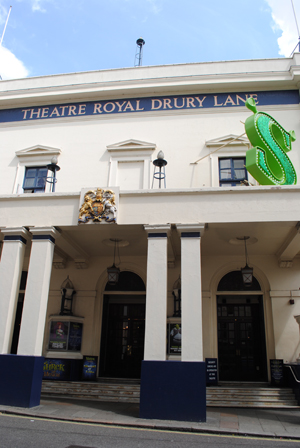
While the remains of some of London’s oldest purpose-built theatres – such as The Rose and The Globe – can be found in once notorious Southwark, London’s oldest, still-in-use theatre is in fact in the West End. The Theatre Royal Drury Lane (not to be confused with the Theatre Royal Haymarket) apparently takes the honor – the latest incarnation of a theatre which has still on the same location since 1663.

First built on the orders of Restoration-era dramatist and theatre manager Thomas Killigrew, the original theatre on the site – where King Charles II’s mistress Nell Gwynn apparently trod the boards and which was originally known as the Theatre Royal in Bridges Street – was burnt down in 1672 only to be rebuilt to the designs of Sir Christopher Wren two years later.

This building lasted for more than a century before it too was demolished – this time to make way for a larger theatre which opened its doors in 1794. Fire seems to have been a perennial problem, for it too burned down in 1809, being rebuilt and opened again in 1812 with a performance of Hamlet (the current building, designed by BenjaminWyatt).

Now owned by star composer Andrew Lloyd Webber via his Really Useful Group, the building has associations with some of London’s theatreland’s finest names – everyone from eighteenth century actor David Garrick (one of the theatre’s managers) to early nineteenth century child actress Clara Fisher and, in more recent times, Monty Python.

Currently hosting Shrek: The Musical, other recent productions there have included Miss Saigon and a musical adaption of Lord of the Rings.

Treasures of London – The White Tower

It’s one of London’s most famous landmarks and, having just undergone a three year, £2 million restoration, we thought it was time to take a look at the origins of the White Tower.

Now the keep of the Tower of London, the White Tower was first built by the Norman King William the Conqueror following his defeat of Saxon King Harold Godwinson and the cream of the Saxon army at the Battle of Hastings in 1066.

Following his coronation at Westminster Abbey on Christmas Day, King William then withdrew to Barking Abbey while his men built several temporary strongholds in the city to ensure it wouldn’t cause any trouble – this included an earth and timber keep standing on an artificial mound in the south-east corner of the city’s Roman-era walls.

The White Tower, a permanent structure, replaced this and although the exact date its construction started is unknown, building – under the watchful eye of Gundulf, the Bishop of Rochester, was well underway by the mid-1070s. While the labourers were English, the masons in charge of the building were Norman and then even used some Caen stone imported from William’s homeland (along with Kentish ragstone). By 1097 the tower was complete.

Primarily built as a fortress rather than for comfort, the size of the Tower was intimidating and, at 27.5 metres tall, it would have dominated the skyline for miles. Initial defences surrounding the White Tower included the Roman walls and two ditches although in later years outer walls were added to create the massive fortifications and series of towers one encounters at the site today.

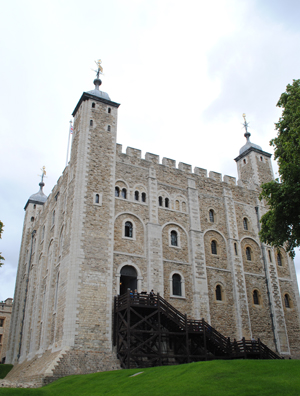
The tower earned its moniker, the White Tower, from the whitewash used on its walls during the reign of King Henry II. The caps on the four turrets which stand at each corner of the tower were originally conical but were replaced with the current onion-shaped domes in the 1500s (the round tower was once home to the Royal Observatory before it moved out to Greenwich). The White Tower’s large external windows are also more modern innovations, these were added in the 1600s by Sir Christopher Wren.

The original entrance to the White Tower was on the first floor, reached by a wooden staircase (that could be removed if necessary), much as it is today while, for security reasons, the internal stone spiral staircase was placed as far from this entry as possible in the north-east turret. A stone forebuilding was later added during the reign of King Henry II but was later demolished.

Inside, accommodation for the king was provided on the second floor – it originally had a gallery above but an extra floor – still there today – was later added. Accommodation for the Tower’s constable was probably on the first floor. Both floors were divided in two – with a large hall on one side and smaller apartments on the other. These rooms now house displays on the Tower’s history – at the present these include the Royal Armouries’ exhibition ‘Power House’.

The White Tower is also home to the Chapel of St John the Evangelist which, made from Caen stone, still looks much the same as it did in Norman times. It was used by the royal family when in residence at the tower but by the reign of King Charles II had become a store for state records. These were removed in 1857. Among some of the events which took place here was the lying in state of Queen Elizabeth of York, wife to King Henry VII, after her death in 1503, and the betrothal of Queen Mary I to Philip of Spain in 1554 (by proxy, Philip was not present). Prince Charles received communion here on his 21st birthday.

Other historic events associated with the White Tower include the apparent murder in 1483 of the ‘Princes in the Tower’ – King Edward V and his younger brother, Richard, Duke of York – while legend says they were killed in the Bloody Tower, the discovery of two skeletons under stairs leading to the chapel during building works in 1674 has led some to believe that they may have been buried here.

It was also in the White Tower that King Richard II was forced to sign away his throne to King Henry IV in 1399 and it was from the White Tower that Gruffydd ap Llywelyn Fawr, the illegitimate son of  Welsh Prince Llywelyn the Great, apparently fell to his death while attempting to escape captivity in 1244.

There are tours of the White Tower daily at 10.45am, 12.45pm, and 2.15pm.

WHERE: Tower of London (nearest tube station Tower Hill); WHEN: 9am to 5.30pm, Tuesday to Saturday, 10am to 5.30pm Sunday to Monday (until 31st October); COST: Included in Tower of London admission – £19.80 adults; £10.45 children under 15; £17.05 concessions; £55 for a family (prices include a voluntary donation); WEBSITE: www.hrp.org.uk/toweroflondon/.

LondonLife – Trooping the Colour…

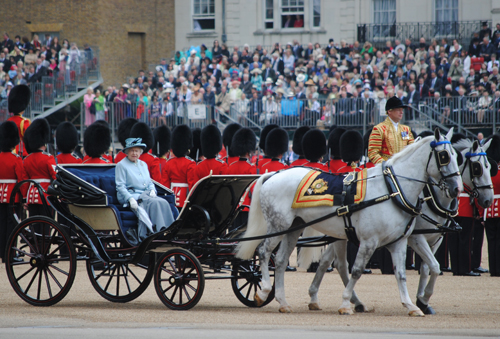
A ceremony first believed to have been performed during the reign of King Charles II, since 1748 the parade has been used to mark the Official Birthday of the Sovereign.

 Queen Elizabeth II inspects the Guards in her phaeton.

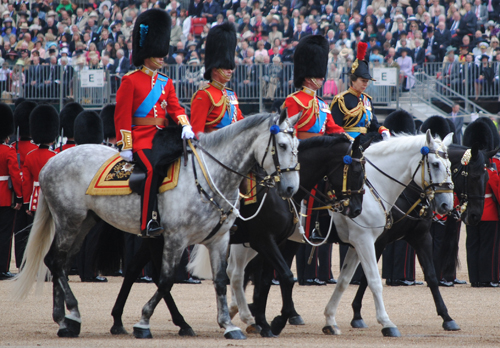
Prince William, Prince Charles, the Duke of Kent and Princess Anne riding Queen’s Escort behind the Queen.

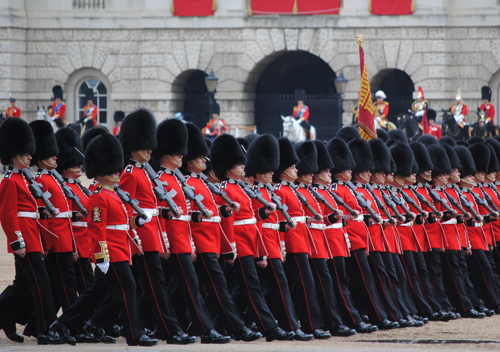
The parade includes six Guards groups. This year it was the turn of the Scots Guards, raised in 1642 at the behest of King Charles I, to parade their colours.

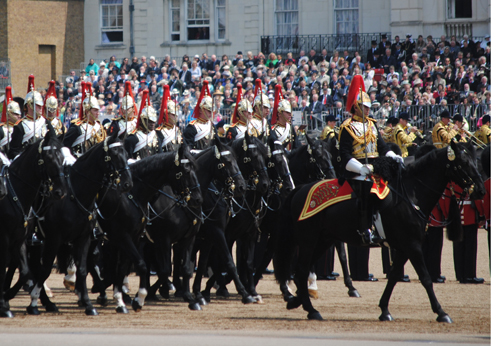
Part of the Household Mounted Cavalry, the Blues and Royals.

At 1pm, back at Buckingham Palace following the firing of a 41 gun salute, the Queen and the Royal Family watch Royal Air Force aircraft performing a fly past overhead.

The RAF’s Red Arrows aerobatic display team perform a colorful flypast over Buckingham Palace.
All images and text are © David S. Adams

Where’s London’s oldest…outdoor statue?

It’s generally believed that London’s oldest outdoor statue is that of King Alfred the Great which stands in Trinity Church Square in Southwark but there are a few others worth mentioning for their age.

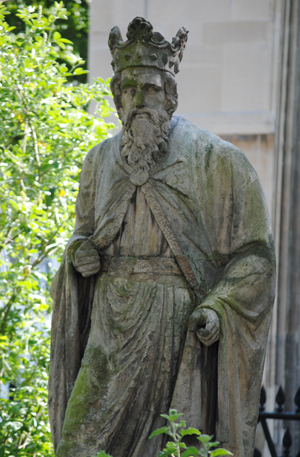
But first, to the statue of Alfred the Great. Located now in Trinity Church Square, it is thought to have been made in the late 14th century (although it’s also suggested it could be much younger) in honor of the man who ruled Wessex in the 9th century and is often credited as being the first “king of the English”.

The statue (right) was apparently located at the Palace of Westminster before it was brought to its present location in 1823 at about the time the square was being laid out.

Others among London’s oldest statues is that of King Charles I sitting astride his horse and looking from Whitehall from its position on the southern side of Trafalgar Square.

Credited as being London’s “oldest equestrian bronze”, this statue is the work of French sculptor Hubert Le Sueur and was cast in 1633 (during King Charles I’s rule) at the behest of Richard Weston, one of the king’s favorites, who that year became the 1st Earl of Portland.

It was removed during the Civil War but later reacquired by the Portland family and, following the Restoration, was reinstalled on its current site – once that of the Charing Cross (see our previous entry for more details) – in 1675 by King Charles II.

Another of London’s oldest statues is that of Queen Elizabeth I which stands on the facade of the church St Dunstan-in-the-West in Fleet Street. This statue, which has been attributed to William Kerwin although other names have also been suggested, dates from 1586 (created during her reign) and decorated the west side of Ludgate until its demolition in 1760, after which it was apparently put into storage until being brought to the church in the 19th century.

Standing nearby in the vestry porch as statues of the legendary pre-Roman British king, Lud, and his sons, Androgeus and Tenvantius, which were also removed from Ludgate and probably date from the same period (about 1586).

King James I’s London – 6. The Queen’s House, Greenwich

Long an admired landmark of Greenwich, the origins of the Queen’s House go back to the reign of King James I.

It was the Queen, Anne of Denmark, who commissioned the building of The Queen’s House in 1616 and gave it the name by which it is still known. Sadly, however, she died before it was completed.

King James I was said to have been a frequent visitor to the Tudor Palace of Greenwich (the building had earlier been known as the Palace of Placentia and was the birthplace of King Henry VIII in 1491).

King James  is traditionally said to have awarded the Manor of Greenwich to Queen Anne as an apology after he had publicly sworn at her when she had accidentally shot one of his favorite hunting dogs.

In 1616, Queen Anne decided to build a new property on the site as both a private retreat and a place where she could entertain and it was to the rising star Inigo Jones that she turned to for the design (in recognition of his growing status, he was appointed Surveyor of the King’s Works the following year).

The house was Jones’ most important job to date and the design he came up – based on a H with the two sides joined by a bridge over the Greenwich to Woolwich road – with is said to be the first Classical building in England.

Among the original features which survive to this day are the striking black and white geometrically patterned marble floor of the Great Hall (the room having been designed as a perfect cube), the painted ceiling of the Queen’s Presence Chamber and the iron balustrade the Tulip Stairs – said to be the first “geometric self-supporting spiral stair in Britain”.

Queen Anne became ill in 1618 and died the following year without seeing the end result of her commission. The work subsequently was shelved and only restarted (and completed in 1638) after King Charles I gave it to his wife, Queen Henrietta Maria.

She only had possession for a short time before Parliamentary forces seized it during the Civil War. After the Restoration, the Queen’s House was returned briefly to her by her son King Charles II (it was at this time that the original H-shape of the house was altered to a square) before part of it as later used as studio for painters and then as grace and favor apartments.

With the Old Royal Naval College now occupying the surrounding site, in 1805, King George III gave the property to the Royal Naval Asylum – a charity caring for the orphan children of seamen – and it later became part of the Royal Hospital School.

The National Maritime Museum took possession in 1934 and the building now houses the National Martime Museum’s collection of fine art. As an interesting aside, there have been several reported sightings of ghosts in the house, the latest as recently as 2002.

WHERE: The Queen’s House, National Maritime Museum, Greenwich (nearest DLR station is Cutty Sark); WHEN: 10am to 5pm daily (check website for closures); COST: Free; WEBSITE: www.nmm.ac.uk/places/queens-house

King James I’s London – 2. St James’s Park

Although royal connections with St James’s Park, the oldest royal park in London, go back to the time of King Henry VIII – it was he who first purchased the marshy watermeadow in 1532 with the idea of creating another of his many deer parks, it was on the accession of King James I that orders were given for the swamp to be drained and landscaped.

The landscape features included a large pool known as Rosamond’s Pond at the west end and, at the east end, a collection of waterways and islands used to attract birds that could then stock the royal larder. There was also a flower garden next to St James’s Palace (this had been built by King Henry VIII).

Among the other uses King James I had for the park were as a site to keep the royal menagerie which included exotic animals like crocodiles and camels. There were also bird aviaries placed along what is now appropriately named Birdcage Walk.

The layout of the park became more formal during the later reign of King Charles II who had been inspired by what he’d seen while in exile in France.

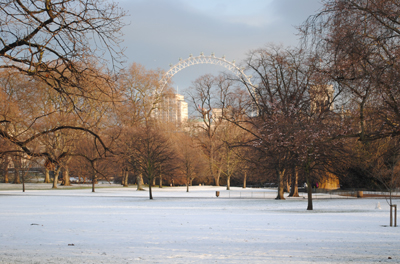
PICTURE: Looking across St James’s Park toward Whitehall in the snow.

WHERE: St James’s Park (nearest tube station is St James’s Park); WHEN: 5am to midnight daily; COST: Free entry; WEBSITE: www.royalparks.gov.uk/St-Jamess-Park.aspx

Happy St David’s Day!

It’s St David’s Day, Wales’ national day of celebration, so you may have noticed the Welsh flag flying in a few places you wouldn’t normally see it – including at 10 Downing Street. In keeping with the theme of all things Welsh, we’re taking a look at a couple of Welsh-related sites in London…

St Benet, Paul’s Wharf – Known as London’s “Welsh church”, the current St Benet’s was rebuilt to the designs of Christopher Wren after the Great Fire of 1666 although a church has stood on this site for 900 years. Services have been held at the church (pictured right) in Welsh since 1879 after Queen Victoria granted Welsh Anglicans the right to worship in their own language there. Known formally at St Benet’s Metropolitan Welsh Church, the premises, located just off Queen Victoria Street in the City, has also been the church of the College of Arms since 1555. Among other historic titbits is the suggestion that both Anne Boleyn and Lady Jane Grey – the “nine day Queen” – may have received the last rites here before going on to their executions at the Tower of London, that 17th century architect Inigo Jones was buried here, and that King Charles II had a special door built for himself in the side of the building and a private room where he could take part in services. See www.stbenetwelshchurch.org.uk

The London Welsh Centre – Located in Gray’s Inn Road, the centre’s origins go back to the founding of the Young Wales Association in 1920, created to provide a focus for young Welsh people in London. The organisation, which initially didn’t have a permanent home, held meetings in several locations before moving to the current premises in the 1930s. Today the premises is used by the London Welsh Centre and is the base for three choirs – the London Welsh Chorale, The London Welsh Gwalia Male Choir and The London Welsh Male Voice Choir. It also provides Welsh language classes and hosts concerts and other cultural events. See www.londonwelsh.org.

Memorial to Welsh poet Iolo Morganwg – A memorial plaque to this Welsh poet and antiquarian stands on Primrose Hill on the site where the first meeting of the Gorsedd of Bards of the Isle of Britain, convened by Morganwg, was held in 1792. The plaque was unveiled in 2009. Follow this link for more information.

Do you know of any other Welsh-related sites in London? Let us know…

Curious London Memorials – 7. Tower Hill scaffold memorial

Nestled on Tower Hill, somewhat overshadowed by the monumental memorial to the merchant naval casualities of World War I and II nearby, lay a series of plaques commemorating more than 125 people who were executed there.

The plaques, which stand on the site of the former scaffold, list the names of some of the most prominent who died there including Simon of Sudbury, Archbishop of Canterbury, who was beheaded by an angry mob during the Peasant’s Revolt in 1381, John Fisher, the Bishop of Rochester, and former chancellor Sir Thomas More – both of whom were executed in 1535 on the orders of King Henry VIII, and Thomas Cromwell, another chancellor who fell foul of King Henry VIII and was executed in 1540.

Later executions include William Laud, another Archbishop of Canterbury who was executed in 1645, James, Duke of Monmouth, the illegitimate son of King Charles II who was executed in 1685, and Simon Fraser, Lord Lovat, who became the last man to be executed there in 1747 (and the last man in England to be beheaded) after his capture following the Battle of Culloden in Scotland.

An inscription at the site reads that the memorial was created to “commemorate the tragic history and in many cases the martyrdom of those who for the sake of their faith, country or ideals staked their lives and lost”.

It’s worth noting that contrary to popular belief only 10 people were ever executed on Tower Green inside the Tower of London including two of King Henry VIII’s queens – Anne Boelyn (1536) and Catherine Howard (1542) – as well as the tragically young Lady Jane Grey, queen for only nine days before she was beheaded in 1554, and three Black Watch soldiers who were shot in 1743 after being charged with mutiny.

Treasures of London – The Crown Jewels

No series on the treasures of London would be complete without a mention of the Crown Jewels, housed – except when being used – under tight security in the same place they’ve been since the early 1300s – the Tower of London.

The jewels, which are described as a ‘working collection’, include the coronation regalia and feature some 23,578 gems  – the Imperial State Crown alone boasts 2,868 diamonds, 273 pearls, 17 sapphires, 11 emeralds and five rubies.

The regalia itself is made up of the crowns of the sovereigns, consorts and Princes of Wales as well as sceptres, orbs, rings, swords, spurs, bracelets, robes, and the oldest piece, a 12th century anointing spoon.

It and three steel coronation swords are the only pieces to survive the destruction of all the pre-Civil War regalia in 1649-50, carried out at the behest of Oliver Cromwell following the execution of King Charles I (many of the earlier crown jewels, dating from the Anglo-Saxon period, had already been replaced in the early 13th century after items were lost while being taken across The Wash during the reign of King John in 1216).

Following Cromwell’s destruction, new regalia was made on the orders of King Charles II. Modelled on that of his father, it was used in the king’s coronation on 23rd April, 1661, and cost more than £12,000.

Today, St Edward’s Crown – with which the sovereign is crowned by the Archbishop of Canterbury – is the principal piece of the regalia. Other items include the Sovereign’s Sceptre, topped with 530 carat First Star of Africa – the largest flawless cut diamond in the world, Queen Victoria’s small diamond crown, and the Imperial Crown of India. There is also a crown made for Queen Elizabeth, the Queen Mother, for her 1937 coronation which features the famous Koh-i-Nur (‘Mountain of Light’) diamond.

Until 1303, the Crown Jewels had been housed at Westminster Abbey. Following a successful robbery that year, however (after which most items were recovered), they were moved to the Tower.

The most famous attempt to steal the Crown Jewels was made by an Irishman, Colonel Thomas Blood, in 1671. He and his gang had arranged to see the jewels (this could be done for a fee) but when they arrived, used a mallet to knock out the jewel keeper before stabbing him.

Colonel Blood had hidden King Charles II’s crown under his cloak, squashing its arches of in the process, while his companion Robert Perot had stuck the coronation orb down his breeches and Blood’s son was in the process of sawing the sceptre in half when the keeper’s son returned unexpectedly and raised the alarm.

Arrested, Blood got off rather lightly – King Charles II decided, apparently for some unknown reason, to pardon him. Security around the jewels, however, was tightened – iron bars were used instead of wooden ones and people were thenceforth forbidden from handling the jewels.

The Crown Jewels are now housed in the Jewel House at the Tower, built in 1967 in the west wing of the Waterloo Barracks, and guarded by the Yeomen Warders.

WHERE: Tower of London (nearest tube station Tower Hill); WHEN: 9am to 4.30pm, Tuesday to Saturday, 10am to 4.30pm Sunday to Monday (until 28th February); COST: £18.70 adults; £10.45 children under 15; £15.95 concessions; £51.70 for a family (prices, which include a voluntary donation, are valid until 28th February); WEBSITE: www.hrp.org.uk/toweroflondon/. For more on the Crown Jewels, see www.royal.gov.uk/MonarchUK/Symbols/TheCrownJewels.aspx or the Royal Collection website, http://bit.ly/i9FM3

Lost London – Nonsuch Palace

Built as a symbol of the triumphal reign of the Tudor dynasty (not to mention as a response to the French King Francis I’s palace Château de Chambord), Nonsuch Palace near Ewell in Surrey, now part of greater London, was the last palace constructed by King Henry VIII.

Construction on the palace started in 1538, the 30th year of Henry’s reign and only six months after the birth of Henry’s son and heir, later King Edward VI. The medieval village of Cuddington was demolished to make way for the new premises.

The multi-storied building was designed around an inner and an outer courtyard, each entered through a fortified gatehouse, with the royal apartments located in the latter. While plain on the outside, the inner courtyard interior was decorated with stucco reliefs depicting, among other things, Roman emperors, gods and goddesses and Henry VIII with his son Edward. To cap it off, there were two great octagonal towers built at either end.

While the bulk of of the work had been completed when Henry died in 1547, it is believed that the palace may still have been unfinished. In any case, it only remained a royal property for a short time before Queen Mary I sold it to Henry Fitzalan, the Earl of Arundel. It passed back into royal hands when the earl’s son-in-law, John Lumley, was forced to sell it back to Queen Elizabeth I to settle a debt. The queen was said to have stayed frequently at the palace.

King James I granted the palace to his wife, Queen Anne of Denmark, and it was also used by his son Henry, Prince of Wales. King Charles I also granted the palace to his wife, Queen Henrietta Maria, before it was sold off by Parliamentary commissioners after the Civil War. When King Charles II came to the throne, the palace was once again given to Henrietta Maria and then, when she died in 1669, to Barbara Villers, Countess of Castlemaine, a mistress of the king.

The building was demolished in 1682 with the materials and sale of the land used to pay off the countess’ gambling debts. While some parts of the building were carted off to be incorporated into others, no trace of the building remains above the ground but its former site, on the west side of what is now Nonsuch Park in Cheam, is marked by three granite bollards. A separate banqueting house and extensive gardens were also built near the site.

The building, which was only depicted a few works, can be confused with Nonsuch Mansion House, the oldest parts of which date from the 18th century, which still stands on the east side of the park and was probably built on the site of a former keeper’s lodge.

There are exhibitions on the palace in the Honeywood Museum (the heritage centre for the London Borough of Sutton) in Carshalton and in the Tudor house known as Whitehall in Cheam. The Epson and Ewell History Explorer website also have a trail you can follow which encompasses the former site of the palace.

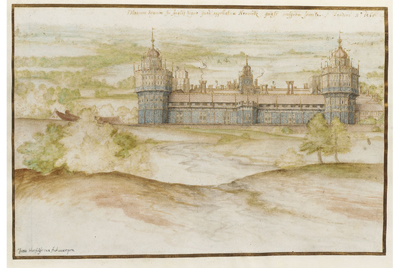
PICTURE: Nonsuch Palace in an engraving by Joris Hoefnagel. Source: Wikipedia.

What’s in a name?…Pall Mall

This curiously named street in the heart of London’s St James district traces the origins of its moniker back to the 17th century when the game of “pall mall” (“pell mell” and “paille maille” being among a host of alternative spellings) was played there.

The game, mentioned by Samuel Pepys in his famous diary, involves the use of a mallet and ball similar to that used in modern croquet but, according to some commentators, pall mall was more likely a predecessor of golf than croquet, with players attempting to belt the ball as far as possible along a pitch before putting the ball through a hoop suspended high off the ground.

Pall Mall, which runs parallel to The Mall from St James’ Street in the west to Haymarket in the east with an eastern extension, Pall Mall East, completing the journey from Haymarket into the northern end of Trafalgar Square, became famous in the 19th and early 20th centuries for housing numerous ‘gentlemen’s clubs’. Among those still in business are the Travellers Club, the Athaenaeum Club, the Reform Club, the Army and Navy Club, the Oxford and Cambridge Club, and the Royal Automobile Club.

St James’s Palace sits at the street’s western end and it is of note that nearly all of the southern side of the street is still part of the Crown Estate (the exception being a home Charles II is believed to have given to the actress Nell Gwynne, who apparently sensibly demanded the freehold on the property).

Other buildings along the street include Schomberg House, built for the Duke of Schomberg in the late 17th century (only the facade of which remains), and the Sir Christopher Wren-designed Marlborough House, which is tucked in between Pall Mall and The Mall and sits opposite St James’s Palace. The National Gallery and the Royal Academy also both briefly had homes in Pall Mall.

LondonLife – Lord Mayor’s Show 2010

On Saturday, the City of London paused for the 2010 Lord Mayor’s Show. We’ve captured some images from the event…

The crowd waiting patiently in Poultry, looking towards Mansion House, home of the Lord Mayor. The parade makes its way to the Royal Courts of Justice, stopping off at St Paul’s and then back via Victoria Embankment.


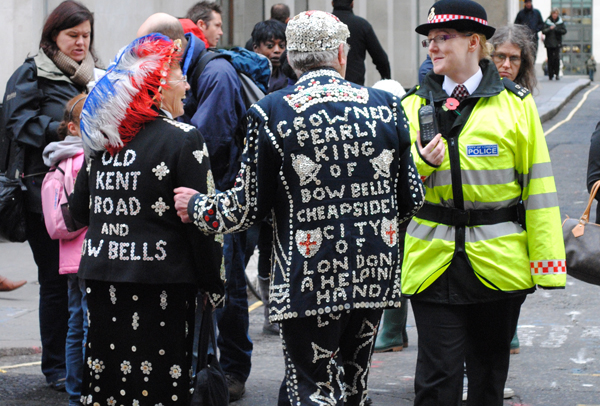
A Pearly King and Queen seek some advice from the local constabulary.


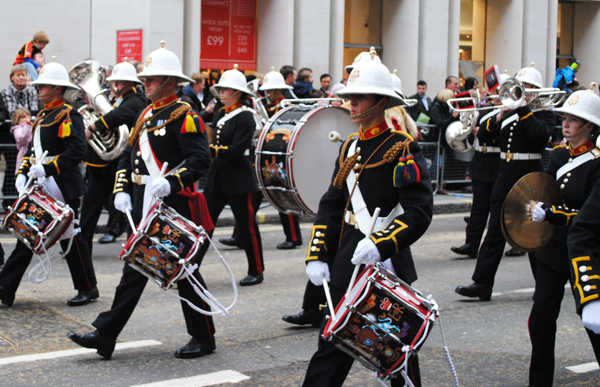
The parade opened with the Band of Grenadier Guards, formed in 1685 by Charles II.


Members of the Council of the Hamburger Morgensprache, successor to the medieval gathering of merchants of Hanseatic cities on the Baltic and North Sea coasts of which Hamburg was a leading member. Under a charter granted by Henry III, the merchants had their own enclave in the City of London.

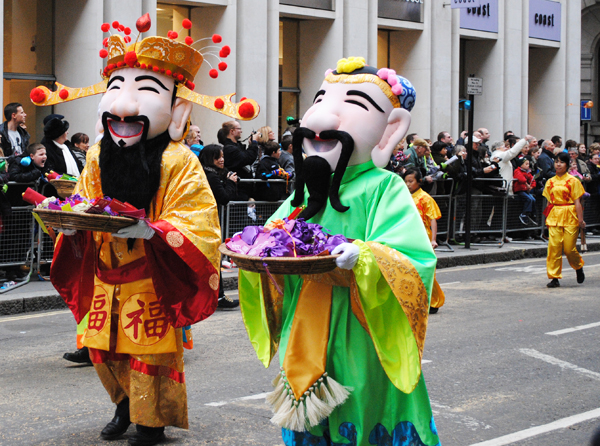
Part of the Hong Kong Economic and Trade Office’s representation.


One of the many bands in the parade.

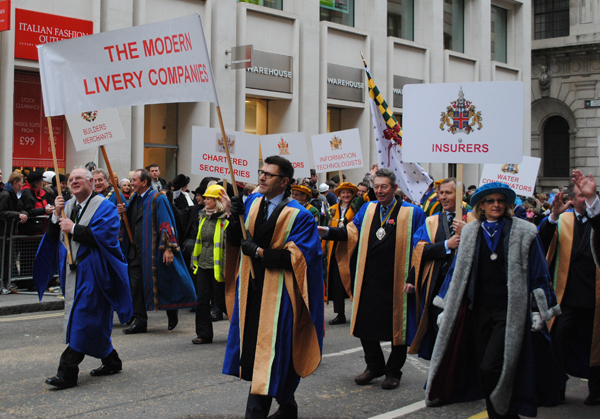
The Modern Livery Companies had walkers representing 21 livery companies, from Actuaries and Arbiters to Farmers, Solicitors, Tobacco Pipe Makers and World Traders. Other livery companies represented in the parade included the Worshipful Company of Lightmongers, the Worshipful Company of Paviors, and the Worshipful Company of International Bankers.


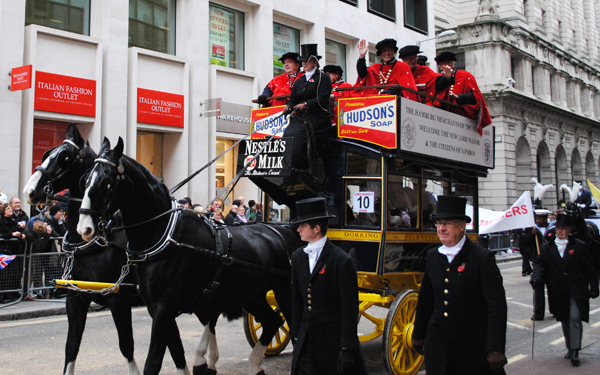
One of the many carriages transporting city officers. This one contains Sheriff Richard Sermon and his chaplain, Rev Michael Marshall, with two Doggett’s Coat and Badge men at the back.


Doggetts Coat and Badge Men – every year since 1715, apprentices from the Company of Watermen have contested a boat race on the Thames to win the coveted Doggett’s Coat and Badge.

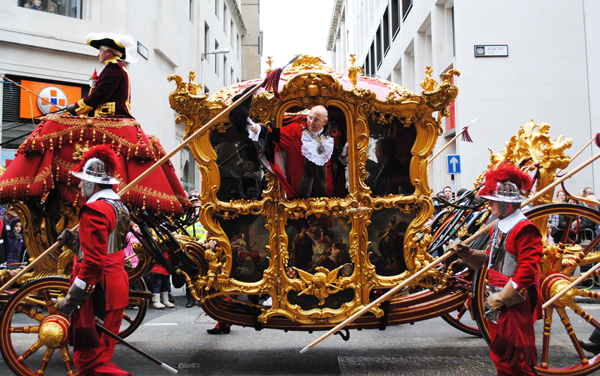
Lord Mayor Michael Bear, the 683rd Lord Mayor of London, greets Londoners. The State Coach dates from 1757.


Pikemen, part of the Lord Mayor’s bodyguard for ceremonial occasions. The style of uniform dates from the reign of Charles I.


On the Thames, looking out from Waterloo Bridge. A fireworks display was held here from 5pm onwards.

~ www.lordmayorsshow.org

LondonLife – Horse Guards Parade…

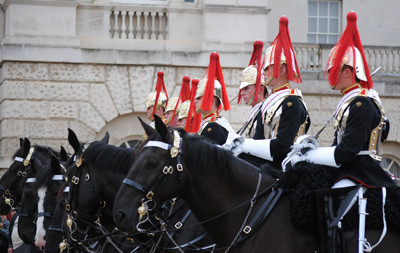
The Queen’s Life Guard at Horse Guards Parade. The parade ground, which lies between Whitehall and St James’ Park, was formerly the site of the tiltyard of the Palace of Whitehall and was the location for tournaments during the rule of Henry VIII. It now serves as the site for the annual Trooping the Colour ceremony. The men pictured (wearing blue tunics and red plumed helmets) are part of a squadron of The Blues and Royals (Royal Horse Guards and 1st Dragoons) who, along with a squadron of The Life Guards (wearing red tunics and white plumed helmets), make up the Household Cavalry Mounted Regiment, responsible for providing The Queen’s Life Guard. The “Horse Guards” have guarded this site – still regarded as the official entrance to St James’ Palace and Buckingham Palace – since the Restoration of Charles II in 1660 and can be seen there in the Changing of the Guard ceremony on weekdays and Sundays. For more information, visit www.army.mod.uk/events/ceremonial/2355.aspx

What’s In A Name? – Piccadilly

One of the principal thoroughfare’s of London’s West End – and lending its name to that most famous of intersections, Piccadilly Circus, the name Piccadilly derives from the stiff ruffs known as ‘piccadils’ which were widely worn by the fashionable during the 17th century.

The street was known as Portugal Street until the 17th century. While there are several different stories explaining the name, the most widely accepted story is that the name’s origins go back to a tailor by the name of Robert Baker.

He’d made a fortune from making and selling piccadils and used that money to purchase a large tract of land in the area, then largely countryside, and 1611-12 built a mansion there which became known, probably derisively, as Piccadilly Hall in reference to his trade.

When the area came to be developing in the years after the Restoration of Charles II in 1660, the name stuck.

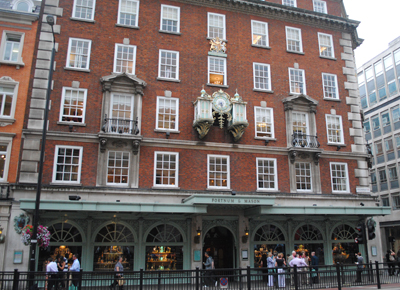
Famous sights along Piccadilly include grocer Fortnum & Mason, founded in 1707 by one of Queen Anne’s footmen (pictured above), the Royal Academy of the Arts, the Ritz Hotel, which opened in 1906 and indicated a new level in luxurious hotels, the Wren-designed St James’ Church, and the entry to the 19th century Burlington Arcade.