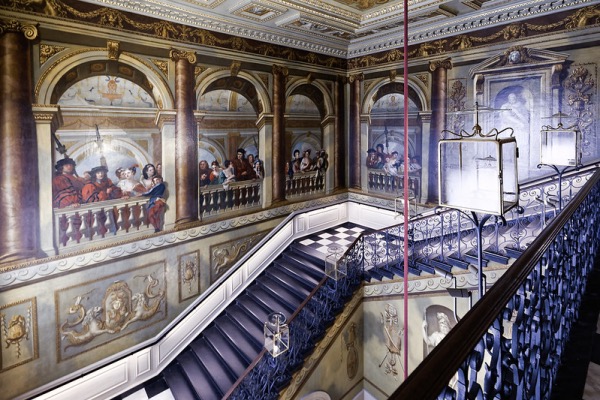
This staircase, a grand entrance to the King’s State Apartments at Kensington Palace, are famous for the paintings on the walls and ceiling which depict an 18th century court looking down on those who ascend.
The work of William Kent, the staircase paintings were complete in 1724 and replaced earlier wooden panelling.
The stairs were originally constructed as part of Sir Christopher Wren’s remodelling Nottingham House into Kensington Palace for King William III and Queen Mary II. Following a fire in 1691, they were rebuilt in marble.
There are 45 people in Kent’s painting and only about a dozen have been identified. As well as members of the Yeomen of the Guard, the images depict King George I’s Polish page Ulric, his Turkish servants Mahomet and Mustapha, Peter the ‘wild boy’, a child found in the woods in Germany, and Dr John Arbuthnot, a medical doctor and satirist who tried to teach Peter to speak.
Interestingly, Kent included a selfie on the ceiling – a depiction of himself, wearing a brown turban and carrying an artist’s palette, standing with his mistress by his side.
The trompe l’oeil (a technique which creates the optical illusion of 3D) work features architecture inspired by Rome where Kent had trained while there’s also a painted figure of Diana on the top landing which is based on an antique statue at Holkham Hall in Norfolk.
In 1734, Queen Caroline commissioned Kent to rework the stairs to the Queen’s State Apartments. His work there features a Roman-inspired scene again created as a trompe l’oeil. There is also a homage to Queen who is compared to Britannia. The staircase’s balustrade was another by Huguenot ironworker Jean Tijou.
WHERE: The Broad Walk, Kensington Gardens, Kensington (nearest tube stations are High Street Kensington or Queensway); WHEN: Daily 10am to 6pm (last admission 5pm); COST: £16 adult/£12.80 concession/£8 child (Historic Royal Palaces members free); WEBSITE: www.hrp.org.uk/KensingtonPalace.
Another ‘oldest’ question that’s not as simple as it might seem.
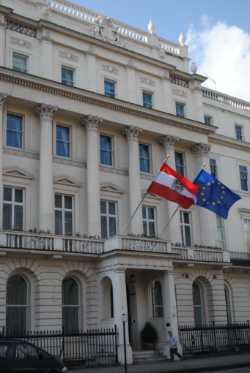
Austrian Embassy, Belgrave Square. PICTURE: David Adams
Austria has occupied a building at 18 Belgrave Square in Belgravia since it moved there from Chandos House in Queen Anne Street in 1866.
But the embassy was vacated with the outbreak of World War I and the building entrusted, firstly to the protection of the ambassador of the United States, and following the severing of their relations in 1917, to the Royal Swedish Legation.
The Austrians returned in 1920 but following Hitler’s incorporation of Austria into the German Reich in 1938, it was used as a department of the German Embassy.
Following the outbreak of World War II, the Swiss legation room over protection of the building and following the end of the war the damaged building fell under the care of Britain’s Ministry of Works.
The Austrians returned in September, 1948, with the new ambassador arriving in 1952. It continues today to serve as the residence of the Austrian Ambassador.
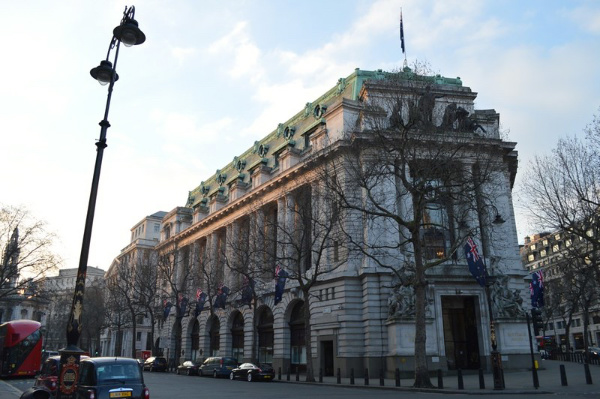
Not to be confused with the Austrians, the Australian High Commission resides in ‘Australia House’ which claims to be “the longest continuously occupied foreign mission in London”.
In 1912, the Australian Government bought the freehold of a site on the corner bounded by Strand, Aldwych and Melbourne Place. Following a design competition, Scottish architects A Marshal Mackenzie and Son were selected as the designers of the new Australia House with Commonwealth of Australia’s chief architect, Mr JS Murdoch, arriving in London to assist them.
Work began in 1913 – King George V laid the foundation stone – but was interrupted by World War I and in 1916, former Australian PM and now High Commissioner Andrew Fisher moved into temporary offices on the site even as the work continued around him. King George V officially opened Australia House on 3rd August, 1918, with then Australian Prime Minister, WM “Billy” Hughes, in attendance.
Catherine, who it has been suggested may have been just 17-years-old when she died, was beheaded on the morning of 13th February, 1542, less than two years after her hastily arranged marriage to the King, just three weeks after his prior marriage to Anne of Cleves was annulled.
Catherine, also spelt as Katherine, was condemned to death after a young noble named Francis Dereham admitted, under torture, to having a sexual relationship with her prior to her marrying the king, and, more importantly, Thomas Culpeper, a Gentleman of the King’s Privy Chamber, who admitted to having an affair with her after her marriage.
Both men were executed at Tyburn following their admissions and their heads were displayed on London Bridge. Catherine sailed under it aboard a barge as she was taken to the Tower on 10th February, 1542.
She is said to have spent the night before her execution practising placing her head on the block – which was brought to her at her request.
Catherine was beheaded with the single stroke of a headsman’s axe on Tower Green – King Henry did not attend but some of her cousins, including the Earl of Surrey, were among the witnesses.
She was said to have been composed, although she needed help mounting the scaffold. It’s often said that her last words were “I die a Queen, but I would rather have died the wife of Culpeper” but there’s no eyewitness report which suggests this and instead she is believed to have stuck to a more traditional script, saying her punishment was just for her crimes and asking forgiveness.
Her maid – Jane Boleyn, Lady Rochford – followed her to the block for her role in facilitating the affair while Henry was away from court. Catherine had apparently spent the night before practising how to lay her head upon the block.
Catherine was buried in an unmarked grave at in the Chapel of St Peter ad Vincula next to Tower Green – there’s a memorial to her in the church. The Queen’s ghost is famously said to be present in what’s known as the ‘Haunted Gallery’ at Hampton Court Palace – it is here that, when she was arrested, she apparently broke free from her guards and ran to the doors of the Chapel Royal where she believed the king was at prayer. Needless to say, her cries for mercy went unanswered.
Memorial stone set in the floor of the Chapel of St Peter ad Vincula. PICTURE: VCR Giulio19/Wikipedia (licensed under CC BY-SA 4.0)
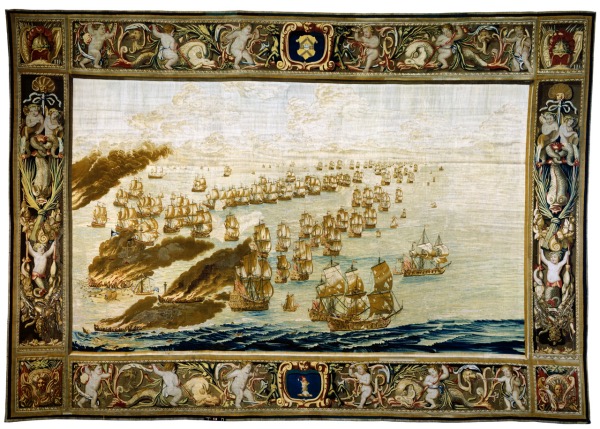
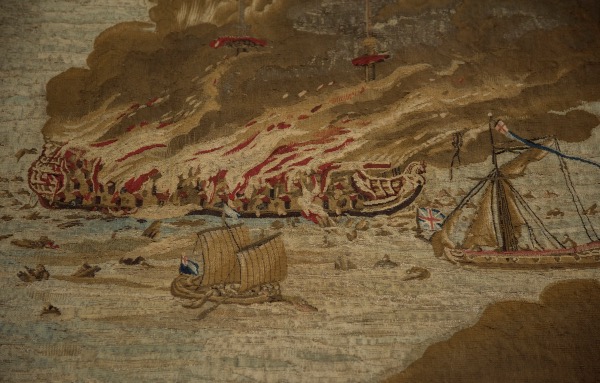
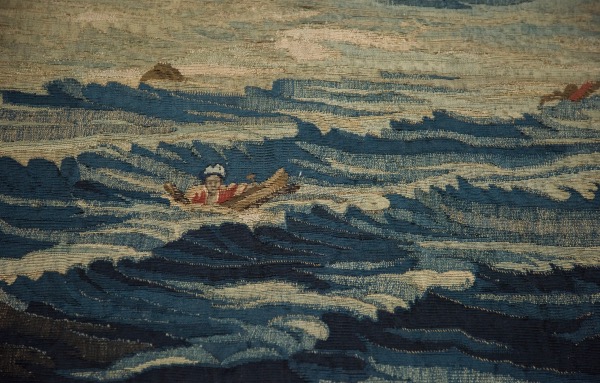
A monumental tapestry – and the only surviving one of its era depicting an English naval scene, the Solebay Tapestry was actually one a series of six designed by father and son team, Willem Van de Velde the Elder and Younger.
Commissioned by King Charles II and his brother, James, Duke of York (later King James II), the tapestry – known as The Burning of the Royal James at the Battle of Solebay, 28 May 1672 – commemorates the Battle of Solebay, a naval battle fought in Southwold Bay off the coast of Suffolk on 28th May, 1672. The first battle of the Third Anglo-Dutch War, it ended with both sides claiming victory and was the final naval battle in which James was engaged.
It depicts the dramatic climax of the battle and shows the Royal James engulfed in flames after it wasset alight by Dutch fireships. Edward Montagu, the first Earl of Sandwich whose was aboard the Royal James, died in the attack.
William Van de Veldes the Elder, who was a contemporary of Rembrandt and, along with his son, is considered the founder of English maritime painting, was present at the battle and made a series of sketches from a boat at the scene (he was actually there for the Dutch, not the English).
Subsequently commissioned to reimagine the battle from the English point-of-view, it was the studios of the Van de Velds in the Queen’s House in Greenwich that a series of ‘cartoons’ – large-scale paper designs – were produced using the sketches.
These were then presented to weavers who, once thought to have been based in Mortlake but now believed to have been based in either at Clerkenwell or Hatton Garden, used them to create the tapestries.
The tapestry in the collection of Royal Museums Greenwich was displayed behind King George VI during his speech at the opening of the National Maritime Museum in 1937 but hasn’t been able to be displayed for the past 22 years due to its fragile condition.
In urgent need of repair, the first phase of a conservation project was completed last year. Royal Museums Greenwich has now launched an urgent crowdfunding campaign through ‘Art Happens with Art Fund’ to raise £15,000 for the completion of the project. This will mean the tapestry can be included in an exhibition at the Queen’s House next February marking 350 years since the Van de Veldes’ arrival in England.
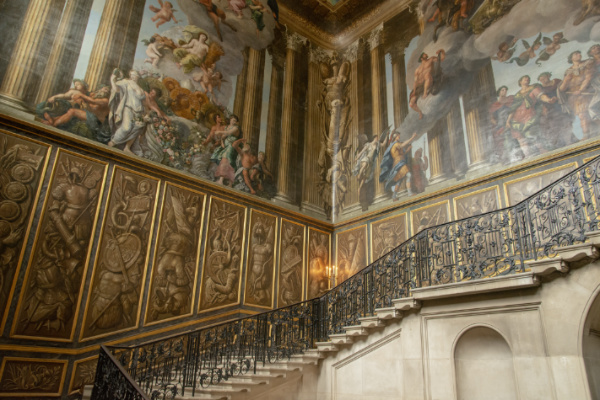
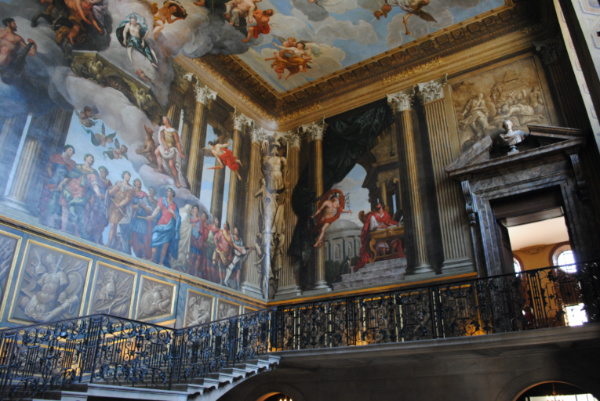
This grand staircase was installed in Hampton Court Palace during the reign of King William III and Queen Mary II as a grand entrance to the King’s Apartments.
The staircase, which features shallow steps, was designed Sir Christopher Wren and features a wrought iron balustrade designed by French ironsmith Jean Tijou.
Another view of the staircase and accompanying art. PICTURE: David Adams
It was decorated in about 1700 by Italian painter Antonio Verrio to resemble a Roman courtyard which is open to the sky. The main image depicts ‘Victory of Alexander over the Caesars’ which features King William III as Alexander the Great and is painted as an allegory of William’s triumph over the Stuart King, James II, in the Glorious Revolution of 1688 (with the Stuarts represented by the 12 Caesars).
The stairs lead up to the Guard Chamber, an anteroom which had to be passed through to reach the Presence Chamber.
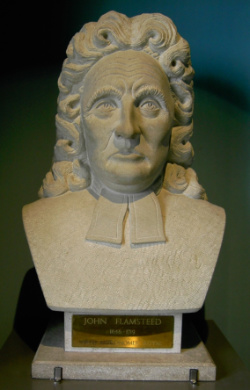
Memorialised in the name of the house where he once lived at the Royal Observatory in Greenwich, John Flamsteed was the first Astronomer Royal.
Flamsteed was born in Denby, Derbyshire, on 16th August, 1646, and was the only child of Stephen Flamsteed, who among other things was involved in the brewing industry, and his first wife Mary (who died when John Flamsteed was still quite young).
A bust of John Flamsteed at the Royal Observatory Greenwich.
He was educated at local schools but left off his studies at the age of 15 due to his own ill health and his father’s need for his assistance in the household and with his business.
His poor health meant he pursued some more sedentary activities and it was during this period that he established interest in astronomy, writing his first paper in 1665. Flamsteed did briefly attend Jesus College in Cambridge in the early 1670s, although it’s not thought he ever took up full residence.
Flamsteed was ordained a deacon and was preparing to take up a living in Derbyshire in 1675 – having by then obtained an MA from Cambridge – when his patron Jonas Moore, whom he’d met in the summer of 1670 during a visit to London and then visited again in mid-1674, invited him to return to the city, ostensibly to establish an observatory which Moore, who was Surveyor-General of the Ordnance, had offered to pay for.
Flamsteed arrived in February, 1675, stayed with Moore in the Tower before, after meeting King Charles II, was made an official assistant to a Royal Commission which the king had established charged with examining the merits of a proposal – put forward by a “le Sieur de St Pierre” to find longitude by the position of the Moon.
The commission decided the proposal wasn’t worth taking further but did recommend the establishment of an observatory from which the movement of the stars and Moon could be mapped in the hope of developing a method of finding longitude. Flamsteed was subsequently appointed “The King’s Astronomical Observator” – the first Astronomer Royal – on 4th March, 1675, by royal warrant, and in June that same year, another royal warrant provided for the founding of the Royal Greenwich Observatory. Flamsteed laid the foundation stone on 10th August.
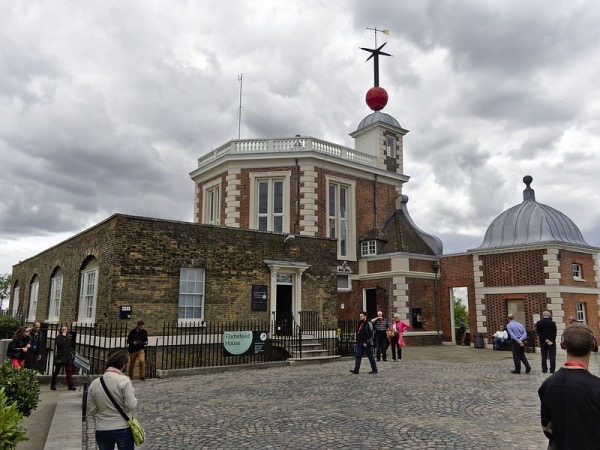
He was admitted as a fellow of the Royal Society in February the following year and in July he moved into the observatory, now known as Flamsteed House (it contains famed Octagonal Room with large windows from which celestial events could be watched), which was designed by Sir Christopher Wren. It was to serve as Flamsteed’s home for next decade or so.
Flamsteed House, Royal Greenwich Observatory, its named after John Flamsteed. PICTURE: Dmitry Djouce.
Flamsteed’s achievements as an astronomer included the accurate calculation of the solar eclipses of 1666 and 1668 and recording some of the earliest sightings of Uranus which he mistakenly thought was a star. He was also in regular contact with many other scientific luminaries of the day and famously fell out with both Sir Edmond Halley (his one-time assistant and future successor as Astronomer Royal) and Sir Isaac Newton.
Flamsteed’s own catalogue of almost 3,000 stars wasn’t published until after death in 1725 thanks to the effort’s of his wife Margaret – whom he had married on 23rd October, 1692 (they were to have no children although Flamsteed’s niece, Ann Heming, did live with them). Margaret also published his star atlas, Atlas Coelestis, posthumously in 1729.
In 1684, Flamsteed was elevated to the priesthood and made rector of the village of Burstow, near Crawley in Surrey – a post, which, along with that of Astronomer Royal, he held until his death on 31st December, 1719.
He was buried in Burstow and there is a plaque on the wall of the church there marking his grave (which was added long after his death). Aside from his earthly honours – which includes the name of Flamsteed House at the Royal Observatory, a crater on the Moon is named after him as is an asteroid.
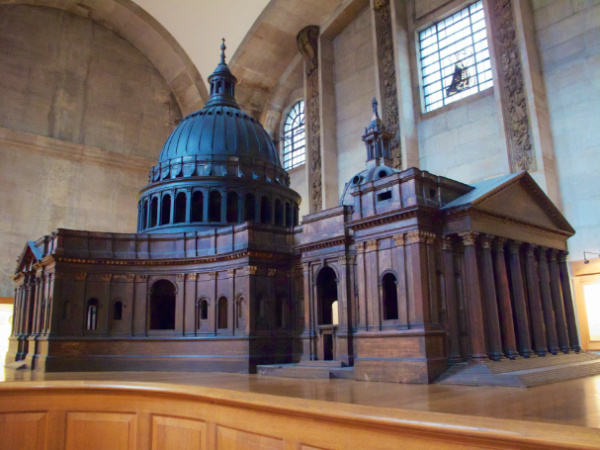
Housed now in the building it depicts, the Great Model of St Paul’s Cathedral was created by architect Sir Christopher Wren to show King Charles II what his proposed grand new English Baroque cathedral would look like (following the destruction of the medieval cathedral in the Great Fire of 1666).
Made of oak, plaster and lime wood, the model was made by William Cleere to Wren’s design in between September, 1673, and October, 1674, at a scale of 1:25. It measures 6.27 metres long, 3.68 metres wide and more than four metres tall, making it one of the largest in the UK.
The model, which cost about £600 to make – an extraordinary sum which could apparently buy a good London house, was designed to be “walked through” at eye level and, as well as being a useful way to show the King what the proposed building would look like, was also something of an insurance policy in case something happened to Wren.
It was based on drawings made by Wren and his assistant Edward Woodroofe on a large table in the cathedral’s convocation or chapter house (later demolished in the early 1690s) and was originally painted white to represent Portland stone with a blue-grey dome and gilded details.
There are some differences between the model and the finished cathedral – among them was a substantial extension of the quire, double-height portico on the west front, and, of course, the bell towers on the west front which were made in place of the cupola which was located halfway down the nave on the model.
Part of an earlier wooden model from 1671 also survives – it was apparently lost for many years and rediscovered in 1935.
The Great Model can be seen on tours of the Triforium.
WHERE: St Paul’s Cathedral (nearest Tube stations are St Paul’s, Mansion House and Blackfriars); WHEN: 8.30am to 4.30pm Monday to Saturday; COST: £21 adults/£18.50 concessions/£9 children/£36 family (these are walk-up rates – online advanced and group rates are discounted); WEBSITE: www.stpauls.co.uk (for tours, head to www.stpauls.co.uk/visits/visits/guided-tours)
This small stone stairway which now sits in the midst of a grassy expanse at the back of the Ministry of Defence was once part of the Palace of Whitehall.
Named for Queen Mary II, wife of King William III, for whom they were designed, the stairs were part of a terrace built in 1691 abutting the Thames in front of an old river wall constructed for King Henry VIII.
Designed by Sir Christopher Wren, the stairs were one of a pair located at either end of the terrace which gave direct access to the river – and state barges – from the Royal Apartments.
Excavations in 1939 during construction of the MoD revealed the Tudor river wall, the terrace and the northern-most of the two flights of steps. The upper part of the steps have been repaired and the terrace and wall reconstructed.
The steps and palace fragments are now a Grade I listed monument.
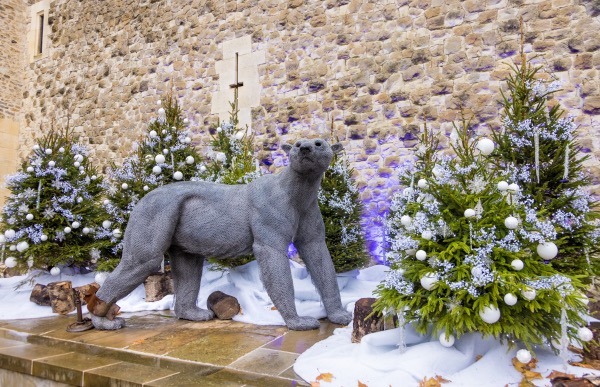
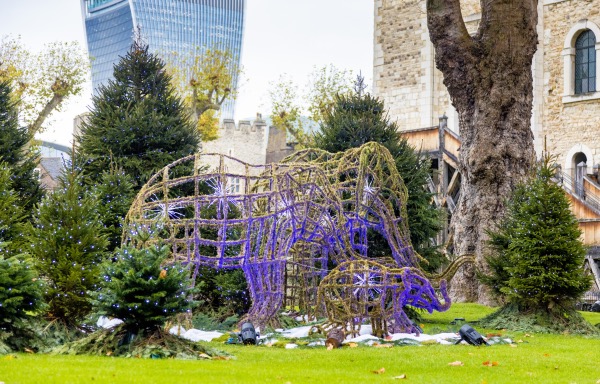
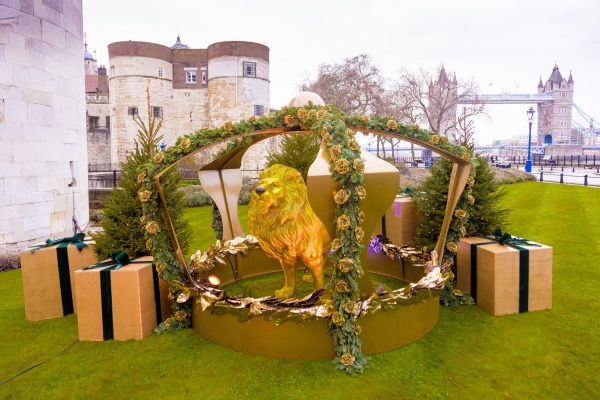
The Royal Menagerie at the Tower of London has been decked out for Christmas with an array of glittering decorations. Animals including a polar bear, elephants and lions were kept at various times in the Tower’s menagerie which started thanks to a royal penchant to giving exotic animals as gifts to fellow monarchs. King Edward I created the first permanent home for the menagerie which, after hundreds of years, closed for good in 1835. The Christmas display the Tower, which centres on the Tower Green Christmas tree, can be seen until 3rd January. Admission charges apply. For more, see www.hrp.org.uk.
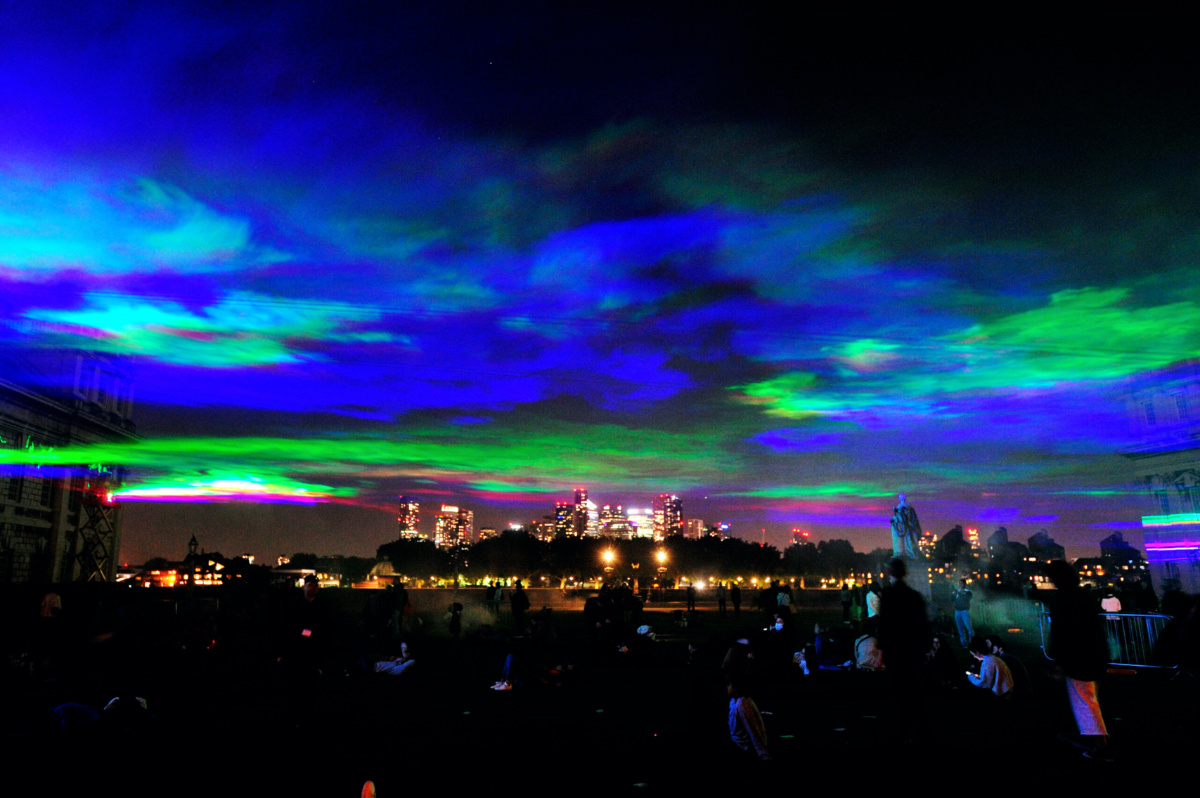
• A dazzling light show inspired by the Northern Lights – one of the seven natural wonders of the world – can be seen in the Guildhall Yard this December. Borealis – which can be seen between 11th and 22nd December – is the work of artist Dan Acher and is one of a number of light displays which is illuminating London this winter as part of Mayor Sadiq Khan’s ‘Winter Lights’ campaign. Others include an animal-themed display bringing to life the beasts that once lived at the Tower of London, an outdoor programme of installations and video art projections illuminating the Southbank Centre’s site, the ‘Illuminated River’ display lighting up nine of London’s bridges in what is be the longest public art project in the world, and a free Canary Wharf ‘Winter Lights Spectacular’ in January which will feature 20 new light commissions by some of the most innovative artists across the globe. In Grosvenor Square, Mayfair, thousands of illuminated white roses will form an ‘Ever After Garden’ designed by fashion designer Anya Hindmarch while traditional favourites like the Hyde Park Winter Wonderland as well as winter markets and ice rinks at locations like the Natural History Museum and Somerset House are also once again returning to the city. London’s red buses are an easy way to see the Christmas lights this year with routes 12, 94, 98, 139 and 390 all travelling through Oxford Circus. Free tickets to Borealis can be booked at www.visitlondon.com/Borealis while, for more on the best bus routes, see https://londonblog.tfl.gov.uk/festive-bus-routes/. For more information on all the light shows and events (some of which are already underway), see visitlondon.com .
• Costumes worn by then Princess Elizabeth and her sister Princess Margaret in wartime-era pantomimes are at the heart of a new display at Windsor Castle this Christmas. The princesses spent much of their time at Windsor during World War II – away from the Blitz in London – and, between 1941 and 1944, they performed in and helped to stage a series of pantomimes to raise money for the Royal Household Wool Fund which supplied knitting wool to make comforters for soldiers fighting at the front. Six of the costumes they wore have been brought together for the first time and are being displayed in the castle’s Waterloo Chamber where the pantos were originally performed. The costumes on show were worn in the last two pantos – Aladdin, which was performed in 1943, and Old Mother Red Riding Boots which was performed in 1944. Also on show are 16 large scale pictures of fairy-tale characters that were pasted around the walls to create the space for the performances. Visitors to Windsor this Christmas will also see State Apartments decorated for the festive season and a 20 foot high Christmas tree in St George’s Hall. The Semi-State Rooms, created for King George IV and now used for official entertaining, are also now open to visitors. The costumes can be seen until 31st January. Admission charges apply. For more on the Christmas activities at Windsor, including a ‘Mary, Queen of Scots at Christmas Family Activity Day’ on 18th December, see www.rct.uk/whatson/. Meanwhile, Buckingham Palace is offering guided tours of the State Rooms over winter with special family guided tours available for the first time. The tours run until 30th January. Admission charge applies. For more on the guided tours, head here and for more on the family tours, head here.
• The ancient Greeks’ pursuit of knowledge is the subject of a new exhibition which has opened at the Science Museum in South Kensington. Ancient Greeks: Science and Wisdom takes visitors on a journey in which they will sail the perilous seas with a statue of Hermes that was discovered on a shipwreck off the island of Antikythera, experience the lost music of the aulos instrument through interactive displays and an exclusive video that reimagines its ancient sounds, and gaze at the starry cosmos through ancient Greek eyes via a beautiful and rare silver globe depicting the known constellations and a Byzantine sundial-calendar – the second oldest known geared mechanism in the world. The free display can be seen until 5th June. Tickets are required – to book head to sciencemuseum.org.uk/ancient-greeks.
Send all items for inclusion to exploringlondon@gmail.com.
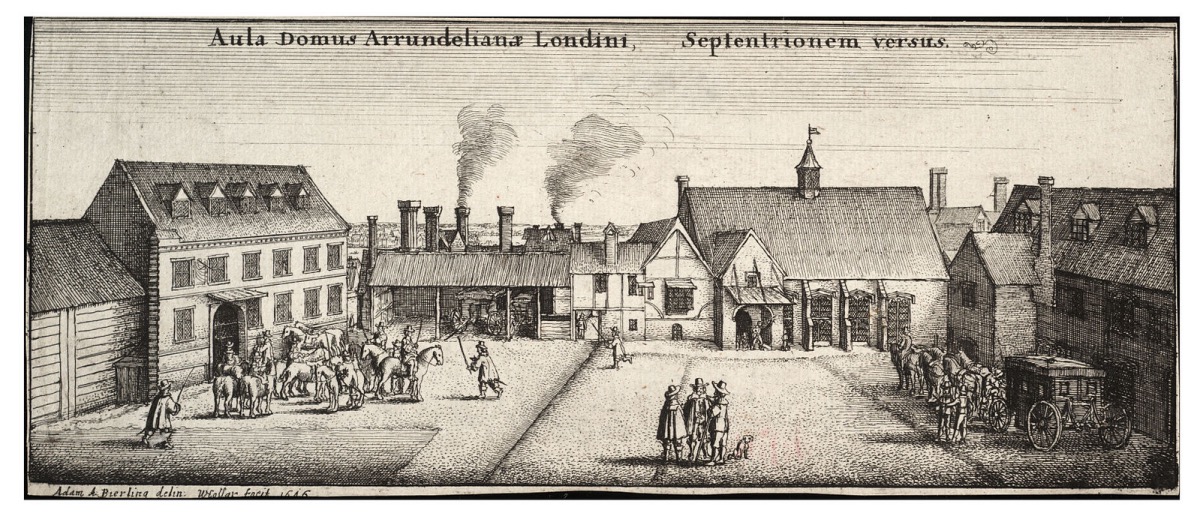
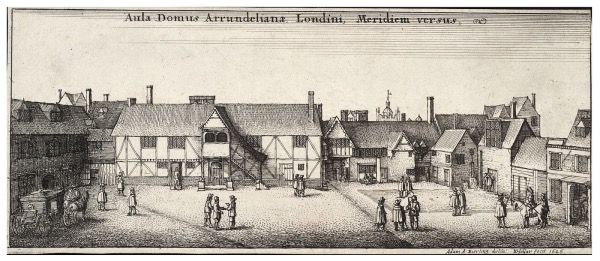
Arundel House, from the south, by Wenceslas Hollar.Via Wikimedia Commons.
One of a string of massive residences built along the Strand during the Middle Ages, Arundel House was previously the London townhouse of the Bishops of Bath and Wells (it was then known as ‘Bath Inn’ and Cardinal Thomas Wolsey was among those who resided here during this period).
Following the Dissolution, in 1539 King Henry VIII granted the property to William Fitzwilliam, Earl of Southampton (it was then known as Hampton Place). After reverting to the Crown on his death on 1542, it was subsequently given to Thomas Seymour, 1st Baron Seymour of Sudeley, a younger brother of Queen Jane Seymour, Henry VIII’s third wife, and known as ‘Seymour Place’. Then Princess Elizabeth (late Queen Elizabeth I) stayed at the property during this period (in fact, it’s said her alleged affair with Thomas Seymour took place here).
Arundel House, from the south, by Wenceslas Hollar.Via Wikimedia Commons.
Seymour significantly remodelled the property, before in 1549, he was executed for treason. The house was subsequently sold to Henry Fitz Alan, 12th Earl of Arundel, for slightly more than £40. He was succeeded by his grandson, Philip Howard, but he was tried for treason and died in the Tower of London in 1595. In 1603, the house was granted to Charles, Earl of Nottingham, but his possession was short-lived.
Just four years later it was repurchased by the Howard family – in particular Philip’s son, Thomas Howard, 14th Earl of Arundel – who had been restored to the earldom.
Howard, who was also the 4th Earl of Surrey, housed his famous collection of sculptures, known as the ‘Arundel Marbles’, here (much of his collection, described as England’s first great art collection, is now in Oxford’s Ashmolean Museum).
During this period, guests included Inigo Jones (who designed a number of updates to the property) and artist Wenceslas Hollar who resided in an apartment (in fact, it’s believed he drew his famous view of London, published in 1647, while on the roof).
Howard, known as the “Collector Earl”, died in Italy in 1646. Following his death, the property was used as a garrison and later, during the Commonwealth, used as a place to receive important guests
It was restored to Thomas’ grandson, Henry Howard, 6th Duke of Norfolk, following the Restoration. Following the Great Fire of London in 1666, for several years the property was used as the location for Royal Society meetings.
The house was demolished in the 1678. It’s commemorated today by the streets named Surrey, Howard, Norfolk and Arundel (and a late 19th century property on the corner of Arundel Street and Temple Place now bears its name).
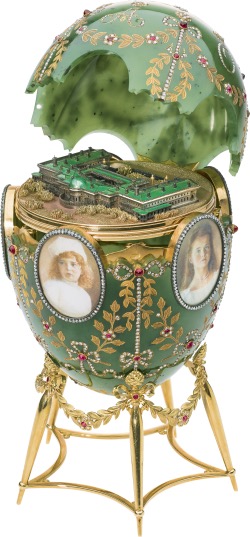
• The largest collection of Faberge’s Imperial Easter eggs to be displayed together in a generation go on show at the V&A from Saturday. Fabergé in London: Romance to Revolution is the first major exhibition devoted to the international prominence of Russian goldsmith, Carl Fabergé, and his little-known London branch. Divided into three sections which cover everything from the techniques and detailing synonymous with the Faberge name to his time in London, the royal patronage he received, and the impact of the Great War and Russian Revolution on the business. The display features more than 200 objects with highlights including a prayer book gifted by Emperor Nicholas II to Empress Alexandra Feodorovna on his Coronation Day, the only known example of solid gold tea service crafted by Fabergé, a rare figurine of a veteran English soldier commissioned by King Edward VII, and a “kaleidoscopic display” of 15 of the Imperial Easter Eggs. The latter include several that have never before been shown in the UK including the largest Imperial Egg – the Moscow Kremlin Egg – which was inspired by the architecture of the Dormition Cathedral, the Alexander Palace Egg – which features watercolour portraits of the children of Nicholas II and Empress Alexandra and contains a model of the palace inside (pictured), the recently rediscovered Third Imperial Egg of 1887 (found by a scrap dealer in 2011) and Empress Alexandra Feodorovna’s Basket of Flowers Egg. Runs until 8th May. Admission charge applies. For more, see www.vam.ac.uk.
• The Royal Family’s relationship with the jeweller Garrard is the subject of a new exhibition which has opened in Kensington Palace’s ‘Jewel Room’. Going on display for the first time are examples of the firm’s ledgers which document royal commissions dating back to 1735 while other highlights include Queen Mary’s fringe tiara which was made in 1919 using diamonds taken from Queen Victoria’s wedding gift to Queen Mary and which was subsequently worn by Queen Elizabeth II on her wedding day. Admission charge applies. For more, see www.hrp.org.uk/kensington-palace.
• Botanical illustrations from the archives at Kew Gardens are brought to life on a canvas consisting of a selection of spectacular trees from the arboretum as part of this year’s Christmas display. Christmas at Kew also includes Spheric – a 15-metre-wide dome of light covered in more than 2,000 individually controlled LED pixels which sits on a reflective water pool and allows visitors to fully immerse themselves in a unique mirrored illusion as they cross the lake, a new installation for Holly Walk which will illuminate the night sky for over 200 metres overhead as it replicates the enchanting visual phenomenon of the Aurora Borealis, a vibrant rainbow tree illumination which brings to life the 12 Days of Christmas, and the ever-popular Fire Garden. The display can be seen until 9th January. Admission charge applies. For more, see www.kew.org.
Send all items for inclusion to exploringlondon@gmail.com.
Think of Austrian composer Wolfgang Amadeus Mozart and chances are it isn’t London which immediately comes to mind. But it was in a home in Belgravia that the then-precocious eight-year-old composed his first symphony.
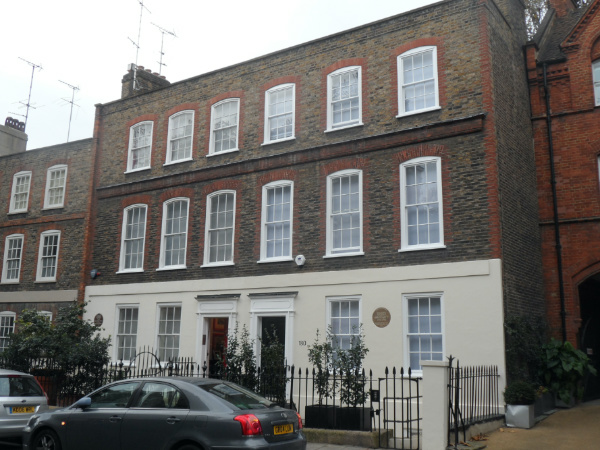
Mozart, his father Leopold, mother Anna Maria and his elder sister Maria Anna spent almost a year-and-a-half in London, between April, 1764, and July, 1765, as part of a European grand tour. Having initially taken lodgings above a barber’s shop in Cecil Court in Soho, they moved to the more rural setting of 180 Ebury Street, then known as Five Fields Row, in August so his father could recover from a serious illness which apparently developed after he caught a cold.
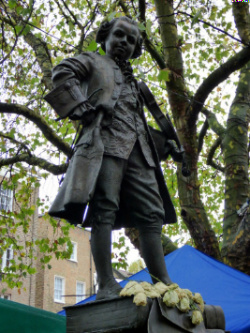
Philip Jackson’s statue of Wolfgang Amadeus Mozart in Orange Square. PICTURE: Peter O’Connor (licensed under CC BY-SA 2.0)
Mozart and his sister were both child prodigies and during their London sojourner performed in various London theatres and for King George III and Queen Charlotte at Buckingham Palace on several occasions. But, with his father now needing quiet, they were forbidden to play instruments in the house and so, according to his sister’s writings, in order to keep himself busy it was there that he composed his “first symphony for all the instruments of the orchestra, especially for trumpets and kettledrums”.
While the work she was referring to is now lost, Mozart did go on to compose the symphony that is now seen as his first at the same time. Known as K.16 in E flat major, it was first performed at the Haymarket Little Theatre in February, 1765.
Leopold did recover and so the family moved back to Soho – lodging at 20 Frith Street to be précise – in September, 1764. It was there that Mozart met the youngest son of Johann Sebastian Bach, Johann Christian, who was to be a key influence on his musical style. They left the property – and brought their time in England to an end in July, 1765, amid waning public interest in their performances (they gone from performing for the Royal Family to entertaining pub patrons). The family continued with their European tour before eventually returning to their home town of Salzburg (Mozart later settled in Vienna where he died at the young age of 35).
Mozart’s time at the Ebury Street residence (and the composition he wrote there) is commemorated with an English Heritage Blue Plaque (albeit this one is brown) which was erected by the then London County Council in 1939. Following damage in the war, it was reinstated in 1951. There’s also a statue commemorating Wolfgang Amadeus Mozart in nearby Orange Square. Designed by Philip Jackson, it was erected in 1994.
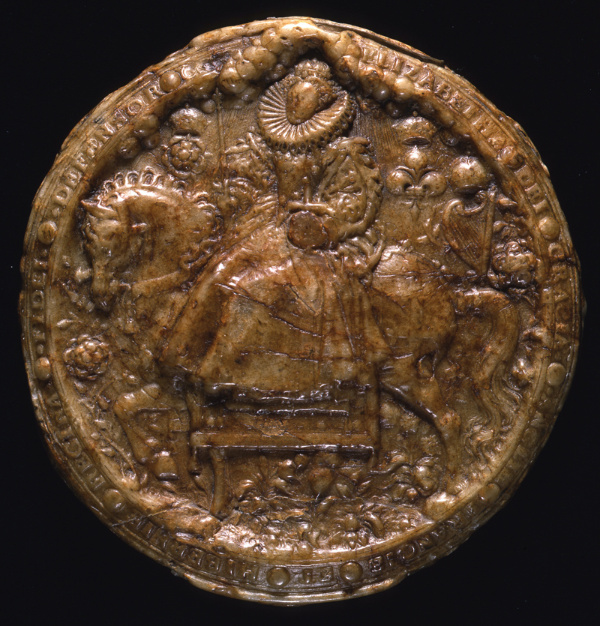
Held in the National Archives at Kew, this great seal was used during the second half of Queen Elizabeth I’s reign – from 1586 to 1603.
The seal, which replaced an earlier one used by Queen Elizabeth I, was used by the Chancery to prove the document it was attached to was issued in the Queen’s name. The seal also acted as a security device, ensuring the document couldn’t be read before reaching the intended recipient. Made of wax, it was created using a metal pattern or matrix.
The metal pattern for this seal was created by court miniaturist Nicholas Hilliard.
The obverse or front side of the seal, which is made of resin and beeswax which turns brown with age, shows Queen Elizabeth I on her throne, her hands holding a sceptre and an orb – royal insignia – and accompanied by the Royal Coat of Arms. The reverse (pictured) shows Queen Elizabeth I mounted on a horse and surrounded by symbols including the Tudor Rose, a harp representing Ireland and fleur de lys representing France. The inscription around the seal reads: Elizabetha dei gracia Anglie Francie et Hibernie Regina Fidei Defensor (‘Elizabeth, by grace of God, Queen of England, France and Ireland, Defender of the Faith’).
The seal was traditionally carried before the Lord Chancellor and Keeper of the Great Seal in a purse or burse. One used to carry Queen Elizabeth I’s matrix is in the collection of the British Museum.
The matrix used to create the second seal was surrendered to King James I on his accession to the throne on 3rd May, 1603. James then used it for the next 11 weeks until his own was ready (at which time Queen Elizabeth I’s matrix was defaced).
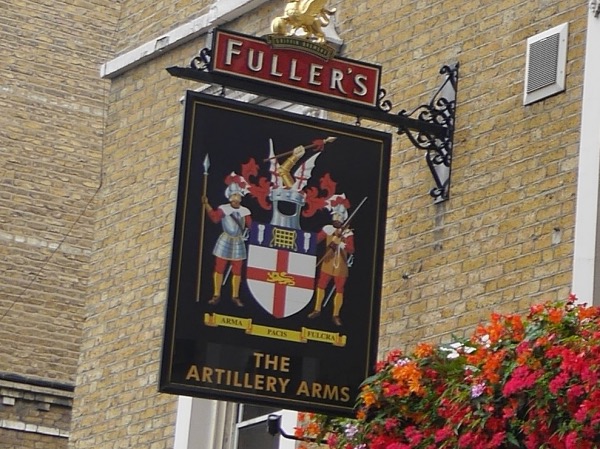
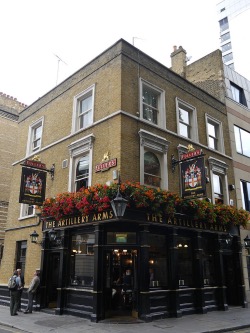
This City of London pub is located opposite the Bunhill Fields Burial Ground, final resting place of the likes of Daniel Defoe, John Bunyan and William Blake, and dates from the 1850s.
Originally known as The Blue Anchor, it – under the landlord ship of Jemmy Shaw – was once notorious for the “sport” of rat-baiting which usually involved betting how long a dog would take to kill a rat and which apparently became popular after the 1835 Cruelty to Animals Act banned bull baiting, cock fighting and dog fighting.
The name of this premises at 102 Bunhill Row comes from the nearby location (just ton the south on the other side of the road) of the Honourable Artillery Company, which was incorporated by a Royal Charter issued by King Henry VIII in 1537 located here since the mid-17th century. The company’s coat-of-arms are on the pub’s sign.
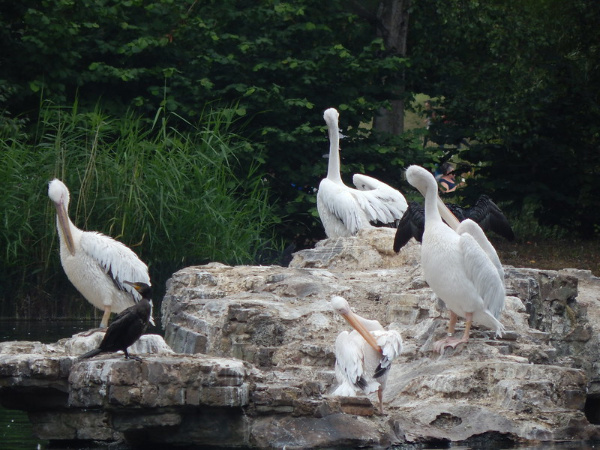
Pelicans were first introduced to St James’s Park in 1664 when a pair of the rather large birds were presented as a gift from the Russian Ambassador to King Charles II. They’ve been there ever since.
More than 40 pelicans have apparently made their home at the park over the years. Past pelicans have included the solitary Daphne – nicknamed the ‘Lady of the Lake’, she lived alone at the park in the early 1970s as well as Astra and Khan, who came from Astrakhan in Russia and were presented by the Russian Ambassador in 1977. There’s also been a Louis, who came from Louisiana in 1982, and Vaclav and Rusalka, who were a gift from Prague Zoo in 1995.
There are currently six members of the ‘scoop’ or ‘squadron’ (just two of the collective nouns used for pelicans) in the park. They include Isla and Tiffany – gifted from Prague in 2013 – and Gargi (gifted in 1996 after he was found in a Southend garden) as well as newer arrivals, brothers Sun and Moon, and a female named Star, all of whom came from Prague Zoo in 2019. Five are Eastern Whites and one is a South American White.
The pelicans are fed fresh fish each day between 2:30pm and 3pm, next to Duck Island Cottage, and while they are free to go where they wish, they rarely go far from the almost 57 acre park. But they did make headlines for eating a pigeon in 2006.
Royal Parks are offering a walking tour of St James’s Park which ends with watching the daily feeding on 5th November. Head here for details.
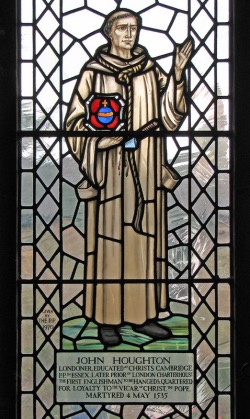
St John Houghton is remembered as the first Catholic Englishman to have been executed for refusing to take the oath prescribed by King Henry VIII’s Act of Supremacy.
Stained glass depicting St John Houghton in St Etheldreda’s Catholic Church in Ely. PICTURE: Lawrence OP (licensed under CC BY-NC 2.0)
Houghton was born around 1487 and is believed to have been educated at Cambridge, becoming ordained around 1511 before he entered the London Charterhouse in 1515 or 1516. By 1523, he held the position of sacristan and in 1528 that of procurator before, in 1531, he was transferred to Beauvale Priory in Nottinghamshire to serve as its prior.
But he returned to London in November that same year when he was unanimously elected Prior of the London Charterhouse. The following year was named Visitor of the English Province for the Carthusian Order.
When the King’s agents visited in April, 1534, requiring the community to take an oath as required under the 1534 Act of Succession (which excluded Katherine of Aragon’s daughter Mary in favour of Anne Boleyn’s daughter, Elizabeth), Houghton asked that the community be exempted.
Such a request was not looked upon kindly and Houghton, along with his procurator, Humphrey Middlemore, was arrested and taken to the Tower of London. Subsequently convinced that the oath was consistent with their Catholic faith by fellow clerics, the two returned to the Charterhouse in May, and there, in the presence of an armed force, the whole community eventually took the oath.
But in 1535, the community was again required to take an oath – this time recognising King Henry VIII as the Supreme Head of the Church of England as required by the 1534 Act of Supremacy. But Houghton, along with the heads of the other two English Carthusian houses – Robert Lawrence, Prior of Beauvale, and Augustine Webster, Prior of Axholme – sought an audience with Thomas Cromwell and asked for an exemption. All three were sent to the Tower.
The three men were interrogated by Cromwell on 26th April and then, a few days later, were called before a special commission and sentenced to death.
Houghton was among five clerics – along with the other two Carthusian priors as well as Bridgettine monk Richard Reynolds and John Haile, the parish priest of Isleworth – who were dragged through the streets to Tyburn on 4th May. There, Houghton – wearing his religious habit – is said to have embraced his executioner as he recited the words of the 31st Psalm before he was the first to be hanged, drawn and quartered.
Catholic tradition says that when Houghton’s body was cut open to remove his heart, he said to have prayed: “O Jesus, what wouldst thou do with my heart?”
Pieces of Houghton’s body were then displayed around London – his head was displayed above London Bridge and his arm was nailed to the gate of the Charterhouse,
Houghton was beatified on 9th December, 1886, and canonised in 25th December, 1970. He is considered one of the 40 Catholic Martyrs of England and Wales, all of whom were executed between 1535 and 1679 during the English Reformation.
Thankfully much copied (at least in part), this full length portrait of King Henry VIII, his third wife and parents was the work of Hans Holbein the Younger.
Holbein, appointed the king’s painter in 1536, was commissioned to create the work following the King’s marriage to Jane Seymour on 30th May, 1536, and completed it in 1537 (there’s some speculation it may have been commissioned in celebration of the birth of King Henry’s son, King Edward VI).
The mural featured the King standing in full splendour, although without typical symbols of royalty such as a crown or sceptre, as well as his wife Jane Seymour, and his parents, King Henry VII and Queen Elizabeth of York. They were all standing around a central pillar upon which are inscribed verses in Latin extolling the Tudor dynasty.
The work is understood to have been commissioned for one of the King’s more private chambers in the Palace of Whitehall which Henry had seized after the downfall of Cardinal Thomas Wolsey.
The portrait survived the reign of King Henry VIII but was destroyed in the fire which devastated the palace in 1698.
A full-sized cartoon of the left-hand side of the work which was completed by Holbein in preparation for its creation is held in the collection of the National Portrait Gallery (pictured right).
While there are numerous copies of the figure of King Henry VIII, the only complete copy of the mural is attributed to Remigius van Leemput who created it in 1667 – it can be seen at Hampton Court Palace.
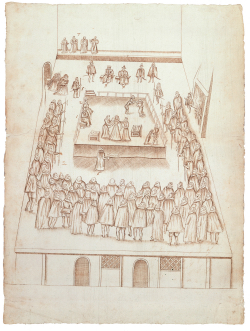
• The complex relationship between Queen Elizabeth I and Mary, Queen of Scots, is the subject of a new exhibition opening at the British Library in King’s Cross tomorrow. Highlights of Elizabeth and Mary: Royal Cousins, Rival Queens, the first major exhibition to consider both women together, include Queen Elizabeth I’s 1545 handwritten translation of her stepmother Katherine Parr’s Prayers and Meditations – a gift for her father King Henry VIII, a sonnet by Mary, Queen of Scots, which was handwritten the night before she was executed in 1587 (possibly the last thing she ever wrote), the ‘Penicuik Jewels’ which she is thought to have given away on the day of her death and Robert Beale’s eye-witness drawing depicting her entering the hall, disrobing, and placing her head on the block (pictured right). Other items on show include King Henry VIII’s Great Bible (dating from 1540, it was later inherited by Elizabeth I), Elizabeth I’s mother-of-pearl locket ring (c1575) containing miniature portraits of herself and her mother Anne Boleyn, and the warrant confining Mary, Queen of Scots, in Lochleven Castle in 1567. The exhibition is accompanied by a programme of events. Runs until 20th February. Admission charge applies. For more, see www.bl.uk/events/elizabeth-and-mary.
• Nineteenth century African-American abolitionists Ellen and William Craft have been honoured with an English Heritage Blue Plaque at their former Hammersmith home. The Crafts escaped from enslavement in Georgia in the US in December, 1848, and fled to Britain, settling in a mid-Victorian house at 26 Cambridge Grove where they raised a family and campaigned for an end to slavery. The Crafts returned to the US following the end of the American Civil War and the emancipation of enslaved people and settled in Boston with three of their children. In 1873, they established the Woodville Cooperative Farm School in Bryan County, Georgia, for the children of those who had been emancipated. Ellen died in Georgia in 1891 and William in Charleston in 1900.
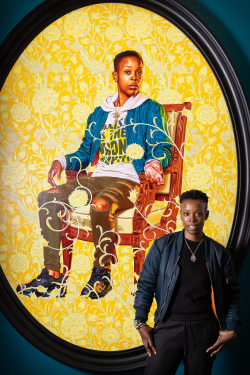
• American artist Kehinde Wiley’s monumental Portrait of Melissa Thompson has gone on display in the V&A’s British Galleries, alongside William Morris’s Wild Tulip designs that inspired it. The massive oil painting, which was created as part of Wiley’s series The Yellow Wallpaper and was first exhibited at the William Morris Gallery in Walthamstow in 2020, was acquired earlier this year and is being displayed as part of a series of initiatives marking the 125th anniversary of William Morris’s death this October. The painting will be displayed in the William Morris Room (room 125) until 2024, after which it will move to its permanent home at V&A East Museum in 2025. Admission is free. For more, head to vam.ac.uk.
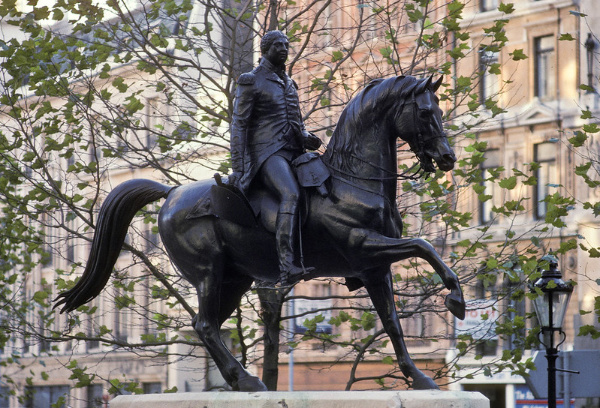
Equestrian statue of King George III in Cockspur Street. PICTURE: David Nicholls (licensed under CC BY-NC 2.0)
This month marks 260 years since King George III and Charlotte of Mecklenburg-Strelitz were crowned King and Queen of the Kingdom of Great Britain at a ceremony at Westminster Abbey.
Only 23-years-old at the time, King George III had ascended to the throne before following the death of his grandfather, King George II, in October, 1760. He and his wife, then Princess Charlotte of Mecklenburg-Strelitz, had married in the Chapel Royal at St James’s Palace just two weeks prior to the coronation on 8th September, 1761 (they had met earlier the same day).
The royal couple started the day of the coronation – 22nd September – at St James’s Palace and were carried in sedan chairs to Westminster Hall, arriving at about 11am. They then processed on foot through crowds from the hall to Westminster Abbey (the crowds were said to be such that numerous carriages had collided with each other in the bid to reach the abbey). There, they proceeded to a special platform built in the abbey for the occasion.
Commencing at about 3pm, the coronation ceremony began. In an elaborate ceremony overseen by the Archbishop of Canterbury Thomas Secker, the new King was then crowned (Zadok the Priest, which George Frideric Handel had written for the coronation of King George II, was the anthem at the new king’s request). A simpler ceremony followed in which Charlotte was crowned Queen Consort.
The whole affair reportedly lasted more than six hours, so long that some guests are said to have tucked into snacks while watching.
A feast was subsequently held in Westminster Hall during which the King’s Champion, wearing full armour, rode into the hall and threw down a gauntlet challenging any who questioned the King’s legitimacy to step up (none did). During the feast, spectators in the galleries above let down baskets and handkerchiefs for their better placed friends below to fill with food.
The King and Queen departed the feat at about 10pm followed by guests. After they’d vacated the premises, the doors were then opened for the public to come in and to finish off the food.