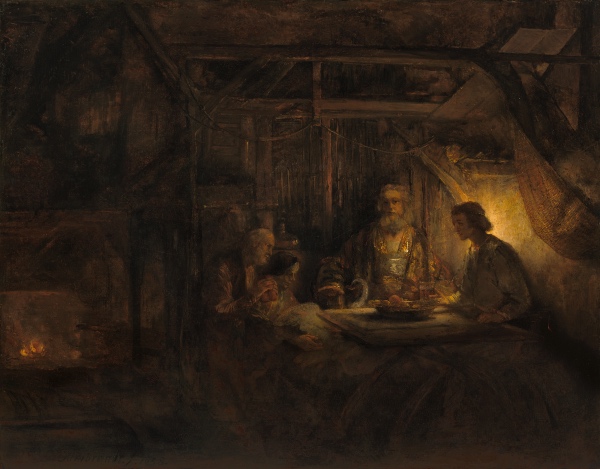
• Rembrandt’s mastery of light is the subject of a new exhibition opening at the Dulwich Picture Gallery on Friday to mark 350 years since the Dutch artist’s death. Rembrandt’s Light includes 35 of his greatest paintings, etchings and drawings including international loans The Pilgrims at Emmaus (1648) and – shown for the first time in the UK – Philemon and Baucis, (1658), Tobit and Anna with the Kid (1645) and The Dream of Joseph (1645). The works have been arranged thematically and show how he used light and shadow for dramatic effect, focusing on his work during the middle period of his career – 1639-1658 – while he was living in his “dream house” on Breestraat in Amsterdam where the large windows provided ideal access to light. The display will employ a new LED Bluetooth lighting system installed at the gallery while cinematographer Peter Suschitzky, famed for his work on Star Wars: The Empire Strikes Back; The Rocky Horror Picture Show and Mars Attacks!, has worked with the curators to create what the gallery promises will be an “atmospheric visitor experience”. Admission charge applies. Runs to 2nd February. PICTURE: Rembrandt van Reign, Philemon and Baucis (1658), oil on panel transferred to panel, National Gallery of Art, Washington.
• The first ever exhibition devoted to the portraits of Paul Gauguin opens at the National Gallery on Monday. The Credit Suisse Exhibition: Gauguin Portraits shows how the French artist, who was famed for his paintings of French Polynesia, revolutionised the portrait to express himself and his ideas about art. It features more than 50 works including paintings, sculptures, prints, and drawings – many of which have rarely been seen together. They include Madame Mette Gauguin in Evening Dress (1884), Young Breton Girl (1889), Tehura (Teha’amana) (1891-93), Young Christian Girl (1894), Père Paillard (1902) and the last self-portrait he ever completed, made in 1903, probably shortly before the end of his life at the age of 55. Runs until 26th January in the Sainsbury Wing. Admission charge applies. For more, see www.nationalgallery.org.uk.
• Fifteen Buddhist and Shinto sacred images from the Nara Prefecture have gone on show at the British Museum. The works, which include five Japanese National Treasures, date from between 600 and 1300 AD and are displayed with related important Japanese and Chinese paintings from the museum’s collection. The objects include a gilt bronze sculpture, Bodhisattva of Compassion, a gilt-bronze libation dish featuring the birth of the Buddha and a pair of imposing wooden sculptures, Heavenly Kings, all of which date from the 700s. Nara: sacred images from early Japan can be seen in Room 3 (the Asahi Shimbun Displays) and the Mitsubishi Corporation Japanese Galleries (Room 93). Runs until 24th November. For more, see www.britishmuseum.org.
Send all items for inclusion to exploringlondon@gmail.com.