A Black Lives Matter tribute shirt worn by Arsenal captain Pierre-Emerick Aubameyang during the 2020-21 Premier League season is being donated to the Museum of London as part of its Collecting COVID project. The Black Lives Matter logo was added to all Premier League shirts following anti-racism protests across the globe earlier this year. Aubameyang – the latest Black player to captain Arsenal – said it was “an honour to have the opportunity to donate my Black Lives Matter shirt to the Museum of London’s Collecting COVID project”. “I hope this will be remembered as the moment that football stood against all forms of racism and that it will inspire young people for the future,” he said. The Collecting COVID project was launched in April this year with the aim of collecting objects relating to how Londoners lived during coronavirus pandemic. For more, see www.museumoflondon.org.uk/discover/museum-for-london-collecting-covid.
News
This Week in London – ‘Dub London’; exploring Sin; and, COVID-19 explored at Science Museum Late…

• Dub music and the impact it’s had on London’s identity and people is the subject of a new, long delayed, exhibition which opened at the Museum of London late last week. Dub London: Bassline of a City, which had been postponed due to the coronavirus pandemic, charts how, from its roots in Jamaican reggae, dub music went on to influence multiple genres and played a key role in the development of punk bands like The Clash. The display includes the iconic speaker stack belonging to Channel One Sound System that has appeared yearly at Notting Hill Carnival since 1983 (pictured above) and a specially created bespoke record shop with a selection of 150 vinyl records chosen by 15 London based independent record shops which can be listened to. Runs until 31st January. Admission is free but must be booked in advance (and bring your own headphones). For more, see www.museumoflondon.org.uk/museum-london/whats-on/exhibitions/dub-london.
• The concept of sin is at the heart of a new free exhibition at The National Gallery. Sin brings together 14 works dating from the 16th century to now by artists ranging from Jan Brueghel the Elder and William Hogarth to Andy Warhol and Ron Mueck. Among the paintings on show are Lucas Cranach the Elder’s Adam and Eve (1526), Hogarth’s The Tête à Tête and Marriage A-la-Mode, Diego Velázquez’s Immaculate Conception, William Holman Hunt’s The Scapegoat (1854-55), and Ron Mueck’s sculpture Youth (2009). The display can be seen in Room 1. For more, see nationalgallery.org.uk.
• The science of the coronavirus is explored in a special night event at the Science Museum next Wednesday, 14th October. Staff from the Francis Crick Institute will be joining with those from the Science Museum in exploring how the immune system remembers and evolves and how the Crick was turned from a biomedical research centre into a COVID-19 testing facility. Visitors can also hear from NHS transplant surgeon Pankaj Chandak who has been using 3D printing tech to make life-saving PPE for frontline staff while the Leonard Cheshire charity shows how assistive eyegaze technology has played a vital role in helping to keep people with access needs connected. There will also be a chance to make a facemask as part of the museum’s #MaskSelfie campaign and the opportunity to explore the museum’s new Medicine: The Wellcome Galleries. Admission charge applies and pre-booking is essential. Head to sciencemuseum.org.uk/see-and-do/lates.
Send all items for inclusion to exploringlondon@gmail.com.
LondonLife – Frieze Sculpture at The Regent’s Park…

Twelve works by leading international artists have gone on show in the English Gardens, The Regent’s Park, in this year’s Frieze Sculpture display. The works, which can be seen until 18th October and form part of an expanded Frieze Week programme, includes pieces from Patrick Goddard, Kalliopi Lemos and Arne Quinze as well as a recent commission by Lubaina Himid which is being exhibited in the UK for the first time. The works touch on a range of themes – from civil rights and ecology to the role of the artist as a disruptor. The display is accompanied by a free audio tour by curator Clare Lilley, director of programme at Yorkshire Sculpture Park, and can also be seen virtually in the Frieze
Viewing Room. For more, see www.frieze.com/FriezeSculpture.


This Week in London – ‘Artemisia’ at The National Gallery, ‘Black Greenwich Pensioners’, and, Bruce Nauman at the Tate…
• The original transcript of the trial in which 17th century Italian artist Agostino Tassi faced charges of ‘deflowering’ female artist Artemisia Gentileschi will be public display for the first time as part of an exhibition on Gentileschi’s work opening at The National Gallery on Saturday. The rescheduled exhibition Artemisia, the first major monographic exhibition of Artemisia Gentileschi (1593–1654 or later), was inspired by the gallery’s recent acquisition of Self Portrait as Saint Catherine of Alexandria (about 1615–17), the first painting by the artist to enter a UK public collection. Gentileschi, the first women to gain membership of the artists’ academy in Florence, had a career spanning more than 40 years and is now widely recognised as one of the most gifted painters of the Italian Baroque period. Alongside her artistic achievements, elements of her biography have also attracted considerable attention including her rape as a young woman and the torture she choose to endure as part of the trial that followed (seen at the time as an accepted means by which testimony could be validated). As well as the trial transcript, written in Latin and Italian, the exhibition will include recently discovered personal letters and works such as two versions of Susannah and the Elders – one painted in 1610 when Gentileschi was just 17 and the other, her last known painting, dating from 1652. There’s also self portraits including Self Portrait as a Female Martyr (mid 1610s), and her two versions of Judith beheading Holofernes – one dating from 1612-13 and the other from 1613-14. Runs until 24th January. Admission charge applies. For more, see www.nationalgallery.org.uk. PICTURE: Installation view of Artemisia at the National Gallery. © The National Gallery, London.
• The history of Black British mariners is the subject of a new exhibition opening at the Old Royal Naval College in Greenwich on Saturday. Marking Black History Month, Black Greenwich Pensioners explores the history of the Black Royal Navy personnel and how they formed one of Britain’s earliest Black communities when they became pensioners at the Royal Hospital for Seaman on the site where the Old Royal Naval College stands today. Through paintings, prints, photographs and a small selection of objects, the display looks at the role Black mariners played in British naval conflicts as well as the personal histories of prominent Greenwich pensioners including John Thomas, who escaped slavery and was later returned to enslavement in Barbados, John Simmonds, a Jamaican veteran of the 1805 Battle of Trafalgar whose descendants still reside in the UK, and Briton Hammon, author of the first slave narrative. Entry is free. Runs until 21st February in the mezzanine gallery at the Visitor Centre. For more, see https://ornc.org/uncovering-the-history-of-black-british-mariners/
• The first exhibition to showcase the full spectrum of American artist Bruce Nauman’s work in more than 20 years opens at the Tate Modern on Wednesday. Bruce Nauman features more than 40 works and “unfolds” over a sequence of immersive installations. Highlights include a selection of early works such as Henry Moore Bound to Fail (1967/70) and A Cast of the Space Under My Chair (1965/68), the moving image installation MAPPING THE STUDIO II with color shift, flip, flop & flip/flop (Fat Chance John Cage) (2001), ground-breaking neon signs like The True Artist Helps the World by Revealing Mystic Truth (Window or Wall Sign) (1967), Human Nature Knows/Doesn’t Know (1983/86) and One Hundred Live and Die (1984) and large scale works such as Going Around the Corner Piece with Live and Taped Monitors (1970) and Double Steel Cage Piece (1974) as well as the whole-room installation, Shadow Puppets and Instructed Mime (1990). Runs until 21st February. Admission charge applies. For more, see www.tate.org.uk.
Send all items for inclusion to exploringlondon@gmail.com.
This Week in London – Richard Leveridge in the spotlight; ‘Paradise Lost’ at Kew; and, Princess Beatrice’s wedding dress at Windsor…
• The life and work of Richard Leveridge, a leading singer of the London stage during the 18th century, is the subject of a new display opening at the Foundling Museum in Bloomsbury tomorrow. The display, which can be seen in the Handel Gallery, charts the life of this popular theatre singer who became the lead bass singer at Drury Lane Theatre in 1695 and sang for Purcell in many of his stage works as well as, later, singing in the first performances of Handel’s early London operas. It also includes a look at Leveridge’s work as a composer and coffee shop owner and among items on show are manuscripts, early printed music, artworks, copies of drinking songs and stage works, contemporary accounts and formal portraits. Runs until 28th March. Admission charge applies. For more, see https://foundlingmuseum.org.uk
• The first solo exhibition by Dutch-born, Mexico-based visual artist Jan Hendrix to be held in the UK opens in Kew Gardens’ Shirley Sherwood Gallery of Botanical Art next week. Paradise Lost features new works in a number of mediums created as a responser to the transformation of the landscape known as Kamay Botany Bay, in Sydney, Australia (which gained its English name – Botany Bay – from plants collected and recorded there in 1770 by European botanists Sir Joseph Banks – Kew Gardens’ first director – and Daniel Solander abroad the HMS Endeavour). Reflecting on how the visit of the Endeavour sparked a transformation of the region – from a pristine environment to what is now a suburban and industrial landscape, the exhibition explores themes including the destruction of the natural world in the wake of colonial industrialisation, contemporary urbanisation and climate change. New works include a vast monochrome tapestry evoking the dynamic texture and beauty of an Australian landscape threatened by wildfire – which ravaged the region in 2019 – as well as the display’s centrepiece – a huge walk-through mirrored pavilion inspired by two plant species that grow in Kamay Botany Bay – Banksia serrata or Wiriyagan (Cadigal) and Banksia solandri, and a moving image work created by Hendrix in collaboration with filmmaker Michael Leggett. A visual tour narrated by the artist will be made available online for those not able to visit in person. Runs from 3rd October until 13th March. Admission charge applies. For more, head to www.kew.org. PICTURE: Mirror Pavilion III, 2020, Stainless Steel by Jan Hendrix/Kew Gardens
• FURTHER AFIELD: Princess Beatrice of York’s wedding dress, first worn by Queen Elizabeth II in the 1960s, goes on display at Windsor Castle from today. Designed by Sir Norman Hartnell, the dress was first worn by the Queen during a State Visit to Rome in 1961 and was altered for Princess Beatrice for her marriage to Edoardo Mapelli Mozzi on 17th July this year. The display, which can be seen in the State Dining Room, also features Princess Beatrice’s wedding shoes, made by Valentino, and a replica of her bouquet. Can be seen until 22nd November. Admission charge applies. For more, see www.rct.uk.
Send all items for inclusion to exploringlondon@gmail.com
LondonLife – The Battle of Britain remembered…
Dignitaries including Prime Minister Boris Johnson and the Chief of the Air Staff, Air Chief Marshal Michael Wigston, were among those attending a service commemorating the 80th anniversary of the Battle of Britain in Westminster Abbey on Sunday. The service, which was witnessed by fewer people than would normally have been the case due to the coronavirus pandemic, included an Act of Remembrance during which the Battle of Britain Roll of Honour – containing the names of the 1,497 pilots and aircrew killed or mortally wounded during the 112 days of fighting – was carried through the church and placed beside the High Altar. After the service three Spitfires and a Hurricane from the Battle of Britain Memorial Flight took part in a flypast over the Abbey. Pictured above are the standard bearers formed up on the altar at the service (all pictures via MOD © Crown copyright 2020)
Above: The Queen’s Colour Squadron lining the entrance to Westminster Abbey.
Above: Prime Minister Boris Johnson carrying out a reading during the service.
Above: FO Buckingham saluting the Battle of Britain memorial stained glass window at Westminster Abbey.
Above: The four planes from the Battle of Britain Memorial Flight fly above the Abbey.
This Week in London – Open House London; The British Army in Germany; and, Christine Granville’s Blue Plaque…
• It’s Open House London this weekend and, thanks to the coronavirus pandemic, this programme features a host of documentary films, online events and self-led walking tours. Highlights from the festival, which runs over Saturday and Sunday with some additional events taking place until 27th September, include online tours of the HM Treasury in Whitehall (pictured) and Dorich House Museum in Kingston-upon-Thames, a self-guided walking tour of Fosters + Partners buildings in London’s centre, and the chance to visit Rochester Square in Marylebone. The programme features a series of collections of related events – such as those related to ‘colonial histories’ or ‘architecture for the climate emergency’ – to help make it easier for people to access. For the full programme of events, head to https://openhouselondon.open-city.org.uk. PICTURE: HM Treasury Building taken from the London Eye (Dave Kirkham/licensed under CC BY-ND 2.0/Image cropped)
• The work and lives of the more than million British Army soldiers who have served in Germany following World War II is the subject of a new exhibition opening at the National Army Museum in Chelsea next Tuesday. Foe to Friend: The British Army in Germany since 1945 charts how the Army helped to rebuild a broken nation in the aftermath of the war, provide protection during the Cold War and, later, how they used Germany as a base to deploy troops all around the world. It will include stories of family life as well as those involving espionage and massive military training exercises. The free exhibition can be seen until 1st July, 2021. For more, see www.nam.ac.uk.
• Christine Granville, Britain’s first and longest-serving female special agent, has been honoured with an English Heritage Blue Plaque. The plaque is located at the 1 Lexham Gardens hotel (previously known as the Shelbourne Hotel) in Kensington which was Granville’s base after the war. Granville, who was once described by Churchill as his “favourite spy”, was born in Warsaw as Krystyna Skarbek. She joined British intelligence after Germany invaded Poland in 1939 and undertook missions including skiing over the snow-bound Polish border in temperatures of -30 degrees Celsius, smuggling microfilm revealing Hitler’s plans to invade the Soviet Union across Europe and rescuing French Resistance agents from the Gestapo (in fact, it’s said she was also the inspiration for Vesper Lynd, a spy in Ian Fleming’s first James Bond novel, Casino Royale). Christine Granville was one of her aliases she had been given during her time with intelligence and it was a name she decided to keep after the war. For more, see www.english-heritage.org.uk/visit/blue-plaques/.
Send all items for consideration to exploringlondon@gmail.com.
LondonLife – ‘Rivers of the World’…
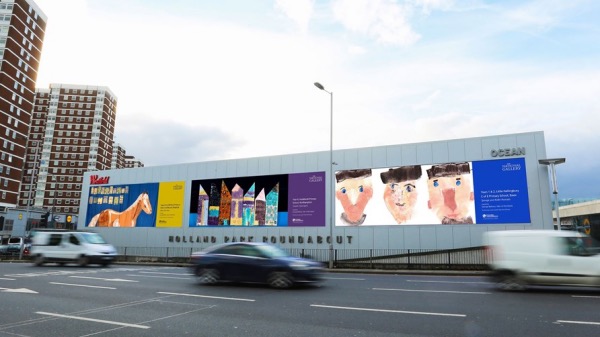
River inspired artwork created by young people from across London, the UK and around the world is one show on South Bank as part of the Totally Thames festival. The art for Rivers of the World was created during the coronavirus lockdown under the guidance of professional artists who provided briefs and films to help the young artists. The outdoor exhibition, on Riverside Walkway near the Tate Modern, is free to visit. For more on Totally Thames, London’s annual month-long celebration of its river, head to https://thamesfestivaltrust.org. PICTURES: Young artists with work created as part of ‘Rivers of the World’ (Courtesy of Totally Thames).
This Week in London – The Havering Hoard on show; and, Totally Thames returns…
With the impact of the new rules being put in place to counter the coronavirus outbreak still being assessed, some scheduled events may be subject to change. As we would always advise anyway, please check with organisations before making any plans…
• The ‘Havering Hoard’ goes on display at the Museum of London Docklands on Friday, the first time it’s ever been on public display. Havering Hoard: A Bronze Age Mystery features all 453 objects found during an archaeological investigation in Havering in London’s east, in September, 2018. Dating from between c900 and c800 BC, the cache of items – the largest Bronze Age hoard ever found in London and the third largest find in the UK – includes fragments of swords and spears as well as tools including axeheads, sickles, gouges and awls, and terret rings, believed to prevent reins from tangling when horses were pulling a cart (these are the first examples found in England). There are also bracelet fragments, part of a double-sided razor, a ceramic loomweight and bronze pin decorated with amber which may have been used to secure a cloak. The display will explore questions surrounding who buried the hoard and why as well as why it was never recovered. Runs until 18th April. Admission charge applies. For more – including how to prebook tickets to the museum – see www.museumoflondon.org.uk/haveringhoard. PICTURE: Part of the hoard found in Havering (© Archaeological Solutions).
• Totally Thames – London’s annual celebration of its river – is once again underway with a program featuring art exhibitions and installations, tours and online performances. The events include an online performance of Whittington about the life of the City’s famous mayor, ‘Words on the Wind’ – an outdoor art installation in Kingston featuring a soundscape of recorded poets, and online tours of The Golden Hinde, a replica of Sir Francis Drake’s famous ship. Many events are free and the festival runs to the end of the month. For more, see https://thamesfestivaltrust.org.
Send all items for inclusion to exploringlondon@gmail.com.
This Week in London – National Maritime Museum, London Transport Museum reopen; and, Picasso at BASTIAN gallery…
• The National Maritime Museum in Greenwich opens its doors this Monday, 7th September. Those who visit in the first week will be able to see all the winning images in the ‘Insight Investment Astronomy Photographer of the Year’ competition.Entry is free but tickets must be booked in advance. For more, see www.rmg.co.uk/national-maritime-museum.
• Other reopenings include the London Transport Museum in Covent Garden which also throws back its doors on Monday. Along with displays including historic vehicles and iconic posters, the reopening includes the ‘Hidden London’ exhibition revealing London’s ‘abandoned’ Underground stations. Tickets must be booked in advance. Admission charges apply. For more, see www.ltmuseum.co.uk.
• Picasso’s Cannes’ studio has been recreated in an immersive experience at the BASTIAN gallery in Mayfair. Atelier Picasso is an installation-style exhibition and features furniture, sculptures, ceramics, drawings and prints. Highlights include portraits of the artist taken by his friend André Villers, ceramic works such as Wood Owl (1969) and Carreau Visage d’Homme (1965), lithograph and linocut posters and books including Gallieri Jorgen Expose Le Lithographies de L’atelier Mourlot (1984), and the masterpiece Minotaure caressing une dormeuse from the artist’s Vollard Suite. Admission is free. For more, see www.bastian-gallery.com. PICTURE: Courtesy of Luke Andrew Walker.
Send all items for inclusion to exploringlondon@gmail.com.
LondonLife – ‘The Sunbathers’ returns to Waterloo Station after almost 70 years…
A sculpture created for the 1951 Festival of Britain has returned to Waterloo Station where it was first displayed almost 70 years ago. The work of Hungarian-born artist Peter Laszlo Peri, The Sunbathers features two figures – made from ‘Pericrete’, a special kind of concrete created by the artist as a cheaper alternative to casting in bronze – and was mounted on the wall close to the station’s entrance. It was presumed lost until it was rediscovered in 2016 at the Clarendon Hotel in Blackheath and, following restoration, was put on show in 2017 in the Southbank Centre’s Royal Festival Hall. Now, thanks to the efforts of Historic England and Network Rail, the sculptures have returned to the station, close to its original site, and will stay there for five years. PICTURES: Courtesy of Network Rail
This Week in London – Rare Hebrew manuscripts at British Library; British Museum to reopen; and art at the Old Royal Naval College…
• The launch of a new exhibition looking at Hebrew manuscripts marks the next phase of the British Library reopening. Hebrew Manuscripts: Journeys of the Written Word explores the history, culture and traditions of the Jewish people around the world and features rarely seen treasures including a letter to King Henry VIII written by an Italian rabbi in 1530 regarding Biblical laws that could support Henry VIII’s claim to annul his marriage to Catherine of Aragon as well as the earliest dated copy – 1380 – of Moses Maimonides’ Guide for the Perplexed, a rare uncensored copy of the Babylonian Talmud dating from the 13th century, and a 15th century illustrated copy of Abraham bar Hiyya’s Shape of the Earth, one of the first Jewish scientific works written in the Hebrew language. Also reopening is the library’s free permanent gallery – the Sir John Ritblat Gallery: Treasures of the British Library – with a new one-way route taking in treasures including Leonardo da Vinci’s sketchbooks and handwritten manuscripts by the Brontë sisters, Virginia Woolf and Sylvia Plath. For more on the exhibition and the library’s reopening, see www.bl.uk. PICTURE: David Jensen.
• The British Museum reopens to visitors from today after the longest closure in its 261 year history. Tickets must be pre-booked online or over the phone and visitors will be able to access the ground floor galleries through a new one-way route. The museum has also announced that Grayson Perry’s work, The Tomb of the Unknown Craftsman – an elaborate, cast-iron coffin-ship originally created for his British Museum exhibition of the same name in 2011 – is returning to the museum. For more, see www.britishmuseum.org.
• A “celestial choir of spinning sound machines” can be seen at the Old Royal Naval College in Greenwich this weekend. Positioned in Lower Grand Square, Chorus is the monumental work of award-winning artist and British Composer of the Year Ray Lee. It features a series of giant metal tripods supporting rotating arms, at the end of which are loudspeakers which emit finely turned musical pitches. It can be viewed from Friday through to Monday. Meanwhile, the Painted Hall is hosting Luke Jerram’s artwork Gaia which features NASA imagery in creating a virtual, 3D small scale Earth. Gaia can be seen from tomorrow until 6th September (admission charge applies). For more, see www.ornc.org.
Send all items for inclusion to exploringlondon@gmail.com.
LondonLife – Windrush generation commemorated in Kensal Green…
A new sundial and garden have been unveiled in Kensal Green commemorating the Windrush generation. The sundial, the work of carver Martin Cook, is located at St John The Evangelist Church which, according to its vicar, Rev David Ackerman, has relied upon the local Caribbean community to survive and thrive since the 1960s. The sundial has been made of a single piece of slate and carved with the words “Work Together, Pray Together, Struggle Together, Stand Up for Freedom Together” which are taken from Martin Luther King Jr’s famous ‘I have a dream’ speech. An official opening ceremony for the sundial – which was funded by Westminster City Council – was held earlier this month. In a statement, Jonathan Glanz, the Lord Mayor of Westminster, said he hoped the outdoor space would become a “beacon of peace and unity for the local community in troubled times”. PICTURES: Courtesy of the City of Westminster.
This Week in London – Family fun at London Transport Museum Depot; and, Science Museum reopens…
• The London Transport Museum Depot in Acton Town has flung its doors open for 10 days of “special family fun”. The depot, which houses more than 320,000 items from the city’s transport history including vintage London buses and classic Tube trains, now features a special family-friendly trail for the 10 day season which takes a look at historic vehicles from the past 200 years including a yellow 1881 horse drawn ‘garden seat’ bus and a red 1938 Stock Tube train. The London Transport Miniature Railway will be running and all children visiting will receive a special sealed pack including a craft kit. Admission charges apply and tickets must be prebooked for times between 11am and 6pm until Sunday, 23rd August, and from Wednesday, 26th to Sunday 30th August. For more, see www.ltmuseum.co.uk/whats-on/depot-summer.
• The Science Museum in South Kensington reopened its doors this week after a closure of five months. As well as the innovative Wonderlab: The Equinor Gallery – which features interactive exhibits and live, socially-distanced science demonstrations – and the world’s largest medical galleries – Medicine: The Wellcome Galleries, visitors will be able to take in the temporary exhibition, Driverless: Who is in control?, the season of which has been extended to January next year. Tickets, which are free, must be pre-booked online and social distancing measures apply in the museum. For more, see www.sciencemuseum.org.uk.
Send all items for inclusion to exploringlondon@gmail.com
LondonLife – Chindit war memorial gets protection upgrade to mark VJ Day…
A memorial commemorating the role of the Chindit Special Forces in Burma during World War II has been awarded a Grade II listing on the National Heritage List for England in honour of the 75th anniversary of Victory in Japan (VJ) Day. Located in Victoria Embankment Gardens outside the Ministry of Defence building in Whitehall, the memorial’s granite plinth is topped with a bronze chinthe, a mythical beast that stands guard outside Burmese temples. The Chindit Special Forces, which were formed by British Army officer Major General Orde Charles Wingate and disbanded in early 1945, are credited with helping to turn the tide of World War II against Japan in the Far East. The memorial was designed by architect David Price and the chinthe sculpture the work of Frank Forster. It was unveiled by Prince Philip on 16th October, 1990. On Saturday, as the nation commemorated VJ Day, a military delegation lad a wreath at the foot of the memorial. PICTURE: Derek Voller (licensed under CC BY-SA 2.0).
This Week in London – VJ Day remembered; Steve McQueen; and, Windsor gardens…
• The National Army Museum in Chelsea is joining with the Royal Air Force Museum, the National Museum of the Royal Navy and the Commonwealth War Graves Commission to mark the 75th anniversary of VJ (Victory over Japan) Day, this Saturday, 15th August, with a series of free events including online talks. Among those taking part are World War II veteran Captain Sir Tom Moore, recently knighted by the Queen for his efforts in helping raise funds for the NHS during the coronavirus pandemic, author and explorer Levison Wood (who explores the story of his grandfather’s service in Burma), and Professor Tarak Barkawi, author of Soldiers of Empire: Indian and British Armies in World War II, as well as General Lord Richards, Grand President of the Royal Commonwealth Ex-Services League who’s involved in a conversation about the contribution of Commonwealth soldiers during the Far East campaign. For the full programme of events, head to www.nam.ac.uk/series/vj-day-75.
• Steve McQueen is back at Tate Modern. The exhibition, which reopened last Friday following the reopening of all Tate galleries, spans 20 years of McQueen’s work and features 14 major pieces spanning film, photography and sculpture. The exhibition adds to the three visitor routes already in place at the Tate Modern and coincides with McQueen’s latest artwork Year 3, an epic portrait of London’s Year 3 pupils created through a partnership between Tate, Artangel and A New Direction which can be seen at Tate Britain until 31st January. Visitors must prebook. For more, head to tate.org.uk/visit.
Beyond London (a new regular feature in which we include sites around Greater London)
• The East Terrace Garden at Windsor Castle – commissioned by King George IV in the 1820s – has opened to weekend visitors for the first time in decades. Overlooked by the castle’s famous east facade, the formal garden features clipped domes of yew and beds of 3,500 rose bushes planted in a geometric pattern around a central fountain. It was originally designed by architect Sir Jeffry Wyatville between 1824 and 1826 on the site of an old bowling green made for Charles II in the 1670s. Plants, including 34 orange trees sent by the French King Charles X, were specially imported for the garden and statues were brought from the Privy Gardens at Hampton Court, including a set of four bronze figures by Hubert Le Sueur which were made for Charles I in the 1630s and which remain in the garden today. Prince Albert is known to have taken a particular interest in the garden and the Queen, then Princess Elizabeth, and her sister Princess Margaret grew vegetables there during World War II. As well as the opening of the East Terrace Garden on weekends, visitors with young children on Thursdays and Fridays in August are being given special access to the Castle’s Moat Garden beneath the iconic Round Tower, thought to have dated from the period of King Edward III and believed to be the setting for Geoffrey Chaucer’s The Knight’s Tale, the first story in Canterbury Tales. Pre-bookings essential. For more, see www.rct.uk.
Send all items for inclusion to exploringlondon@gmail.com.
LondonLife – Concept designs for proposed Smithfield redevelopment revealed…
The City of London Corporation has unveiled early ideas for the redevelopment of the Smithfield Market following the proposed relocation of the meat market to Dagenham Dock along with Billingsgate and New Spitalfields. The work of architecture practice Studio Egret West, the new designs see the Grade II*-listed East and West Smithfield buildings and Grade II-listed Rotunda transformed for public and commercial use including removing some of the modern additions to the market buildings, such as loading bays and cold rooms, to reveal the elegance of the original Victorian structure and create four large, clear “halls” under the oversailing roof. While there’s been a meat market on the site since the 12th century, the Victorian-era markets buildings, featuring ornate iron frames, were built between 1866 and 1883. Members of the public are able to share their feedback on the initial concept drawings via the website, www.wholesalemarkets.co.uk/smithfield until 4th September.
This Week in London – V&A reopens; institution reopenings; and, ZSL London Zoo looks for volunteers…
• The V&A in South Kensington reopens its doors to visitors today in the first phase of a staged reopening strategy. All of the ground floor galleries are reopening including the Medieval & Renaissance Gallery, the Cast Courts, The Jameel Gallery of Islamic Art and Fashion Gallery, as well as the Europe 1600–1815 galleries on lower ground floor. The first and second floor collection galleries including The William and Judith Bollinger Jewellery Gallery, Theatre & Performance Galleries, and the Photography Centre as well as the museum’s Paintings, Tapestries and Silver Galleries are all scheduled to open on 27th August as well as the exhibition Kimono: Kyoto to Catwalk, which had closed just two weeks into its run. For more, see www.vam.ac.uk. PICTURE: M.chohan (Public domain).
• Other recent and upcoming reopenings include: the Horniman Museum, the Foundling Museum, the National History Museum, The Queen’s House in Greenwich (Monday, 10th August) and the National Maritime Museum in Greenwich (exhibitions only; galleries coming later).
• ZSL London Zoo is calling for volunteers to help assist visitors as they make their way around the zoo via three new one-way trails. The move, which follows a successful fundraising effort fronted by Sir David Attenborough, is aimed especially at people still furloughed and students forced to cancel gap year travel plans. Those interested in volunteering are asked to commit to a minimum of half a day each fortnight. For more, see www.zsl.org/volunteering.
Send all items for inclusion to exploringlondon@gmail.com.
LondonLife – Listening to London…
The first recorded soundscape of London’s busy streets was created in 1928 as part of a Daily Mail campaign calling for noise restrictions. Recordings were made at five sites – Whitechapel East, St George’s Hospital at Hyde Park Corner, Leicester Square, Cromwell Road and Beauchamp Place in South Kensington – in a collaborative project between the Mail and the Columbia Graphophone Company. Now, more than 90 years later, the sounds at the five original locations – or rather the lack of sounds during the coronavirus pandemic lockdown – have been captured again, this time as binaural recordings, a method of recording sound that uses two microphones to create a 3D stereo sound. It’s all part of the Museum of London’s ongoing ‘Collecting COVID’ project and was created in collaboration with String and Tins, an award-winning team of sound designers, composers, sound supervisors and mix engineers. Both the 1928 recordings (now digitised) and the modern recordings have been made available to listen to in their entirety for the first time on the Museum of London’s website. There are accompanying photographs by Damien Hewetson as well as historic imagery from the museum’s archive. PICTURE: A sparsely populated Leicester Square in an image taken in May this year during the coronavirus lockdown (ACME/licensed under CC BY-NC 2.0)
This Week in London – Kensington Palace reopens with Diana’s ‘Travolta dress’; institution reopenings; the Luna Cinema at Greenwich; and, ‘British Surrealism’ online…
• Kensington Palace has reopened its doors today after four months of lockdown and, to celebrate, the famous “Travolta dress” worn by Princess Diana is going on show for the first time. Designed by Victor Edelstein, the midnight blue velvet gown became the focus of world attention in 1985 when the Princess wore it to a White House Gala during which she danced with actor John Travolta. Historic Royal Palaces acquired the dress at auction in 2019. The palace will feature a new one-way route as part of coronavirus social distancing measures. For more, see www.hrp.org.uk/kensington-palace/.
• Other reopenings this week include: the Imperial War Museum, Churchill War Rooms, Wellington Arch, the Ranger’s House in Greenwich and the Jewel Tower in Westminster (Saturday, 1st July); the Royal Observatory in Greenwich (Monday, 3rd August); and, the Natural History Museum in South Kensington (Wednesday, 5th August).
• The Old Royal Naval College at Greenwich will host Luna Cinema’s open-air cinema from Tuesday 4th to Thursday, 6th August. Audiences will be able to sing and dance along to blockbuster hits Rocketman, Judy and Dirty Dancing with the college as the backdrop. Meanwhile the Old Royal Naval College is launching new smartphone tours with the first, available for free on any smartphone using the Smartify app, a family tour aimed at those visiting with children aged five to 12 years. For more, see www.ornc.org.
• The Dulwich Picture Gallery’s British Surrealism exhibition will be available for anyone to view online from Friday. The exhibition, which celebrates the British artists that contributed to the iconic surrealist movement, features more than 70 artworks from 42 artists, including Leonora Carrington, Francis Bacon, Henry Moore, Paul Nash, Ithell Colquhoun, and Conroy Maddox. For more, see www.dulwichpicturegallery.org.uk.
Send all items for inclusion to exploringlondon@gmail.com.