Around London – Dulwich celebrates 200 years, and Tube life captured on lens…

The Dulwich Picture Gallery  in south London is celebrating its bicentenary this year and to celebrate it’s holding a day of celebrations on Sunday (9th January). The gallery was founded in 1811 when art dealer Sir Francis Bourgeois bequeathed his collection of old masters for the “inspection of the public”. Interestingly, Sir Francis and his colleague Noel Desenfans had assembled the collection at the behest of the Polish King, Stanislaus Augustus, but when Poland was annexed by Russia and the king forced into exile, the two dealers were left with the goods. Sunday’s programme of events includes music, falconry displays and a family costume workshop as well as fireworks. For more information, see www.dulwichpicturegallery.org.uk.

Artist Belinda Dawley had captured life on the Underground with a series of photographs of people riding the escalators. Called, appropriately enough, Escalators, the work features portraits of travellers on 14 different escalators. To see the image, head to www.belindalawley.com.

Around London – New Year’s Eve fireworks; New Year’s Day Parade; and remembering the Blitz…

A British pyrotechnic company, Kimbolton Fireworks, will be used for the first time in the creation of the Mayor of London’s fireworks display at the London Eye on New Year’s Eve. And in another first, the firework display will be accompanied by music. The mayor’s office have warned that viewing areas for the fireworks fill up early (and will be closed when full) and have suggested that families with young children may consider attending a fireworks display closer to home. For more information, including a detailed viewing area plan, see www.london.gov.uk/get-involved/festivals/newyearseve/at-fireworks.

London’s New Year’s Day parade celebrates it’s 25th anniversary when it kicks off at 11.45am on New Year’s Day. The parade route starts outside the Ritz Hotel in Piccadilly and runs down Lower Regent Street and along Pall Mall and Cockspur Street into Trafalgar Square before heading down Whitehall and into Parliament Square where it concludes at 3pm. The parade will involve some 10,000 people representing 20 different countries. More than half a million people are expected to line the route. For more information, see www.londonparade.co.uk.

Firefighters have laid wreaths at the Firefighters’ Memorial outside St Paul’s Cathedral in commemoration of the 70th anniversary of one of the worst nights of the Blitz. More than 160 people were killed on the night of 29th December, 1940, in what became known as the ‘Second Great Fire of London’. While large parts of the city were destroyed in the German attack, St Paul’s was spared a similar fate thanks to the actions of specialist firefighters assigned to the building. The night was immortalised by Daily Mail photographer Herbert Mason in what is now an iconic photograph of the Blitz showing the great dome of St Paul’s wreathed in smoke.

Around London – 100 years since the Siege of Sidney Street;

It’s 100 years since the Siege of Sidney Street and the Houndsditch Murders and to mark the occasion, the Museum of London Docklands opens a special exhibition this Saturday.

The murders took place on 16th December, 1910, when a group of Latvian revolutionaries attempted to break into a jeweller’s shop in Houndsditch. Three City of London policemen were killed and two more disabled for life in the gunfight which broke out.

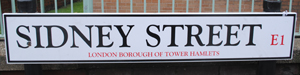
Two weeks later, on 3rd January, 1911, the Siege of Sidney Street began when more than 200 armed police and a detachment of Scots Guards besieged a home at 100 Sidney Street in Stepney where two of the Houndsditch gang were believed to be hiding.

The exhibition, which has been put together in partnership with the Jewish East End Celebration Society, features objects from the trial of suspected gang members as well as never-before-seen objects including guns taken from the crime scene and safe-breaking equipment. The overcoat Winston Churchill wore on the day of the siege – he attended in his capacity as Home Secretary – will also be on display.

London Under Siege: Churchill and the Anarchists, 1911, runs from 18th December to April 2011. Entry is free. For more information, see www.museumindocklands.org.uk.

• Meanwhile a plaque was unveiled today on the site in Cutler Street where three policemen – Sergeant Robert Bentley, 36, Sergeant Charles Tucker, 46, and PC Walter Choat, 34 – were killed during the gunfight with the gang. Two other policemen were disabled for life and a fireman, Superintendent Charles Pearson, later died after he entered the Sidney Street property which had been gutted by fire. A plaque will be unveiled in his honor on 6th January.

Around London – Imperial War Museum’s WWI revamp; St Paul’s Christmas broadcasts; House Mill to be restored; Henry III’s rolls online; and, Winter Wonderland in Hyde Park

The Imperial War Museum has unveiled plans for a major rebuilding project at its Lambeth headquarters to culminate with the 100th anniversary of the start of World War I in 2014. Under a £71 million proposal, the size of the existing World War I galleries will be doubled and a new atrium will be created with further works – including a new sunken entrance – to be completed by 2019. The museum moved to its Lambeth location, formerly the Bethlem Royal Hospital, in 1936. Prince William is fronting the first £29 million appeal for funds. Meanwhile plans have reportedly been mooted to have the decommissioned aircraft carrier, the HMS Ark Royal, brought to London where it would be permanently moored in the Thames as a tourist attraction akin to the HMS Belfast.

St Paul’s Cathedral has announced it will provide live outdoor broadcasts of its three most popular Christmas services for the first time to allow those who can fit in the cathedral to participate. A 25 metre screen will be set up in Paternoster Square, next to the cathedral, where ‘A Celebration of Christmas’ will be screen on 16th December at 6.30pm along with Christmas Carol services on the 23rd and 24th December at 4pm. See www.stpauls.co.uk.

An historic 18th century mill in East London will undergo restoration after the granting of a £248,000 lottery grant. House Mill, which dates from 1776, is believed to be the largest tidal mill still in existence anywhere in the world. Built across the River Lea, the mill was used for flour-making and for a distillery located next door on Three Mills Island in Bow. The project, which is being managed by the River Lea Tidal Mill Trust, involves the restoration of the mill as well as the adjoining Miller’s House and the creation of a visitor’s centre. The trust says it has also been given the “green light” for a further £2.65 million Heritage Lottery Fund grant. See http://housemill.org.uk.

A three year project has made documents drawn up for King Henry III in the 13th century available on the internet for the first time. Project partners Canterbury Christ Church University, King’s College London, and the National Archives in Kew have translated and digitised the king’s ‘fine rolls’, written to record money and favours owed to the king. The rolls consist of 56 parchments – one for each year of his reign which started in 1216 and ended in 1272 – and contain as many as 40,000 entries amounting to some two million words. Some of the parchments, the originals of which are held at the National Archives, measure up to three metres in length. See www.finerollshenry3.org.uk.

On now: Winter Wonderland in Hyde Park. Christmas festivity on a vast scale, Winter Wonderland includes the city’s largest open air ice rink, circus acts, a giant observation wheel, rides and eating places including the igloo-style E:Cube and the Spiegel Saloon. For more information see www.hydeparkwinterwonderland.com.
Around London – Skating at a palace or a tower?; British Military Tournament; and, new blue plaques

Christmas is looming and snow and ice have been besieging London. But there’s plenty you can do to keep warm, including visiting one of the many ice skating venues about the city. Among those with a particularly historic location are rinks at Hampton Court (located against the backdrop of the palace’s west front, it’s open until 9th January – see website for ticket prices and times), in the moat of the Tower of London (also open until 9th January, see website for ticket prices and times), and at Somerset House (open until 23rd January, see website for ticket prices and times).

The British Military Tournament 2010 will be held at Earl’s Court this weekend. The programme features 500 troops, 145 horses, military bands, the field gun run and will include a re-enactment of a combat incident in Afghanistan involving recently returned troops. Presented by ABF The Soldiers’ Charity, with performances on both Saturday and Sunday. For more information – including booking information, see www.britishmilitarytournament.com.

New blue plaques have been unveiled in London marking the former homes of speed daredevils Sir Malcolm Campbell and his son Donald, and ground-breaking photographer Bill Brandt. The plaque for the Campbells, who between them set 10 land speed records and 11 water speed records, is located at Canbury School in Kingston-upon-Thames – Sir Malcolm moved here in 1919, married to Dorothy Whittall the following year, and, Donald was born here in 1921. The family moved in 1922 to Surrey. The plaque for German-born Brandt, meanwhile, was unveiled at 4 Airlie Gardens in Campden Hill. He lived here with his second wife Marjorie Beckett from 1958 and family members still live in the home. Some of his nudes were taken inside. For more information, visit www.english-heritage.org.uk.

Around London – New VC gallery at Imperial War Museum; Roman remains unearthed at Syon Park; and, High Society at the Wellcome Collection…

An exhibition containing the world’s largest collection of Victoria Crosses has opened at the Imperial War Museum, housed in what is the museum’s first new major permanent gallery for 10 years. The Extraordinary Heroes exhibition – housed in the Lord Ashcroft Gallery – contains his Lordship’s collection of 162 Victoria Crosses, awarded for parts played in wars stretching from the Crimean to the Falklands, displayed alongside the 48 Victoria Crosses and 31 George Crosses already held by the museum. As well as the awards, the new gallery will display many objects for the first time, including a badly damaged backpack worn by Lance Corporal Matt Croucher when he leapt on a grenade during action in Afghanistan in 2008 to save the lives of his fellow soldiers (he survived as well), and the diving suit worn by Acting Leading Seaman James Magennis who won a VC for his role in placing limpet mines in the Johore Straits in World War II. The gallery was paid for with a £5 million donation from Lord Ashcroft. Admission is free. For more information, see www.iwm.org.uk.

The remains of a Roman settlement have been unearthed at historic home, Syon Park, in London’s west. Archaeological experts from the Museum of London have already removed around 11,500 pieces of pottery, jewellery and about 100 coins from the site on the Syon Park estate. Syon Park, the home of the Duke of Northumberland, sits on the northern bank of the Thames, opposite Kew Gardens. The site was excavated in 2008 in preparing for the construction of a new luxury hotel there. Some of the artefacts will go on display at the new hotel, the London Syon Park, A Waldorf Astoria Hotel, which will open early next year. The settlement, which includes a Roman road and burials, was discovered only half a metre below ground level. For more information on the property, see www.syonpark.co.uk.

Now on: From an early morning coffee in European cities to chewing betel nut in Asia, the Wellcome Collection’s major winter exhibition, High Society, traces the role mind-altering drugs have played in history and culture. The display includes more than 200 exhibits, from an 11th century manuscript written by monks in Suffolk detailing poppy remedies, to a 17th century account by Captain Thomas Bowrey describing his crew’s experiments with the cannabis drink bhang, and an account of NASA’s experiments with intoxicated spiders. Admission is free. The exhibition runs until 27th February. For more information, see www.wellcomecollection.org.

Around London – The Magazine gets a new life, Lennon’s former home commemorated, and, The Titanic Exhibition

News this week that The Magazine building in Kensington Gardens – which dates from 1765 and was built to house munitions initially intended to help repel a Napoleonic invasion – is getting a new lease of life as an art gallery. The Royal Parks have awarded the Serpentine Gallery a contract to create a new art space – the Serpentine Sackler Gallery – in the building. Pritzker Prize architect Zada Hadid will oversee the renovation of the building which will be open in time for the Olympic Games in 2012. PICTURE: John Offenbach © The Royal Parks and Serpentine Gallery.

• A Blue Plaque commemorating singer, songwriter and one-time Beatle John Lennon’s stay in a house in Marylebone was unveiled last month. Yoko Ono unveiled the plaque at 34 Montagu Square, where she and John lived in the basement and ground floor flat in the latter half of 1968 when Lennon was working on The Beatles’ White Album. It was the first home the couple shared and, while Lennon lived at a number of London addresses between 1963 and 1971, of those that survive it is the home he occupied for the greatest period. Previous occupants included Ringo Starr, Paul McCartney and Jimi Hendrix.

• ON NOW: Titanic: The Artefact Exhibition will be held at the O2 from 5th November until 1st May. The exhibition traces the Titanic’s final journey, from Cherbourg on 10th April, 1912 to its sinking with the loss of 1,500 lives after striking an iceberg three days later. Featuring more than 200 artefacts from the ship, the exhibition includes recreated interiors from the ship. Tickets start at £13 for adults. For more information, see www.titaniclondon.co.uk.

Around London – Strawberry Hill to reopen; ‘Films on Foot’ festival; and images of a London menagerie…

• Horace Walpole’s Georgian Gothic villa Strawberry Hill will reopen its doors this weekend after a £9 million restoration project. The house at Twickenham in west London was built between 1747 and 1792 had fallen into such a state of disrepair that it had been listed as one of the world’s most endangered heritage sites in 2004. The son of Sir Robert Walpole, Britain’s first prime minister, Walpole built the house as a summer getaway and created an architectural masterpiece incorporating the features of cathedrals into the property. For more information, see www.strawberryhillhouse.org.uk.

• Walking charity, the Ramblers is holding a Films on Foot festival celebrating London’s film heritage this October. The festival, which runs from 13th to 28th October, coincides with the 54th Times BFI London Film Festival and will feature 16 free “films on foot” walks taking in different areas around London which have been used in films. The walks will start every weekday at 7pm and every weekend at 1.30pm (you simply have to turn up at the starting place to take part). There is also a self-guided film walk along South Bank available for download. For more about the festival, see www.ramblers.org.uk/walkthemes/filmsonfoot/

Animals from across London feature in a new exhibition at National Theatre. A London Bestiary features the work of photographer Ianthe Ruthven who has captured some of the most famous and lesser known animals around London – everything from the lions guarding Nelson’s Column to the statue of a dog in Highgate cemetery and an elephant and camel from the Albert Memorial. Runs until 31st October. For more information, see www.nationaltheatre.org.uk/60094/exhibitions/a-london-bestiary.html.

Around London…

• It’s only a week to go until the annual Open House London event. Held on the 18th and 19th September, Open House London is your chance to get inside all manner of buildings – from private homes through to grand edifices – which are often normally closed to the public. Be warned, however, that some buildings, such as the BT Tower (open for the first time) require bookings to be made. These close 15th September, so you’ll have to be quick. The free event, which has run for 18 years, also includes neighbourhood walks, cycle tours and talks. For more information on the event, to purchase the guide (an electronic copy can be downloaded for £3.50) or to find out how to book, head to www.openhouselondon.org.uk.

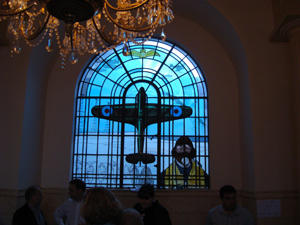
Looking for a weekend out of the city? English Heritage’s Heritage Open Days program – which doesn’t cover London – runs from today until Sunday and grants free access to properties around the country which are either normally closed to the public or usually charge admission fees. The program includes buildings ranging from medieval castles and Georgian townhouses through to World War II cemeteries and 21st century eco-homes. Among the properties within easy reach of daytrippers from London are Waverley Abbey in Fareham, Surrey – founded in 1128, it was the first in England housing Cistercian monks; an historic ‘net shop’ in Hastings, East Sussex; the Battle of Britain command centre at Bentley Priory in Stanmore, Hertfordshire (see picture of the entrance hall above); and, the new Aardman Animation headquarters in Bristol, home to the creators of Wallace and Gromit. Some places require prebooking so check before heading off. For more information, see www.heritageopendays.org.uk.

• The headless skeleton of a rare North Atlantic right whale recently found in the Thames has gone on display at the Museum of London Docklands. The seven metre long, half tonne skeleton was unearthed at Bay Wharf Greenwich by archaeologists and is believed to be the largest single object ever found at an archaeological dig in the city. The skeleton is only on display in the museum’s foyer until 14th September when it goes to the Natural History Museum. Entry is free. For more information, see www.museumindocklands.org.uk.

Around London…

• A 145-year-old replica of an Eleanor’s Cross was unveiled outside Charing Cross railway station last month following a major restoration. The monument, located near Trafalgar Square, was built in 1865 and was a copy of one of the 12 which were constructed by King Edward I to mark the route where the body of his wife Eleanor of Castile rested each night on its way to Westminster Abbey following her death in 1290. Only three of the original crosses remain intact – at Geddington north of Northamptonshire, Hardingstone near Northamptonshire, and Waltham Cross in Hertfordshire. The original monument at Charing Cross, which was demolished in 1647, marked the point from which distances are measured from London (a plaque now marks the site). The restoration involved replacing some 100 damaged and missing features. Due to deterioration, the monument has been hidden behind scaffolding for the past five years.

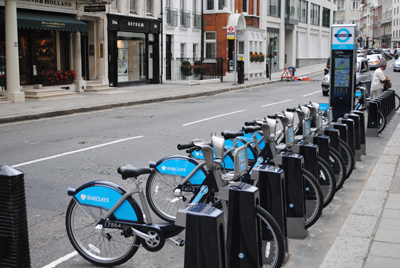
None of London’s Barclay bikes will be available to tourists until the end of the year, reports the London Evening Standard. The newspaper says plans to widen the scheme to allow tourists to hire the bikes have been put on hold after the emergence of logistical problems. The hire scheme was launched for locals at the end of July.

A new heritage trail has been opened at Kenley Common in the city’s outer south to commemorate the 70th anniversary of the Battle of Britain. The 56 hectare common in Surrey surrounds Kenley Airfield, a former Battle of Britain airfield these days used by the RAF for glider training. The trail, which was an initiative of a range of organisations including the Kenley Airfield Friends Group, RAF Association, Tandridge District Council, English Heritage, the Ministry of Defence and City of London Corporation, kicks off at the RAF Tribute on Kenley Common (off Hayes Lane in Surrey) and features a series of interpretative panels, the first two of which are mounted on scaled down Spitfire wings. These explain the role the area played in defending London from attacks and the significance of the tribute and the World War II blast pens. For more information, follow this link. For information on London’s Battle of Britain memorial, head here www.bbm.org.uk.

Around London…

London’s bicycle hire scheme is up and running. The scheme was launched at the end of July and boasts 5,000 bikes which can be found at 315 docking stations. More than 21,000 people signed up in the first weeks and some of the early popular hire sites included Soho Square, Drury Lane in Covent Garden and Wardour Street. The bikes are available 24 hours a day, seven days a week. Members of the scheme must be 18 years old and you must be at least 14 years old to ride the bikes. A membership key costs £3 while the membership itself costs at £1 for a 24-hour membership, £5 for seven days and £45 for an annual membership. The first 30 minutes of any journey is then free (with fees applicable after that). As the bikes don’t come with a lock, it’s expected people will simply make a journey to another docking station before getting off. For more information on the Barclay’s Cycle Hire scheme, see Transport for London’s website at www.tfl.gov.uk. Meanwhile, in other transport news, the first air-conditioned Tube train is now in active service on the Metropolitan Line.

A cafe has been opened at Buckingham Palace, 173 years after Queen Victoria first moved in following her accession to the throne. Located on the West Terrace overlooking the lawn and lake, the Garden Café is open during visiting hours. The Palace’s State Rooms, meanwhile, are open to the public until 1st October. The palace this year hosts The Queen’s Year exhibition which features displays of ceremonial robes, gifts, uniforms, dresses and jewellery, as well as archive photography and film in an illustration of the monarch’s work throughout the year at everything from the State Opening of Parliament to the Garter Day ceremony at Windsor Castle and investitures, garden parties and State Visits. Entry to the State Rooms – which comprise just 19 of the palace’s 775 rooms – is £17.00 an adult, £15.50 concessions, £9.75 for under 17s and under fives are free. Family tickets are £45 and combined tickets – including the Royal Mews and the Queen’s Gallery – are also available. www.royalcollection.org.uk/default.asp?action=article&ID=30. For more on the special exhibition, see www.royalcollection.org.uk/microsites/thequeensyear/

The Tower of London was the most visited royal site in Britain last year, attracting 2.4 million tourists, according to a report from VisitBritain. The tourism agency found that while overseas tourists spent some £4.6 billion while in the UK last year, more than £500 million was spent on tourism associated with the Royal Family. The top 10 most visited sites included several royal attractions – Edinburgh Castle came in at number six with 1.2 million visitors, Windsor Castle at number seven with 987,000 and Buckingham Palace at number 11 with 402,000. Other top London sites included the National Maritime Museum in Greenwich (#2 – 2.4 million), the Victoria and Albert Museum in South Kensington (#3 – 2.3 million), St Paul’s Cathedral (#4 – 1.8 million), Westminster Abbey (#5 – 1.4 million) and Hampton Court Palace (#9 – 541,646).

Around London…

• A team of archaeologists from the Museum of London have unearthed the remains of a brewhouse close to the purpose-built theatre, known simply as The Theatre, where Shakespeare first acted. The brewhouse could represent what became a dedicated ‘tap room’ aimed at theatre customers and may well have been a watering hole of the Bard himself. It – and a nearby bakehouse – were originally part of Holywell Priory, once one of the richest in England, which was dissolved in 1539. You can follow the dig’s progress here: www.mymuseumoflondon.org.uk/blogs/blog/category/excavations-at-shakespeare’s-theatre/

London’s Dickens Museum has unveiled the long-lost tombstone of a cartoonist who took his own life after he was believed to have been rejected by the famous author. Robert Seymour apparently took his own life after Charles Dickens was believed to have informed him that he would no longer be employed to illustrate The Pickwick Papers (there remains considerable debate over whether Dickens should be blamed for his death). The gravestone had been missing for a century but was reportedly discovered in the crypt of a London church by scholar Stephen Jarvis. It will now be displayed in the back garden of the museum which is housed at 48 Doughty Street in Dicken’s only surviving London home (he lived there between 1837 and 1839 while writing novels including The Pickwick Papers and Oliver Twist). The museum is preparing to celebrate the bicentenary of Dickens’ birth in 2012.  www.dickensmuseum.com

• Sir William and Sir Joseph Hooker – the father and son responsible for transforming Kew Gardens in the nineteenth century – have been honored with a blue plaque at their former home on Kew Green. The home where Princess Alexandra was to unveil the plaque became the official residence of the garden’s director when Sir William moved there in 1851. Sir William had been appointed director of the Botanic Gardens 10 years before and during his 24 year tenure not only greatly expanded them but also opened them to the public. His son, Sir Joseph, had travelled aboard the HMS Erebus as it explored the southern oceans between 1839-1843 before succeeding his father as director upon his death in 1865. www.english-heritage.org.uk/about/news/princess-alexandra-unveils-blue-plaque-for-former-directors-of-kew-gardens

Around London…

This year marks the 400th anniversary of Ham House in south west London. Located on the south bank of the Thames, between Richmond and Kingston, the property was built for Sir James Vavasour, Knight Marshall to James I with later owners including William Murray, the ‘whipping boy’ of Charles I (that is, the boy who took Charles’ punishment if he was naughty – let’s hope they got on well!), and his daughter, Elizabeth, Countess of Dysart. To find out more about the property, now under the care of the National Trust, and how they’re celebrating the 400th anniversary, see http://www.nationaltrust.org.uk/main/w-hamhouse.

The former treasury in  the crypt beneath St Paul’s is hosting a new exhibition – Oculus: An Eye Into St Paul’s – which aims to bring 1400 years of the history of the church and surrounding streets of London to life through a 270 degree film experience. The film takes visitors from the streets of Saxon London in 604 AD when the first cathedral was constructed on the site to the its destruction in the Great Fire in 1666 and the days of the Blitz in World War II when it stood as a symbol of English defiance. The exhibition also opens up access of areas of the cathedral to the less mobile – with virtual tours of the dome including the Whispering Gallery and the view from the Golden Gallery. See www.stpauls.co.uk.

The Monument has won the City of London’s City Heritage Award for 2010. The city has recently spent £4.5 million in a restoration project which included a new balustrade on the viewing platform of the memorial to the Great Fire of 1666, regilding the flaming orb, and the installation of a real-time feed of the panoramic views from the top to web with updates every minute. See www.themonument.info.

Around London…

• The British Military Tournament takes up where the Royal Tournament left off. The abolition of Royal Tournament in 1999 ended almost 120 years of tradition and left a significant gap in London’s annual events calender. No longer. The concept has been reborn as the British Military Tournament which will be held on 4th and 5th December this year. Presented by ABF The Soldier’s Charity, the spectacle will feature 500 troops, 145 horses, massed bands and the “field gun run” among other things. Tickets start at £29 for adults/£22 for children.  www.britishmilitarytournament.com.

• A rare sketch of pre-1666 St Paul’s is to be auctioned. The drawing, made less than 10 years before the Great Fire consumed the cathedral, is by Bohemian artist Wenceslaus Hollar and was created for William Dugdale’s illustrated history of the cathedral. www.thisislondon.co.uk/standard/article-23851487-long-lost-sketch-of-medieval-st-pauls-cathedral-for-sale.do

• On Now – Treasures of Lambeth Palace Library. At the Lambeth Palace Library (open Monday to Saturday (10am-5pm), admission £8 adults/£7 concessions, www.lambethpalacelibrary.org/content/treasuresexhibition). Held in celebration of the 400th anniversary of the library’s foundation, the exhibition in the palace’s Great Hall features some of the most significant books and documents in the English-speaking world including a Gutenberg Bible – the first great printed book in Western Europe using moveable type, the warrant for the execution of Mary, Queen of Scots, signed by Queen Elizabeth I, the 9th century Irish McDurnan Gospels, the 13th century Lambeth Apocalypse, and a rare edition of the Babylonian Talmud. Exhibition closes 23rd July.

The Weekly Roundup

Each week, we’ll be bringing you a round-up of some of the news affecting historic and interesting places in London. So, to kick it off…

The gardens surrounding the neo-Palladian masterpiece Chiswick House have been reopened following a £12 million restoration. The 65 acres of gardens, known as the birthplace of the English Landscape Movement, were designed by Lord Burlington and William Kent in the 1720s and 1730s. They were created as a backdrop for the magnificent house Lord Burlington designed and had built on the west London property following a grand tour of Italy. The garden’s original vistas have been restored and statutory and garden buildings repaired – including a 19th century conservatory housing rare camellias. More than 1,600 trees have been planted – some of which were propagated from the original 18th century Lebanon cedars planted in the garden – and the Walled Gardens have also been restored (these will only be open to the public on special occasions). There’s also a new cafe designed by award-winning architects Caruso St John. ~ www.english-heritage.org.uk/chiswickhouse

Four new Blue Plaques have been unveiled in London. They include one for Sir William Nicholson (1872-1949), painter and printmaker (1 Pilgrim’s Lane, Hampstead); another for Charles Rolls (1877-1910), motoring and aviation pioneer (14/15 Conduit Street, Mayfair); Baron Carlo Marochetti (1805-1867), sculptor (34 Onslow Square, South Kensington); and, Wing Commander FFE Yeo-Thomas GC (1902-1964), secret agent (24-28 Queen Square, Holborn). ~ www.english-heritage.org.uk/blueplaques

On Now – Magnificent Maps: Power, Propaganda and Art. At the British Library (open daily, admission free, www.bl.uk/magnificentmaps/). The exhibition contains some 80 spectacular, mainly European, maps, dating from as far back as the Roman era, and explores how they have been employed for various purposes – as propaganda, works of art, teaching aids and indoctrination. Included in the exhibition are the world’s biggest and smallest atlases – the latter created for a doll’s house. Exhibition closes 19th September.