The Royal Wedding – Eight curious facts about Royal Weddings past and present…

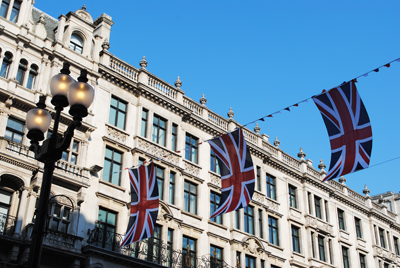
PICTURE: Bunting in Regent Street ahead of the Royal Wedding tomorrow.

Ahead of the wedding of Prince William and Kate Middleton tomorrow, here’s a look at some of the more curious and interesting facts related to London’s Royal Wedding past…

The first public Royal Wedding in modern times was that of Prince Albert, Duke of York (later King George VI), and Lady Elizabeth Bowes-Lyon (later Queen Elizabeth, the Queen Mother) which took place on 26th April, 1923. Instead of being held at a royal chapel as was more usual, they were married at Westminster Abbey in a public display which was apparently staged to lift the national spirit in the aftermath of World War I.

Lady Diana Spencer (later Diana, Princess of Wales) memorably said Prince Charles’ name in the wrong order during their wedding ceremony at St Paul’s Cathedral on 29th July, 1981. Lady Diana accidentally called him Philip Charles Arthur George instead of the correct Charles Philip Arthur George.

• Queen Victoria’s extravagant wedding cake was the first to feature a model of the bride and groom on its summit (with a figure of Britannia looming over them). The two tier cake measured nine foot across and weighed 300 lbs.

While white wedding dresses had been worn for some time, it was apparently after Queen Victoria wore a white dress at her 1840 wedding that the idea spread to the masses. (Interestingly, the first documented princess to wear a white wedding dress is said to have been Philippa of England, the daughter of King Henry IV, in 1406).

The first televised Royal Wedding was that of Princess Margaret, younger sister of Queen Elizabeth II, to Antony Armstrong-Jones (Lord Snowdon) on 6th May, 1960. It attracted some 300 million viewers worldwide.

The tradition of a royal bride leaving her bouquet on the Tomb of the Unknown Warrior in Westminster Abbey was started by Queen Elizabeth, the Queen Mother. She apparently did so in tribute to her brother Fergus who had died during World War I. Princess Mary, daughter of King George V, made a similar gesture at her wedding in 1922 – she left her bouquet at the Cenotaph in Whitehall after her wedding.

One of the most scandalous Royal Weddings was that of George, Prince of Wales (later King George IV) to Princess Caroline of Brunswick on 8th April, 1795 at the Chapel Royal in St James’s Palace. Described as being “far from a love match” on the Historic Royal Palaces’ website, Prince George was said to have been drunk during the wedding and at one stage apparently even attempted to escape from the ceremony.

If the rain stays away, the newly married prince and his bride will be returning to Buckingham Palace in the 1902 State Landau. The open-topped carriage was constructed for King Edward VII’s coronation and apparently made roomy to accommodation him. The carriage was used by Prince Charles and Lady Diana when they left St Paul’s Cathedral after their 1981 wedding. If the weather it poor, it’s expected that the 1881 Glass Coach, bought for the coronation of King George V in 1911, will be used instead.

For more fascinating facts on Royal Weddings, see the BBC website (www.bbc.co.uk/history/royal_weddings), or Historic Royal Palaces’ blog, The ‘other’ royal weddings (http://blog.hrp.org.uk). For more on the current Royal Wedding, see the official website (www.officialroyalwedding2011.org).
The Royal Wedding – Royal residences…

Word is that Prince William and his soon-to-be wife, Catherine Middleton, have yet to formally decide where they will live when in London (they are expected to spend much of their first two-and-a-half years of marriage in North Wales). 

Their initial London base, however, will reportedly be Clarence House. Located in The Mall, just down the road from Buckingham Palace and beside St James’s Palace, the grand building is currently the home of William’s father Charles, the Prince of Wales, his wife Camilla, Duchess of Cornwall, and, William’s brother, Prince Harry (it is also the home of William himself).

In years gone past, Clarence House served as the home of the newly married Queen Elizabeth II (then Princess Elizabeth) and her husband, Prince Philip, the Duke of Edinburgh. Prince Charles, who lived there with his parents until the age of three, returned to the property in August 2003 after the death of his grandmother Queen Elizabeth, the Queen Mother, who had lived in the building from 1953.

Clarence House was built between 1825 and 1827 to the designs of architect John Nash on the orders of Prince William Henry, the Duke of Clarence and later King William IV.

Choices for a permanent home in London for the soon-to-be married couple reportedly include Buckingham Palace (see yesterday’s entry), as well as Kensington Palace.

It was converted from a Jacobean mansion for King William III and Queen Mary II and has since been the home of many royals including, most famously, Diana, Princess of Wales. She and her then husband, Prince Charles, moved in following their wedding in 1981, and Princess Diana continued to live there after her divorce in 1996.

Other notable royal residents have included Queen Anne and Princess Margaret, sister of Queen Elizabeth II.

Another option – St James’s Palace – was built in 1531 on the site of a medieval leper hospital by King Henry VIII. Used initially for state occasions and to house royal relatives (Tudor monarchs actually lived at Whitehall Palace), it became the official royal residence in 1702, when Whitehall Palace burnt down, and remained so until the 1830s when King George III moved to Buckingham Palace.

The Royal Wedding – London’s royal reception venue

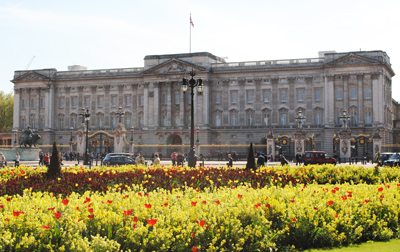
Following the wedding ceremony at Westminster Abbey on Friday, the now married happy couple will head in a carriage via a processional route down The Mall to Buckingham Palace.

There, they will enjoy a champagne reception with 600 guests hosted by the Queen before, at 1.30pm, appearing on the balcony of the palace to wave to the crowds and watch an aircraft flypast expected to include a Lancaster, Spitfire, Hurricane, two Typhoons and two Tornados.

Buckingham Palace, which has served as the official London residence of the reigning monarch since 1837, has a long tradition of hosting royal events. Then much smaller and known as Buckingham House, the property was built for the Duke of Buckingham in 1705.

It passed into royal hands when it was bought by King George III in 1761 for his wife, Queen Charlotte, to use as a family home located conveniently close to St James’s Palace where many court functions were held.

The house was extensively remodelled in 1762 and again, this time on the orders of King George IV, in the 1820s (after initially wanting to use it, like his father, as a family home, the king decided after the works had started to instead transform it into a palace, created to the designs of architect John Nash).

When King George IV died in 1830, his brother King William IV ordered the works to be continued albeit with a new architect, Edward Blore (the spiralling costs of Nash’s work are said to have cost him the contract). The king himself never lived in the house – even offering at at one stage as a seat for Parliament after the Houses of Parliament were destroyed by fire in 1834 – and it wasn’t until the accession of Queen Victoria in 1837 that the palace became the sovereign’s official residence.

Further works were subsequently needed to ensure there was adequate accommodations for the Queen’s family and it was during these works that the monumental Marble Arch – designed as the centrepiece of the palace’s courtyard – was moved away to its present location on the north-eastern corner of Hyde Park.

The palace, which now boasts 775 rooms including 19 staterooms, has since been the site of numerous royal wedding receptions – it was on the balcony  where Queen Elizabeth II and Philip, the Duke of Edinburgh, greeted crowds on 20th November, 1947, after their wedding in Westminster Abbey and, similarly, where Prince William’s parents, Prince Charles and Princess Diana, held a reception before greeting crowds on 29th July, 1981, after their ceremony at St Paul’s Cathedral.

Buckingham Palace was also the location for Queen Victoria’s wedding breakfast following the ceremony in the Chapel Royal at St James’s Palace on 10th February, 1840.

LondonLife – Horse Guards Parade…

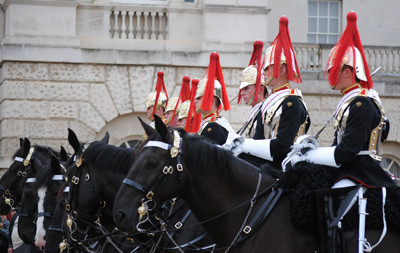
The Queen’s Life Guard at Horse Guards Parade. The parade ground, which lies between Whitehall and St James’ Park, was formerly the site of the tiltyard of the Palace of Whitehall and was the location for tournaments during the rule of Henry VIII. It now serves as the site for the annual Trooping the Colour ceremony. The men pictured (wearing blue tunics and red plumed helmets) are part of a squadron of The Blues and Royals (Royal Horse Guards and 1st Dragoons) who, along with a squadron of The Life Guards (wearing red tunics and white plumed helmets), make up the Household Cavalry Mounted Regiment, responsible for providing The Queen’s Life Guard. The “Horse Guards” have guarded this site – still regarded as the official entrance to St James’ Palace and Buckingham Palace – since the Restoration of Charles II in 1660 and can be seen there in the Changing of the Guard ceremony on weekdays and Sundays. For more information, visit www.army.mod.uk/events/ceremonial/2355.aspx

Around London – HMS Belfast restored, Buckingham Palace record, plumber’s new statue

• The HMS Belfast’s newly restored masts were unveiled to the public this week following an 18 month restoration project. Moored on the Thames between Tower and London Bridges, the ship is one of only a few surviving Royal Navy ships that served in Arctic convoys supplying Russia during World War II. The restoration was carried out for free by a team of more than 20 men and women from the JSC Shipbuilding plant, Severnaya Verf, in St Petersburg, Russia as a tribute to the British and Allied sailors who risked their lives on the convoys. The work involved removed and replacing all of the masts. For more information, see http://hmsbelfast.iwm.org.uk.

A record 413,000 people visited Buckingham Palace over the summer – the highest number in 16 years. The record numbers were partly ascribed to the new Garden Cafe which served 46,000 cups of tea. Meanwhile, the palace has announced the exhibition, Victoria & Albert: Art & Love, at the Queen’s Gallery has been extended until 5th December. For more information, see www.royalcollection.org.uk.

• The Worshipful Company of Plumbers has reportedly announced it will be installing a bronze statue of a plumbers’ apprentice outside Cannon Street station next year. The statue’s installation will  mark 400 years since the company first received its Royal Charter from King James I. The station was the site of the company’s livery hall until 1863 when the site was compulsorily acquired to make way for the new railway.

Wren’s London – 7. Kensington Palace

A once favored residence of British monarchs, Kensington Palace’s connections with royalty date back to 1689 when, then a private country home known as Nottingham House, the building was purchased by King William III and Queen Mary II.

The royal couple turned to Sir Christopher Wren, then Surveyor of the King’s Works, who was charged with adapting the property into a suitably regal residence.

Wren’s work included the addition of four new pavilions – one at each corner – to provide extra accommodation for the king and queen. The King’s Apartments, approached by a Grand Staircase, were located in the south east, and the Queen Apartment’s in the north west. While many later additions were made, the basic layout of these buildings remains true to Wren’s original design.

Among the many spectacular original rooms is the King’s Gallery, built for William in 1695. It features an 1694 wind dial connected to a weather vane which turns according to the direction of the prevailing wind.

The property’s subsequent royal residents have included Queen Anne, King George I and King George II (it was King George III who made Buckingham Palace his primary London residence). Princess (later Queen) Victoria was born here in 1819 (it was she who first opened the State Apartments to visitors in 1899) while more recent residents in the palace’s private areas have included Princess Margaret and, of course, Diana, Princess of Wales.

WHERE: The Broad Walk, Kensington Gardens, Kensington (nearest tube stations are High Street Kensington or Queensway); WHEN: Daily 10am to 5pm (last admission 4pm); COST: £12.50 adult/£11 concession/£6.25 child/£34 family (online booking discounts available, Historic Royal Palaces members free); WEBSITE: www.hrp.org.uk/KensingtonPalace

PICTURE: Historic Royal Palaces/newsteam.co.uk