The Royal Parks – 8. Bushy Park

And so we come to the final entry in our special series on Royal Parks – Bushy Park (Royal Parks also look after Brompton Cemetery, but given it’s not strictly a park, we’ll deal with that in an upcoming post).
Lying off the beaten track near Hampton Court in south-west London, Bushy Park’s location means it’s perhaps the least glamourous of the Royal Parks we have looked at. Yet, like the other parks, its connection with royalty goes back a long way – in this case to the time of King Henry VIII.

The park was included as part of the Hampton Court estate given to the king by Cardinal Wolsey. Henry immediately transformed what had been farmland (complete with artifical medieval rabbit warrens, the remains of which can still be seen) into a deer chase and enclosed the park with a brick wall (a section of the original wall lies on the north side of Hampton Court Road).

The character of the park was altered again in 1610 when King Charles I ordered the creation of the Longford River, a 12 mile ornamental canal designed to bring water from the River Colne in Hertfordshire to the park’s water features.

Christopher Wren had a hand in the park’s design in 1699 when he designed Chestnut Avenue – a mile long formal roadway which runs through the centre of the park. He also added the round pond at its end and placed a fountain topped with a statue in its midst.

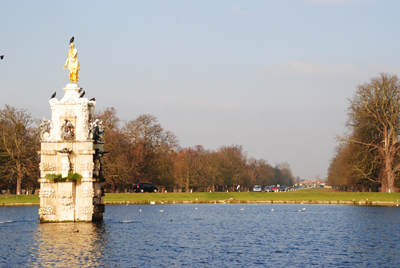
Known as the Diana Fountain after the Roman goddess of hunting, the statue (pictured above with Chestnut Avenue behind) actually represents one of Diana’s nymphs Arethusa. It was commissioned by King Charles I for his wife, Queen Henrietta Maria, and originally stood at Somerset House before Oliver Cromwell moved it to the Privy Garden at Hampton Court and Wren then moved it to its current location.

The 17th and 18th century also saw the appearance of houses at the park to be used as hunting lodges (and the ranger’s home), and gardens were added.

Worth noting here is the story of shoemaker Timothy Bennet. A resident of nearby Hampton Wick, in 1752, when an old man, he successfully fought to ensure a public right-of-way through the park after the then ranger, Lord Halifax, ordered it closed to the public. There’s a monument to him outside Hampton Wick Gate and a walking path which runs across the park at perpendicular to Chestnut Avenue is still known as Cobbler’s Walk.

More gardens were added in the 20th century including the Waterhouse and Pheasantry Plantations. Other areas include the tranquil Woodland Gardens and the Water Gardens which are comprised of a Baroque-style collection of pools, cascades, basins and the canal. There are also a series of ponds – including a pond for model boats – to the east of Chestnut Avenue.

The park saw service in both World Wars. During the first, Canadian troops were stationed there (there’s a totem pole in the Woodland Garden marking this) and other areas within the park were used for growing produce as part of the “Dig for Victory” campaign.

During the second, it was used again for food production and in 1942 became a US base and later Supreme Headquarters Allied Expeditionary Forces – the location where General Dwight Eisenhower planned Operation Overland, the reinvasion of Europe which kicked off with the D-Day landings. There are memorials concerning this connection in the park’s north-east corner.

Facilities today include the Pheasantry Welcome Centre, which opened in 2009, and includes a cafe, toilets and information. There are also sporting facilities, a small cafe near the carpark and a children’s playground.

WHERE: The park lies north of Hampton Court Palace, just west of Kingston and Hampton Wick and south of Teddington (nearest train station is Hampton Wick or Hampton Court). WHEN: 24 hours except in September and November when it’s open between 8am and 10.30pm; COST: Free; WEBSITE: www.royalparks.gov.uk/Bushy-Park.aspx

King James I’s London – 10. Westminster Abbey’s Lady Chapel

And so we come to the final instalment in our series on King James I’s London. This week we’re looking at Westminster Abbey’s Lady Chapel where King James I – who was crowned in Westminster Abbey in 1603 – was laid to rest after his death in 1625.

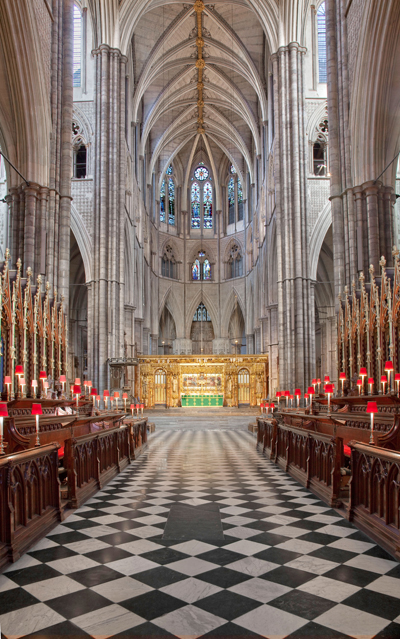
But before we turn to James himself, it’s worth noting that several members of his immediate family are also buried in the abbey’s Lady Chapel (pictured). These include his eldest son, Henry Fredrick, Prince of Wales, who died in 1612 at the age of 18 (and thus opened the way for his younger brother Charles to become King Charles I). He is buried in the south aisle of the magnificent Lady Chapel which had been added at the behest of King Henry VII between 1503 and 1519 and replaced a 13th century chapel.

Three of James’ daughters are also buried in the Lady Chapel – Mary, who died in 1607, aged two, and Sophia, who died in 1606, aged just three days old. Both of them have monuments in the north aisle while their sister Elizabeth, wife of King Fredrick V of Bohemia, who died much later in 1662, is buried near her brother Henry Fitzpatrick.

As we’ve previously mentioned, King James I also outlived his wife, Queen Anne of Denmark, who died of dropsy at Hampton Court Palace on 2nd March, 1619, at the age of 43. She lay in state at Somerset House until her funeral on 13th May and was then buried in the south-eastern area of the Lady Chapel where her gravesite is marked by a modern stone bearing her name. Her wooden funeral effigy is one of a collection which can still be seen in the Abbey’s Museum.

After James himself died on 27th March, 1625, he was laid in the vault beneath King Henry VII’s monument beside Elizabeth of York, Henry’s wife. No monument was erected to mark his passing save for a modern inscription placed nearby (in fact Queen Elizabeth I was the last monarch to be buried with a monument above the site – see below).

It’s also worth noting that in 1612 – nine years into his reign – James arranged for the body of his mother – Mary, Queen of Scots, who was executed in 1587 on the orders of Queen Elizabeth I – to be transferred from its resting place in Peterborough Cathedral to the south aisle of the Lady Chapel where he had an elaborate tomb erected featuring an elegant white marble effigy showing her wearing a coif, ruff and long mantle.

In the north aisle, James had previously erected a marble monument to his predecessor, Queen Elizabeth I and had her body moved from where it had lain in the vault of her grandfather, King Henry VIII, to a place beneath the new monument. Her half-sister, Queen Mary I, is also buried beneath the monument.

That’s the final in our series on King James I’s London – it’s by no means a comprehensive look at significant sites in the early Stuart period and we shall be looking at more from the period down the track, but it’s a good start. Our new special series starts next week. 

WHERE: Westminster Abbey, Westminster (nearest Tube station is Westminster or St James’s Park); WHEN: Open to tourists everyday except Sunday  (times vary so check the website); COST: £16 an adult/£13 concessions/£6 schoolchildren (11-18 years), free for children aged under 11/£38 for a family (two adults, two children); WEBSITE: www.westminster-abbey.org

King James I’s London – 9. Hampton Court Palace

It’s fitting given the important role Hampton Court Palace played in the creation of the King James Bible that we include it in this series. But Hampton Court Palace is also notable for some other events during King James I’s reign. First, however, we turn to the Hampton Court Conference…

It was in 1604 that King James I meet at Hampton Court with representatives of the Church of England, including one party led by Archbishop John Whitgift (representing the church hierarchy) and another party led by John Rainolds (representing the Puritans), to discuss complaints made by the Puritans concerning a range of matters. While a new Bible wasn’t initially on the agenda, the three days of discussions did eventually lead to King James I commissioning the creation of a new Bible which eventually became known as the King James Version.

King James I was already familiar with Hampton Court Palace – it was in the palace that he had celebrated his first Christmas as king the previous year. Notably, it was during this Christmas and New Year period that Shakespeare’s acting company, the King’s Men, performed in the palace’s Great Hall for the king and his court.

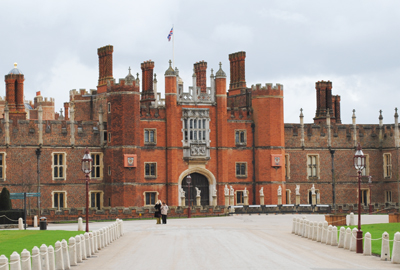
At that stage, the palace hadn’t been dramatically updated since Tudor times – in fact, it wasn’t until after the accession of King William III and Queen Mary II following the “Glorious Revolution” in 1689 that the Tudor palace was given a major overhaul.

King James I continued to visit Hampton Court during the remainder of his reign and his visits, which were generally proceeded by a program of repairs, were noted for the lavish entertainment that took place when they occurred.

It was also at Hampton Court Palace that James’ wife, Queen Anne, died of dropsy in 1619. And where his son King Charles I, who had commissioned some improvements to the palace, was imprisoned for a period during the Civil War. But more of that another time…

WHERE: Hampton Court Palace, East Molesey, Surrey (nearest station is Hampton Court from Waterloo); WHEN: 10am to 6pm everyday (winter hours 10am to 4.30pm from 31st October to 26th March); COST: Adult £15.40, Concession £12.65, Child under 16 £7.70 (under fives free), family tickets, garden only tickets and online booking discounts available; WEBSITE:www.hrp.org.uk/HamptonCourtPalace/

The Royal Wedding – London’s Royal Wedding venues

In the first of a series this week looking at aspects of royal weddings in London in days past, we canvas some of the venues which have hosted the sometimes glittering occasions.

First up is Westminster Abbey (pictured), the location of Prince William and Kate Middleton’s wedding this Friday, which, despite its thousand year history, is only believed to have hosted 15 royal weddings.

Among them is said to have been the wedding of King Henry I to Matilda of Scotland on 11th November, 1100, as well as that of Richard, Earl of Cornwall and brother of King Henry III, who married his second wife, Sanchia of Provence, there on 4th January, 1243, and Joan of Acre, daughter of King Edward I, who married Gilbert, Earl of Gloucester, on 30th April, 1290 (her sister Margaret married John, Duke of Brabant, at the same venue less than three months later). The abbey also hosted the wedding of King Richard II to Anne, daughter of Emperor Charles IV of Bohemia, on 20th January, 1382.

The abbey church has become increasingly favored as a venue for royal weddings in more recent times. Among the most prominent hosted there last century were that of Prince Albert, Duke of York (later King George VI), who married Lady Elizabeth Bowes-Lyon on 26th April, 1923 and that of their daughter Princess Elizabeth (later Queen Elizabeth II) who married Prince Philip of Greece (later the Duke of Edinburgh) there on 20th November, 1947.

Two of the current Queen’s children were also married there – Princess Anne, who married Captain Mark Phillips on 14th November, 1973, and Prince Andrew, who married Sarah Ferguson on 23rd July 1986. (For more on Royal Weddings at the Abbey, see www.westminster-abbey.org/our-history/royals/weddings)

A notable break with the trend in recent times was the marriage of Prince Charles and Lady Diana Spencer – they were married in a fairytale ceremony at St Paul’s Cathedral on 29th July, 1981.

Other London locations for royal weddings have included the now non-existent Greenwich Palace (King Henry VIII married Katherine of Aragon on 11th June, 1509) and Hampton Court Palace (another of King Henry VIII’s marriages – that in which he was wed to Catherine Parr – was held here in a private chapel on 12th July, 1543).

Along with St George’s Chapel at Windsor, the Chapel Royal at St James’s Palace  in London was particularly popular in Victorian times – Queen Victoria married Prince Albert there on 10th February, 1840, and their eldest daughter, Princess Victoria, married Prince Frederick (the future German Emperor Frederick III) there on 25th January, 1858. On 6th July, 1893, the chapel also hosted the wedding of the future King George V and Princess Mary of Teck.

PICTURE: Copyright Dean and Chapter of Westminster

Around London – Skating at a palace or a tower?; British Military Tournament; and, new blue plaques

Christmas is looming and snow and ice have been besieging London. But there’s plenty you can do to keep warm, including visiting one of the many ice skating venues about the city. Among those with a particularly historic location are rinks at Hampton Court (located against the backdrop of the palace’s west front, it’s open until 9th January – see website for ticket prices and times), in the moat of the Tower of London (also open until 9th January, see website for ticket prices and times), and at Somerset House (open until 23rd January, see website for ticket prices and times).

The British Military Tournament 2010 will be held at Earl’s Court this weekend. The programme features 500 troops, 145 horses, military bands, the field gun run and will include a re-enactment of a combat incident in Afghanistan involving recently returned troops. Presented by ABF The Soldiers’ Charity, with performances on both Saturday and Sunday. For more information – including booking information, see www.britishmilitarytournament.com.

New blue plaques have been unveiled in London marking the former homes of speed daredevils Sir Malcolm Campbell and his son Donald, and ground-breaking photographer Bill Brandt. The plaque for the Campbells, who between them set 10 land speed records and 11 water speed records, is located at Canbury School in Kingston-upon-Thames – Sir Malcolm moved here in 1919, married to Dorothy Whittall the following year, and, Donald was born here in 1921. The family moved in 1922 to Surrey. The plaque for German-born Brandt, meanwhile, was unveiled at 4 Airlie Gardens in Campden Hill. He lived here with his second wife Marjorie Beckett from 1958 and family members still live in the home. Some of his nudes were taken inside. For more information, visit www.english-heritage.org.uk.

The Tip – Cheaper palaces?

Thinking of visiting the Tower of London and Hampton Court Palace while in London? Become a member of Historic Royal Palaces and you could make substantial savings, especially if travelling as a family. The annual pass allows you to enter all five Royal Palaces – including Hampton Court and the Tower as well as Kensington Palace, the Banqueting House and Kew Palace – as many times as you like during the year and brings with it invitations to members only events. It’s certainly worth checking out whether its worth it. For more information, see www.hrp.org.uk/SupportUs/Membership/Default.aspx

Wren’s London – 4. Hampton Court Palace

Hampton Court Palace in London’s outer south-west is known to many as the palace of Henry VIII. Yet a considerable part of the complex of buildings we see today was also created during the reign of some time joint rulers William III and Mary II.

It was to Christopher Wren – assisted by the able Nicholas Hawksmoor – that the rulers turned when looking to update the Royal Apartments. Wren’s designs for a domed baroque palace to rival Versailles in France were apparently so ambitious that they were only half-built (and built in haste – two workmen died and another 11 were injured when the main wall collapsed in 1689). The death of the queen in 1694 also meant work on the palace stopped – it was resumed in 1697 (under control of Wren’s deputy William Talman who had offered a lower price than Wren) but again stalled after the death of the king in 1702.

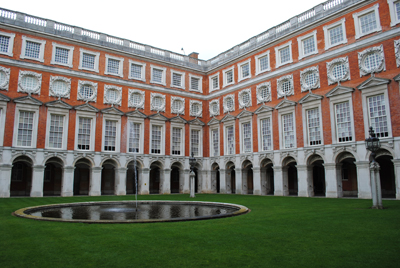
Wren’s imprint is on the palace we see today is nonetheless considerable and includes the Baroque-style South and East Front (the size of the formal gardens which radiate out from the latter give a glimpse into the grand plans Wren had for the palace), Fountain Court which replaced the Tudor Cloister Court and around which were located new state apartments for both the king and queen, and the Orangery.

Among those who worked on the interiors of were the famous woodcarver Grinling Gibbons and painter Antonio Verrio.

WHERE: Hampton Court Palace, East Molesey, Surrey (nearest station is Hampton Court from Waterloo); WHEN: 10am to 6pm everyday (winter hours 10am to 4.30pm from 31st October to 26th March); COST: Adult £15.40, Concession £12.65, Child under 16 £7.70 (under fives free), family tickets, garden only tickets and online booking discounts available; WEBSITE: www.hrp.org.uk/HamptonCourtPalace/

Treasures of London – The Great Vine at Hampton Court Palace

PICTURE: Historic Royal Palaces/newsteam.co.uk

In the first in a series looking at some of the treasures held in museums, galleries and other collections London along with some of the more unusual things you’ll find in the city, we’re heading out to the southwest of the city firstly to Hampton Court Palace and what is perhaps a lesser known treasure, the Great Vine.

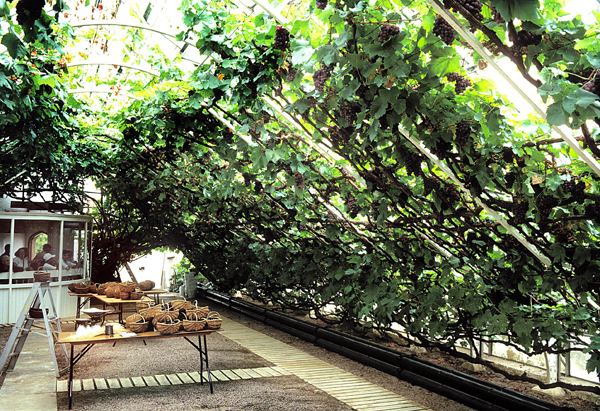
Claimed to be the oldest and largest vine in the world, it was believed to have been planted by Lancelot ‘Capability’ Brown around 1768 and has prospered ever since, now being an astonished 12 foot (3.65 metres) around the base and boasting ‘rods’ of up to 120 metres in length.

The vine, which is housed in a purpose-built greenhouse in the gardens, still produces a whopping 22o to 32o kilograms (500 to 700 bunches) of black, sweet grapes annually (you can even buy the grapes in Hampton Court’s Garden Shop – they’ve been sold to the public since the 1930s), although this is well down on the 2,245 bunches of grapes picked in 1807.

WHERE: Hampton Court Palace, East Molesey, Surrey (nearest station is Hampton Court from Waterloo); WHEN: 10am to 6pm everyday (winter hours 10am to 4.30pm from 31st October to 26th March); COST: Adult £15.40, Concession £12.65, Child under 16 £7.70 (under fives free), family tickets, garden only tickets and online booking discounts available; WEBSITE: www.hrp.org.uk/HamptonCourtPalace/