10 islands in the Thames – 9. Taggs Island…


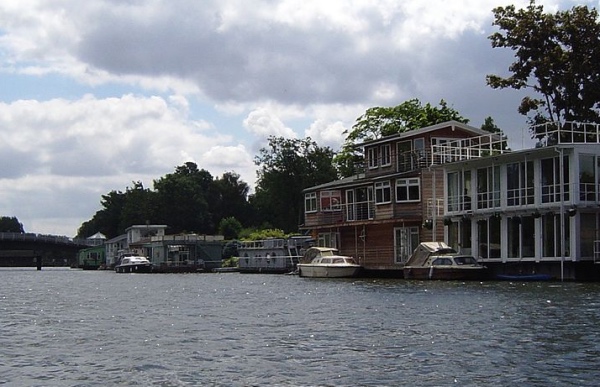
Formerly known as Walnut Tree Island (among other names), this Thames River island, which lies just upstream of Hampton Court Place, was once a playground for the wealthy and is now home to about 100 residents living in houseboats.

The island was once part of the manor of Hampton Court and by the mid-19th century was home to a number of squatter families who made a living by harvesting osiers (willow rods) used in basket weaving.

In 1850, it was purchased by a property speculator and lawyer Francis Kent (another name for the island was Kent’s Ait) who evicted the squatters and rented part of the island to Joseph Harvey, who established a pub called The Angler’s Retreat there. Another part he leased to a local boatbuilder and waterman named Thomas George Tagg who set up a boat rental and boat-building business there.

In the 1870s, Tagg – whose name became that of the island’s – took over the licence of the pub and built a larger, more imposing hotel in its place, transforming the backwater establishment into a high society favourite. Among its patrons were none other than Edward, Prince of Wales (later King Edward VII) and the actress Sarah Bernhardt.

The island also become a mooring site for luxurious houseboats and by the 1880s, the island was ringed with the craft – among those who rented one was none other than JM Barrie, later the author of Peter Pan.
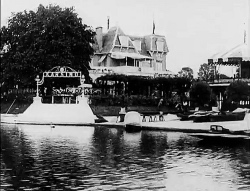
In 1911, Tagg’s original lease of the island ran out and it was subsequently taken by Fred Karno (formerly known as Fred Westcott), a theatre impresario who is credited with having ‘discovered’ Charlie Chaplin and Stan Laurel and who had stayed in houseboats on the island.

He subsequently built a luxurious hotel there, The Karsino, which he sold in 1926, but which went on to change hands several time over the ensuring years (and names – it became known variously as the Thames Riviera and the Casino Hotel).

Eventually, in a badly dilapidated state, the hotel once known as The Karsino was demolished in 1971 (but not before putting in an appearance in Kubrick’s A Clockwork Orange).

Karno also owned a luxurious houseboat, the Astoria, which was once moored on the island but which is now owned by Pink Floyd guitarist David Gilmour (who adapted it into a rather stylish recording studio in the Eighties – A Momentary Lapse of Reason and The Division Bell were apparently both recorded here) and moored upstream on the northern bank of the Thames.

A road bridge was built to connect the island to the mainland in the 1940s – when the island was being used to produce munitions – but this collapsed in the 1960s.

A new bridge was built to the island in the 1980s and a small lagoon carved out of the centre to increase the number of mooring sites for houseboats.

No homes are these days permitted to be constructed on the island but it’s still a mooring place for houseboats, some 62, in fact. These days the island owned by an association of the houseboat owners who each have their own garden on the island.

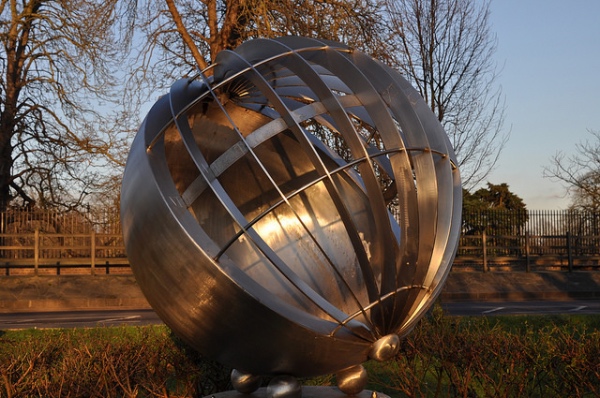
In the centre of the island is a rather unique sundial (see below). And just to the south-east of Taggs Island lies the much smaller Ash Island; the stretch of water separating the two was apparently once known as Hog’s Hole.

PICTURES: Top – Houseboats on Taggs Island ( Motmit at en.wikipedia/licensed under CC BY-SA 3.0) ; Right – The Karsino in 1924 (Adam37/licensed under CC BY-SA 4.0); Below – The sundial (stevekeiretsu/licensed under CC BY-NC 2.0)
10 islands in the Thames – 8. Thames Ditton Island…

We’re skipping upstream, past a few islands this week, to take a look at Thames Ditton Island which lies in Kingston Reach, above Teddington Lock. The island is the largest of a group of three which also includes Swan Island (the smallest) and Boyle Farm Island.

Located opposite the grounds of Hampton Court Palace (built by Cardinal Thomas Wolsey in the early 16th century and then, following his fall from grace, claimed by King Henry VIII in 1525), the 320 metre long Thames Ditton Island owes its existence to King Henry who had the river widened and straightened here so that he could use the river for an uninterrupted journey up the river from Westminster to Hampton Court. In doing so, the island was created.

Used as pasture land for the local manor (and known apparently at one point as Colly’s Ait, ait being a word for a river island, before being renamed Thames Ditton after the village on the west bank) for several centuries, the island became a popular recreation spot for the wealthy interested in water sports during the Edwardian era, thanks to the arrival of the railway in the area in the late 19th century.

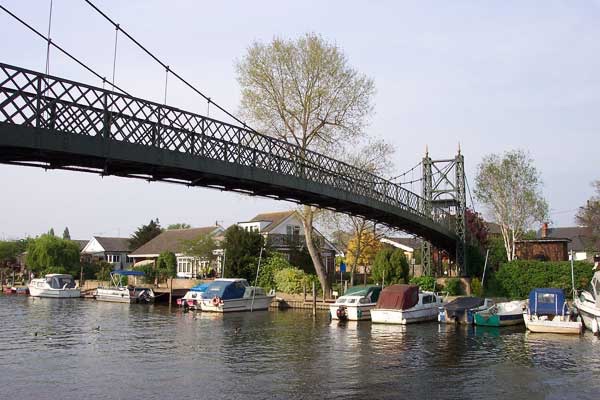
The island is these days connected to the Thames Ditton bank by a 1930s suspension bridge which ends near the 13th century Ye Olde Swan pub. It is now home to more than 45 rather exclusive riverside properties (almost all are in stilts to help ward off the danger of flooding, a phenomenon with which long-term residents in the area are familiar).

Swan Island, while lies just to the south of Thames Ditton Island, is tiny and the location of the home of the ferryman, who up until 1911, would take people across the river to Hampton Court.

Further to the south likes Boyle Farm Island which also has a single house open it. It stands opposite the mainland property formerly known as Boyle Farm but now a nursing home known as the Home of Compassion.

Interestingly, while Thames Ditton Island is part of Greater London, Boyle Farm Island is part of Surrey (along with Thames Ditton village).

PICTURE: Andrew Lewin (licensed under CC BY-NC-ND 2.0)

This Week in London – Death and burials in Roman London; Edward Bawden retrospective; and, ‘Horrible Histories’ at Hampton Court…

Death and burials in Roman London are the focus of a new exhibition opening at the Museum of London Docklands on Friday with a rare sarcophagus discovered in Southwark last year one of the highlights. Roman Dead will look at the cemeteries of ancient London, the discoveries made there and their context in the modern cityscape. Alongside the sarcophagus discovered in Harper Road (which had possibly been disturbed by grave robbers), the exhibition features more than 200 objects including a multi-coloured glass dish found with cremated remains, a jet pendant in the form of a Medusa’s head and four men’s skulls which showed signs of violence and were buried in pits by the city’s wall as well as a tombstone of a 10-year-old girl named Marciana, found during excavations in 1979, and a pot decorated with a human face which was used as a cremation urn. The free exhibition can be seen until 28th October. For more, see www.museumofondon.org.uk/docklands.

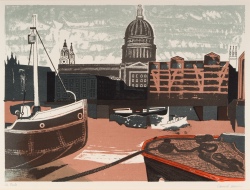
The work of celebrated Twentieth century British artist and designer Edward Bawden (1903-89) has gone on display in a new exhibition at the Dulwich Picture Gallery. Edward Bawden is described as the “most wide-ranging” exhibition of his work since his death and the first to look at every aspect of his 60 year career. It features a number of previous unseen works as well as 18 rarely seen war portraits which are being displayed together for the first time. Some 170 works – half from private collections – are arranged thematically to follow the evolution of his style with rooms dedicated to leisure, architecture, animals, fantasy and gardens. Among the highlights are early designs for the London Underground, Rain (1926) – on display for the first time, portraits of places he visited in North Africa, the Middle East and Europe while working as an official war artist during World War II, and several linocuts from Aesop’s Fables. Runs until 9th September. Admission charge applies. For more, see www.dulwichpicturegallery.org.uk. PICTURE: Edward Bawden, St Paul’s, 1958 (Colour autolithograph/Trustees of the Cecil Higgins Art Gallery (The Higgins Bedford), © Estate of Edward Bawden).

Delve into the world of the ‘Gorgeous Georgians’ and ‘Vile Victorians’ at Hampton Court Palace this May half term. The Birmingham Stage Company will be uncovering centuries of grisly history in an hour long outdoor ‘Horrible Histories’ performance featuring characters including Georgian kings, Lord Horatio Nelson, the Duke of Wellington, Florence Nightingale, and Dr John Snow. Guests are encouraged to bring a blanket and some food for the “ultimate historical picnic”. Admission charge applies – check website for dates. For more, see www.hrp.org.uk/hampton-court-palace/explore/the-gorgeous-georgians-and-vile-victorians/.

Send all items for inclusion to exploringlondon@gmail.com.

LondonLife – ‘The Last Days of Anne Boleyn’ at the Tower…


The final days of Anne Boleyn are being brought to life in a new play running at the Tower of London. Written and directed by Michael Fentiman, The Last Days of Anne Boleyn tells the story of the last 17 days of the Queen’s life before her execution in 1536 following her spectacular fall from grace. The performance is staged on the site of the lost Tudor palace at the Tower where Anne spent her final days and is based on contemporary sources including letters to her husband, King Henry VIII, and her final speech on the scaffold in the moments before she was beheaded. The outdoor show (suitable for all ages) runs for 35 minutes with two performances a day – 11am and 2pm, from Friday to Tuesday until 28th August (weather permitting). Admission is included in the entry price. For more information, head here. PICTURES: Courtesy of Historic Royal Palaces.

This Week in London – James Cook’s voyages; Diana’s landmine moment remembered; and, the influence of the Greeks on Rodin…

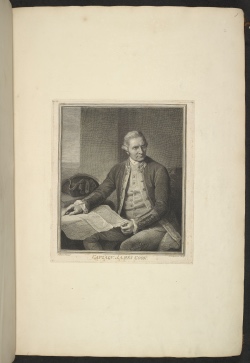
Marking 250 years since Captain James Cook set sail from Plymouth aboard the Endeavour in 1768 comes a new exhibition at the British Library focusing on the explorer’s three world-changing voyages aboard the Endeavour, the Resolution and the Discovery. Maps, artworks and journals from the voyages will be on show in James Cook: The Voyages alongside recently commissioned films bringing contemporary perspectives. The display features a collection of drawings by Polynesian high priest and navigator Tupaia – on display for the first time, as well as Sydney Parkinson’s natural history drawings including the first European depiction of a kangaroo, John Webber’s watercolour landscapes including the first European illustrations of Hawaii and works by William Hodges including the first artworks depicting the Antarctic. There’s also the first chart of New Zealand, specimens including the mouth parts of a squid from the first voyage, and, jewellery and musical instruments including a necklace from Tierra del Fuego, a ceremonial rate from Nootka Sound (Vancouver Island) and a bamboo flute from Tahiti. The display, which runs until 28th August, is being accompanied by a programme of public events. Admission charge applies. For more, see www.bl.ukPICTURE: Portrait of Captain James Cook (1728-79) © British Library Board.

A HALO Trust branded flak vest as well as a denim shirt and Armani chinos all worn by Diana, Princess of Wales, during a high profile visit to Angolan landmine fields in 1997 is among new items on show at Kensington Palace. Running since February last year, Diana: Her Fashion Story – which traces the evolution of the Princess’ style and her impact on British and global fashion – has been spruced up with the addition of new items including the landmine visit outfit as well as a pink Bellville Sassoon suit worn to board the train for her honeymoon, a Victor Edelstein evening gown worn for an official portrait by Terence Donovan (on public display for the first time), a floor length Yuki gown designed for the Prince and Princess of Wales’ visit to Japan, and a tartan dress by Caroline Charles worn to the 1982 Braemar Games in the Scottish Highlands. Admission charge applies. For more, see www.hrp.org.uk/Diana.

The influence of ancient Greek art on 19th century sculptor Rodin is the subject of a new exhibition opening at the British Museum today. Rodin and the art of ancient Greece displays his work alongside the Parthenon sculptures that inspired him. Thanks to a collaboration with the Musée Rodin in Paris, the exhibition features more than 80 of Rodin’s works in marble, bronze and plaster along with sketches. Key works on show include The Kiss (1882), which, like two female goddesses originally on the East Pediment of the Parthenon, was carved from a single block of stone. Runs until 29th July. Admission charge applies. For more, see www.britishmuseum.org.

Send all items to exploringlondon@gmail.com for inclusion.

A Moment in London’s History – The execution of George, Duke of Clarence…

Among the gruesome deaths said to have taken place at the Tower of London is that of George, the Duke of Clarence, who, so the story goes, was drowned in a butt of Malmsey wine on 18th February, 1478 – 540 years ago this year.

George, who was born on 21st October, 1449, was the younger brother of King Edward IV and older brother of (although he was only king after George’s death) King Richard III.

George, who was made Duke of Clarence and Lord Lieutenant of Ireland soon after the House of York’s King Edward IV’s ascendancy to the throne in 1461 during the volatile period known as the Wars of the Roses, had betrayed his brother King Edward IV at least twice before his death.

The first time came in the late 1460s when he joined with Richard Neville, Earl of Warwick, in helping the previously deposed Lancastrian King Henry VI back onto the throne. The second time came after his brother Edward has retaken the throne in March, 1471, and the two of them had reconciled. George had sought to wed Mary of Burgundy, but Edward had objected – one of a series of events which apparently led George, whose mental state was said to be deteriorating fast by this point, to once again scheme against the king and eventually saw King Edward IV have him thrown in prison in June, 1477.

The King brought charges – including that he had slandered the King and prepared for rebellion – against George in Parliament in January, 1478, and both houses subsequently passed a bill of attainder with the sentence of death carried out in private (thus perhaps sparing him the humiliation of a public execution?) in the Tower soon after.

The story that he had been drowned in a butt of his favourite malmsey (a sweet wine) in the Bowyer Tower apparently circulated soon after his death – among proponents of the story was William Shakespeare who in Richard III has the duke stabbed and then drowned in a butt of malmsey – and to this day it remains something of a mystery as to whether it actually occurred (although, interestingly, his body when exhumed was not beheaded which was the common means of executing members of the nobility).

It has been suggested that sawn down wine butts were used for baths at the time – which may mean George was drowned in a wine butt, but one he was using to take a bath rather than one which had wine stored in it. It has also been suggested that the reference to a butt of wine refers to a barrel used for storing his body for removal to Tewkesbury where he was buried alongside his wife rather than his actual execution.

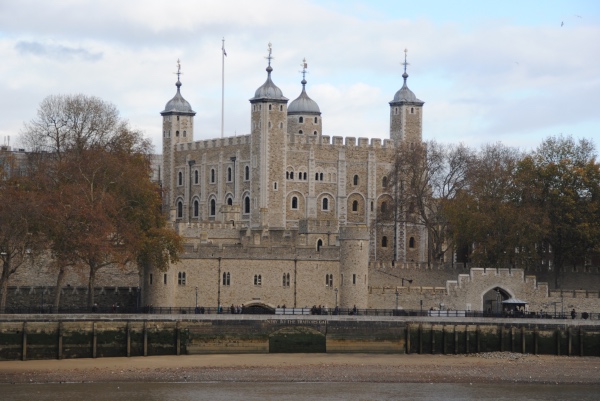
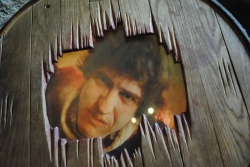
PICTURES: Top – The Tower of London where the Duke was executed; Right – A virtual re-enactment of George’s death at the Tower.


This Week in London – Happy Easter!; Egg hunting at English Heritage properties; Peter Rabbit at Kew; and The Science Museum’s Frankenstein Festival…

Wishing all of our readers a very Happy Easter!

Six special eggs designed by six top children’s book illustrators have been hidden at English Heritage sites across the country for Easter. The illustrators – including Ian Beck, Polly Dunbar, Olivia Lomenech Gill, Trisha Kraus, Lydia Monks and Grahame Baker Smith – have all designed eggs inspired by English Heritage properties. Young visitors taking part in the Easter Adventure Quests – which will be held at 20 English Heritage properties including London’s Eltham Palace and Gardens and Down House – will need to hunt for a special “chicken token” hidden in the undergrowth with those who find one presented one of the six “eggsclusive” eggs. The tradition of decorating Easter eggs has been recorded as far back as 1290 in England when King Edward I purchased 450 of them to be decorated and covered in golf leaf for his courtiers. In the early 16th century, King Henry VIII received a silver-mounted egg as an Easter gift from the Pope. The Easter Egg Adventure Quest will be held from 30th March (Good Friday) through to 2nd April (Easter Monday). For more on what’s happening at Easter, see www.english-heritage.org.uk/easter/.

Peter Rabbit and his furry friends are visiting Kew Gardens this Easter. From tomorrow until 15th April, the Peter Rabbit themed festival – A big day out with Peter Rabbit – will see visitors presented with a copy of Mr McGregor’s garden notebook so they can follow a Peter Rabbit-themed trail to the Secluded Garden where they can find life-sized selfie boards of Peter and other characters and take part in a range of activities including games, craft activities and workshops (including how to build their own rabbit warren). The nearby Kitchen Garden will also be on display with mini-tours for families to show off the growing produce. Admission charge applies. For more, see www.kew.org.

An Easter Egg Hunt will take place at The Royal Mews, Buckingham Palace, on Saturday. Between 11am and 3pm, children are invited to hunt for pictures of Rex the corgi and the royal horses Majesty and Scout among the carriages as well as dress up as a footman, learn how to harness a horse, take part in art activities and find out what it’s like to ride in a royal carriage. Each child will be able to claim an Easter egg to take home. For more, see www.royalcollection.org.uk.

The Science Museum’s free Frankenstein Festival – celebrating the 200th anniversary of the publication of Mary Shelley’s Frankenstein or the Modern Prometheus – kicks off on 3rd April. Featuring immersive theatre, experiential story-telling and hands-on activities, the festival will encourage visitors to examine the ethical scientific questions surrounding the artificial creation of life and allow them to step into Dr Frankenstein’s shoes and create a creature which they can bring to life using stop-motion animation. There’s puzzles and experiments to do, a Frankenstein-themed audio tour of the museum called It’s Alive, a choose-you-own-adventure experience – Pandemic – in which visitors decide how far Dr Frankenstein should go to tackle a virus sweeping across the world, and, Humanity 2.0, a play performed by Emily Carding which examines what could happen if a benevolent AI recreated humanity in an apocalyptic future world. There’s also the opportunity to meet researchers at the cutting edge of science including bio chemists who manipulate DNA and engineers creating artificial intelligence. The festival runs daily between 3rd and 8th April (some activities have limited availability so tickets can be found at sciencemuseum.org.uk/Frankenstein). A Promethean Tales Weekend will be held on 27th to 28th April, featuring panel discussions and special screenings of Terminator 2: Judgement Day and The Curse of Frankenstein in the IMAX cinema. For more, head to sciencemuseum.org.uk/Frankenstein.

Send all items for inclusion to exploringlondon@gmail.com.

LondonLife – Crenellations…

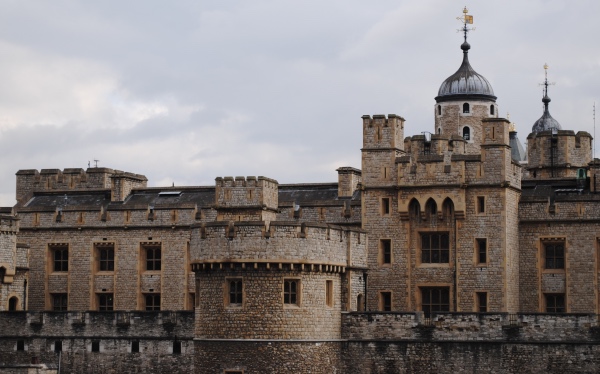
Tower of London crenellations from Tower Hill.

LondonLife – Cannons in snow…

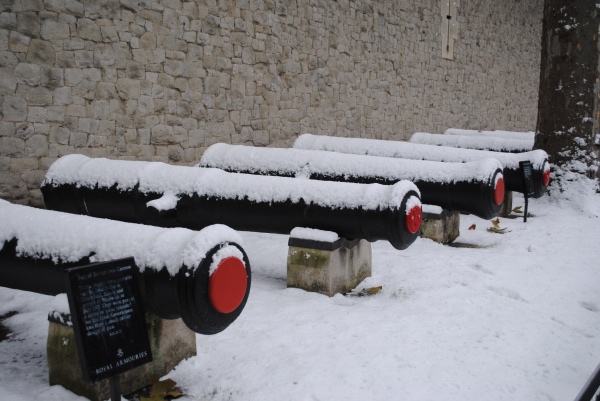
Cannons in snow at the Tower of London.

10 subterranean sites in London – A recap…

Recapping our recent Wednesday series. We kick off a new series next week…

10 subterranean sites in London – 1. The Greenwich Foot Tunnel…

10 subterranean sites in London – 2. The London Silver Vaults…

10 subterranean sites in London – 3. The Banqueting House undercroft…

10 subterranean sites in London – 4. St Paul’s Cathedral Crypt…

10 subterranean sites in London – 5. Whitefriars Priory crypt…

10 subterranean sites in London – 6. Guildhall crypts…

10 subterranean sites in London – 7. Alexander Pope’s Grotto…

10 subterranean sites in London – 8. Priory of St John of Jerusalem church crypt…

10 subterranean sites in London – 9. The Mail Rail…

10 subterranean sites in London – 10. Chislehurst Caves…

A Moment in London’s History – The great flood of 1928…

It was 90 years ago this month – 6th and 7th January, 1928 – that the River Thames flooded disastrously in what was the last major flood in central London.

Fourteen people are reported to have died and some 4,000 made homeless when the river burst its banks and spilled over the top of the Thames Embankment. Part of the Chelsea Embankment collapsed.

The flood – which was blamed on a range of factors including a sudden thaw upstream, heavy rain, a tidal surge and the impact of dredging – peaked at about 1.30am on 7th January at a height of 18 foot, three inches (5.56 metres) above ordnance datum.

The city saw extensive flooding on the City of London itself as well as in Southwark and as far upriver as Putney and Hammersmith and downriver in Greenwich and Woolwich as well as beyond.

Most of the deaths occurred when the embankment gave way near Lambeth Bridge and a wall of water swept through the slums on the Westminster side of the bridge with 10 people losing their lives.

Among the buildings flooded were the Tate Gallery at Millbank – where many works including some by JMW Turner were damaged, parts of the Houses of Parliament including Westminster Hall and the House of Commons, numerous Underground stations and Blackwall and Rotherhithe tunnels. The moat of the Tower of London, dry for 80 years, was filled.

While the flood waters receded by the end of the day, the damage took years to repair with many buildings in Millbank, the worst affected area, demolished. Embankments were raised in the wake of the flooding but it wasn’t until after the North Sea flood of 1953 that authorities took action to build the Thames Barrier (it was eventually completed in 1982).

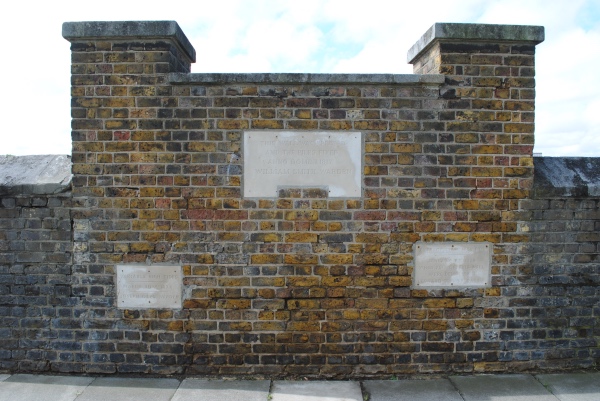
Above – A marker recording the height of the flood outside Trinity Hospital in Greenwich (the plaque below right records the details).

This Week in London – The Royal Collection and Charles II; convicts lives explored; and, ‘Gold’ at the National Gallery…

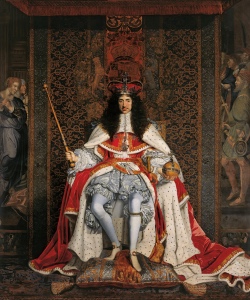
A new exhibition celebrating the role of the court of King Charles II in promoting the arts in England has opened at The Queen’s Gallery in Buckingham Palace. Charles II: Art and Power highlights the key role Charles II played in developing the Royal Collection following the Restoration in 1660 as a means of decorating royal apartments and, perhaps more importantly, of glorifying the restored monarchy and helping it to take its place back on the European stage. The display features works ranging from John Michael Wright’s monumental portrait of the king in coronation robes (pictured) to Henry Greenway’s silver-gilt dish that adorned the high altar of Westminster Abbey and Wenceslaus Hollar’s The Coronation of King Charles the II in Westminster Abby the 23 of April 1661. Other paintings on show include Titian’s Madonna and Child in a Landscape with Tobias and the Angel (c1535-40), Antonio Verrio’s The Sea Triumph of Charles II (c1674), Pieter Brugel the Elder’s The Massacre of the Innocents (c1565-67), and Sir Peter Lely’s Barbara Villiers, Duchess of Cleveland (c 1665) as well as tapestries and silver-gilt furnishings. The exhibition, which will be accompanied by a major exhibition in the Royal Academy of Arts in January and a series of documentaries on various BBC channels under the banner of a BBC Royal Collection Season, runs until 13th May. Admission charge applies. For more, see www.royalcollection.org.uk. PICTURE: John Michael Wright, Charles II, c.1676 Royal Collection Trust/© Her Majesty Queen Elizabeth II 2017.

The lives of convicts in 18th and 19th century London are the subject of a new exhibition opening at the London Metropolitan Archives. Criminal Lives, 1780-1925: Punishing Old Bailey Convicts includes original documents from the Old Bailey archives and items such as a policeman’s truncheon, a reproduction Millbank Prison uniform and convicts’ photographs drawn from collections in Britain and Australia to provide insights into the lives of offenders, from the time of the Gordan Riots in 1760 to the early 20th century. Among those whose lives are featured are prostitute and pickpocket Charlotte Walker, notorious receiver of stolen goods Ikey Solomons and serial thief Thomas Limpus. The exhibition, created in collaboration with the Arts and Humanities Research Council Digital Panopticon Project, opens on Monday and runs until 16th May. Admission is free. There is an accompanying programme of events. For more, see www.cityoflondon.gov.uk/lma.

The National Gallery is running a season of events aimed at exploring the theme of ‘gold’ in its collection in the run-up to Christmas. Running until 1st January, the programme includes free lunchtime talks, a life drawing session this Friday, a workshop on the traditional intaglio printmaking technique of drypoint, drawing sessions and a series of films. For the full season of events, check out www.nationalgallery.org.uk/whats-on/christmas-at-the-gallery/christmas-events.

Send all items for inclusion to exploringlondon@gmail.com.

This Week in London – ‘It’s beginning to look a lot like Christmas’…

Christmas is looming and that means Christmas themed events are kicking off all over the city. Here’s a sample of what’s happening:

The world famous Trafalgar Square Christmas Tree will be lit next Thursday – 7th December – in an event that kicks off at 6pm. The 25 metre high tree is an annual gift from the people of Norway as a thank you for Britain’s support during World War II. Christmas carols will kick off in the square on 11th December while the Mayor’s Christmas Carol Service will be held in Southwark Cathedral on 18th December. For more, see www.london.gov.uk/events.

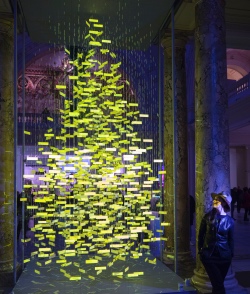
Sounds Like Christmas at the V&A. A month long musical celebration across the museum’s South Kensington and Museum of Childhood sites, it features choirs, candlelit concerts, pop-up performances, film screenings, decoration-making workshops, and special installations of objects relating to the music of Christmas, as well as, at the grand entrance to the South Kensington site, ‘The Singing Tree’ (pictured). A project conceived by leading stage designer Es Devlin, the tree features digital word projections that create a poem and comes with a layered polyphonic soundscape of human and machine-generated voices. The season runs until 6th January. For the full programme, see www.vam.ac.uk/Christmas. PICTURE: © Victoria and Albert Museum, London.

Greenwich Winter Time Festival. The inaugural festival, set in the grounds of the World Heritage-listed Old Royal Naval College, kicks off in December and features an alternative to the traditional seasonal market as well as a covered ice rink, entertainment including live music, theatre and children’s shows, and an “authentic” Father Christmas experience. Admission charge applies. Runs until 31st December. For more, see www.ornc.org.

Christmas at the Historic Royal Palaces. As well as its ice rink, Hampton Court Palace is hosting the BBC Good Food’s Festive Feast and a Christmas Music Weekend while at the Tower of London, visitors can once again skate in the dry moat, join in medieval Christmas festivities and enjoy a treat for their ears with the Noel Noel concert in the Chapel of St Peter ad Vincula. Kensington Palace, meanwhile, is hosting Christmas festivities under a Victorian theme with a 25 foot tall Christmas tree, a display of illuminated Victorian scenes, live music performances and family friendly events including ‘Under the Christmas Tree’, ‘Funtastic Sunday’, and ‘Tasty Talks’. Check website for dates – admission prices apply. See www.hrp.org.uk for more.

Meanwhile, the final release of New Year’s Eve tickets goes on sale tomorrow (Friday) from noon. People can buy up to four tickets, priced at £10 each to be among the 100,000 spectators lining the banks of the River Thames. Those without a ticket can still watch it live on BBC One. Head to www.london.gov.uk/nye for tickets.

Send all items for inclusion to exploringlondon@gmail.com.

Treasures of London – The Yeomen Warders…

Commonly known as Beefeaters (more on that in a moment), the Yeoman Warders have long been a presence at the Tower of London.

The Yeomen Warders, more properly known as the ‘Yeomen Warders of Her Majesty’s Royal Palace and Fortress the Tower of London, and Members of the Queen’s Body Guard of the Yeoman Guard Extraordinary’, are a distinct detachment of the Yeomen of the Guard.

With a history stretching back to at least the reign of King Edward IV (1461-83), they have formed the Royal Bodyguard since at least 1509.

The Warders are nicknamed ‘Beefeaters’, it is thought, due to the fact their privileged position meant they could eat as much beef as they liked from the King’s table.

These days, Yeoman Warders, most of whom live in the Tower with their families (part of their job has always been to guard the Tower at night), must have served in the armed forces for at least 22 years, have reached the rank of warrant officer, and been awarded the Long Service and Good Conduct Medal (the current warders have served in Northern Ireland, during the Falklands War, in Bosnia, in the first and second Gulf conflicts and in Afghanistan).

There are usually around 40 Yeoman Warders at any one time under the command of four Yeoman Serjeants and a Chief Yeoman Warder (currently Alan Kingshott). They wear age dark blue and red undress uniform for everyday duties but also have a state dress uniform featuring the familiar heavy red coat (pictured above).

The first female to be appointed to the role of Yeoman Warder was Moira Cameron in 2007. The most recent person to join the Yeoman Warders is Gary Burridge who did so in August following 32 years in the Royal Navy.

One of the Yeoman Warders – currently Chris Skaife – serves in the role of Ravenmaster of the Tower of London and has the responsibility of caring for the tower’s famous ravens (important because, so they story goes, should the ravens ever leave the tower, the White Tower will fall and disaster will befall the kingdom). Other specialist roles include that of Yeoman Clerk.

Upon joining the Yeoman Warders, the new warders take an oath of allegiance (believed to date back to 1337) after which they drink a toast of port served in an 18th century pewter bowl.

Tradition holds that the Chief Yeoman Warder toasts all new recruits with the words “May you never die a Yeoman Warder”. The origins of this apparently lie in the fact that the positions of Yeoman Warder were in the past purchased from the Constable of the Tower for 250 guineas with most of the money returned to the warder when they retired and the Constable keeping the rest. But if the Yeoman Warder died in office, the Constable would keep all the money – hence the toast. The practice was apparently abolished by the Duke of Wellington in 1826.

Yeoman Warders, as well as participating in ceremonial duties like the daily Ceremony of the Keys and the annual Ceremony of the Constable’s Dues, they also take tours of the Tower of London.

WHERE: Tower of London (nearest Tube is Tower Hill); WHEN: 9am to 4.30pm Tuesday to Saturday/10am to 4.30pm Sunday to Monday; COST: £21.50 adult/£9.70 child (Historic Royal Palaces members free); WEBSITE: www.hrp.org.uk/tower-of-london/

PICTURE: Yeoman Warders at the Ceremony of the Constable’s Dues, 2014 (Peter Rowley/Flickr/CC BY 2.0)

10 subterranean sites in London – 3. The Banqueting House undercroft…

Located beneath the Banqueting House – a remnant of the Palace of Whitehall, the undercroft was originally designed by Inigo Jones (who designed the building as a whole) as a private drinking den for King James I.

French landscaper and architect Isaac de Caus was commissioned to decorate one end of the vaulted undercroft as a shell grotto where the king could relax with his friends. In 1623, it received a dedication from Ben Jonson:

“Since Bacchus, thou art father
Of wines, to thee the rather
We dedicate this Cellar
Where now, thou art made Dweller.”

Following the Restoration, during the reign of King Charles II, the basement was used to hold lotteries – John Evelyn describes one such event taking place in 1664 in his famed diary, although soon after this was moved into a purpose-built facility nearby.

The undercroft was subsequently used for storage including during the reign of King James II when it was apparently used to store furnishings from the Privy and Council Chambers of Whitehall Palace while they were being rebuilt.

From the late 1890s until the 1960s, it became part of the museum of the Royal United Services Institute (which also used the hall upstairs) but following a restoration in 1992, is now open to the public and also used for special events at the building.

WHERE: Undercroft, Banqueting House, Whitehall (nearest Tube is Westminster or Charing Cross); WHEN: 10am to 5pm daily (check if there is a private function); COST: £5.50 adults (16+)/children under 16 free/Historic Royal Palaces members free; WEBSITE: www.hrp.org.uk/banqueting-house/

PICTURE: alh1/Licensed under CC BY-NC-ND 2.0

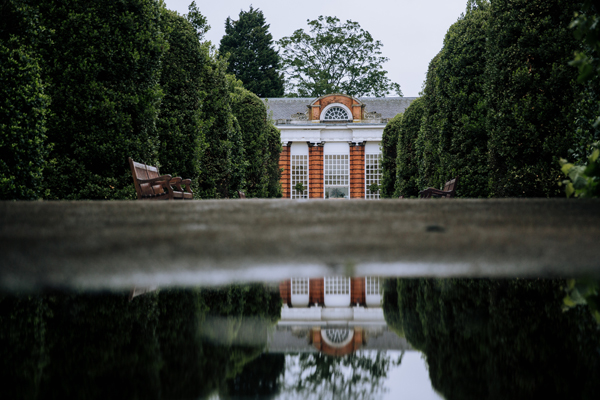
LondonLife – Looking toward The Orangery, Kensington Palace…

Now an elegant place to have lunch or afternoon tea, The Orangery was originally built in 1704-05. Its construction came at the behest of Queen Anne – the younger sister of Queen Mary II, she had ascended to the throne after the death of Mary’s husband King William III in 1702 following a fall from a horse (Mary had died of smallpox at Kensington Palace in 1694). Queen Anne used the building for parties in summer and in winter, thanks to underfloor heating, as a conservatory for plants (two engines were later fitted to the building to lift the orange trees kept there in colder months). The building’s architect is thought to have been the renowned Nicholas Hawksmoor, clerk of works for Kensington Palace, but it was extensively modified by Sir John Vanbrugh. The building also contains carvings by Grinling Gibbons. For more, see www.orangerykensingtonpalace.co.ukPICTURE: Vapor Kopeny/Unsplash

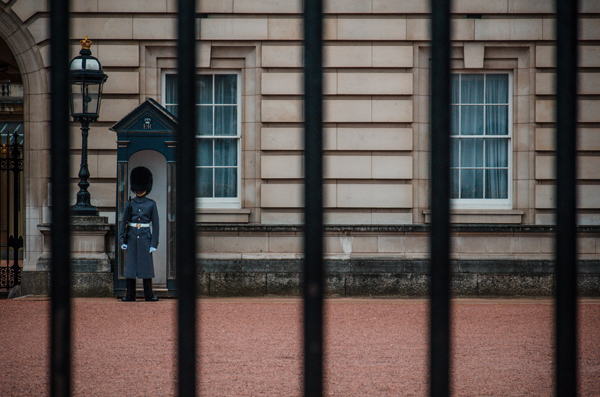
LondonLife – Buckingham Palace…

PICTURE: Shane Rounce/Unsplash

10 sites of significance in Jane Austen’s London…6. Carlton House…

It’s perhaps the most famous of the visits that Jane Austen made during her London stays and while the property no longer exists, we thought it was worth mentioning. 

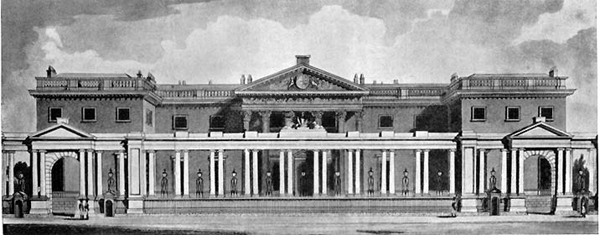
But first, let’s explain. The Prince Regent (later King George IV) was an admirer of Jane’s novels, so much so that when he was aware of the author’s presence in London, he issued – via his librarian and chaplain Rev James Stanier Clarke – an invitation for her to visit the library and tour his palatial London property, Carlton House.

The grand, lavishly decorated property, created from an existing property between 1783 and 1812 by the architect Henry Holland, was among the grandest in London at the time. Facing on to the south side of Pall Mall, the building sat across what is now Waterloo Place while its gardens abutted St James’s Park.

Jane visited on 13th November, 1815, and in the company of Rev Clarke toured the library. During her visit, it was suggested she could dedicate her next novel to the Prince Regent, an idea which didn’t sit that well with Jane who was a supporter of his estranged wife, Princess Caroline.

After her initial equivocation, her publisher John Murray apparently managed to prevail upon Jane to do so and she eventually capitulated, dedicating her novel Emma to him (a special copy of the novel was sent to the Prince at Carlton House).

Carlton House, meanwhile, didn’t last for much longer. King George IV, on his accession to the throne, decided to create a property more fitting for a king and ordered works to be carried out on Buckingham House so it could be his main London residence (as Buckingham Palace).

Carlton House, despite the exorbitant sums the Prince had spent transforming it, was demolished in 1825 and the John Nash-designed Carlton House Terrace built upon the site. Columns from the Carlton House were reused in creating the portico of the National Gallery on Trafalgar Square.

PICTURE: Carlton House (via Wikipedia).

LondonLife – Remains of Greenwich Palace unearthed…


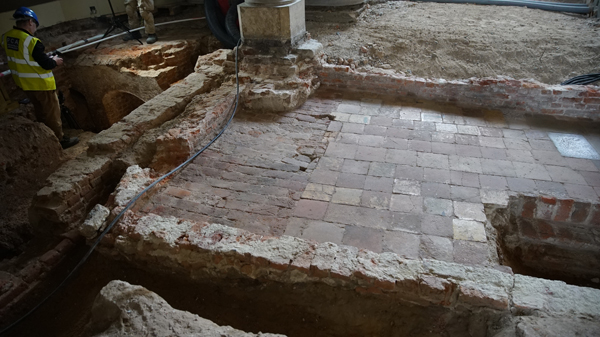
The remains of two rooms, which once formed part of the splendid Greenwich Palace – birthplace of King Henry VIII and his daughters Queen Mary I and Queen Elizabeth I, were discovered during works being undertaken ahead of the construction of a new visitor centre under the Old Royal Naval College’s famed Painted Hall, it was revealed last week.

The rooms, set well back from the river Thames, are believed to have formed part of the service range, believed to be the location of kitchens, a bakehouse, brewhouse and laundry.

As well as the discovery of a lead-glazed tiled floor, one of the rooms, which was clearly subterranean, featured a series of unusual niches where archaeologists believe may have been ‘bee boles’ – where ‘skeps’  (hive baskets) were stored during winter when the bee colonies were hibernating and where, when the bees were outside during summer, food and drink may have been stored to keep cool.

Discussions are reportedly now underway over the possibility of displaying the Tudor finds in situ. Duncan Wilson, chief executive of Historic England, hailed the find as “remarkable”.

“To find a trace of Greenwich Palace, arguably the most important of all the Tudor palaces, is hugely exciting,” he said. “The unusual and enigmatic nature of the structure has given us something to scratch our heads over and research, but it does seem to shine a light on a very poorly known function of the gardens and the royal bees. The most exciting aspect is that the Old Royal Naval College is able and willing to incorporate this into the new visitor centre, so everyone can see a small part of the palace, for the first time in hundreds of years.”

Greenwich Palace was built by King Henry V’s brother, Humphrey, Duke of Gloucester, in 1426 and rebuilt by King Henry VII between about 1500 and 1506.

Substantially demolished at the end of the 17th century (and with plans to build a new Stuart palace on the site never realised), it was replaced with the Greenwich Hospital which became the Royal Naval College designed by Sir Christopher Wren and Nicholas Hawksmoor between 1692 and 1728.

The Painted Hall, located in the Old Royal Naval College, is currently undergoing an 18 month transformation which includes the creation of a new visitor centre, Sackler Gallery and café. Visitors to the hall currently have the unique opportunity to get up close to the famous ceiling of the hall, described as the “Sistine Chapel of the UK”, on special tours. Visit www.ornc.org/painted-hall-ceiling-tours-tickets for more.

PICTURES: © Old Royal Naval College

LondonLife – Queen Victoria from on high…

The Queen Victoria Memorial, looking from Buckingham Palace across to St James’s Park. PICTURE: Robin Bilney/Royal Parks