We’ll kick off a new series next week, but, in the meantime, here’s a recap…
1. Queen Elizabeth’s Oak, Greenwich…
4. The Royal Oak, Richmond Park…
We’ll kick off a new series next week, but, in the meantime, here’s a recap…
1. Queen Elizabeth’s Oak, Greenwich…
4. The Royal Oak, Richmond Park…
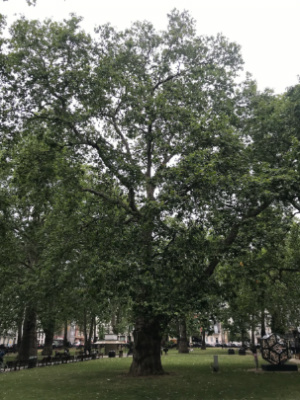
Located in the heart of Mayfair are some of the oldest – and most valuable – plane trees in London.
London plane trees (Platanus × acerifolia) – believed to be a hybrid of the American Sycamore Platanus occidentalis) and the Oriental Plane (Platanus orientalis) – were widely planted across London in the 18th century due to their resistance to pollution.
These grand old trees are believed to have been planted in 1789 by MP Edward Bouverie, who lived at 13 Berkeley Square.
Among the 30 or so plane trees in the Grade II-listed park is one known variously as the ‘Victorian Plane’ or ‘Berkeley Plane’.
It was reportedly assessed under the Capital Asset Value for Amenity Trees system in 2008 as being worth $750,000, a price tag which is understood to have made it the most valuable tree in Britain at the time.
The tree was one of the original 41 Great Trees of London.
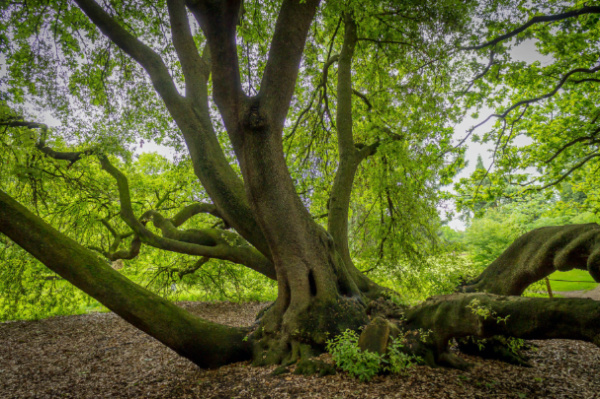
Said to be the oldest of its species in the UK (and a contender for the oldest tree in London), this holm oak (Quercus ilex), also known as a holly leaved oak, is believed to be more than 500-years-old.
The site was the home of senior clergy for much longer – Waldhere, the Bishop of London, first bought the site in 704 AD. And over the years, Fulham Palace and its gardens have evolved significantly with some of the current structures dating from Tudor times.
The Bishops of London left the palace in 1973 and it’s now managed under a trust which was established in 2011.
It’s possible this immense evergreen oak, which is native to the Mediterranean region, was among a number planted in the mid-16th century during the tenure of Bishop Edmund Grindal (about 1553 to 1559).
Bishop Grindal is known to have had a keen interest in the garden and who is credited with introducing the tamarisk tree to England and growing grapes which were sent to Queen Elizabeth I.
It’s also possible the tree was planted during the later tenure of Bishop John Aylmer (1576 to 1594).
The oak, which was coppiced many years ago extending its life, is among the original 41 trees awarded “Great Tree” status in 1988.
WHERE: Fulham Palace Gardens, Bishop’s Avenue, Fulham (nearest Tube station is Putney Bridge); WHEN: 10.30am – 5pm daily; COST: Free; WEBSITE: https://www.fulhampalace.org
Not one but five trees located in Kew Gardens, the “Old Lions” are five of the oldest trees in the garden.
Kew’s first curator, John Smith, is credited with first using the term to describe the trees.
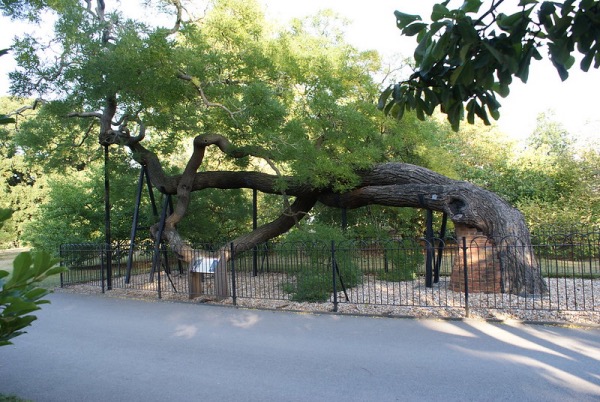
They include a Japanese pagoda tree (Styphnolobium japonicum) which was planted in 1762 after having been brought back to London from China by London nurseryman James Gorden.
There’s also the oldest of the maidenhair trees (Ginkgo biloba) in the garden, one of several grown by Gorden in 1758. Originally planted in the Duke of Argyll’s Garden at Whitton, it was transferred to Kew in 1762 following his death by his nephew Lord Bute, and is thought to be one of the first of its species to be grown in the country.
The Oriental plane (Platanus orientalis), located next to the Orangery, also apparently come from Whitton, brought to Kew in 1762, while the Caucasian elm (Zelkova carpinifolia) was planted in 1760 and is the only survivor of a group of three, the other two lost in storms in 1987 and 1990.
The last of the five trees is a Black locust (Robinia pseudoacacia) tree, also known as the false acacia tree. It was planted in the gardens in 1762 and was also transplanted from the Duke of Argyll’s Garden at Whitton.
WHERE: Kew Gardens (nearest Tube station is Kew Gardens); WHEN: 10am to 7pm (see website for seasonal changes); COST: From £20 for adults; from £18 concessions; from £9 young person (16 to 29 years); from £5 for children (4 to 15 years); see website for ticket categories WEBSITE: www.kew.org.
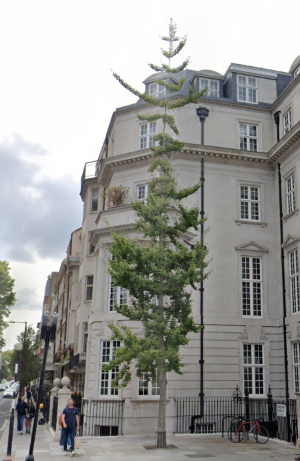
Nations, including the UK, have just marked the 80th anniversary of the D-Day landings in Normandy at a range of locations in France and England. But did you know London has its own “D-Day tree”?
The tree, a Ginkgo biloba or Maidenhair tree, is located outside number 22 in Grosvenor Square in Mayfair (on the corner with Upper Brooks Street). It was planted in 1994 to mark the 50th anniversary of the D-Day landings.
As well as the tree itself, the landings are commemorated with plaques around the base which provide the date of the landings and its code-name, Operation Overlord.
The location apparently relates to 20 Grosvenor Square being, for a time, the headquarters of Dwight D Eisenhower, Supreme Commander of the Allied Expeditionary Force launched on D-Day. There’s a plaque on the building commemorating his tenure.
In fact, the number of Americans working in the square – at locations including the US Embassy – led to it being known colloquially as ‘Eisenhower Platz’).
The tree was planted by the City of Westminster.
Note: There seems to be some conflicting information, not the least on a plaque in Bushy Park about Eisenhower’s connections with Grosvenor Square and Norfolk House in St James’s Square. We’ll be investigating further to clarify.
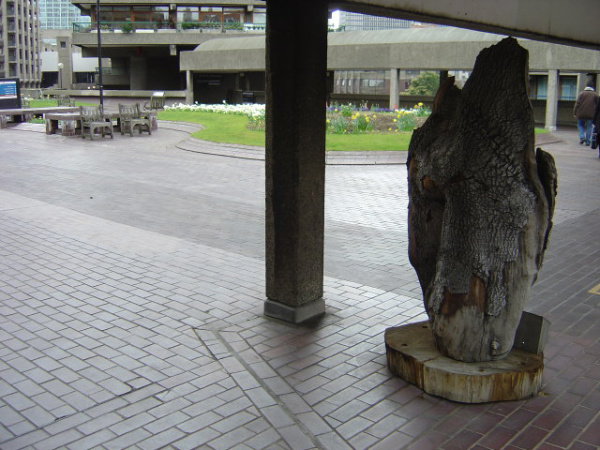
Standing on a Barbican walkway is the remnant of a tree believed to be at least 500-years-old which fell during a storm January, 1990.
The now hollowed-out stub of the beech tree (Fagus Sylvatica) had previously been located in the woodland known as Burnham Beeches, in Buckinghamshire – a woodland which was purchased by the City of London Corporation in 1880.
But what apparently sets this tree out from the others at Burnham Beeches is that it is believed famed German composer Felix Mendelssohn Bartholdy (1808-1847) used to sit under its then leafy branches while staying nearby during his several visits to England.
He is said to have done so to gain inspiration for his compositions and among the works he is said to have composed while here is some “incidental music” for A Midsummer Night’s Dream (although it has been suggested this might not actually be the exact tree under which he sat).
The tree and its plaque were installed in 1993 by the Barbican Horticultural Society and unveiled by conductor and composer Carl Davis.
There is now a replacement “Mendelssohn’s Tree” in Burnham Beeches which was planted in 2005.
WHERE: Barbican, off Aldersgate St (nearest Tube station is Barbican); WHEN: Anytime; COST: Free; WEBSITE: N/A.
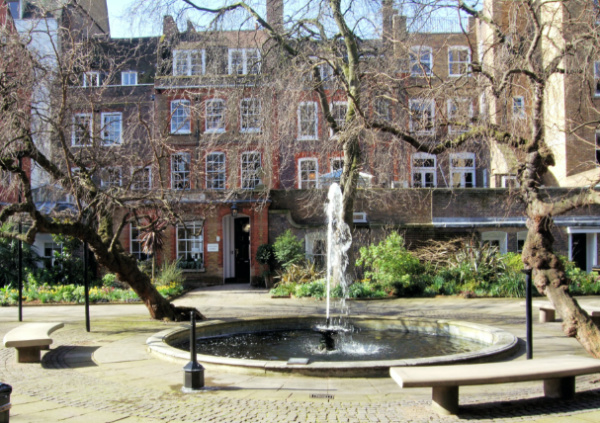
While there’s been gardens here dating back possibly as far as the middle of the 12th century when the Templars established a preceptory here, these two trees have a more recent historic (and royal) link.
The gnarled black mulberrys (Morus nigra) in the Fountain Court were planted here on 20th June, 1887, to commemorate the Golden Jubilee of Queen Victoria.
There were actually four mulberry trees planted to mark the occasion – which was celebrated with a grand dinner in the nearby Middle Temple Hall – but these two trees are the only survivors, the other two having been removed in the 1970s.
Both trees are these days leaning on supports.
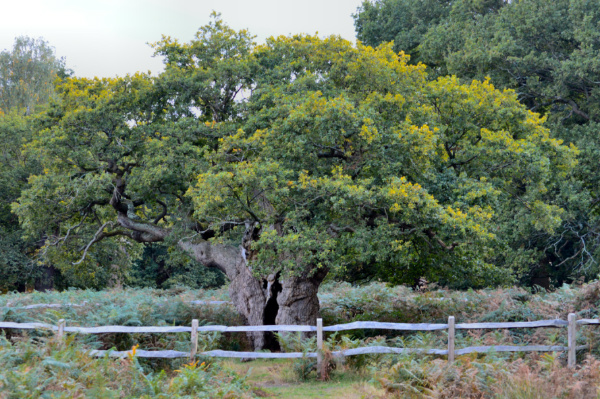
Estimated to be more than 750-years-old, the tree known as the Royal Oak is located near Pen Ponds and Richmond Gate.
This massive English oak (Quercus robur), which is hollow, doesn’t have any direct connections to royalty but it did survive the felling of trees which took place in Richmond Park and across the south-east of England so King Henry VIII’s navy could be built.
That may have been thanks to the King himself, who wisely passed a law to spare every 10th tree in the park for future seed.
While the park had been used by King Henry VIII as a hunting ground, it wasn’t until 1637 – during the reign of King Charles I – that it was first enclosed.
The tree, which is said to be one of 1,400 “veteran trees” in the park, was pollarded for several hundred years which helped create its shape – this is a method of pruning which removes the top-most branches to form a denser head (and creates wood which can be used for a variety of purposes).
WHERE: Near Pen Ponds, Richmond Park; WHEN: 24/7 pedestrian access; COST: Free; WEBSITE: www.royalparks.org.uk/visit/parks/richmond-park

Located in Danson Park in Bexley, south-east London, this tree is another of those in London which has been awarded “Great Tree” status.
Estimated to be around 200-years-old, it was planted in what was originally the grounds of the Danson Mansion Estate.
Danson House, a Palladian villa, was built by Sir John Boyd in 1766 for his second wife Catherine Chapone and designed by Sir Robert Taylor, the architect who also designed the Bank of England.
The Charter Oak of Bexley’s name comes from the charter which changed Bexley from a Urban District Council to the Borough of Bexley. It was presented to the first municipal council by Lord Cornwallis underneath the oak in 1937.

The oak’s significance is underlined by its presence on the Borough of Bexley’s coat-of-arms.
Visibly deteriorating, in 2017, “revolutionary geo-injector technology” was used to decompact the soil around the tree and feed its roots, successfully extending the tree’s life.
WHERE: Danson Park, Bexley (nearest railway stations are Bexleyheath and Welling); WHEN: 24 hours a day; COST: Free; WEBSITE: https://www.bexley.gov.uk/discover-bexley/visitor-attractions/danson-house-and-park/house

Said to be among the oldest still living trees in the City of London, the Cheapside Plane stands in what was once the churchyard of St Peter Cheap.
The church itself was destroyed in the Great Fire of London but how long this leafy tree, which stands more than 70 feet high, has occupied the site remains a matter of some conjecture.
A City of London tree trail puts the age of the tree – which stands at the corner of Wood Street and Cheapside – at 250 years (records held by the City say the tree was originally purchased for sixpence).
Over the years, this landmark tree – which has stood silent witness to everything from the 1854 cholera outbreak to the bombs of the Blitz – has garnered considerable attention appearing in various media, such as the Illustrated London News, and even, so say some, a 1797 poem by William Wordsworth (although some say the poem doesn’t refer to the tree at all).
The tree, which stands behind protective black iron railing, is the only one in the City of London listed among the “Great Trees of London” and planning laws protect it from over-development of the surrounding buildings.
Spring is upon us, so we thought it an appropriate time to consider some of London’s greatest natural assets – its trees. But, as well as being significant for their environmental impact, each of these trees (or, in some cases, the remains of them), are significant for historic reasons (we’ve previously mentioned a couple including what’s believed to be the oldest tree and the unusual – and sadly now deceased – Hardy Tree).
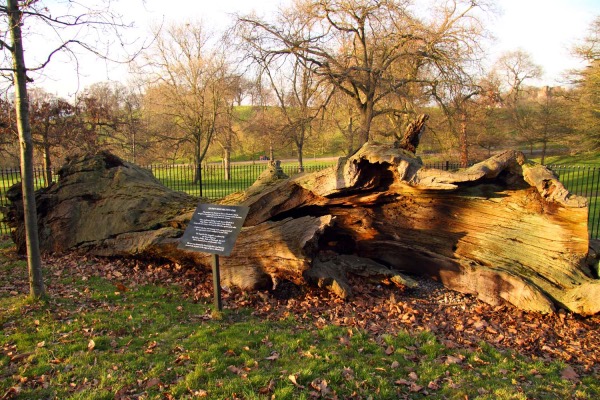
First up, it’s the tree known as Queen Elizabeth’s Oak in Greenwich. Thought to date from possibly as far back as the late 13th century, this tree survived until the 19th century before its carcass finally fell to the ground during a storm in 1991. It has lain in Greenwich Park ever since.
The tree, which is located at the end of what is now Lover’s Walk close to the Maze Hill Gate, was located in the grounds of Greenwich Palace (also known as the Palace of Placentia) and was there when King Henry VIII resided at the palace.
In fact, it’s said that he and Anne Boleyn danced around the oak while courting, and (and here’s where the name comes from) that Elizabeth, their daughter (and later Queen Elizabeth I), picnicked under its canopy (some accounts suggest she actually picnicked in the tree’s hollow – but still then upright – trunk).
Following the creation of what is now Greenwich Park, the hollow tree was apparently used as a prison for those caught illicitly on the grounds. They were secured behind a heavy wooden door fitted to the trunk (a park keeper’s lodge was built nearby in the 17th century; it was demolished in the 1850s).
The tree, one of 3,000 in the park, had died in the 19th century and was reduced to an eight metre high stump, partly supported by ivy, when it was blown over by the storm in June, 1991.
A replacement oak, which was donated by the Greenwich Historical Society was planted nearby by the Duke of Edinburgh on 3rd December, 1992, to mark Queen Elizabeth II’s 40 years on the throne.
A ring analysis carried out on the tree found in 2014 it dated back to at least 1569 but with the core missing a precise date of germination couldn’t be found. Estimates, however, place the date of germination to the last 13th or early 14th century. The analysis placed the tree’s death to between 1827 and 1842.
The tree is marked with a plaque and both it and the new tree are surrounded by an iron railing.
WHERE: Queen Elizabeth Oak, Greenwich Park (nearest DLR station is Greenwich); WHEN: 6am to 8pm daily; COST: Free; WEBSITE: https://www.royalparks.org.uk/visit/parks/greenwich-park.
This is an expanded version of a post first made in 2017.
 Exploring London