10 sites of (historic) musical significance in London – 3. Denmark Street…

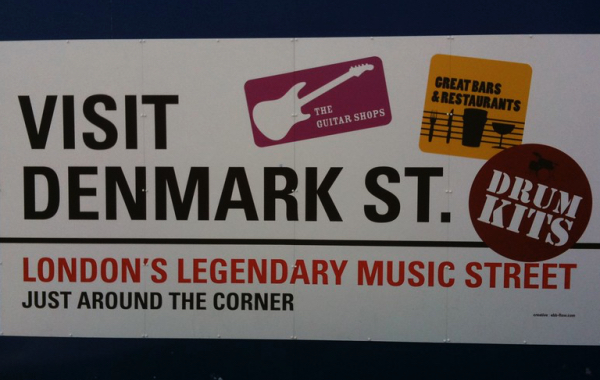
A sign promoting Denmark Street in 2009. PICTURE: Ged Carroll (licensed under CC BY 2.0)

Nicknamed ‘Tin Pan Alley’ after a famous New York City area associated with music publishers and songwriters, Denmark Street in Soho is famous for its 20th century music connections.

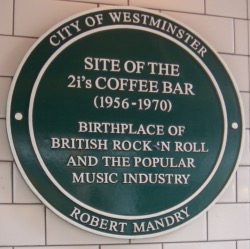
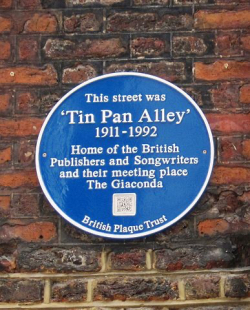
The British Plaque Trust plaque in Denmark Street. PICTURE: Andrew Davidson (licensed under CC BY-SA 3.0)

The street, which is just 100 yards long, was home to most major music publishing and management companies during the 1950s and 1960s as well as recording studios while publications Melody Maker and New Musical Express (better known to some as the NME) were also founded there.

Artists with a connection include David Bowie, Paul Simon, The Rolling Stones, The Kinks, and The Sex Pistols (who reportedly left a considerable amount of graffiti at number six), while two members of Bananarama apparently lived there in the 1970s. Lionel Bart, writer of the musical Oliver!, also started out here and was later known as the “King of Denmark Street”.

The street was also home to the famous Gioconda Cafe – whose patrons have included Bowie, Jimi Hendrix and Elton John.

These days home to many musical instrument shops, the future of the Denmark Street has been a matter of some controversy in recent years with a planned redevelopment attracting considerable protest.

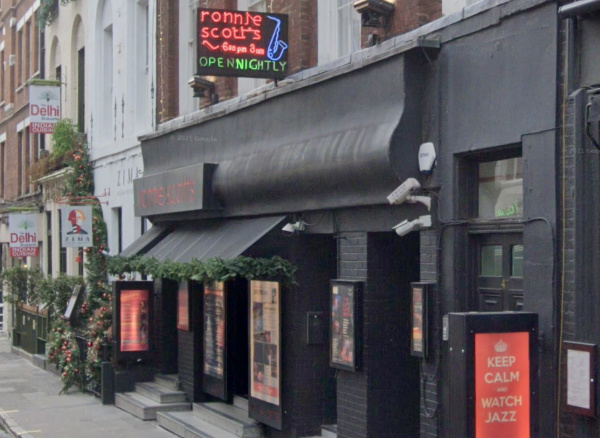
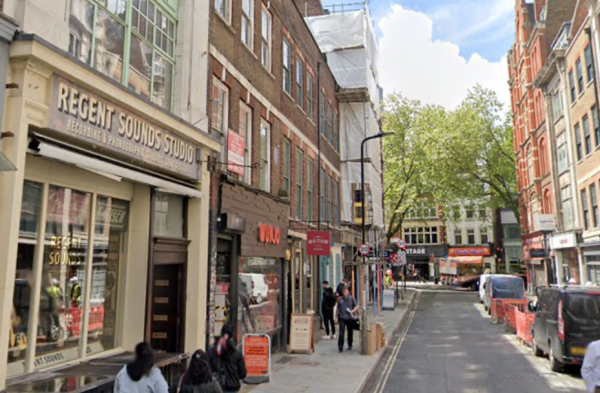
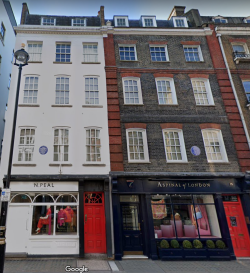
Looking west down Denmark Street in May, 2021. PICTURE: Google Maps.

A plaque – put in place by the British Plaque Trust (pictured above; it’s not to be confused with the English Heritage Blue Plaque commemorating dive helmet pioneer Augustus Siebe on number five) – was unveiled at number nine in 2014 commemorating the street’s musical connections between 1911 and 1992. It reads “Home of the British Publishers and Songwriters and their meeting place The Giaconda.”

Sixties pop singer Donovan, who recorded here, performed a song he’d written specifically for the occasion – appropriately named Tin Pan Alley.

10 sites of (historic) musical significance in London – 2. 23 Heddon Street…

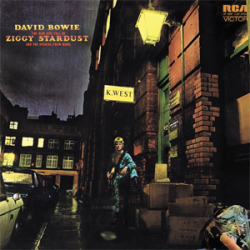
This property (and the street, which runs in a horseshoe off Regent Street in the West End, I which it sits) is famous for its appearance on the cover of David Bowie’s 1972 album, The Rise and Fall of Ziggy Stadust and the Spiders from Mars.

The famous album cover.

The cover – which features Bowie (who was ill with the flu at the time) dressed as Ziggy Stardust standing outside the building under the light of a lamp – was one of several shots taken by photographer Brian Ward on a cold and wet night in January, 1972.

Originally taken in black and white, the selected image was subsequently hand-coloured by artist Terry Pastor for the album cover.

There’s been much commentary over the years about the sign which appears over Bowie’s head in the shot and reads K West. Bowie himself, lamenting the fact the sign had been removed when the furrier moved out in the early 1990s, commented later that that it had taken on “mystical overtones” for some fans who thought it was code for the word quest. But the truth is more mundane – it was apparently the name of a furrier who at the time occupied part of the building.

PICTURE: Jnicho02 (licensed under CC BY-SA 3.0)

The back cover of the album featured Ziggy inside an iconic red phone box which was located just around the corner from number 23, still in Heddon Street. One of the K2 boxes, it’s since been replaced.

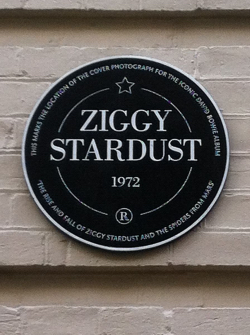
While the street has been considerably gentrified since Ziggy stood there (rather than a deserted back street, it’s now a popular al fresco dining area), a plaque was unveiled commemorating the role of the building in 2012 (pictured above).

The album, meanwhile, was released on 16th June, 1972, by RCA Records to what was generally a favourable reception.

10 sites of (historic) musical significance in London – 1. 25 (and 23) Brook Street, Mayfair…

OK, so we all know about the Abbey Road crossing and its connection with the Beatles, but where are some other sites of historic musical significance in London?

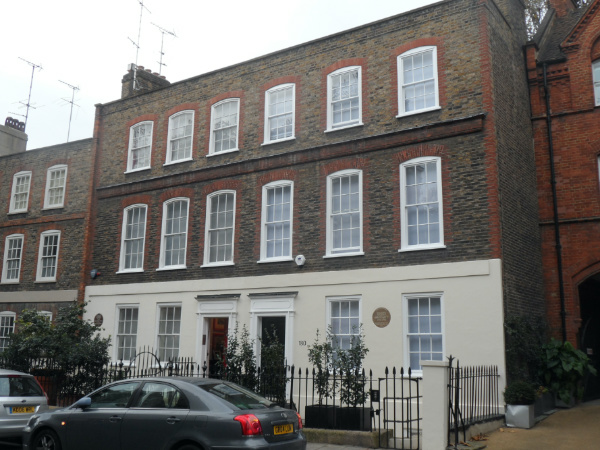
23 and 25 Brook Street, Mayfair. PICTURE: Google Maps.

First up, it’s the Mayfair home where 18th century composer George Frideric Handel lived from 1723 until his death in 1759 – and where he composed much of his best known work including masterpieces such as Zadok the Priest (1727, it was composed for the coronation of King George II), Israel in Egypt (1739), Messiah (1741), and Music for the Royal Fireworks (1749).

The German-born Handel, who settled permanently in London in 1712 (and who became a naturalised British citizen in 1727), was the first occupant of the terraced house located at what is now 25 Brook Street (but previously known as 57) which is now a museum dedicated to his life and work.

The property, which is today decorated as it would have been during early Georgian times, is thought to have been convenient for its proximity to be the theatres where his works works were performed and St James’s Palace, where he served as Composer of Music for the Chapel Royal.

A small room on the first floor is believed to be where Handel did most of his composing. He is also understood to have used the larger adjoining music room for rehearsing his works from the 1730s (possibly due to a lack of space at the venue where he mainly performed, the Covent Garden Theatre).

Handel died in the house on 14th April, 1759. The property, which subsequently was lived in by various people, became a museum dedicated to the composer in 2001.

Known for the first 15 years of its existence as the Handel House Museum, in 2016 it was expanded to include the upper floors of the adjoining home, 23 Brook Street, a flat which served as home to another musical great, Jimi Hendrix, in 1968-1969. The museum is now known as Handel & Hendrix in London.

Both properties have English Heritage Blue Plaques upon them. The first plaque were erected on Handel House in about 1870 by the Society of Arts and was replaced in 1952 and again in 2001, when his middle name was corrected to Frideric from Frederick. The plaque commemorating Hendrix’s residence in Number 23 was erected in 1997.

The museum is closed, with limited exceptions, until March, 2023, for a refurbishment project called the The Hallelujah Project. But you can head to the website to take a 3D virtual tour: https://handelhendrix.org.

10 London memorials to foreign leaders – A recap…

Before we move on to our next Wednesday special series, here’s a recap

1. Abraham Lincoln…

2. Jawaharlal Nehru…

3. Simón Bolívar…

4. Charles de Gaulle…

5. Prince Henry the Navigator…

6. Nelson Mandela…

7. Mahatma Gandhi…

8. General Don José de San Martín…

9. Władysław Sikorski…

10. Skanderbeg…

10 London memorials commemorating foreign leaders – 10. Skanderbeg…

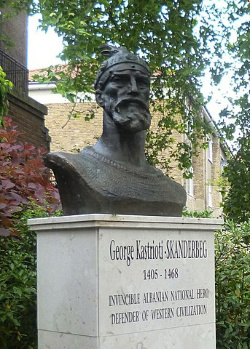
Des Blenkinsopp / An Albanian Hero (licensed under CC BY-SA 2.0)

Unveiled just nine years ago, this bust in Bayswater commemorates George Kastrioti Skanderbeg, a 15th century Albanian lord who led a rebellion against the Ottoman Empire (and who later became a central figure of inspiration in the Albanian National Awakening of the 19th century).

Located on the corner of Inverness Terrace and Porchester Gardens, the bronze bust was created by Kreshnik Xhiku.

An inscription on the front reads “George Kastrioti Skanderbeg, 1405 – 1468, invincible Albanian national hero, defender of western civilization.”

It was unveiled on the 100th anniversary of Albanian independence on 28th November, 2012, with Westminster City Councillor Robert Davis and  Albanian Charge d’affaires, Mal Berisha, in attendance.

The bust was installed as part of Westminster’s City of Sculpture initiative.

10 London memorials commemorating foreign leaders – 9. Władysław Sikorski…

PICTURE: Chmee2 (licensed under CC BY-SA 3.0)
PICTURE: Ethan Doyle White (licensed under CC BY-SA 4.0)

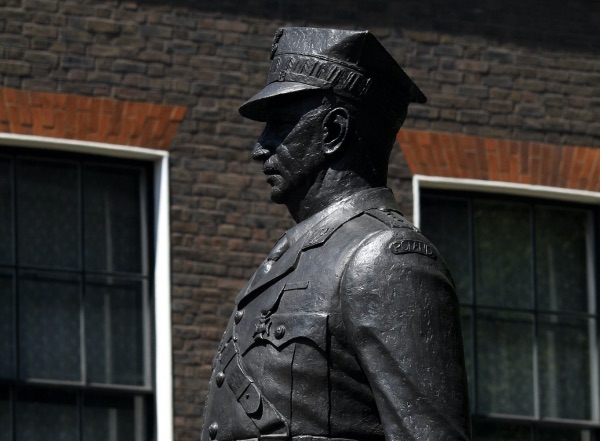
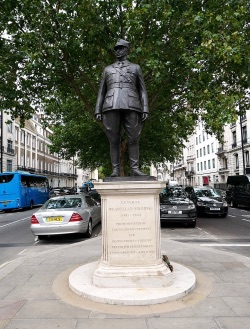
This statue in Portland Place in Marylebone commemorates wartime Polish Prime Minister and military leader (and British ally) Władysław Sikorski (1881-1943).

Larger than lifesize, the bronze statue depicts Sikorski in military uniform standing on a white stone plinth. It is the work of late British artist Faith Winter (also the sculptor of a controversial statue of Air Chief Marshal Sir Arthur Harris outside the RAF church on the Strand).

Funded by public subscription, this statue of Sikorski was erected on 24th September, 2000, and unveiled by the Duke of Kent. It stands near the Polish Embassy on a traffic island near the intersection with Weymouth Street.

There’s inscriptions on each face of the plinth which commemorate Sikorski as well as the “Soldiers, Seamen and Airmen of the Polish Armed Forces and the Resistance Movement” between 1939 – 1945. The east face inscription commemorates Polish involvement in World War II through a listing of battles.

Sikorski is also commemorated with a plaque adorning the Rubens Hotel in Buckingham Palace Road which served as his headquarters between 1940 until his death in an air crash in Gibraltar in 1943 (where there is another memorial to him).

10 London memorials commemorating foreign leaders – 8. General Don José de San Martín..

PICTURE: Peter O’Connor/licensed under CC BY-SA 2.0)

Another of the many statues in Belgrave Square and surrounds, this statue depicts a giant of South American history.

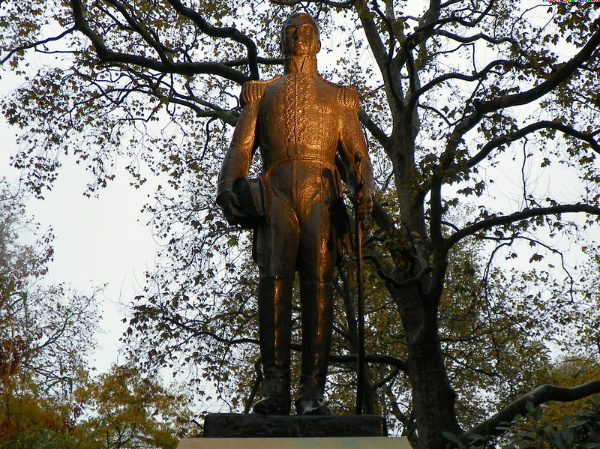
Don José de San Martín was an Argentine general who was instrumental in the continent struggle for independence from the Spanish Empire and is regarded as a hero in Argentina, Chile and Peru.

The bronze statue, the work of Juan Carlos Ferraro, was cast in Buenos Aires in 1993 and unveiled in the northern corner of the square’s gardens by the Duke of Edinburgh in 1994 in the presence of dignitaries including Senator Eduardo Menem of Argentina, Lord Mayor of Westminster Angela Hooper, UK Foreign Secretary Douglas Hurd and Argentine Ambassador Mario Campora. It was erected by the Argentine-British community in Argentina and is dedicated to the people of London.

San Martín is depicted standing in military uniform on top of a heavy plinth. It’s inscribed on the front with the words “General Don José de San Martín, 1778-1850, founder of the Argentine independence, he also gave freedom to Chile and Peru.” There are also some further inscriptions referring to its creation and one on the right side of the plinth saying “His name represents democracy justice and liberty”.

A plaque was added on the ground in front of the statue to mark the 150th anniversary of San Martin’s death – 17th August, 2000.

It’s not the only memorial to San Martín in London – there’s also a Blue Plaque, erected by the London County Council in 1953, at 23 Park Road in Marylebone (San Martín stayed here for a few months in 1824).

10 London memorials commemorating foreign leaders – 7. Mahatma Gandhi…

PICTURE: Alvesgaspar (licensed under CC BY-SA 4.0)

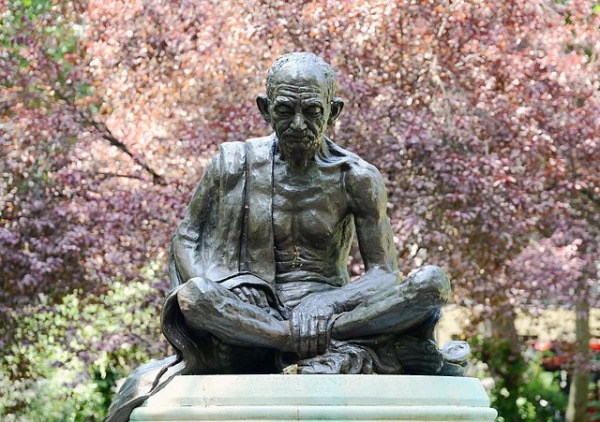
There’s a couple of statues commemorating Mahatma Gandhi in London with the most recent one was unveiled in Parliament Square in 2015.

But this week we head Bloomsbury where we find an older one in the centre of the gardens in Tavistock Square.

The work of Fredda Brilliant, it was unveiled by then Prime Minister Harold Wilson in May, 1968. Also present was the first High Commissioner of India to the UK after independence, VK Krishna Menon, and the then-current High Commissioner of India to the United Kingdom, Shanti Swaroop Dhavan.

Menon apparently chose the location for the statue – Gandhi had studied at the nearby University College London between 1888 and 1891.

Gandhi, who was assassinated in 1948 after having playing an instrumental role in the push for India’s independence, is depicted sitting in a cross-legged in the lotus position wearing a loincloth with a shawl over his right shoulder. The statue sits atop a rounded Portland stone plinth.

The memorial was erected by the Mahatma Gandhi Memorial Committee, with the support of the India League. It was Grade II-listed in 1974.

A further plaque was added beneath the statue in 1996 commemorating the 125th anniversary of the birth of Gandhi.

10 London memorials commemorating foreign leaders – 6. Nelson Mandela…

Back to Parliament Square this week where we look at a bronze statue of anti-apartheid activist and former President of South Africa, Nelson Mandela.

PICTURE: Prioryman (licensed under CC BY-SA 4.0)

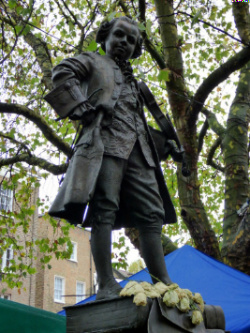
Unveiled on 29th August, 2007, this larger-than-life statue is the work of English sculpture Ian Walters (he completed a clay sculpture of the Parliament Square statue before his death in 2006 but sadly didn’t live to see it cast in bronze in London.)

The statue was proposed by South African journalist and anti-apartheid activist Donald Woods but after his death in 2001, the fundraising effort, officially launched in 2003, was led by his wife Wendy and Sir Richard Attenborough.

It depicts Mandela standing on a low plinth with his arms outstretched as though making a speech. He is shown wearing a flowery shirt.

It was originally proposed the statue be located outside of the South African High Commission in Trafalgar Square but after planning approval was refused, the alternative site of Parliament Square was eventually decided upon.

The unveiling in the south-west corner of the square was attended by Mandela himself along with his wife Graça Machel and then Mayor of London Ken Livingstone while then PM Gordon Brown did the official duties.

Interestingly it’s not the only work of Walters depicting Mandela – he was also the sculptor behind the bust of Mandela which stands outside Royal Festival Hall in South Bank.

It’s also not the only South African who has a statue in Parliament Square – there’s also one of Jan Smuts, twice Prime Minister of the Union of South Africa in the early 20th century (in fact Mandela recalled at the unveiling that he and his friend Oliver Tambo, who went on to become president of the ANC, had once joked about seeing the statue of a Black man one day erected in the square – Tambo never lived to see it, but Mandela, at age 89, did).

10 London memorials commemorating foreign leaders – 5. Prince Henry the Navigator…

Prince Henry the Navigator. PICTURE: David Adams

We go back to Belgrave Square this week to its westernmost corner where there is a bronze statue of 15th century Portuguese aristocrat and explorer, Prince Henry the Navigator.

Prince Henry (1394-1460) was the son of King John I of Portugal and Philippa, the daughter of English nobleman John of Gaunt and sister of King Henry IV.

As well as being appointed the Governor of the Algarve in 1419, Henry became famous for his scientific and exploratory endeavours – he was instrumental in opening the navigational route to India (although his nickname “The Navigator” apparently was applied to him until centuries later5)

The statue, which has the prince wearing robes seated on a rocky outcrop with a rolled map in his hand, is attributed to Simoes de Almeida (who died in 1950) and it’s been claimed it was made as far back as 1915. There is a duplicate of the statue located in the US – at Fall River, Massachusetts – but this is credited to the sculptor, Aristide Berto Cianfarani.

While it’s origins remain somewhat unclear, we do know the statue was unveiled by the President of Portugal in February, 2002, with the Duke of Westminster present.

There are some verses from Portuguese poet Fernando Pessoa on the side of the plinth.

10 London memorials to foreign leaders…4. Charles de Gaulle…

PICTURE: Metro Centric (licensed under CC BY 2.0)

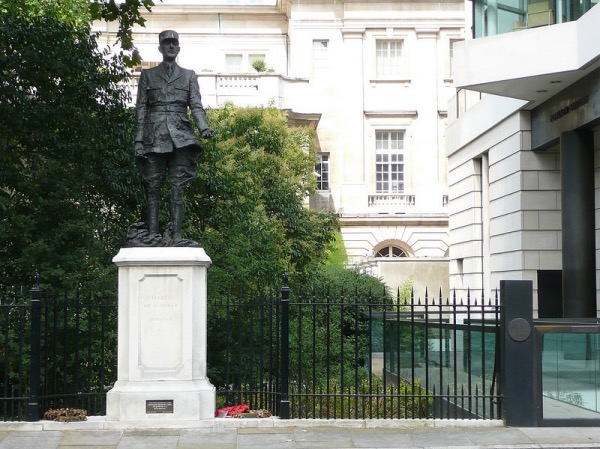
Unveiled in the early 1990s, this statue of the French leader Charles de Gaulle (1890-1970) is located in St James’s, close to the headquarters where de Gaulle headed the government-in-exile following the fall of France in 1940.

The life-sized statue is the work of sculptor Angela Conner and architect Bernard Wiehahn and was erected in Carlton Gardens following a campaign by Lady Soames, daughter of Winston Churchill. De Gaulle is depicted standing in the uniform of a General de Brigade.

The was unveiled by Queen Elizabeth, The Queen Mother, in June 1993. Nearby are an English Heritage Blue Plaque as well as another plaque, both commemorating the location of the headquarters.

A commemorative ceremony takes place each year at the statue organised by the French Embassy.

De Gaulle flew to England in June, 1940, and was subsequently recognised by Britain as the leader of the Free French. He established his headquarter at 4 Carlton Gardens on 22nd July that year, initially living at the Connaught Hotel and, from 1942 to 1944, in Hampstead. He returned to France following the D-Day invasion in 1944.

10 London memorials to foreign leaders…3. Simón Bolívar…

PICTURE: Rept0n1x (licensed under CC BY-SA 1.0/image cropped)
PICTURE: Another Believer (licensed under CC BY-SA 4.0)

One of a cluster of statues depicting foreign leaders around Belgravia Square (thanks to the presence of so many foreign embassies in the area), this work depicting Simón Bolívar, a towering figure in the early 19th century liberation of South America from colonial powers, was erected in 1974.

The bronze, by Hugo Daini, shows Bolívar standing as though about to make a speech

The inscription describes Bolívar as the liberator of Venezuela, Colombia, Ecuador, Peru, and Panama and the founder of Bolivia and also mentions the details of his birth – Caracas, Venezuela, 24th July, 1783 – and death – Santa Maria, Colombia, 17th December, 1830.

It is accompanied by a quote on the side of the pedestal, featuring words attributed to Bolívar: “I am convinced that England alone is capable of protecting the world’s precious rights as she is great, glorious and wise”.

The statue was erected by the aforementioned nations (the coats-of-arms of which are on the plinth) and unveiled in by James Callaghan, then Foreign Secretary (and later PM).

10 London memorials to foreign leaders…2. Jawaharlal Nehru…

PICTURE: Ham (licensed under CC BY-SA 3.0/Image cropped)

Located on the west side of India House – location of the High Commission of India – is a bust of Jawaharlal Nehru, the first Prime Minister of independent India.

The bust, which stands in India Place between Aldwych and The Strand, is the work of Latika Katt and stands on a granite plinth. It was unveiled in 1990 by the High Commissioner of India LM Singhvi and the Mayor of London.

In 2009, the bronze bust was temporarily dislodged from the plinth but was subsequently returned to its home.

10 London memorials to foreign leaders…1. Abraham Lincoln…

PICTURE: JR P (licensed under CC BY-NC 2.0)

Standing on the edge of Parliament Square opposite the UK’s home of government, this statue of the 16th US President was erected to mark the friendship between Britain and the United States of America.

The statue was proposed by the American Committee for the Celebration of the Hundredth Anniversary of Peace Among English Speaking Peoples to commemorate the centenary of the end of conflict between the two nations in 1915.

But World War I broke out and so it wasn’t until July, 1920 that this statue, a replica of a statue Auguste Saint-Gauden made for the city of Chicago and now Grade II-listed in its own right, was formally presented to then UK Prime Minister David Lloyd George by the US Ambassador and subsequently unveiled by Prince Arthur, the Duke of Connaught.

The 12 foot high, larger than life, monument – which includes a granite plinth – depicts Lincoln wearing a frock coat standing in front of his Grecian chair and about to give a speech. The original was completed in 1887 and was unveiled in Chicago’s Lincoln Park with Abraham Lincoln II, grandson of the President, in attendance as well as a crowd of some 10,000.

Interestingly, the UK wasn’t the only nation given a copy of the statue – a replica was also given to Mexico in 1964 and now stands in the Parque Lincoln in Mexico City.

There is also a replica at Lincoln’s tomb in Springfield, Illinois and in 2016, a newly cast replica of the statue was installed at the Saint-Gaudens National Historic Site – the former home and studio of the sculptor – in Cornish, New Hampshire. There are also numerous smaller replicas including a bust which is sometimes displayed in the Oval Office in the White House.

10 London Hills…A recap…

1. Ludgate Hill…

2. Cornhill…

3. Tower Hill…

4. Parliament Hill…

5. Primrose Hill…

6. Shooter’s Hill…

7. Brockley Hill…

8. Harrow Hill…

9. Highgate Hill…

10. Richmond Hill…

10 London hills – 10. Richmond Hill…

The famous and protected view looking south-west from Richmond Hill across The Thames and Glover’s Island. PICTURE: flicksmores (licensed under CC BY-NC-ND 2.0)

For the final in this series we head out west to Richmond Hill which takes its name from the palace which once stood nearby.

At the summit of the hill, which stands about 50 metres (165 feet) high, stands the gate to Richmond Park while the steeper western slopes drop down to Petersham Meadows by the River Thames.

What was the village of Richmond – now incorporated into greater London – sits partly on the slopes of the hill. It and the hill take their names from a palace, established here in the early 16th century by King Henry VII as a replacement for Sheen (Shene) Palace which had been destroyed in a fire in 1499. The King named the new building Richmond Palace, in honour of the earldom of Richmond in Yorkshire, one of his titles.

Richmond Hill is famed for its views – they include the only view in England protected by an Act of Parliament (passed in 1902). It looks to the south-west over Petersham to the Thames, taking in Glover’s Island, and reaching as far as Windsor and has been immortalised in works by the likes of artists JMW Turner and Sir Joshua Reynolds as well as by author Sir Walter Scott.

Richmond Hill features many fine 18th century homes including Wick House (built for Joshua Reynolds in 1771) and the westward slopes boast the Terrace Walk and Terrace Gardens, both of which are Grade II* listed, while the massive bulk of the former Royal Star and Garter Home for disabled ex-servicemen (now apartments) can be seen close to the summit.

Other famous residents on the hill have included Rolling Stones’ guitarist Ronnie Wood and actress Celia Johnson while scenes for the film, The Hours, were shot on The Terrace.

Looking at Richmond Hill from the Petersham meadows; to the left is the Petersham Hotel, to the right, the former Star and Garter Home. PICTURE: Maxwell Hamilton (licensed under CC BY 2.0)

10 London hills – 9. Highgate Hill…

Highgate Hill seen from Hampstead Health (with the spire of St Michael’s visible). PICTURE: Adrian Scottow (licensed under CC BY-SA 2.0/image cropped)

This hill in the city’s north rises 136 metres (446 feet) above sea level and is said to take its name from a tollgate the Bishop of London once erected on the summit.

The hill, which stands to the northeast of the expansive Hampstead Heath and south of Highgate Wood, is topped by Highgate Village, long a fashionable residential district which features some significant 18th century buildings. It boasts views of central London.

Landmarks include the famous Highgate Cemetery – resting place to everyone from Karl Max to George Eliot and Douglas Adams – and the Highgate School, established on 1565 to educate the poor and now a rather exclusive – and expensive – establishment (the school, incidentally, was built on the site of an earlier hermitage). TS Eliot was a former master there and students included Poet Laureate Sir John Betjeman.

Other buildings of note include The Flask pub, St Michael’s Church (dating from 1831) and St Joseph’s Roman Catholic Church (dating from 1888).

Famous residents have included Romantic poet Samuel Taylor Coleridge (he was originally buried in a crypt below the school’s chapel but his remains were relocated to St Michael’s Church in 1961) while 16th and early 17th century philosopher and statesman Sir Francis Bacon died in what was then called Arundel House (now The Old Hall) in 1626. Classical scholar and poet AE Housman’s former house at 17 North Road is marked with an English Heritage Blue Plaque.

Highgate Hill is also famous for being where, so the story goes, Dick Whittington, who was accompanied by his cat, heard the Bow bells and felt called back to London (there’s a monument to Whittington and his cat close to the bottom of Highgate Hill Road).

10 London hills – 8. Harrow Hill…

The Harrow School (left) and St Mary’s Church on top of Harrow Hill. PICTURE: Google Maps

This hill in outer north-west London, which rises 124 metres (408 feet) above sea level, is the location of the village Harrow-on-the-Hill.

The hill’s name is said to refer to a Saxon place of worship and was later taken to mean the Christian church that stood upon it.

That church – the historic St Mary’s, the latest incarnation of a Christian church which has stood on the hill since the Norman Conquest – dominates the hill to this day. Nearby is a spot called King Charles’ Well where King Charles I is said to have stopped and taken one last look at London as he made his way from Oxford to surrender to the Scottish army in Nottinghamshire.

The other famous landmark atop the hill, opposite the church, is the world renowned Harrow School, founded under a Royal Charter by John Lyon in 1572, during the reign of Queen Elizabeth I.

The hill is also host to a Grade II-listed war memorial and a fine array of historic homes dating from the Georgian period to the early 20th century. Among this who have lived on the hill are 19th. century critic and writer Matthew Arnold and 19th century Scottish author RM Ballantyne.

Panoramic views of Central London can be seen from the top of the hill and there is a famous viewpoint in the churchyard known as Lord Byron’s View, which looks away to the north-west. It’s so-called because Byron, while a schoolboy at Harrow, was a frequent visitor to the spot by a tombstone – called the “Peachy Tomb”- where he would apparently spend time “dreaming”.

Byron’s View atop Harrow on the Hill. PICTURE: Google Maps

10 London hills – 7. Brockley Hill…

Looking north along the A5 as it passes over Brockley Hill. PICTURE: Google Maps

Located in Stanmore in London’s northern outskirts, Brockley Hill has an elevation of 136 metres above sea level.

The name apparently comes from an Old English word for badger holes (the sandy soil on top of the hill being easier for them to dig than the surrounding clay).

The Celtic tribe the Catuvellauni is believed to have had a settlement on the hill top and legend says that it was on the hill that a battle was fought between the Catuvellauni, under their leader Cassivellanus, and the Roman Julius Caesar in 54 BC.

The Romans later are understood to have established their own settlement on the hill – Sulloniacae – which was served as an imperial posting station on Watling Street as it made its way north from Marble Arch to Verulamium (St Albans).

The sandy soil also meant the area was a centre for pottery making during the Roman period, in particular flagons and vessels known as mortaria (bricks were made here in more recent centuries). There’s a plaque commemorating the Roman pottery on the A5 (just pass the junction with Wood Lane)

There is an obelisk commemorating the battle on top of the hill which was erected in 1750 (which can still be seen although it suggests the Catuvellauni won the battle when historians today believe the reverse). It stands now in the grounds of the Royal National Orthopaedic Hospital which moved into the site of an earlier hospital in the late 1920s.

10 London hills – 6. Shooter’s Hill…

Sunset from Shooters Hill. PICTURE: matbickle (licensed under CC BY 2.0)

The highest point in the Borough of Greenwich in London’s south-east, Shooter’s Hill rises to 433 feet (132 metres) above sea level and provides views over the Thames to the north and London to the west as well as Kent and Essex.

Severndroog Castle. PICTURE: Public Domain

The name, which is also that of the surrounding district, apparently comes from the fact that archery was practiced there in the Middle Ages.

But the area – which still is reasonably well wooded – was also the haunt of highwaymen (in response, there was a gallows at the crossroads at the bottom of the hill and a gibbet on the summit where bodies were displayed).

The modern road known as Shooters Hill Road, part of the A2 and later the A207, follows part of the route of the ancient roadway known as Watling Street.

Landmarks on the hill include a Gothic revival water tower dating from 1910 and a rather impressive folly known as Severndroog Castle which was built in in 1784 by Lady James in honour of her husband, Commodore Sir William James, who captured a pirate fortress at Suvarnadurg on India’s west coast in 1755.

Other landmarks include Christ Church Shooters Hill which features a Grade II-listed milestone and a Bronze Age mound known as Shrewsbury Barrow.

Literary mentions include one in Samuel Pepys’ famous diary – he rode past a body on the gibbet in 1661 – and in Charles Dickens’ A Tale of Two Cities.