 Tower Bridge opens up to allow a boat to pass up the Thames. The bascule bridge (the word ‘bascule’ is taken from the French for ‘see-saw’) was completed in 1894 and was built to cater for East End traffic while minimising disruption to boats moving up and down the rive. It was the first bridge built to the east of London Bridge (a bridge which many often confuse it with!). For more information, see www.towerbridge.org.uk.
Waterways
LondonLife – the Thames near Richmond

Sun reflects off the River Thames in a view from Richmond Hill Road, looking westward. Beyond the island on the far back is Marble Hill House, built Henrietta Howard, mistress of King George II when he was Prince of Wales, which is set in almost 27 hectares (66 acres) of parkland. Richmond is located in the south-west of the city.
10 sites in London you may not know about – 9. Regent’s Canal
Opened in 1820 as a link between the Grand Junction Canal and the London docks in the east, Regent’s Canal remains a terrific way to see another, oft forgotten (at least in visitor terms), part of the city.
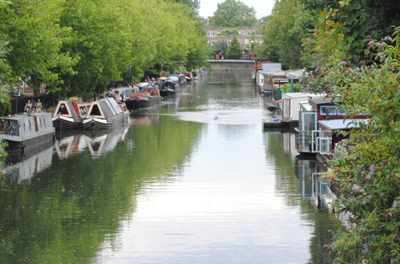 Once at the heart of London’s goods transportation system, the canal is now a recreational and residential precinct. There’s a terrific tow path which runs between Camden Lock, home of great markets including terrific food, and the pool of Little Venice in Paddington – taking in Regent’s Park, canal-side mansions, and the London Zoo along the way.
If you don’t want to walk, you can take a boat trip (among those offering trips between Little Venice and Camden Lock are the London Waterbus Company and Jason’s Trip; for kayaking, see Thames River Adventures) along largely the same route (although the tow path takes you over the top of Maida Hill while the boats head through a tunnel underneath).
John Nash, designer of Regent’s Park, was one of the proponents of the canal seeing it as nice addition to his park (he apparently originally wanted the route to run through the park but was convinced otherwise thanks to some fears over the language of those involved in steering boats along the canal).
He become one of the directors of the company which developed the canal following the passing of an act of parliament in 1812. It was named for the then Prince Regent, later King George IV.
You can find out more about the history of the canal at the London Canal Museum, located further to the east on the Regent’s Canal between St Pancras Lock and the Islington Tunnel.
WHERE: While the canal runs to the docks, the journey from Camden Lock to Little Venice is a walk of around 5 kilometres. Nearest tube stations are Warwick Avenue at the Little Venice end and Camden Town at the Camden Lock end; WHEN: Daily, tow path is open from dawn to dusk between Camden Lock and Little Venice (see the boating company websites for trip times); COST: The tow path is free, one way trips on boats between Little Venice and Camden Lock start at around £6.50; WEBSITE: For more on the history of the Regent’s Canal, see www.canalmuseum.org.uk/history/regents.htm.
The Tip – Walk under the Thames
Walk under the Thames. Heading to Greenwich for a day out? While the Docklands Light Railway (DLR) will take you from Tower Hill to Cutty Sark station in the heart of Greenwich itself, get off a station early at Island Gardens and you can walk to Greenwich instead, taking the foot tunnel under the Thames. Opened in 1902, the 387 metre long tunnel, which runs about 15 metres underneath the river, was built so labourers from south London could walk to work in the docks on the Isle of Dogs and surrounding areas. Signs mark the way to the tunnel which is marked at either end by a dome at each end containing stairs and a lift. http://bit.ly/aQMujS

