Where is it? #21

The latest in the series in which we ask you to identify where in London this picture was taken and what it’s of. If you think you can identify this picture, leave a comment below. We’ll reveal the answer early next week. Good luck!

Congrats to Jameson Tucker who correctly placed this in the gardens which now occupy the site of the former church of St John Zachary which lie, as Mike Paterson correctly pointed out, near the Goldsmiths’ Hall.

In fact, the gardens, located at the corner of Gresham and Noble Streets in the City (opposite the Goldsmith’s Hall), are also known as the Goldsmith’s Garden and were laid out following bomb damage during the Blitz (the church of St John Zachary had been destroyed in the Great Fire of London and not rebuilt).

The gardens were redesigned in 1957 by landscape architect Sir Peter Shepheard and have been added to and amended over the years since (including by landscape architect Anne Jennings in the mid-Nineties).

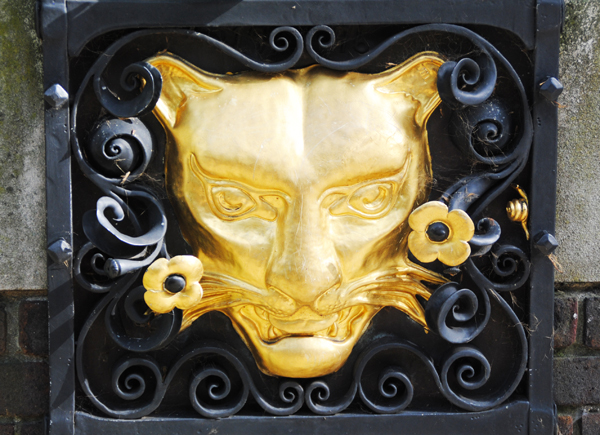
The iron arch, which was commissioned by the Blacksmith’s Company and put here in 1994, features the leopard’s head which is the hallmark of the Goldsmiths’ Company Assay Office, the premier hallmark in the UK (the term hallmark dates from the 15th century when London craftsmen were first required to bring their creations to the Goldsmiths’ Hall for verification and marking although the mark of the leopard’s head has been in use since the early 1300s).

For more on the Goldsmiths, see www.thegoldsmiths.co.uk.

Where is it? #20

The latest in the series in which we ask you to identify where in London this picture was taken and what it’s of. If you think you can identify this picture, leave a comment below. We’ll reveal the answer early next week. Good luck!

Yes, as was guessed, this is indeed Little Ben, a miniature clock tower which usually stands on a traffic island at the junction of Vauxhall Bridge Road and Victoria Street, close to Victoria Underground Station (it has been temporarily removed while upgrade works are being carried out at Victoria Station).

The 30 foot/nine metre high cast iron tower, designed as a smaller version of the Houses of Parliament Clock Tower, affectionately referred to as Big Ben, which lies at the other end of Victoria Street, was the work of Croydon-based clockmakers Gillett & Johnson in 1892.

The clocktower was removed in 1964 when roadworks were being carried out but, following a restoration, was put back close to its original location in 1981 by  Westminster City Council with the financial aid of French oil company Elf Aquitaine UK who intended its return as “a gesture of Franco-British friendship” as well as, so it’s been reported, to mark the wedding of Prince Charles and Lady Diana.

There is a rhyming couplet inscribed on tower, ‘Little Ben’s Apology for Summer Time’: My hands you may retard or may advance, my heart beats true for England as for France. This  refers to the fact the clock is permanently set one hour ahead of Greenwich Mean Time.

Interestingly, there is apparently a fullsize replica of Little Ben erected in Victoria, capital of the Seychelles – it was built to mark Queen Victoria’s Golden Jubilee in 1897.

Where is it? #19

The latest in the series in which we ask you to identify where in London this picture was taken and what it’s of. If you think you can identify this picture, leave a comment below. We’ll reveal the answer early next week. Good luck!

Thanks to those who had a shot at where this was located. It is located at Elephant and Castle, on the busy roundabout where New Kent Road meets St George’s Road, and contains a transformer for the London Underground’s Northern Line which passes underneath.

But more than that, the stainless steel boxlike structure pictured is actually one of London’s more obscure memorials – it commemorates Michael Faraday, the eminent Victorian scientist noted in particular for his contributions to the fields of electromagnetism and electrochemistry.

Erected in 1960-61 not far from where Faraday was born (in the delightfully named Newington Butts), it was designed by the Brutalist architect Rodney Gordon and apparently was originally to feature glass panels so the interior workings of the transformer could be seen but unfortunately this was altered due to the threat posed by vandals.

The monument, which features 728 steel panels, was given Grade II listed building status in 1996, the same year a new lighting scheme was added following a competition by children’s TV show Blue Peter. Plans to move the monument to a new site next to the Faraday Museum in Mayfair have been mooted.

Where is it? #18

The latest in the series in which we ask you to identify where in London this picture was taken and what it’s of. If you think you can identify this picture, leave a comment below. We’ll reveal the answer early next week. Good luck!

Congratulations to Janet Holmes who correctly stated this is the weathervane on top of the cupola Whitechapel Gallery, located in Whitechapel High Street. The weathervane was created by Canadian artist Rodney Graham for the opening of the extended gallery in 2009 when the gallery was expanded to include the former Passmore Edwards Library next door (a weathervane had been planned to top the library’s cupola when it was built in the late 19th century but was never installed). Graham’s weathervane depicts the Renaissance scholar Erasmus sitting backwards on a horse reading a book, In Praise of Folly (there’s a story that this is how Erasmus wrote the book). For more on the gallery, see www.whitechapelgallery.org. Or check out Rodney Graham’s art book, British Weathervanes.

Where is it? #17

The latest in the series in which we ask you to identify where in London this picture was taken and what it’s of. If you think you can identify this picture, leave a comment below. We’ll reveal the answer early next week. Good luck!

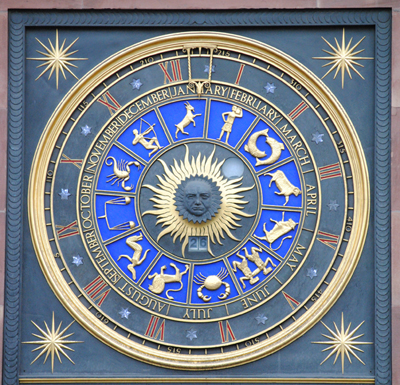
This is an image of the metre wide zodiacal clock on Bracken House on Friday Street. The clock was designed by Frank Dobson and Philip Bentham and, alongside the classical influences on its face, curiously features the image of Winston Churchill’s face at its centre. Churchill was apparently a friend of Bernard Bracken, the former chairman of the Financial Times, after whom the building, which dates from the 1950s, was named. The Financial Times newspaper was published here until the 1989 when it moved to Number One Southwark Bridge. Meanwhile, Bracken House, which was one of the first post-war buildings in the city to be listed, was redeveloped in the early Nineties but retained its original facade.

Where is it? #16

The latest in the series in which we ask you to identify where in London this picture was taken and what it’s of (or in this case who is the person named?). If you think you can identify this picture, leave a comment below. We’ll reveal the answer early next week. Good luck!

Thanks to those who had a guess at where and what this was and congratulations to Janet for correctly stating that it is located in Finsbury Avenue Square in the City of London’s Broadgate development. The group of bronze figures, located in front of the UBS building, dates from the 1980s and is the work of US sculptor George Segal. It is called Rush Hour and depicts office workers making the grim daily march to the office (or away from it!).

Where is it? #15

The latest in the series in which we ask you to identify where in London this picture was taken and what it’s of (or in this case who is the person named?). If you reckon you know the answer, leave a comment below. We’ll reveal the answer early next week. Good luck!

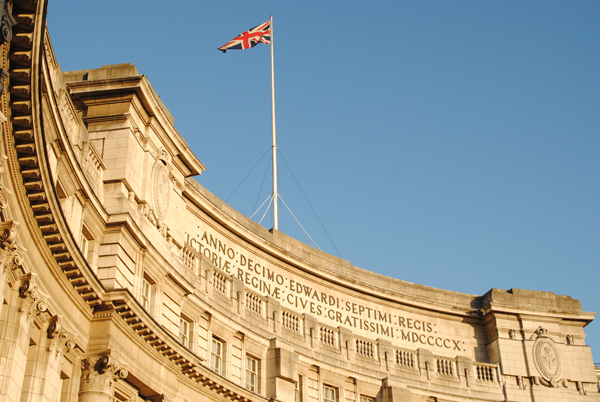
Of course, as those below noted, this is Admiralty Arch, an ornate archway which stands between The Mall and Trafalgar Square. Commissioned by King Edward VII to honor the memory of his mother, Queen Victoria, it was designed by Sir Aston Webb and completed in 1912. Named for the fact that it joins the Old Admiralty Buildings in Whitehall, the structure contains office space and up until last year were occupied by the Cabinet Office. It is currently on the market with a reported price tag of £75 million. Mooted future uses include it being transformed into a swanky hotel.

Where is it? #14

The latest in the series in which we ask you to identify where in London this picture was taken and what it’s of (or in this case who is the person named?). If you reckon you know the answer, leave a comment below. We’ll reveal the answer early next week. Good luck!

And the answer is…Congratulations to Janet Holmes who correctly named this as the grave of Granville Sharp, slavery abolitionist, located in the graveyard of All Saints Church, Fulham, in Fulham High Street close to Putney Bridge. Sharp was a driving force behind the London Committee of the Society for Effecting the Abolition of the Slave Trade and is also considered one of the founders of the African nation of Sierra Leone, thanks to his at first ill-fated work in helping former slaves to settle in the region the country now encompasses. The now Grade II listed grave monument was restored as part of celebrations marking the 200th anniversary of Britain’s Slave Trade Act in 2007. Sharp is buried with his brother and sister. For more on the church, see www.allsaints-fulham.org.uk.

Where is it? #13

The latest in the series in which we ask you to identify where in London this picture was taken and what it’s of. If you reckon you know the answer, leave a comment below. We’ll reveal the answer early next week. Good luck!

And the answer is…This winged figure is that of Victory, who supported by Courage and Constancy, looks ready to launch herself off the top of the Queen Victoria Memorial outside Buckingham Palace.

The memorial was unveiled in 1911 by Victoria’s grandson, King George V. It was designed by architect Sir Aston Webb and sculpted by Sir Thomas Brock, and, below the gilded figure of Victory, features a seated statue of the queen looking down the ceremonial road known as The Mall.

The monument also features numerous other sculptures representing everything from Truth and Justice to Manufacture and Agriculture.

Recommended reading: For some great walks around London’s monuments, you can’t go past Rupert Hill’s, Walking London’s Statues and Monuments.

Where is it? #12

The latest in the series in which we ask you to identify where in London this picture was taken and what it’s of. If you reckon you know the answer, leave a comment below. We’ll reveal the answer early next week. Good luck!

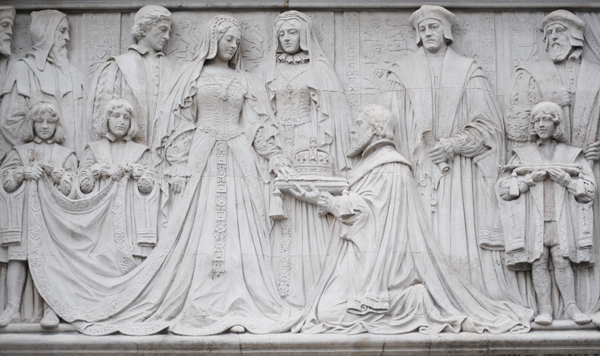
And the answer is…this is part of the decorative facade of the Middlesex Guildhall which stands opposite the Houses of Parliament in Parliament Square. The building, which dates from 1912-13 and stands on the former site of the Westminster Abbey Sanctuary Tower and Old Belfry (where fugitives from the law could seek sanctuary), is now home to the Supreme Court and the Judicial Committee of the Privy Council.

Designed by architect James Gibson, it is the latest in a series of buildings which stood on the site which have served as courthouses and the headquarters of the Middlesex County Council (the first Middlesex Guildhall was built here in 1889). Described by Nikolaus Pevsner as “art nouveau Gothic”, it features a series of medieval-looking decorative friezes and sculptures by Henry Charles Fehr.

The image pictured above shows one of the friezes – this one of the Duke of Northumberland offering the ill-fated Lady Jane Grey the Crown (known as the “Nine Days Queen”, she was later imprisoned and eventually executed on 12th February, 1554). Others show King John handing the Magna Carta to the English barons and the granting of the charter of Westminster Abbey.

It was refurbished for use of the Supreme Court in 2007 and the court has occupied it since its creation in 2009.

Interestingly, according to Ed Glinert of The London Compendium, it was here that courts martial were held of those suspected of giving aid to the enemy during World War I.

Where is it? #11

The eleventh in the series in which we ask you to identify where in London this picture was taken and what it’s of (this week, we’ll give you a clue – this weekend is Remembrance Sunday!). If you reckon you know the answer, leave a comment below. We’ll reveal the answer early next week. Good luck!

Seems this one had people stumped. This mythical beast stands on top of a monument built to honor the Chindits outside the Ministry of Defence in Whitehall, near the corner of Victoria Embankment and Richmond Terrace. It commemorates all those who fought in Burma in 1943 and 1944 with the Chindit Special Forces. The Chindits were an allied Special Force – consisting of soldiers from the UK, Burma, Hong Kong, India, Nepal, West Africa and the US – and were formed under the command of Major General Orde Wingate to fight behind Japanese lines, relying on airdrops for their supplies. The mythical beast is a Chinthe, a guardian of Burmese temples, from which the group derived their name. The memorial was unveiled in 1990. For more on the Chindits and the role they played, see www.chindits.info.

Where is it? #10

The tenth in the series in which we ask you to identify where in London this picture was taken and what it’s of. If you reckon you know the answer, leave a comment below. We’ll reveal the answer early next week. Good luck!

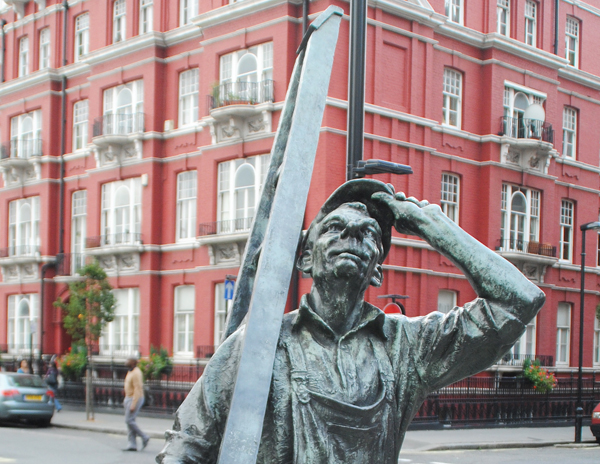
Congrats to Janet Holmes – this statue/sculpture is indeed opposite the Edgware Road Underground Station, standing at the corner of Chapel and Cabbell Streets in Marylebone. Called The Window Cleaner, it is the work of Allan Sly. Created in 1990, it was designed, according to Allan’s video on it, to evoke a “wry sense” – the window cleaner is looking up at the huge glass building, Capital House, which stands on the corner. Sly is a senior lecturer at the Wimbledon College of Art and a fellow of the Royal Society of British Sculptors and has created numerous works located around the UK including the The Spirit of Cricket, located in Hastings, and The Pearl Diver, located on a cruise ship.For more on Sly’s work, see www.allansly.co.uk.

Where is it? #9


The ninth in the series in which we ask you to identify where in London this picture was taken and what it’s of. If you reckon you know the answer, leave a comment below. We’ll reveal the answer early next week. Good luck!

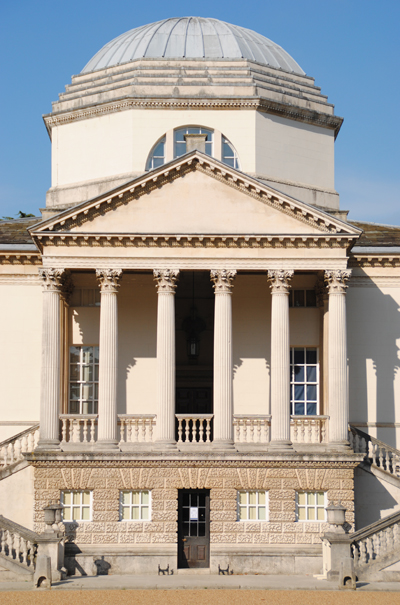
Yes, as it seems everyone knew (well done Joe from Kew, Mike Paterson, and Gillian Blackman on Facebook) this is an image of Chiswick House, a magnificent example of Palladian architecture in London’s west. Inspired after a Grand Tour of Italy and Greece (and by the work of the Italian Renaissance architect Andrea Palladio), the home was built by the 3rd Duke of Burlington and completed in 1729. It wasn’t designed as a residence but as a grand villa where the Duke could show off his extensive art collection and entertain friends. We’ll be taking a more detailed look in the house and gardens in a future post. In the meantime, you can follow this link for more.

Where is it? #8

This is the eighth in our series in which we ask you to identify where in London this picture was taken and what it’s of. If you reckon you know the answer, leave a comment below. We’ll reveal the answer early next week. Good luck!

And the answer is…that this is an image of one of the signs which project hang in Lombard Street in the City. Named for the Italian bankers who once occupied it, Lombard Street contains numerous signs once used to advertise the services of various banking institutions. The signs were banished by King Charles II after the Restoration but was revived in honor of the coronation of King Edward VII in 1902.

Where is it? #7

This is the seventh in our series in which we ask you to identify where in London this picture was taken and what it’s of. If you reckon you know the answer, leave a comment below. We’ll reveal the answer early next week. Good luck!

No takers this week (are we making them too hard?) The answer is that this is the steeple of the St Marylebone Parish Church near Regent’s Park. Consecrated in 1817 and designed by Thomas Hardwick (a clerk of works to King George III), it was built after the previous church on the site had become too small. Among the many famous people the church has associations with are the poets Robert Browning and Elizabeth Barrett – they were married here in 1846, Elizabethan philosopher Francis Bacon – he was married in one of the previous churches in 1606, and Lord Byron – he was christened in the previous church in 1778. The church is also depicted in the marriage scene in William Hogarth’s The Rake’s Progress. For more on the origins of the word Marylebone, see our previous entry here

Where is it? #6

This is the sixth in our series in which we ask you to identify where in London this picture was taken and who it’s of. If you reckon you know the answer, leave a comment below. We’ll reveal the answer early next week. Good luck!

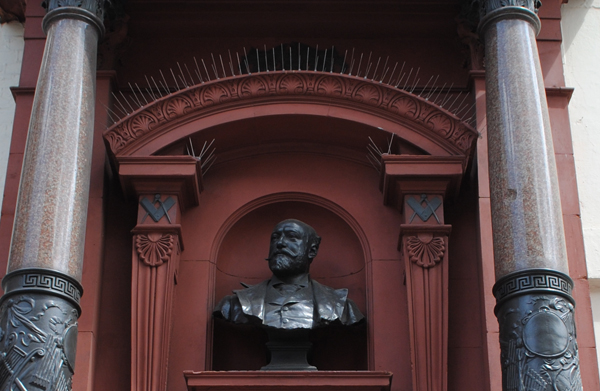
And the answer is…This is actually a bust of journalist and MP Tom O’Connor (1848-1929) and is located on the wall of Chronicle House, 72-78 Fleet Street. O’Connor worked on papers including the Daily Telegraph and the New York Herald (where he was London correspondant) after moving to London from Ireland. He was later known for his parliamentary sketches published in the Pall Mall Gazette and for founding several newspapers. O’Connor, although perhaps best remembered as a journalist, was also an MP – most famously for Liverpool (he was the only Irish Nationalist Party MP ever to sit in a constituency outside of Ireland), a position he held from 1885 until his death in 1929. The inscription underneath his bust reads: “His pen could lay bare the bones of a book or the soul of a statesman in a few vivid lines.”

Where is it? #5

This is the fifth in our series in which we ask you to identify where in London this picture was taken and what it’s of. If you reckon you know the answer, leave a comment below. We’ll reveal the answer early next week. Good luck!

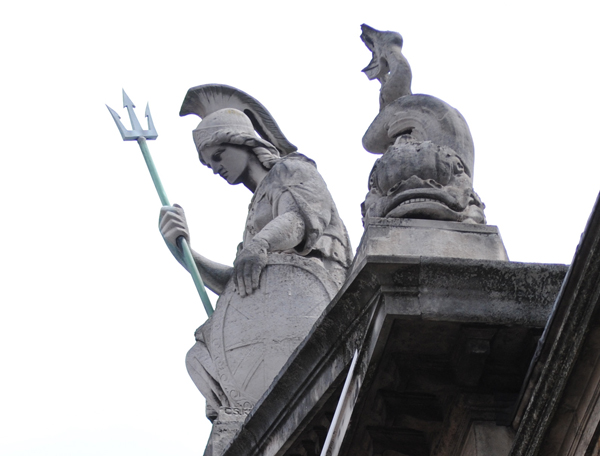
Thanks to all those who took a look at our Where is It? for last week and for those who hazarded a guess as to where it may be. There were no correct answers – the picture is actually of part of Old Billingsgate Fish Market down on Lower Thames Street (the fish and statue of Poseidon being clues!). While there has been a market on the site for centuries, it only became particularly associated with fish in the 1500s and the first purpose-built market was constructed on the site as late as 1850. Not up to the job, however, it was demolished and a new building, designed by then City Architect Sir Horace Jones, was built upon the site and opened in 1876. In 1982, the market was relocated to Canary Wharf in the Docklands where it still operates today as the UK’s largest inland fish market.

Where is it? #4

This is the fourth in our series in which we ask you to identify where in London this picture was taken and what it’s of. If you reckon you know the answer, leave a comment below. We’ll reveal the answer early next week. Good luck!

And the answer is…that the picture shows a publicly-funded memorial to Sir Augustus Henry Glossop Harris, a former manager of the Theatre Royal Drury Lane, located outside the theatre itself. Harris, who bore the nickname “the father of modern pantomime”, co-wrote and produced many productions and was also a member of the London County Council as well as a sheriff.

Where is It? #3

This is the third in our series in which we ask you to identify where in London this picture was taken and what it’s of. If you reckon you know the answer, leave a comment below. We’ll reveal the answer early next week. Good luck!

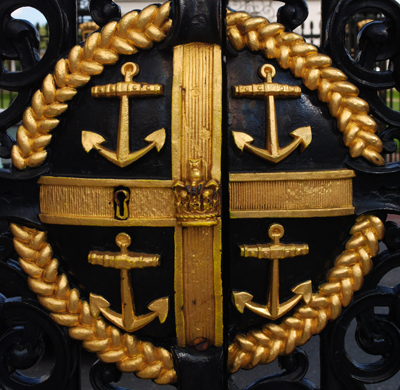
Apologies for the delay in getting this answer to you (Exploring London has been on a summer break!). But if you’ve been wondering, the answer is that the picture shows a lock detail from one of the gates leading into the old Royal Naval College at Greenwich – the anchors were a clue! Congrats to Ian who guessed the location was near the Queen’s House (contained within the former Royal Naval College). Click here if you’re interested in reading our previous entry about the former Royal Naval College and Sir Christopher Wren’s role in its design.

Where is it? #2…

This is the second of our series in which we ask you to identify where in London this picture was taken and what it’s of. If you reckon you know the answer, leave a comment below. We’ll reveal the answer on Monday.

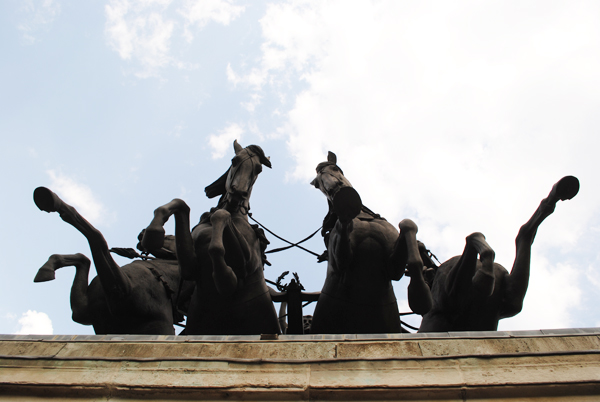
Obviously, this one was too easy – yes, it is the top of Wellington Arch at Hyde Park Corner. The Decimus Burton-designed arch, which dates from 1826-30 and was initially known as the Green Park Arch, was built to commemorate Britain’s victory over Napoleon.

In 1846, it was adorned with a controversial giant statue of the Duke of Wellington on horseback but in 1883, when the arch had to be moved from its initial position parallel to the Hyde Park Screen to where it now stands to accommodate increased road traffic, the statue was removed to Aldershot (where it still stands) and not replaced.

In 1912, thanks to the support of King Edward VII (initially as Prince of Wales), the space was occupied with Adrian Jones’ sculpture of four horses pulling a chariot (known as a quadriga) driven by a boy with a winged figure representing peace standing behind him. It remains to this day.

Congrats to Hazel Edmunds who was the first to guess it on Exploring London and Sarah Goldsworthy, who was the first on Facebook. Honorable mention to Mike Paterson who also guessed it.

We’ve decided to make this a weekly feature – have a look for the next challenge on Friday afternoon!