Members of the Household Division in London rehearse for the King’s Birthday Parade, known as Trooping the Colour. The Colonel’s Review is held one week before and saw some 250 musicians, 20 pipers, 240 military working horses, and almost 1,000 dual role soldiers of the British Army’s Household Division run through their paces on Saturday. Trooping the Colour will take place on 15th June.
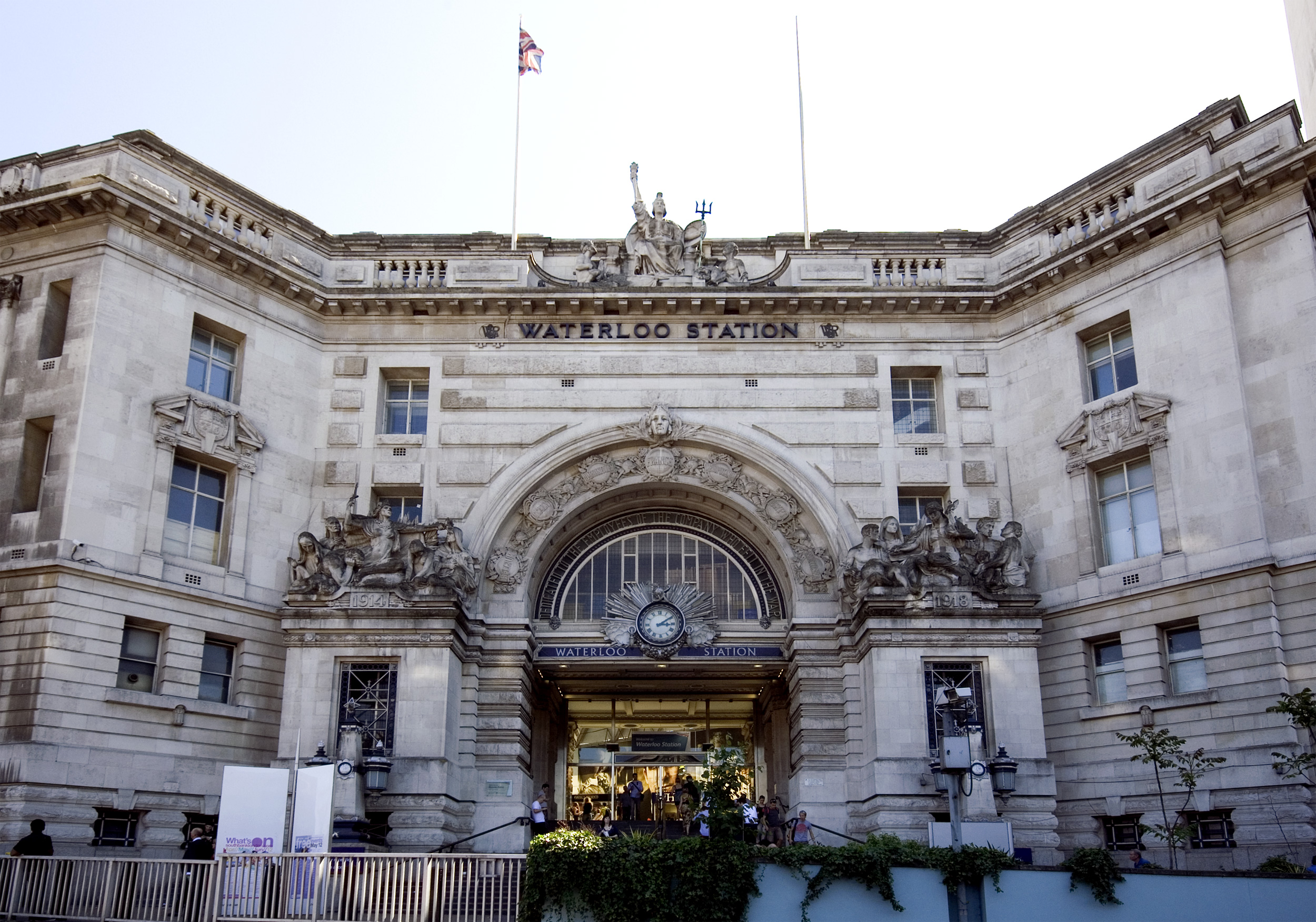
Sitting over the main entrance to Waterloo Station is a Victory Arch which commemorates railway personnel who died in World War I and II.
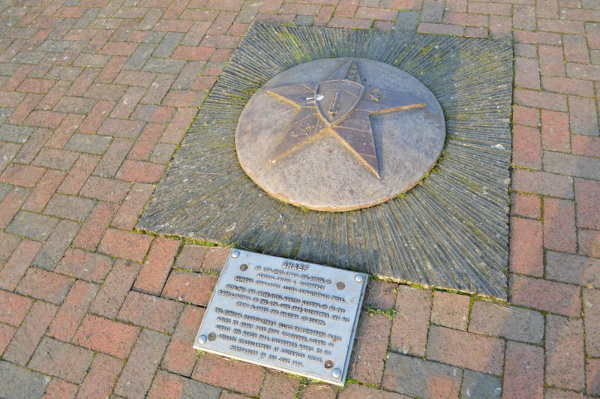
There are several plaques located at the top of the steps under the arch commemorating those who died in the conflicts and among them, particularly notable this week as the world marks the 80th anniversary of D-Day, is one commemorating those who died in the Normandy landings.
The plaque was installed on the 50th anniversary of the landings – 6th June, 1994.
The arch was built as part of a station rebuild in the first couple of decades of the 20th century and added to the design following World War I. The new station was completed in 1922.
The now Grade II-listed memorial, the work of sculptor Charles Whiffen, features two sculptural groups located on either side – one dedicated to Bellona and dated 1914 and the other dedicated to Peace and dated 1918.
Set around a glazed arch are the names of countries where key battles were fought in the conflict and at the centre is a clock set within in a sunburst. Sitting above the arch is a depiction of Britannia holding aloft the torch of liberty.
As well as the D-Day plaque under the arch, a Roll of Honour commemorates the 585 London and South Western Railway employees who lost their lives in World War I. There is also a plaque commemorating the 626 men of the Southern Railway who died in World War II.
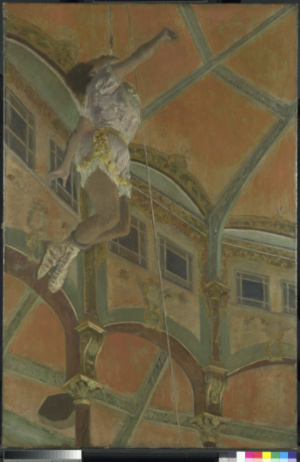
• Edgar Degas’ Miss La La at the Cirque Fernando (1879) takes centre stage in a new free exhibition at The National Gallery. Part of the free ‘Discover’ series of displays, Discover Degas & Miss La La takes a close look at the painting and reveals new information about the sitter, circus artist Miss La La, or Anna Albertine Olga Brown (1858‒1945). The display features new material, from rare, hitherto untraced drawings of her by Degas and entirely unpublished photographic portraits. In the Sunley Room until 1st September. For more, see www.nationalgallery.org.uk.
• Daily life at the Old Royal Naval College has been captured in a series of photographic images now on show at the Greenwich institution.A Year in the Life: People and places of the Old Royal Naval College features 12 images snapped by award-winning photographer Hugh Fox over the past 12 months and includes some portraits of staff show alongside short interviews. Visitors are encouraged to bring their own headphones to better experience the audio-visual display in the Ripley Tunnel. Free to attend, the display can be seen until 1st September. For more, see https://ornc.org/whats-on/.
Send information for inclusion to exploringlondon@gmail.com.
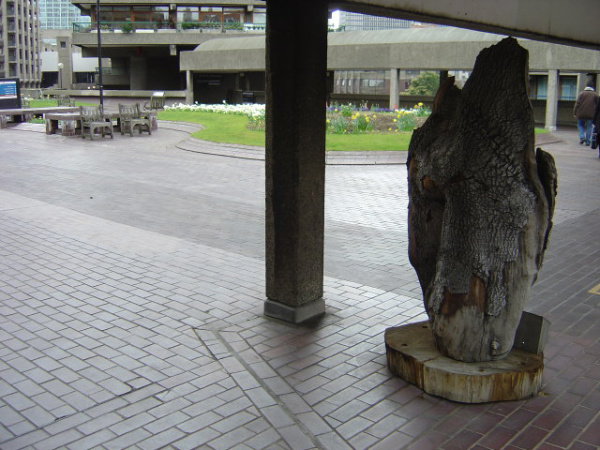
Standing on a Barbican walkway is the remnant of a tree believed to be at least 500-years-old which fell during a storm January, 1990.
The now hollowed-out stub of the beech tree (Fagus Sylvatica) had previously been located in the woodland known as Burnham Beeches, in Buckinghamshire – a woodland which was purchased by the City of London Corporation in 1880.
But what apparently sets this tree out from the others at Burnham Beeches is that it is believed famed German composer Felix Mendelssohn Bartholdy (1808-1847) used to sit under its then leafy branches while staying nearby during his several visits to England.
He is said to have done so to gain inspiration for his compositions and among the works he is said to have composed while here is some “incidental music” for A Midsummer Night’s Dream (although it has been suggested this might not actually be the exact tree under which he sat).
The tree and its plaque were installed in 1993 by the Barbican Horticultural Society and unveiled by conductor and composer Carl Davis.
There is now a replacement “Mendelssohn’s Tree” in Burnham Beeches which was planted in 2005.
WHERE: Barbican, off Aldersgate St (nearest Tube station is Barbican); WHEN: Anytime; COST: Free; WEBSITE: N/A.
A ring-tailed lemur who famously once lived in Eltham Palace, Mah-Jongg was the much-indulged pet of rich-listers Stephen and Virginia Courtauld during the interwar period.
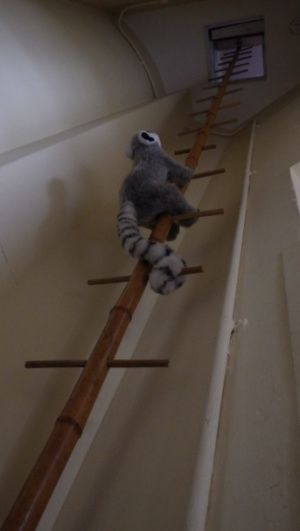
A replica of Mah-Jongg climbs his bamboo ladder at Eltham Palace. PICTURE: BEV Norton (licensed under CC-BY-NC-ND 2.0)
The couple purchased the lemur through Harrod’s then pet department soon after their marriage in 1923. He was immediately christened Mah-Jongg but commonly referred to as “Jongy”.
As well as residing with them in their Grosvenor Square, Mayfair, residence, the lemur also travelled with the Courtaulds.
This included on their luxurious motor yacht, the Virginia, on which he had a specially designed deck chair to lounge in (although Jongy, who had a reputation for being a bit nippy at times, is said to have disgraced himself at a farewell lunch for the British Arctic Air Route Expedition, of which Stephen was a sponsor, when he bit the expedition’s wireless operator, Percy Lemon, and severed an artery; it took Lemon three months to recover).
When the Courtaulds bought Eltham Palace in 1933, Mah-Jongg’s image was incorporated into the building including in a mural in the billiard room and in wooden bosses carved in his likeness in the Great Hall.
Mah-Jongg also had specially designed living quarters on the first floor with a trapdoor opening to a bamboo ladder that led down to the Flower Room on the ground floor. His cage was decorated with Madagascan rainforests by Gertrude Whinfield.
Mah-Jongg died in 1938. A memorial to him was originally installed at Eltham Palace but is now located at the Courthauld’s last home, a replica French villa called La Rochelle, in what is now Zimbabwe.
He’s also famously seen in Leonard Campbell Taylor’s 1934 portrait of the Courthaulds in the music room of their Grosvenor Square home.
The Eisenhower Memorial in Bushy Park. PICTURE: Matt Brown (licensed under CC BY 2.0)
• A new digital exhibition revealing the role Bushy Park played in planning D-Day has gone online ahead of the 80th anniversary of D-Day on 6th June. The exhibition, which is on the Royal Parks website and coincides with new interpretative material at the park itself, features previously unseen archive images of Camp Griffiss which once housed more than 3,000 service personnel. For more, see www.royalparks.org.uk/read-watch-listen/operation-bushy-park-plotting-d-day-royal-park
• Umbrellas lost on London’s trains, Tubes and buses have been transformed into yōkai – a class of supernatural beings and entities that abound in Japanese folklore, literature, art and popular culture – in a new installation at the Young V&A.Lost and Found Yōkai, which features the sounds of supernatural Japan, celebrates Young V&A’s current exhibition, Japan: Myths to Manga and takes visitors on a journey through “Kasa-obake Alley”, where the umbrellas once lost, now dance with life. The installation can be experienced until 1st December which Myths to Manga runs until 8th September. For more, see vam.ac.uk/young.
• On Now: HEROES: The British invasion of American comics. This exhibition at how early American comics such as Buster Brown, Miss Fury and Superman influenced British artists and culture, and then explores how subsequent British comic creations, such as Watchmen and V For Vendetta, were then exported to the US. Highlights include British imitations of American comic strips dating from the 1940s; an exploration of the story behind the 1972 launch of Marvel UK; see rarely-seen full-colour early American comic newspaper pages by RF Outcault, Harold Foster and Alex Raymond; and artwork by key figures from the history of British and American comics, including works by Jack Kirby, Jack Davis and Tarpe Mills. Runs until 19th October. Admission charge applies. For more, see www.cartoonmuseum.org.
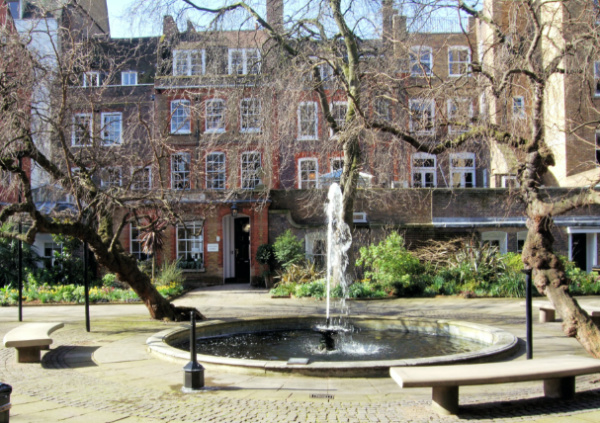
The two gnarled mulberry trees on either side of the fountain. PICTURE: Jim Linwood (licensed under CC BY 2.0)
While there’s been gardens here dating back possibly as far as the middle of the 12th century when the Templars established a preceptory here, these two trees have a more recent historic (and royal) link.
The gnarled black mulberrys (Morus nigra) in the Fountain Court were planted here on 20th June, 1887, to commemorate the Golden Jubilee of Queen Victoria.
There were actually four mulberry trees planted to mark the occasion – which was celebrated with a grand dinner in the nearby Middle Temple Hall – but these two trees are the only survivors, the other two having been removed in the 1970s.
Postcard showing the Empire Stadium. PICTURE: Via Wikipedia/Public Domain
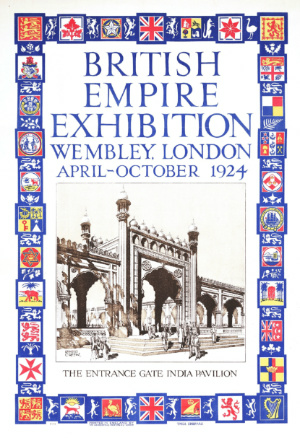
It’s 100 years ago this year that the British Empire Exhibition was held in Wembley Park.
Located on a more than 200 acre site, the exhibition was designed to showcase the diversity and reach of the empire. It ran for two six-month long summer seasons – first opening on 23rd April, 1924, and running until 1st November that year and then reopening on 9th May, 1925, and running until 1st October.
The opening ceremony, which took place on St George’s Day, was attended by King George V and Queen Mary, and the event, in a first for a monarch, was broadcast on BBC radio.
The exhibition, which cost £12 million and attracted some 27 million visitors, featured what was said to be the largest sports arena in the world – Empire Stadium (later known as Wembley Stadium) – as well as four main pavilions dedicated to industry, engineering, the arts and the government, and a series of pavilions for 56 of the empire’s 58 territories as well as some commercial pavilions.
The latter included an Indian pavilion modelled on Jama Masjid in Delhi and the Taj Mahal in Agra, a West African pavilion designed to look like an Arab fort, a Burmese pavilion designed to look like a temple and a Maltese pavilion designed as a fortress with the entrance resembling the famed Mdina Gate.
The Empire Stadium hosted events including military tattoos and Wild West rodeos while other attractions included a lake, a 47 acre fairground, a garden, restaurants and a working replica coal mine.
Star attractions included a replica of King Tutankhamen’s tomb (housed in the fairground), a working model of Niagara Falls and a full-sized sculpture of the Prince of Wales (later Edward VIII) made of butter (both in the Canadian pavilion), a 16 foot diameter ball of wool (Australian pavilion) and dodgem cars (also in the funfair). Queen Mary’s Dollhouse – now housed at Windsor – was designed by Sir Edwin Lutyens and served as a miniature showcase of the finest goods of the period.
Reinforced concrete was the main building material used in its construction, earning it the title of the first “concrete city”. The streets of the exhibition, meanwhile, were named by Rudyard Kipling.
The Malta Pavilion entrance. PICTURE: Wikipedia/Public Domain
Wembley Park Tube station, which had first opened in 1893, was rebuilt for the event and a new station – Exhibition Station (Wembley) added (it was officially closed in 1969).
While many of the buildings were dismantled after the exhibition, some survived for decades afterwards including, of course, the Empire Stadium which became Wembley Stadium and was the home of English football until replaced in 2003.
• The City of London has unveiled a new blue plaque commemorating the Royal National Lifeboat Institution which is this year marking its 200th anniversary. The plaque is on the Furniture Makers’ Hall in Austin Friars which is where the organisation has its first headquarters from 1824 to 1826. The plaque was unveiled by the Lord Mayor of London, Professor Michael Mainelli. The RNLI, which today operates 238 lifeboat stations in the UK and Ireland including four on the River Thames, was founded by Sir William Hillary in the City of London Tavern in Bishopsgate on 4th March, 1824, and early meetings were held at various addresses until it moved into 12 Austin Friars. Meanwhile, ‘Ian Visits’ reports that a new plaque has also been installed at Limehouse Basin to commemorate Lifbåt 416 which was built there by Forrestt & Son’s boatyard in 1868 and sent as a gift to the King of Sweden, Karl XV. The Lifbåt 416, which has been restored, returned to Limehouse Basin this week after attending RNLI commemorations in Poole, Dorset (where it was the oldest lifeboat to take part in a mile-long flotilla).
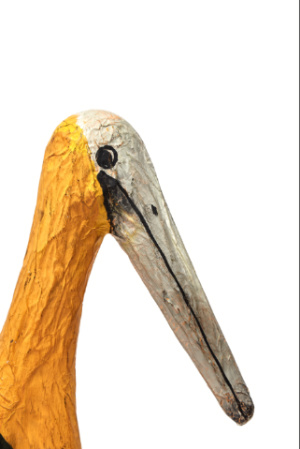
Hargila army papier-mache headdress close up. PICTURE: Courtesy of Natural History Museum
• The “weird and wonderful” ways birds have adapted to survive are celebrated in a new exhibition at the Natural History Museum. Birds: Brilliant and Bizarre, which opens at the South Kensington institution on Friday, has been created in partnership with the Royal Society for the Protection of Birds and features installations and hands-on exhibits which allow visitors to feel how fast a hummingbird’s heart beats when in flight, smell the strange oil one bird uses to protect its eggs and listen to the sound of a dawn chorus of birds in the year 2050. Objects on show include the ‘Wonderchicken’ – the oldest known fossil of a modern bird, a replica of a stork that flew across the world from the African continent with a spear lodged in its neck, and a headdress of the ‘Hargila army’ (pictured), a group of women in the Indian state of Assam who work to protect one of the world’s rarest storks. Admission charge applies. Runs until 5th January. For more, see www.nhm.ac.uk/visit/exhibitions/birds-brilliant-bizarre.html.
• A walk-through photographic exhibition featuring some of the most iconic photos of Princess Diana opens on Saturday.Princess Diana: Accredited Access features 75 life-sized photographs by her official royal photographer, Anwar Hussein, and his two sons – Samir and Zak – which include behind the scenes access. The exhibition at the Dockside Vaults, St Katharine Docks, runs until 2nd September. Admission charge applies. For more, see www.princessdianaexhibit.com.
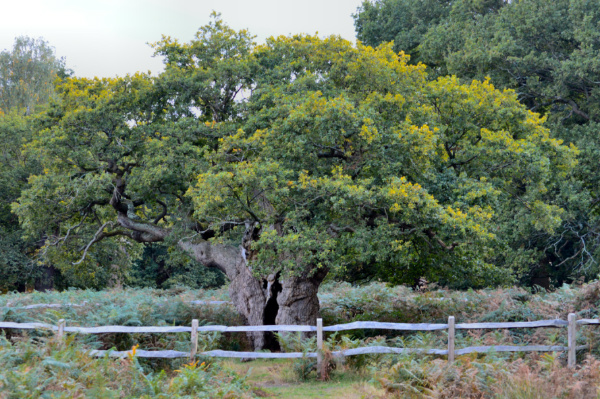
Estimated to be more than 750-years-old, the tree known as the Royal Oak is located near Pen Ponds and Richmond Gate.
This massive English oak (Quercus robur), which is hollow, doesn’t have any direct connections to royalty but it did survive the felling of trees which took place in Richmond Park and across the south-east of England so King Henry VIII’s navy could be built.
That may have been thanks to the King himself, who wisely passed a law to spare every 10th tree in the park for future seed.
While the park had been used by King Henry VIII as a hunting ground, it wasn’t until 1637 – during the reign of King Charles I – that it was first enclosed.
The tree, which is said to be one of 1,400 “veteran trees” in the park, was pollarded for several hundred years which helped create its shape – this is a method of pruning which removes the top-most branches to form a denser head (and creates wood which can be used for a variety of purposes).
View of Castletown Road in Barons Court. PICTURE: Courtesy of Google Maps
This district in west London doesn’t have anything to do with any particular baron but rather was named Barons Court by the late 19th century developer Sir William Palliser.
It apparently refers to the Court Baron, a form of manorial court which could be held in medieval times by any Lord of the Manor and is perhaps a nod to nearby Earl’s Court. It’s said by some that it may also be a reference to the Baronscourt estate in County Tyrone, Northern Ireland, where Sir William possibly had connections.
Many of the street names refer to members of the Palliser family or estates and the district, which lies between West Kensington and Hammersmith, features a Tube station which opened in 1905.
Barons Court did suffer bomb damage during World War II.
Landmarks include the London Academy of Music and Dramatic Art (LAMDA), housed in what was formerly a ballet school on Talgarth Road, the Queen’s Club tennis club, and the Margravine or Hammersmith Cemetery, which, laid out by architect George Saunders, opened in 1868.
• Royal portrait photography, from the 1920s through to today, is the subject of a new exhibition opening at the King’s Gallery at Buckingham Palace on Friday. Royal Portraits: A Century of Photography features more than 50 photographic prints, proofs and documents from the Royal Collection and the Royal Archives. Among the royal photographers whose work is on show are everyone from Cecil Beaton and Dorothy Wilding to Annie Lebovitz and Rankin as well as Lord Snowdon (born Antony Armstrong-Jones). Highlights include Beaton’s 1939 shoot featuring Queen Elizabeth, The Queen Mother, in Buckingham Palace Gardens dressed in her “White Wardrobe” by Norman Hartnell, and his original coronation portraits of Queen Elizabeth II. Admission charge applies. Runs until 6th October. For more, head here.
• More than 300 prints from the private photographic collection of Sir Elton John and David Furnish got on display at the V&A from Saturday.Fragile Beauty: Photographs from the Sir Elton John and David Furnish Collection will showcase the work of more than 140 photographers and the V&A’s largest temporary exhibition of photography to date. Photographers include everyone from Robert Mapplethorpe, Cindy Sherman, and William Eggleston to Diane Arbus, Sally Mann, Zanele Muholi, Ai Weiwei and Carrie Mae Weems and the subjects explored include fashion, reportage, celebrity, the male body, and American photography. Portraits of Marilyn Monroe, Miles Davis, and Chet Baker are among the highlights. Runs until 5th January in The Sainsbury Gallery. Admission charge applies. For more, see www.vam.ac.uk.
• An exhibition focusing on the path women have taken to being recognised as professional artists opens today at Tate Britain.Now You See Us:Women Artists in Britain 1520-1920 features more than 200 works, including oil painting, watercolour, pastel, sculpture, photography and ‘needlepainting’, created by more than 100 artists including Artemisia Gentileschi, Angelica Kauffman, Julia Margaret Cameron and Gwen John. Highlights include Tudor miniatures by Levina Teerlinc, Gentileschi’s Susanna and the Elders (1638-40), the work of 18th century needlewoman Mary Linwood, Elizabeth Butler (née Thompson)’sTheRoll Call (1874), and, the work of Laura Knight and Ethel Walker, who, on the 120th century achieved critical acclaim and membership of the Royal Academy. Runs until 13th October. Admission charge applies. Head to tate.org.uk.
Danson Mansion and the Charter Oak of Bexley. PICTURE: Brian Toward (Public Domain)
Located in Danson Park in Bexley, south-east London, this tree is another of those in London which has been awarded “Great Tree” status.
Estimated to be around 200-years-old, it was planted in what was originally the grounds of the Danson Mansion Estate.
Danson House, a Palladian villa, was built by Sir John Boyd in 1766 for his second wife Catherine Chapone and designed by Sir Robert Taylor, the architect who also designed the Bank of England.
The Charter Oak of Bexley’s name comes from the charter which changed Bexley from a Urban District Council to the Borough of Bexley. It was presented to the first municipal council by Lord Cornwallis underneath the oak in 1937.
The Charter Oak of Bexley in 2011. PICTURE: Brian Toward (Public Domain)
The oak’s significance is underlined by its presence on the Borough of Bexley’s coat-of-arms.
Visibly deteriorating, in 2017, “revolutionary geo-injector technology” was used to decompact the soil around the tree and feed its roots, successfully extending the tree’s life.
Greater London, which includes the former county of Middlesex and parts of what were Surrey, Kent, Essex and Hertfordshire, is governed by 32 local authorities – boroughs – as well as the City of London itself.
The Crystal Building in Newham, seat of the Greater London Authority. PICTURE: Matt Buck (licensed under CC BY-SA 2.0)
Overarching these is the Greater London Authority, which consists of two branches – the Mayor of London (currently Sadiq Khan), who has executive powers, and the 25 member London Assembly who, as well as the mayor, are elected.
The Greater London Authority is now headquartered at City Hall in Newham, having moved there from City Hall in Southwark at the end of 2021.
The London boroughs, which were all created on 1st April, 1965, include three “Royal boroughs” – that of Greenwich, Kensington and Chelsea, and, Kingston upon Thames (more on them in a future post).
The boroughs are administered by councils who are elected every four years.
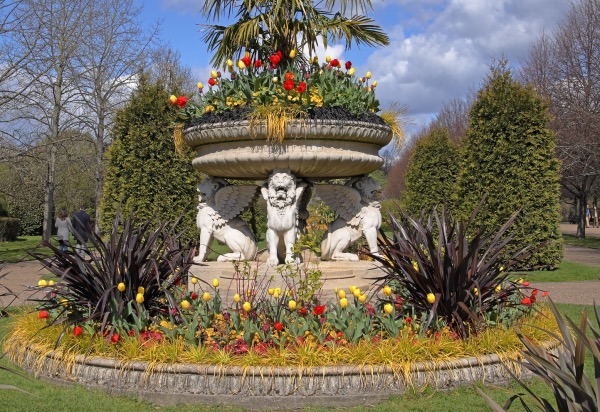
Located in The Regent’s Park, this circular stone planter – often called the ‘Lion Vase’ – dates from the 1860s.
The vase (‘tazza’ just means ‘vase’), which features a circular bowl sitting atop four winged lions or griffins, was designed by Austin and Seeley out of artificial stone.
It was installed as the centrepiece of the Italian Gardens by their designer, William Andrews Nesfield, in 1863.
The vase – which is one of about 30 stone vases in the Avenue Gardens – was restored in the mid-1990s.
WHERE: The Griffin Tazza, The Avenue Gardens, The Regent’s Park (nearest Tube stations are Regent’s Park and Great Portland Street); WHEN: 5am to 9:30pm daily; COST: Free: WEBSITE: www.royalparks.org.uk/visit/parks/regents-park-primrose-hill
• See a glimpse of London as it was during the Victorian era at a new exhibition opening at the London Metropolitan Archives.Lost Victorian City: a London disappeared features photographs, prints, watercolours and documents depicting buildings, horse-drawn transport, docks and various forms of entertainment along with artists’ views of the capital. Highlights include images taken in 1875 by the Society for Photographing Relics of Old London of the 17th century coaching inn, the Oxford Arms, which was demolished two years later, two images by Philip Henry Delamotte showing the moving of the Crystal Palace from Hyde Park to Sydenham following the Great Exhibition of 1851, and a photograph showing the public disinfects whose job was to remove all textiles after an infectious disease outbreak. The display can be seen at the Clerkenwell-based archives until 5th February next year. For more, see
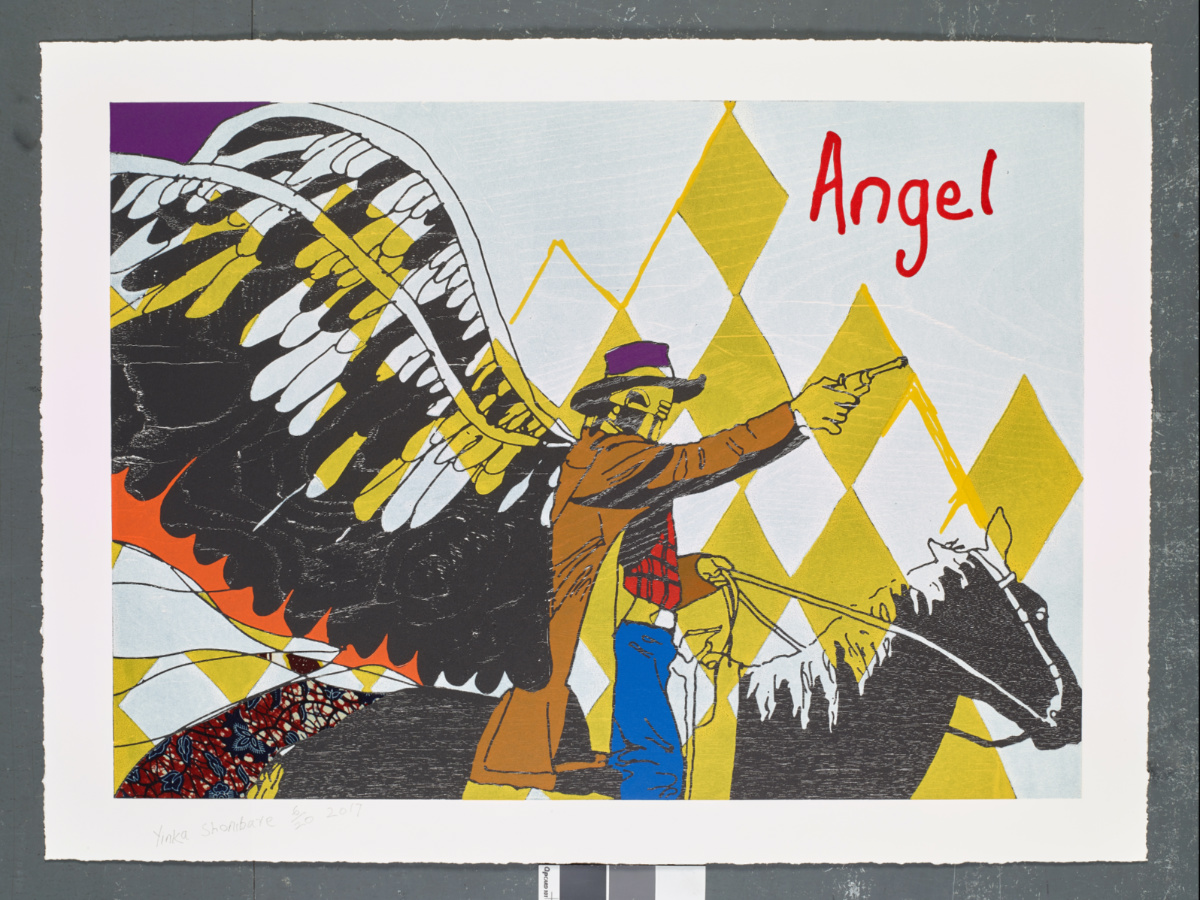
Yinka Shonibare CBE, Cowboy Angel V from the series Cowboy Angels. Colour woodcut and collage of Dutch wax batik fabric. Reproduced by permission of the artist.
• An exhibition has opened featuring works of art acquired by the British Museum over the past two decades including works by David Hockney, Damien Hirst, Julian Opie, Yinka Shonibare and Cornelia Parker. Contemporary collecting: David Hockney to Cornelia Parker features around 100 works acquired since 2001. Many of the works, which span the period from the 1960s onwards, are being exhibited for the first time. Highlights include Hockney’s prints The Marriage (1962) and Henry Seated with Tulips (1976), Parker’s Articles of Glass and Jug Full of Ice from One Day This Glass Will Break (2015), Michael Craig-Martin’s Coathanger, Light bulb and Watch from Drawings (2015); Caroline Walker’s colour lithograph Bathed (2018); Shonibare’s colour woodcuts Cowboy Angel I, II, V (2017) and Joy Gerrard’s Vigil/Protest (Westminster 14th March 2021), a 2023 drawing in Japanese ink. Runs until 29th September in Room 90. Admission is free. For more, see www.britishmuseum.org/david-hockney-cornelia-parker.
Said to be among the oldest still living trees in the City of London, the Cheapside Plane stands in what was once the churchyard of St Peter Cheap.
The church itself was destroyed in the Great Fire of London but how long this leafy tree, which stands more than 70 feet high, has occupied the site remains a matter of some conjecture.
A City of London tree trail puts the age of the tree – which stands at the corner of Wood Street and Cheapside – at 250 years (records held by the City say the tree was originally purchased for sixpence).
Over the years, this landmark tree – which has stood silent witness to everything from the 1854 cholera outbreak to the bombs of the Blitz – has garnered considerable attention appearing in various media, such as the Illustrated London News, and even, so say some, a 1797 poem by William Wordsworth (although some say the poem doesn’t refer to the tree at all).
The tree, which stands behind protective black iron railing, is the only one in the City of London listed among the “Great Trees of London” and planning laws protect it from over-development of the surrounding buildings.









 Exploring London


