4. 10 historic London homes that are now museums…2. Carlyle’s House…
10 most popular (new) posts for 2023 – Numbers 6 and 5…
10 most popular (new) posts for 2023 – Numbers 8 and 7…
10 most popular (new) posts for 2023 – Numbers 10 and 9…
And so we come to our annual countdown of our most read new posts for 2023 (although the data is indicative only of posts looked at on their own page (and not on the homepage). But, with that caveat, we commence the countdown…
10. 10 historic vessels in London’s Thames…1. PS Tattershall Castle…
Have a Merry Christmas!
Wishing you a safe and happy Christmas and New Year.
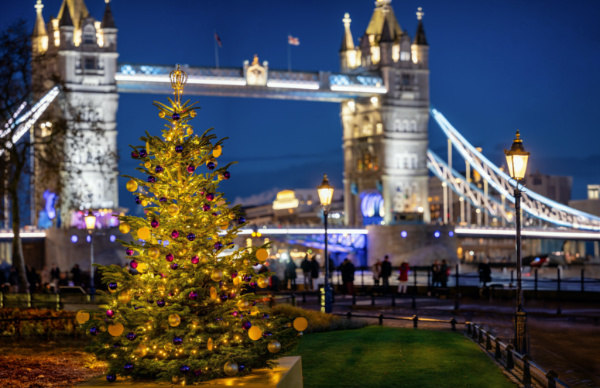
Keep an eye out for our annual countdown of the most popular posts for 2023 next week!
10 London locations related to Sir Christopher Wren – A recap…
We finish our series on Christopher Wren by providing a quick recap…
1. The Old Court House, Hampton Court Palace Green…
9. St James’s Street, Piccadilly…
We’ll start a new series in the New Year!
LondonLife – St Pancras ‘book tree’…

A Christmas tree with a difference, this year’s festive display at St Pancras International features a 12 metre high ‘book tree’ with a winding staircase and 270 shelves adorned with over 3,800 hand-painted books, including classics like Charles Dickens’ A Christmas Carol and CS Lewis’ The Lion, The Witch, and the Wardrobe. There’s also a series of nooks where passerby can ensconce themselves and listen to a five minute excerpt from an audio book. The display is the result of a collaboration with bookseller Hatchards.
A Moment in London’s history – The first Selfridges Christmas windows display…
Oxford Street department store Selfridges is known for many firsts and among them is that it was the first department store in the UK to have window displays for Christmas.
It was in 1909, having opened the store in March that year, that American Harry Gordon Selfridge, drawing on his experience in the states where Macy’s in New York had featured Christmas window displays since the 1870s, decided to illuminate the display windows at his store in a bid to allow passersby to see the goods on display.

The windows were just one of the many innovations aimed at celebrating Christmas Selfridge – who is credited with having been the first to use the line “only (x) number of shopping days till Christmas” while working at Marshall Field’s in Chicago – embraced in the store.
Christmas displays were said to almost cover an entire floor and there were mince pies for customers, a chance to visit with Santa Claus, and a gift advice service as well as men-only tours of the store to help them with buying gifts for the females in their lives.
This year’s Christmas display at Selfridges was created around the theme of ‘showtime’ and reportedly took 100 hours to put together. It features characters including Santa Claus and the elves in a workshop.
This Week in London – Time to get your skates on…
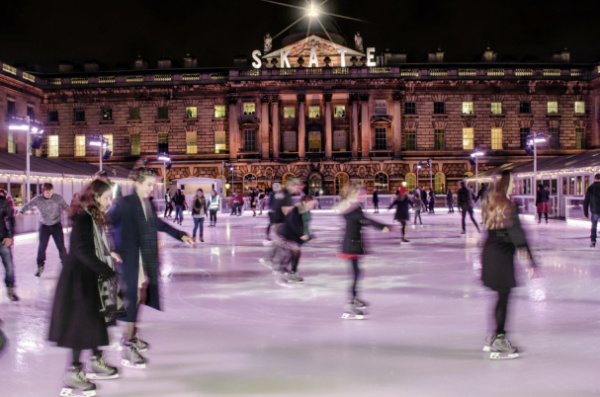
It’s ice-skating time in London – here’s some of the most spectacular rinks:
• Skate at Somerset House transforms the palace’s spectacular courtyard with a backdrop provided by Switzerland Tourism. There’s a 40 foot tall Christmas tree and a host of experiences to take part in, including the Skate School, featuring coaching sessions with National Ice Skate Association (NISA) instructors, a Kid’s Club and Chilled Out sessions as well as Skate Lates. Runs until 14th January. For more, see somersethouse.org.uk/whats-on/skate-somerset-house.
• Hampton Court Palace Ice Rink features the chance to skate with stunning views of the Tudor palace as a backdrop. There’s also festive refreshments available from the onsite café and bar. Open until 7th January. For more, see www.hrp.org.uk/hampton-court-palace/whats-on/hampton-court-palace-ice-rink/#gs.24q96i.
• The Queen’s House Ice Rink is set outside the historic Queen’s House in Greenwich with views of the Old Royal Naval College. There’s special sessions for young ones and relaxed sessions for those after a calmer environment. The Benugo café is located next to the rink. Open until 7th January. For more, see www.rmg.co.uk/queens-house/attractions/queens-house-ice-rink.
• The UK’s largest open air ice rink, the Ice Rink at Hyde Park Winter Wonderland, is set under a canopy of lights and centred around a Victorian bandstand. There’s live entertainment on selected dates. Runs until 1st January. For more, see https://hydeparkwinterwonderland.com/things-to-do/ice-skating/.
• Set in Canada Park Square, the Ice Rink Canary Wharf spans 1275 square metres. Wednesday nights feature DJs and on the 20th December, there’s an ‘Ultimate Christmas Party on Ice’. The rink stays open until 24th February. For more, see https://icerinkcanarywharf.co.uk.
10 London locations related to Sir Christopher Wren…10. St Paul’s Cathedral…
For the final entry in our Wednesday special series, we go to see Sir Christopher Wren’s greatest work – and also his resting place, St Paul’s Cathedral.
Following his death on 25th February, 1723, Wren was buried in the crypt of St Paul’s Cathedral on 5th March.
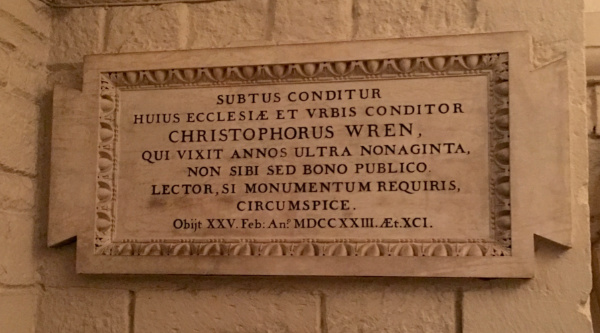
His burial location was in the south-east corner of the crypt and a simple memorial was placed there near that of his daughter Jane and his sister Susan Holder and her husband William.
The plaque which marks the location was written by his eldest son Christopher. Inscribed in Latin, it reads: “Here in its foundations lies the architect of this church and city, Christopher Wren, who lived beyond ninety years, not for his own profit but for the public good. Reader, if you seek his monument – look around you. Died 25 Feb. 1723, age 91.”
It’s a fitting tribute to one responsible for some of London’s most famous landmarks.
Interestingly, a fragment of Wren’s coffin can be seen at the RIBA Library. It was taken from his tomb in 1851 when it was last opened to allow for his last surviving direct descendent to be placed within.
WHERE: St Paul’s Cathedral (nearest Tube stations are St Paul’s, Mansion House and Blackfriars); WHEN: 8.30am to 4.30pm Monday to Saturday; COST: £23 adults/£20.50 concessions/£10 children/£56 family (these are walk-up rates – online advanced and group rates are discounted); WEBSITE: www.stpauls.co.uk.
London Explained – Freedom of the City of London…
On 1st December this year – World AIDS Day, four leading figures from two major HIV charities – Richard Angell, chief executive of Terrence Higgins Trust, and colleagues Dominic Edwardes and Barbara Tinubu, and Mark Santos, executive director of Positive East – were awarded the Freedom of the City of London.
But what exactly does it mean to be awarded the Freedom of the City of London?
An ancient tradition of the City of London, the Freedom is believed to date back to 1237 and was originally awarded to help citizens carry out their trade. The recipient was viewed as a “free man” and not subject to a feudal lord with the right to earn money for themselves and own property.
The Freedom of the City became closely linked with London’s medieval guilds, known as livery companies, and it was through membership of such a company that an application could be made to be a freeman, a necessary step for anyone who wants to hold office in a livery company.
In 1835, the Freedom was widened to include people living or working in the City or those with a strong London connection.
The award is these days also offered to people as a way of paying tribute to their “outstanding contribution” to London or public life, or to celebrate a very significant achievement. It is also necessary to be a freeman to stand for elected office in the City.

Freedom ceremonies take place in the Chamberlain’s Court at Guildhall and are usually conducted by the Clerk of the Court or his assistant. Prospective freemen read the ‘Declaration of a Freeman’ – which, among other things they swear allegiance to the King and obedience to Lord Mayor of London – and sign the Freeman’s Declaration Book.
A parchment document, known as The Copy of the Freedom, is then presented to the recipient along with a copy of the ‘Rules for the Conduct of Life’ which date from the mid-18th century. The clerk then extends the right hand of fellowship to the recipient and greets them as “a Citizen of London”.
A fee, known as a “fine”, is charged for applications (currently it’s £170).
Other recent high-profile recipients of the Freedom of the City of London include the UK’s Chief Medical Officer, Professor Sir Chris Whitty, England football captain and former Tottenham Hotspur striker Harry Kane, Deputy Governor for Financial Stability at the Bank of England, Sir Jon Cunliffe and theatrical impresario Sir Cameron Mackintosh.
This Week in London – Trafalgar Square Christmas tree lights up tonight; first ever exhibition on Renaissance painter Pesellino; and, ‘Coalescence’ at The Painted Hall…
• The world famous Trafalgar Square Christmas tree will be illuminated tonight. This year is the 76th year that tree has been gifted from the City of Oslo, Norway, in recognition of the support Britain gave the nation during World War II. The tree lighting ceremony kicks off at 6pm and the tree will remain in the square until 4th January, the 12th night of Christmas, before being recycled and used as mulch in gardens around the city. You can follow the tree on X. Meanwhile, in other Christmas-related activities, the Princess of Wales will host a special Christmas carol service at Westminster Abbey tomorrow night. The service will be filmed for broadcast and will air in the UK as part of a special programme on ITV1 and ITVX on Christmas Eve.
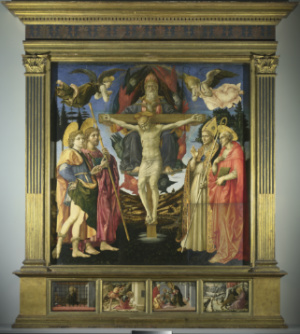
• The first-ever exhibition dedicated to the career of Italian Renaissance painter Francesco Pesellino (about 1422– 1457) opens at The National Gallery today. Pesellino was active in Florence in the mid-15th century but his early death at 35 and the subsequent misattribution of his surviving works meant he’s become one of the greatest Renaissance painters you’ve never heard of. Highlights include two ‘Story of David’ panels which date from the last years of his career and are being displayed in the round, the ‘Pistoia Trinity Altarpiece’, one of only two large-scale altarpieces Pesellino is known to have produced (and unfinished at his death), and his small-scale devotional work Madonna and Child (1450s). Entry to the exhibition in Room 46 is free. Can be seen until 10th March next year. For more, see www.nationalgallery.org.uk/exhibitions/pesellino-a-renaissance-master-revealed.
• Coalescence, an artwork by designer Paul Cocksedge, is making its London debut at the Old Royal Naval College’s Painted Hall from Saturday. Made from over 2,500 pieces of coal – the amount consumed by a single 200 watt light bulb in a year – Coalescence will “create an intricate play of shadow and sparkle that draws on the lustrous quality of the anthracite, a form of high-carbon coal”, inviting visitors to question our dependence on fossil fuels. Also on show in the Nelson Room, will be a new artwork, 20 Trees, which brings a message about ecological balance by blending mathematical calculations with dwindling natural resources.
10 London locations related to Sir Christopher Wren…9. St James’s Street, Piccadilly…
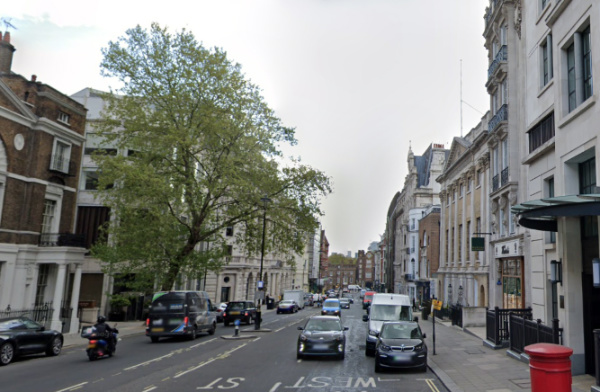
As noted at the outset of this series, in his latter years Sir Christopher Wren retired to the property on Hampton Court Palace Green, a property he was granted after he was appointed Surveyor-General to King Charles II in 1669.
But he also still spent time in London and, no longer having access to Scotland Yard, he lodged at his son Christopher’s house in St James’s Street, off Piccadilly. In fact, it was in this property that Wren, having suffered a chill, died while sitting in a chair at the age of 91 on 25th February, 1723.
It’s been suggested that the house in which Wren died was on the west side of the street. There’s an apocryphal story that suggests Wren came to London to check up on his greatest work, St Paul’s Cathedral.
LondonLife – The number 15…
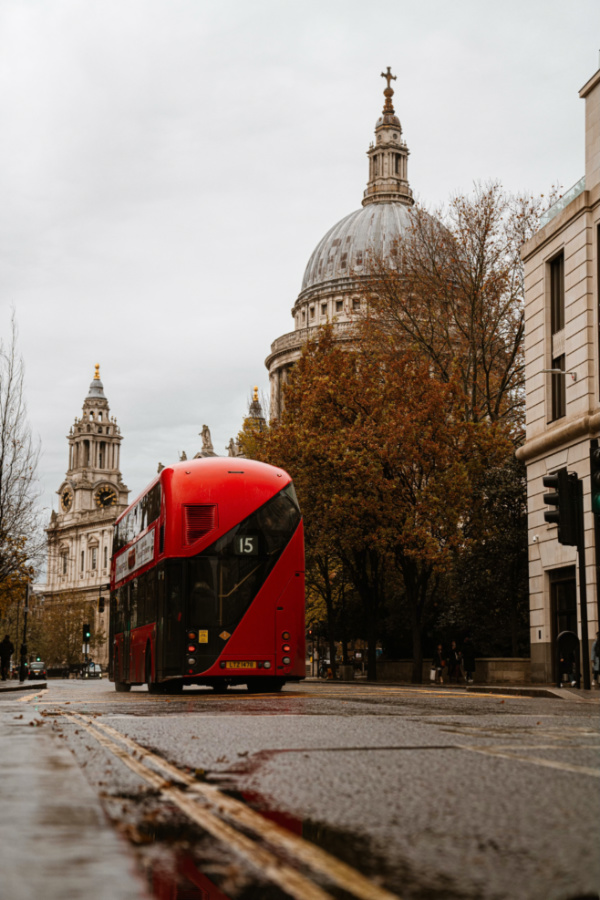
The number 15 runs from Blackwall Station via Poplar High Street through the City, finishing at Charing Cross Station.
This Week in London – London homes in winter; artworks commemorating people of African, Caribbean, and Asian heritage; and, final NYE tickets…
• See how Londoners lived during winters past at the Museum of the Home in Hoxton. Rooms Through Time: Winter Past centres on the museum’s ‘Rooms Through Time’ and reveals how winter has changed London homes through the last 400 years. The display – which includes rooms set out as they would have been on Millennium Eve, Christmas Eve in 1915, Twelfth Night in 1830, and during a Frost Fair in 1683 – takes a multi-sensory storytelling approach, offering new sounds, smells, sights and stories across the room sets. The display is accompanied by a series of ‘Winter Festival’ events. Runs until February next year. Entry is free. For more, see www.museumofthehome.org.uk.
• A series of artworks commemorating people of African, Caribbean, and Asian heritage from London’s past opens at the London Metropolitan Archives in Clerkenwell on Monday. Art at the Archive: Reimagining Unforgotten Lives sees three artists creating works after taking as their inspiration a range of people featured in LMA’s Unforgotten Lives exhibition. The works include Annie-Marie Akussah’s three-dimensional artwork depicting landscapes Black abolitionist Quobna Ottobah Cugoano would have seen in Ghana as well as London’s West and East India Docks, Elyssa Rider’s oil portraits of Ann Duck, a young woman living in London from 1717 to 1744 whose criminal past is preserved in the court records of the Old Bailey and Tara Jerome-Bernabé’s woven painting which reimagines the lives and images of young Black servants who were enslaved and forced to work in aristocratic households. Runs until 27th March. Admission is free. For more, see head here.
• The final tickets to see London’s New Year’s Eve fireworks celebrations on the banks of the River Thames go on sale on Friday. Just over 20,000 tickets will go on sale at noon, taking to 100,000 the total number of tickets sold. Tickets, which cost £20 each, must be bought in advance from the only authorised outlet, AXS. Only ticket holders will be able to watch the fireworks in person. Those without a ticket are encouraged to watch the display live on BBC One or via BBC iPlayer alongside millions of viewers or to celebrate the new year at the capital’s fantastic range of bars, restaurants, pubs and clubs. Tickets can be bought online at AXS.com. For more, see www.london.gov.uk/nye.
Send all items to exploringlondon@gmail.com
10 London locations related to Sir Christopher Wren…8. The Bankside Plaque…
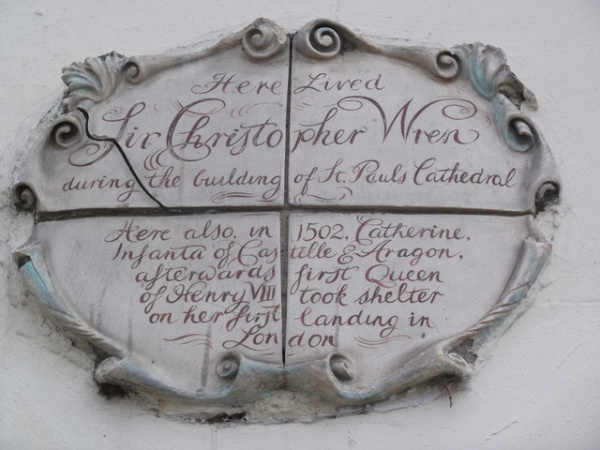
Sir Christopher Wren’s name is one which pops up in association with buildings all over London – some authentically so, others less so.
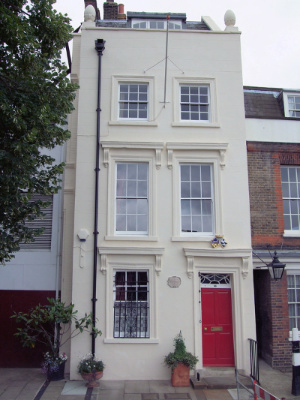
One of the more talked about locations where it can be physically seen is on a plaque attached to the front of a house overlooking the Thames at 49 Bankside, on the corner with Cardinal Cap Alley.
The plaque, written in a flowery script, claims that “Here lived Sir Christopher Wren during the building of St Pauls Cathedral” before going on to state that the property was also where in 1502, Catherine of Aragon, “took shelter” on first arriving in London before her marriage to King Henry VIII.
But author and historian Gillian Tyndall debunks the claim in her 2006 book The House by the Thames and the People who Lived There.
Tyndall explains that the property apparently dates from 1710 – St Paul’s was officially declared complete in 1711, leaving little cross-over (and certainly ruling out any residence by Queen Catherine who actually landed in Plymouth). She says that while it’s true the present house stands in the footprint of an older one, the house where Wren may have actually lodged during the 1670s is located further west along Bankside.
London Remembers notes that this property was apparently marked with an 18th century plaque commemorating Wren. But when that house was demolished in 1906, the plaque was saved and subsequently attached to a power station’s outer wall. When that was redeveloped in the post-war period, the plaque disappeared.
It was apparently that plaque which inspired the creation of the current plaque which was created by Major Malcolm Munthe, who acquired the property in 1945, and subsequently had the plaque made for the home’s exterior.
So it seems the plaque, despite what it says, does not commemorate a Wren residence (although perhaps it may commemorate the residence of Wren in the area). And, it’s been suggested, that while the plaque may not actually have marked a Wren home, its presence may have been enough to protect the building it adorns from threatened redevelopment in the mid-20th century.
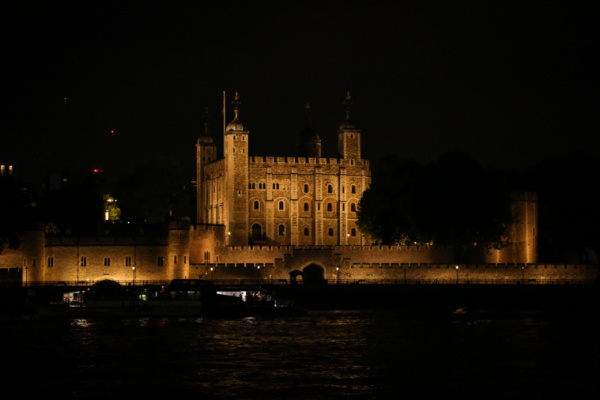
LondonLife – Tower by night…
What’s in a name?…Poplar…
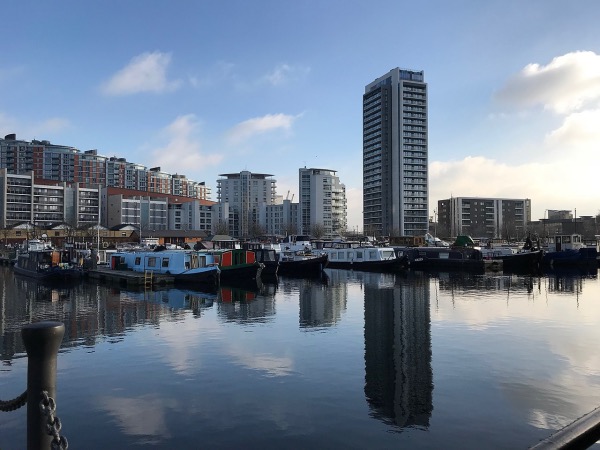
Though they no longer in evidence, this Thames-side East London district takes its name from the Black Poplar trees which were once abundant in the area.
The area was apparently fertile ground for the poplars thanks to the proximity of the Lea and Thames Rivers which created the moist soil the tree needs. There was still a poplar tree in the area until the mid-1980s.
The name goes back to the 14th century but Poplar wasn’t an independent parish until the 19th century (before which it was a hamlet of Stepney). Poplar is now part of the Borough of Tower Hamlets.
The medieval village of Poplar was centred on Poplar High Street and the East India Company, which built ships in Blackwall Yard, established a chapel and almshouses in Poplar.
The area expanded rapidly in the early 19th century thanks to the maritime industries that grew up here but by late that century this had diversified into other manufacturing and transport-related industries.
The area has long had a maritime association with ship fitting taking place in the area from the 15th century. Poplar was impacted by bombings during World War I and then devastated during the Blitz with about half the houses in the area damaged and the population dropping significantly as a result.
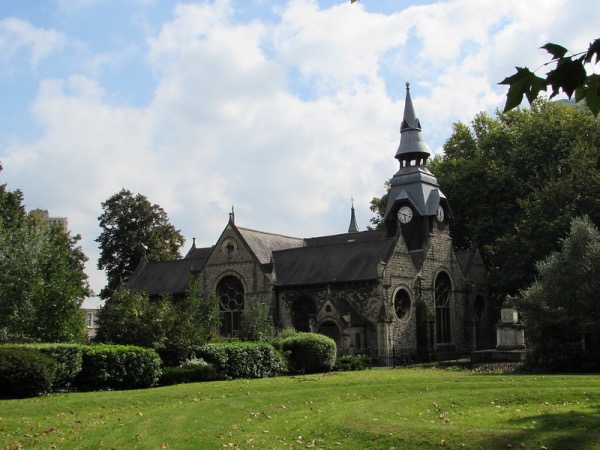
Landmark buildings include the old Poplar Town Hall, now a hotel, the Grade II*-listed St Matthias Old Church (originally the chapel built by the East India Company in 1654 and now a community centre), the Grade II-listed All Saints Church, dating from 1821-23, and the Museum of London Docklands at West India Quay.
The area also features considerable post-war housing including the Brutalist-style 26 storey Balfron Tower. In more recent years, with the development of the Docklands and the linking of the area to the city by the Docklands Light Railway, the area has continued to undergo regeneration.
This Week in London – Impressionists on paper; Vanessa Bell and Duncan Grant honoured with a Blue Plaque; new Burnham Beeches history app; and, young artists celebrated on London billboards…
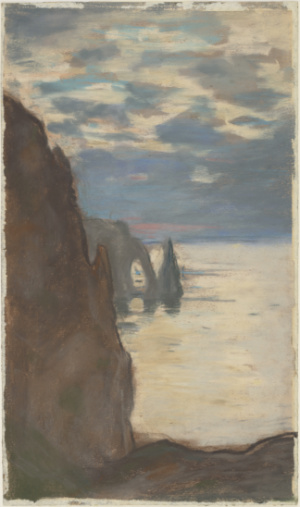
• A new exhibition exploring how Impressionist and Post-Impressionist artists in late 19th-century France radically transformed the status of works on paper opens at the Royal Academy on Friday. Impressionists on Paper: Degas to Toulouse-Lautrec features around 80 works on paper by artists including Mary Cassatt, Paul Cézanne, Edgar Degas, Paul Gauguin, Eva Gonzalès, Claude Monet, Berthe Morisot, Odilon Redon, Pierre-Auguste Renoir, Georges Seurat, Henri de Toulouse-Lautrec and Vincent van Gogh. Among the highlights are Degas’ Woman at a Window (1870-71), van Gogh’s The Fortifications of Paris with Houses (1887), Monet’s Cliffs at Etretat: The Needle Rock and Porte d’Aval (c1885) and Toulouse-Lautrec’s images of the urban underworld of Montmartre. The display can be seen in The Gabrielle Jungels-Winkler Galleries until 10th March. Admission charges apply. For more, see royalacademy.org.uk.
• English Heritage have unveiled their final Blue Plaque for 2023 and it celebrates two of the most influential painters of the early-to-mid 20th century, Vanessa Bell and Duncan Grant. The plaque was unveiled at number 46 Gordon Square in Bloomsbury, from where the Bloomsbury Group – of which Bell and Grant were leading members – drew its name. Bell first lived at number 46 with her siblings, including Virginia Stephen (later Woolf), and, in 1914, Grant moved in with Vanessa and her husband, Clive Bell. Paintings the pair made at number 46 include Grant’s Interior at Gordon Square (c1915) and Bell’s Apples: 46 Gordon Square (c1909-10), a still-recognisable view from the drawing-room balcony to the square. For more on the English Heritage Blue Plaques scheme, head to www.english-heritage.org.uk/visit/blue-plaques/.
• The history of Burnham Beeches has been brought to life with a new augmented reality app. The app allows users to superimpose periods of Burnham Beeches’ history – from the Iron Age, Middle Ages and World War II – over what they see when visiting the site and incorporates sounds from selected era as well. It can be accessed via a QR code which is being published on signs at Burnham Beeches. Burnham Beeches, located near the village of Burnham in Buckinghamshire, was acquired by the City of London in 1880 when the area was threatened by development and is managed as a free open space. For more, head here.
• The work of 30 young artists celebrating African community and culture is being showcased on billboards across the city in conjunction with Tate Modern’s current exhibition, A World in Common. The photographs have been selected following a call from the Tate Collective for 16-to-25-year-olds to submit images responding to the exhibition. More than 100 entries were submitted by young people based across the UK and beyond and Londoners will be able to view the 30 shortlisted works on billboards in Haringey, Lambeth, Southwark and Tower Hamlets over the next two weeks.
Send all items to exploringlondon@gmail.com.
LondonLife – Autumnal walk…
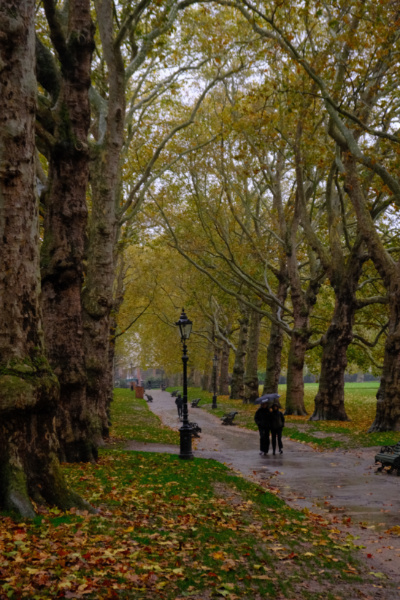
Seen in Green Park on a wet day.
 Exploring London