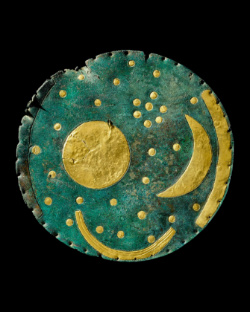
Nebra Sky Disc, Germany, about 1600 BC. PICTURE: Courtesy of the State Office for Heritage Management and Archaeology Saxony – Anhalt, Juraj Lipták.
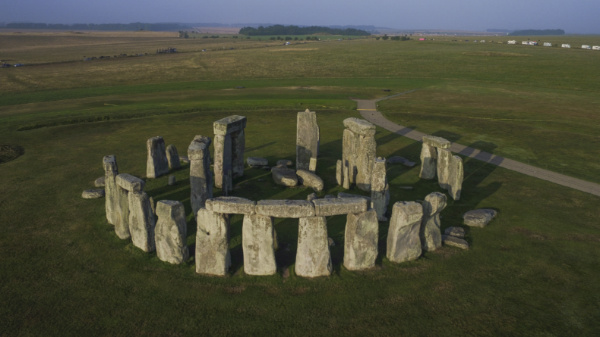
• The UK’s first major exhibition on the story of Stonehenge opens at the British Museum today. The World of Stonehenge features more than 430 objects gathered from across Europe including Bronze Age grave goods unearthed near Stonehenge in the grave of a man known as the Amesbury Archer, the Nebra Sky Disc – the oldest surviving representation of the cosmos anywhere in the world, and the 4,000-year-old wooden monument, called Seahenge, that was discovered in 1998 on a Norfolk beach (and is being loaned for the exhibition for the first time). Admission charge applies. The exhibition can be seen in the Sainsbury Exhibitions Gallery until 17th July. For more, see www.britishmuseum.org/exhibitions/world-stonehenge
• The contribution people of Caribbean heritage have made to London’s transport history is the subject of a new exhibition at the London Transport Museum in Covent Garden.Legacies: London Transport’s Caribbean Workforce features personal oral histories from past and present generations of people of Caribbean descent along with newly commissioned and re-edited films, archive photography, historic advertising posters, and objects such as a Syllabus of Training for Cooks manual from staff canteens. The exhibition is expected to run until summer 2024. Included in general admission. For more, see www.ltmuseum.co.uk/legacies.
Send all items for inclusion to exploringlondon@gmail.com
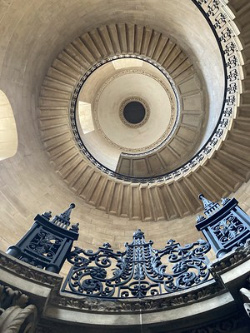
Known more formally as the Dean’s Staircase, this spiral staircase was designed by none other than Sir Christopher Wren and provides access to the triforium in St Paul’s Cathedral.
The staircase – each step of which is embedded into the wall – was built between 1675 and 1710 in the cathedral’s south-west tower by William Kempster. The ironwork is by famed French metal worker Jean Tijou.
Located in the south-west bell tower, the stair’s 88 Portland stone steps rise some 50 feet.
The staircase, which can be seen on the cathedral’s guided tours including triforium tours, has become famous in recent years thanks to its appearance in the 2004 Harry Potter film, The Prisoner of Azkaban, as well as Guy Ritchie’s 2009 film Sherlock Holmes.
The staircase has also been the site of art installations including Antony Gormley’s Flare II – which featured a falling figure within a cloud of wire.
WHERE: St Paul’s Cathedral (nearest Tube stations are St Paul’s, Mansion House and Blackfriars); WHEN: 8.30am to 4.30pm Monday to Saturday; COST: £21 adults/£18.50 concessions/£9 children/£36 family (these are walk-up rates – online advanced and group rates are discounted); WEBSITE: www.stpauls.co.uk (for tours, head to www.stpauls.co.uk/visits/visits/guided-tours)
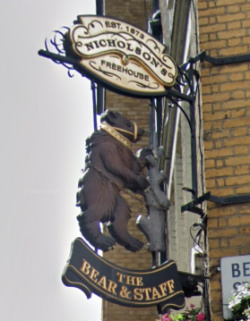
This storied central London pub, located close to Leicester Square, dates back to 1714 although the current building dates from 1878.
The name comes from the crest of the Neville family, who were Earls of Warwick (most famous among them was Richard Neville, the “King-Maker”). It depicts a rampant bear chained to a ragged staff. (There is apparently an alternative explanation for the name with some believing the pub is named after a glazier named Augustus Beare who worked in the area in the late 17th century).
Among the stories associated with the pub, which is located on the corner of Charing Cross Road and Bear Street, is that of one 19th century landlord, William Heartwell, who lost his licence in 1858 after being found trading on a Sunday and (perhaps more significantly) robbery. The pub is also believed to have been frequented by early 20th century actor Charlie Chaplin – its restaurant is named in his honour.
• Artworks from some of Beatrix Potter’s most famous storybooks and sketches of the real-life animals, places, art and literature that inspired them are at the heart of a new exhibition opening at the V&A in South Kensington on Saturday. Beatrix Potter: Drawn to Nature, which is being run in partnership with the National Trust, features more than 240 personal objects which also include rarely seen personal letters, family photographs, early sketchbooks, manuscripts and scientific drawings in a family friendly display exploring Potter’s passion for animals and the natural world. The display is spread across four sections: ‘Town and Country’ which provides the backdrop to her childhood in South Kensington in London; ‘Under the Microscope’ which highlights Potter’s interest in natural science; ‘A Natural Storyteller’ which reveals her “almost accidental journey to becoming a best-selling author”; and, ‘Living Nature’ which follows Potter to the Lake District and celebrates her profound impact on the natural landscape. The exhibition can be seen until 8th January next year. Admission charge applies. For more, see vam.ac.uk/exhibitions/beatrix-potter-drawn-to-nature.
• A rare copy of renowned theoretical physicist Stephen Hawking’s PhD thesis (one of only five known copies), his Permobil F3 modelwheelchair and a blackboard which hung on his office wall have gone on show at the Science Museum as part of a new exhibition on his working life.Stephen Hawking at Work also features his spectacles which were adapted to aid communication, a photograph from the set of Star Trek: The Next Generation where Hawking made a guest appearance, the insignia given to him on becoming a member of the Pontifical Academy of Sciences in 1986, and an invitation to a time travellers’ party Hawking hosted. The blackboard, one of Hawking’s most treasured possessions, came from a 1980 conference – Superspace and Supergravity – at which delegates covered it in equations, cartoons and jokes about each other. Hawking’s subsequently had the blackboard framed and hung in his office. The free display can be seen until 12th June. For more, see www.sciencemuseum.org.uk/stephen-hawking.
• Free immersive outdoor light installations and pop-up performances can be seen in the city’s centre over this half-term as part of the Mayor of London’s ongoing ‘Let’s Do London’ campaign. The events include ‘City Lights’ – an illuminated light trail in the City of London by internationally renowned artists including Colour by Light which invites people to use their smartphones to turn the city into a colourful canvas (11th to 20th February), free pop-up performances in the streets of central London including storytelling, puppetry, dance, and music (17th to 20th February) as well as discounts to West End shows and dining out. For other events and more information, head to www.visitlondon.com/things-to-do/lets-do-london.
Send all items for inclusion to exploringlondon@gmail.com.
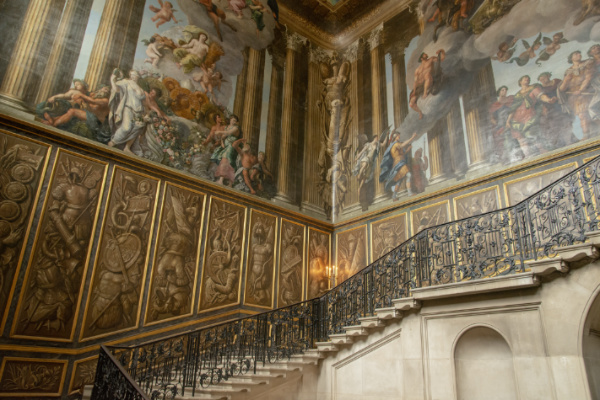
This grand staircase was installed in Hampton Court Palace during the reign of King William III and Queen Mary II as a grand entrance to the King’s Apartments.
The staircase, which features shallow steps, was designed Sir Christopher Wren and features a wrought iron balustrade designed by French ironsmith Jean Tijou.
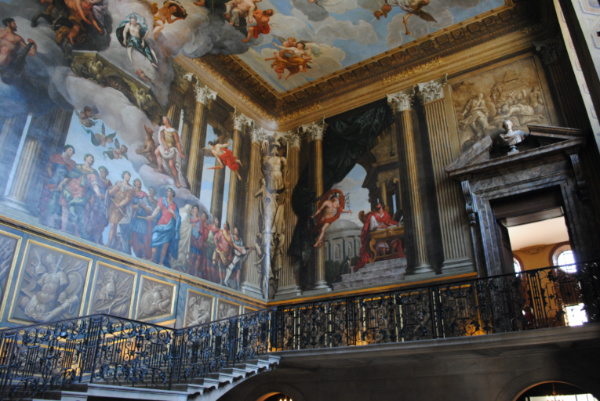
Another view of the staircase and accompanying art. PICTURE: David Adams
It was decorated in about 1700 by Italian painter Antonio Verrio to resemble a Roman courtyard which is open to the sky. The main image depicts ‘Victory of Alexander over the Caesars’ which features King William III as Alexander the Great and is painted as an allegory of William’s triumph over the Stuart King, James II, in the Glorious Revolution of 1688 (with the Stuarts represented by the 12 Caesars).
The stairs lead up to the Guard Chamber, an anteroom which had to be passed through to reach the Presence Chamber.
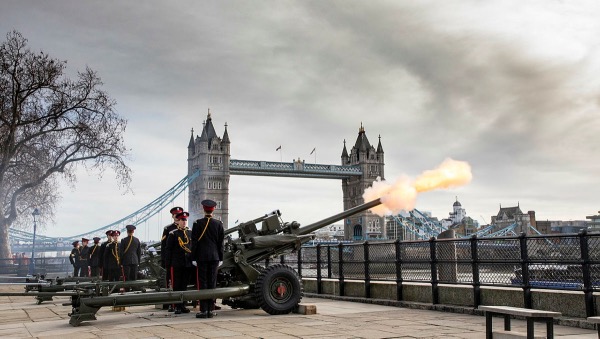
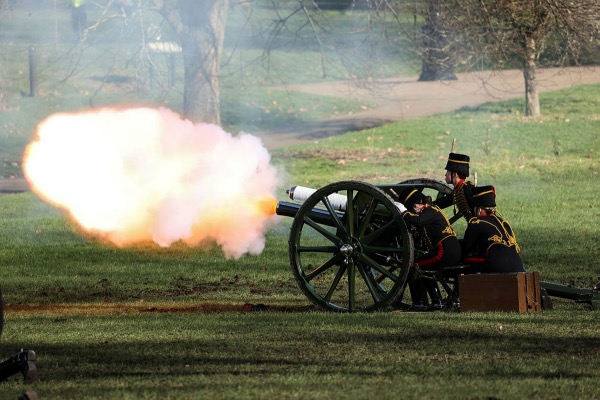
The Honourable Artillery Company fires a 62 gun salute at the Tower of London to mark the 70th Anniversary of Queen Elizabeth II’s accession to the throne. The gun salute at the Tower was one of a number which took place across the UK on Monday – while the date of the Queen’s accession was the 6th February, gun salutes do not traditionally take place on a Sunday. The gun salutes are traditionally comprised of 21 rounds with a further 20 rounds fired at Royal Parks and palaces and a further 21 at the Tower to show the respect the City of London has for the Queen. Below, the King’s Troop Royal Horse Artillery can be seen firing 41 rounds in Green Park.
Memorialised in the name of the house where he once lived at the Royal Observatory in Greenwich, John Flamsteed was the first Astronomer Royal.
Flamsteed was born in Denby, Derbyshire, on 16th August, 1646, and was the only child of Stephen Flamsteed, who among other things was involved in the brewing industry, and his first wife Mary (who died when John Flamsteed was still quite young).
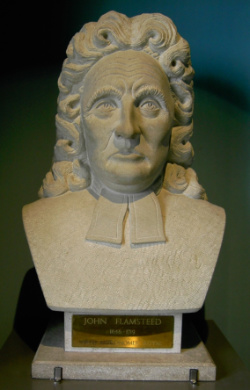
A bust of John Flamsteed at the Royal Observatory Greenwich.
He was educated at local schools but left off his studies at the age of 15 due to his own ill health and his father’s need for his assistance in the household and with his business.
His poor health meant he pursued some more sedentary activities and it was during this period that he established interest in astronomy, writing his first paper in 1665. Flamsteed did briefly attend Jesus College in Cambridge in the early 1670s, although it’s not thought he ever took up full residence.
Flamsteed was ordained a deacon and was preparing to take up a living in Derbyshire in 1675 – having by then obtained an MA from Cambridge – when his patron Jonas Moore, whom he’d met in the summer of 1670 during a visit to London and then visited again in mid-1674, invited him to return to the city, ostensibly to establish an observatory which Moore, who was Surveyor-General of the Ordnance, had offered to pay for.
Flamsteed arrived in February, 1675, stayed with Moore in the Tower before, after meeting King Charles II, was made an official assistant to a Royal Commission which the king had established charged with examining the merits of a proposal – put forward by a “le Sieur de St Pierre” to find longitude by the position of the Moon.
The commission decided the proposal wasn’t worth taking further but did recommend the establishment of an observatory from which the movement of the stars and Moon could be mapped in the hope of developing a method of finding longitude. Flamsteed was subsequently appointed “The King’s Astronomical Observator” – the first Astronomer Royal – on 4th March, 1675, by royal warrant, and in June that same year, another royal warrant provided for the founding of the Royal Greenwich Observatory. Flamsteed laid the foundation stone on 10th August.
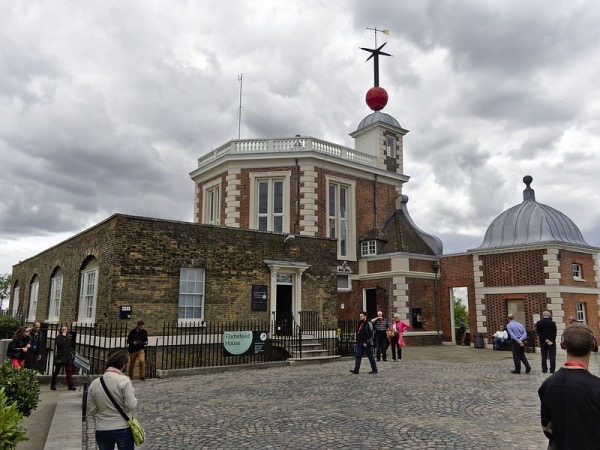
He was admitted as a fellow of the Royal Society in February the following year and in July he moved into the observatory, now known as Flamsteed House (it contains famed Octagonal Room with large windows from which celestial events could be watched), which was designed by Sir Christopher Wren. It was to serve as Flamsteed’s home for next decade or so.
Flamsteed House, Royal Greenwich Observatory, its named after John Flamsteed. PICTURE: Dmitry Djouce.
Flamsteed’s achievements as an astronomer included the accurate calculation of the solar eclipses of 1666 and 1668 and recording some of the earliest sightings of Uranus which he mistakenly thought was a star. He was also in regular contact with many other scientific luminaries of the day and famously fell out with both Sir Edmond Halley (his one-time assistant and future successor as Astronomer Royal) and Sir Isaac Newton.
Flamsteed’s own catalogue of almost 3,000 stars wasn’t published until after death in 1725 thanks to the effort’s of his wife Margaret – whom he had married on 23rd October, 1692 (they were to have no children although Flamsteed’s niece, Ann Heming, did live with them). Margaret also published his star atlas, Atlas Coelestis, posthumously in 1729.
In 1684, Flamsteed was elevated to the priesthood and made rector of the village of Burstow, near Crawley in Surrey – a post, which, along with that of Astronomer Royal, he held until his death on 31st December, 1719.
He was buried in Burstow and there is a plaque on the wall of the church there marking his grave (which was added long after his death). Aside from his earthly honours – which includes the name of Flamsteed House at the Royal Observatory, a crater on the Moon is named after him as is an asteroid.
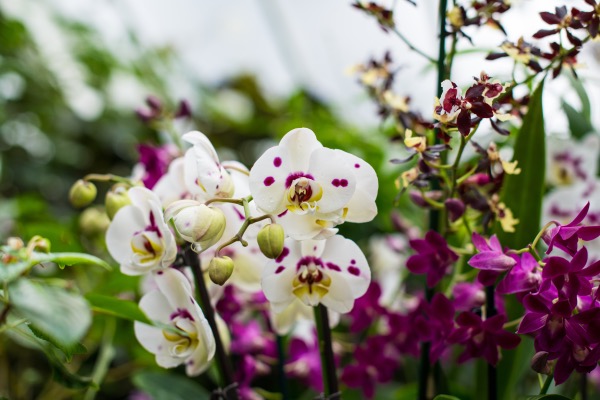
A scene from Kew Gardens’ Orchid Festival in 2020.
• Biodiversity hotspot Costa Rica is the focus of this year’s Orchid Festival which opens at Kew Gardens on Saturday. The festival, which returns for the first time in two years, sees a recreation of the verdant landscape of the Caribbean island nation in the Princess of Wales Conservatory – including the creation of monkeys, sea turtles, toads and hummingbirds in plant form – with a central display in the glasshouse pond of vibrant orchids and bromeliads. Meanwhile, the International Garden Photographer of the Year exhibition is also opening in Kew’s Arboretum and features a selection of images from across categories including ‘Beautiful Gardens’, ‘The Beauty of Plants’ and ‘The World of Fungi’ as well as winner of the ‘Captured at Kew’ special award. Both can be seen until 6th March. Admission charge applies. For more, see www.kew.org.
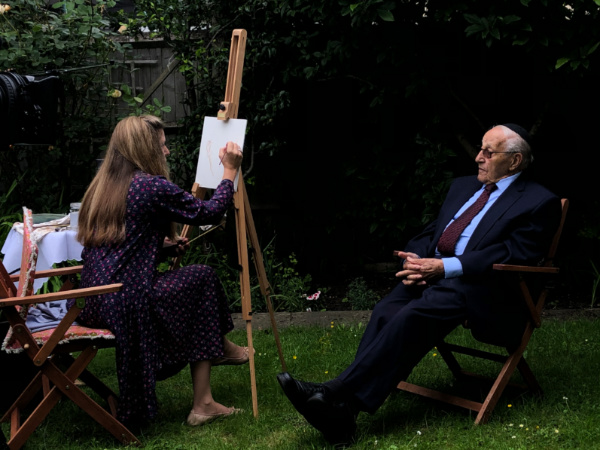
Artist Clara Drummond and Holocaust survivor Manfred Goldberg BEM, PICTURE: Angel Li and BBC Studios
• A series of portraits depicting Holocaust survivors has gone on show at The Queen’s Gallery in Buckingham Palace. The seven works in SevenPortraits: Surviving the Holocaust were commissioned by Prince Charles in his role as patron of Holocaust Memorial Day which was marked last week. The exhibition can be seen at The Queen’s Gallery until 13th February. Admission charge applies. For more on Holocaust Memorial Day, see www.hmd.org.uk. For more on The Queen’s Gallery, head to www.rct.uk/visit/the-queens-gallery-buckingham-palace.
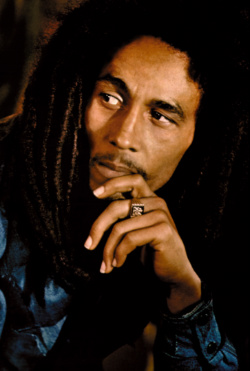
• Music icon Bob Marley is the subject of an exhibition which opened at the Saatchi Gallery this week. Bob Marley: One Love Experience features hitherto unseen photographs of Marley as well as memorabilia, giant art installations and multi-sensory experiences as visitors are led through a series of rooms including the ‘One Love Music Room’, the ‘One Love Forest’ and the ‘Soul Shakedown Studio’. The exhibition runs until 17th April. Admission charges apply. For more, see www.bobmarleyexp.com.
Send items for inclusion to exploringlondon@gmail.com.
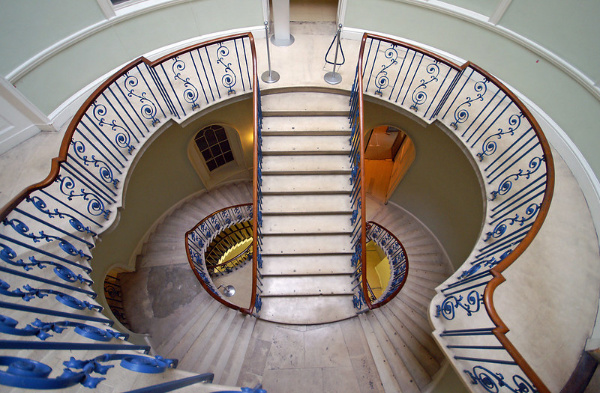
Located in Somerset House, this grand rotunda stairway rises up through the building to the Navy Board Rooms.
The present five storey stair is a replica of what was there up until the original suffered significant damage in The Blitz during World War II. It was rebuilt in the early 1950s under the supervision of Sir Alfred Richardson using original plans which had been kept safe in Sir John Soane’s House in Lincoln’s Inn Fields.
The architecturally interesting stair, which is located in the South Wing, was originally built in the late 18th century to the designs of Sir William Chambers with each flight a different configuration to the one underneath (the design was apparently made to reflect something of the stairs on ships).
It was initially known as the Navy Stair but renamed the Nelson Stair, ostensibly in honour of the heroic Vice-Admiral Horatio Nelson.
It’s not the only historic stair of note in Somerset House. The cube-like Stamp Stair, also located in the South Wing, is so-named for the stamping of newspapers that once took place here. Meanwhile, the Miles Stair, designed by Eva Jiricna Architects and named for Gwyn Miles, former director of the Somerset House Trust, is a stunning contemporary addition featuring a steel-mesh newel and a transparent balustrade.
Somerset House, Strand (nearest Tube stations are Temple and Charing Cross): WHEN: Daily (check website for times); COST: Free (but charges for exhibitions); WEBSITE: www.somersethouse.org.uk.
The Tower of London is one of the palaces under the care of Historic Royal Palaces. PICTURE: Nick Fewings/Unsplash
Visitors to several of London’s landmark royal properties will across an organisation known as Historic Royal Palaces.
HRP, as its sometimes shortened to, is a self-funding charity charged with the management of palaces which are owned by the Crown (technically by Queen Elizabeth II ‘in Right of Crown’ meaning she holds them in trust for the next monarch and by law cannot sell or lease them). The palaces are generally no longer used as royal residences.
These include the Tower of London, Hampton Court Palace, Kensington Palace, Kew Palace and the Banqueting House (once part of the Palace of Whitehall). Buckingham Palace, which remains the official London residence of Queen Elizabeth II and a working royal palace, is not one of them nor is St James’s Palace, home to several members of the Royal Family and their households.
All five of the properties in London which are under the care of Historic Royal Palaces ceased being regularly used by the Royal Court in the 19th century and were opened up to the public. The government became responsible for their care under the Crown Lands Act 1851.
In 1989, the government established Historic Royal Palaces as part of the Department of the Environment to oversee care of the five palaces. Six years later it became part of the Department of National Heritage(now known as the Department for Culture, Media & Sport).
In April, 1998, Historic Royal Palaces became an independent charity by Royal Charter. It is governed by a board of trustees who include the director of the Royal Collection Trust and the Keeper of the Privy Purse from the Royal Household as well as the Constable of the Tower of London.
Historic Royal Palaces now oversees management of the palaces under a contract with the Secretary of State for Culture, Media & Sport (as well as the five London properties, since 2014, it has also been responsible for the care of Hillsborough Castle in Northern Ireland).
Perhaps the most well-known faces of Historic Royal Palaces are joint curators – Tudor historian Tracy Borman, and architectural and social historian Lucy Worsley.
HRP collects revenues through entries to the palaces but also offer an annual membership through which you can have unlimited entry.
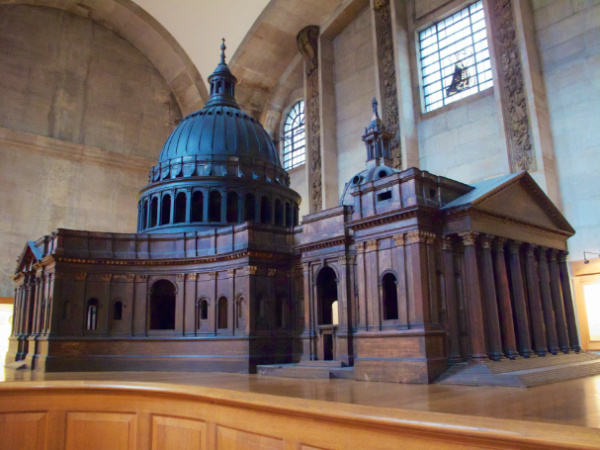
Housed now in the building it depicts, the Great Model of St Paul’s Cathedral was created by architect Sir Christopher Wren to show King Charles II what his proposed grand new English Baroque cathedral would look like (following the destruction of the medieval cathedral in the Great Fire of 1666).
Made of oak, plaster and lime wood, the model was made by William Cleere to Wren’s design in between September, 1673, and October, 1674, at a scale of 1:25. It measures 6.27 metres long, 3.68 metres wide and more than four metres tall, making it one of the largest in the UK.
The model, which cost about £600 to make – an extraordinary sum which could apparently buy a good London house, was designed to be “walked through” at eye level and, as well as being a useful way to show the King what the proposed building would look like, was also something of an insurance policy in case something happened to Wren.
It was based on drawings made by Wren and his assistant Edward Woodroofe on a large table in the cathedral’s convocation or chapter house (later demolished in the early 1690s) and was originally painted white to represent Portland stone with a blue-grey dome and gilded details.
There are some differences between the model and the finished cathedral – among them was a substantial extension of the quire, double-height portico on the west front, and, of course, the bell towers on the west front which were made in place of the cupola which was located halfway down the nave on the model.
Part of an earlier wooden model from 1671 also survives – it was apparently lost for many years and rediscovered in 1935.
The Great Model can be seen on tours of the Triforium.
WHERE: St Paul’s Cathedral (nearest Tube stations are St Paul’s, Mansion House and Blackfriars); WHEN: 8.30am to 4.30pm Monday to Saturday; COST: £21 adults/£18.50 concessions/£9 children/£36 family (these are walk-up rates – online advanced and group rates are discounted); WEBSITE: www.stpauls.co.uk (for tours, head to www.stpauls.co.uk/visits/visits/guided-tours)
Festivities to celebrate Chinese New Year in London’s Chinatown area and surrounding streets in 2018. PICTURE: Ben Gingell/iStockphoto.
• The Lunar New Year will be celebrated at the National Maritime Museum in Greenwich this Saturday. The free programme of events includes family workshops on dragon and lion dancing, a talk on some of the objects from the museum’s collection that have Chinese collections and a Tea Ceremony demonstration. The event is free but booking advised. The London Chinatown Chinese Association announced earlier that for the second year running, the usual celebrations will not take place in the West End. For more on events at the National Maritime Museum, head to www.rmg.co.uk/whats-on/national-maritime-museum/lunar-new-year-2022.
• Three ‘benches of reflection’ have been installed at Hampstead Heath, Highgate Wood and Queen’s Park in association with suicide prevention charity Campaign Against Living Miserably (CALM) to encourage people to talk and get advice if they’re struggling. The bench installations are part of a campaign under which Netflix has donated 25 benches to local authorities and the City of London Corporation to coincide with the release of the third series of Rick Gervais’ After Life which has regularly been filmed at Hampstead Heath. Each bench is inscribed with a quote from season three – “Hope is Everything” – each also has a QR code which will lead them to resources from CALM.
PH301-1987 HRH Princess Margaret (1930 – 2002), aged 19, full-length portrait with studio backdrop; by Sir Cecil Beaton (1904 – 80) English; 1949. C-Type colour print.
• Members of the public are being asked to share photographs taken during royal engagements, including those which may show what it’s like to be part of one of the famous ‘royal walkabouts’. Up to 20 of the photographs will be selected by Kensington Palace curators and a guest judge from royal jewellers Garrard to be shown alongside those taken by the likes of Cecil Beaton, Norman Parkinson, Rankin and Annie Leibovitz in a new exhibition – Life Through a Royal Lens – opening at the palace on 4th March. You’ll have to be quick – photographers only have until 31st January to submit their photos via the Historic Royal Palaces website.
Send all items for inclusion to exploringlondon@gmail.com.
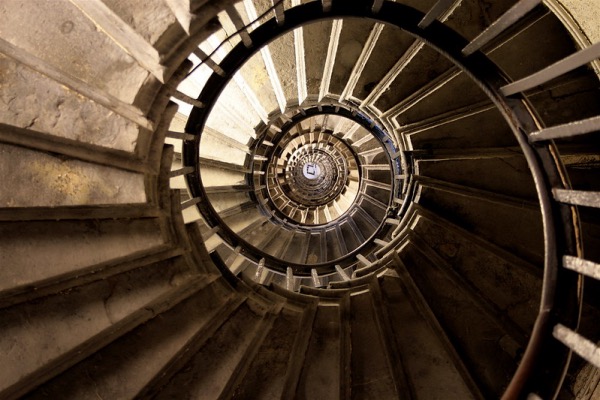
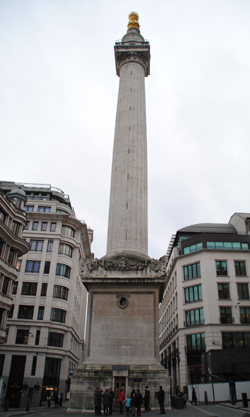
Running up the centre of the tallest free-standing stone column in the world, this 311 step stairway takes the visitor straight to the top of the Monument erected to commemorate the Great Fire of 1666.
The Monument
The Monument – actually a Doric column – was built close to Pudding Lane in the City – where the fire is believed to have started – between 1671 and 1677. It was designed by Sir Christopher Wren in collaboration with City Surveyor Sir Robert Hooke.
The cantilevered stairway – each step of which measures exactly six inches high – leads up to a viewing platform which provides panoramic views of the City. Above the platform stands is a large sculpture featuring a stone drum topped with a gilt copper urn from which flames emerge as a symbol of the fire (King Charles II apparently squashed the idea of an equestrian statue of himself lest people think he was responsible for the fire).
Interestingly, the circular space in the centre of the stairway was designed for use as a zenith telescope (a telescope which points straight up). There is a small hatch right at the top which can be opened up to reveal the sky beyond and a subterranean lab below (reached through a hatch in the floor of the ticket both) where it was envisaged the scientist could take measurements using a special eyepiece (two lenses would be set into the actual telescope). But it wasn’t successful (reasons for this could have been vibrations caused by passing traffic or the movement of the column in the wind).
Hooke also apparently attempted to use the staircase drop for some other experiences – including measuring differences in air pressure.
Among those who have climbed the stairs was writer James Boswell who visited the Monument and climbed the stairs in 1763. He suffered a panic attack halfway up but was able to complete the climb.
WHERE: The Monument, junction of Fish Street Hill and Monument Street (nearest Tube station is Monument); WHEN: Check website; COST: £5.40 adults/£2.70 children (aged five to 15)/£4.10 seniors (joint tickets with Tower Bridge available); WEBSITE: www.themonument.org.uk
Amid controversy over plans for a new Holocaust memorial in London and the marking of Holocaust Memorial Day this week, we thought it would be a good time to take a look at where the oldest public memorial to the victims of the Holocaust in London, which actually isn’t that old, is located.
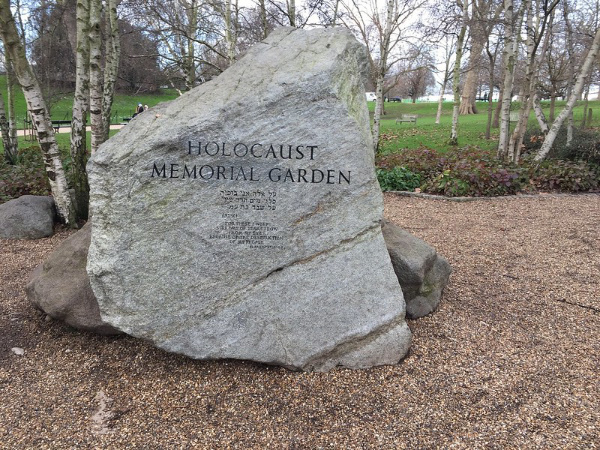
Unveiled in 1983 in Hyde Park at site just to the east of the Serpentine, it consists of a grouping of boulders surrounded by white-trunked birch trees. Designed by Richard Seifert and Derek Lovejoy and Partners, the largest of the boulders is inscribed with a text, in Hebrew and English, from the Biblical Book of Lamentations. It reads: “For these I weep. Streams of tears flow from my eyes because of the destruction of my people.”
The Holocaust Memorial Garden, which was actually the first such memorial dedicated to the victims of the Holocaust in Britain, was erected by the Board of British Jews.
Plans for a new memorial to the victims of the Holocaust – to be located in Victoria Tower Gardens, just to the south of the Houses of Parliament – were approved by the government in the middle of last year following a controversial public inquiry. But a High Court judge subsequently granted the London Historic Parks And Gardens Trust permission to appeal that decision.
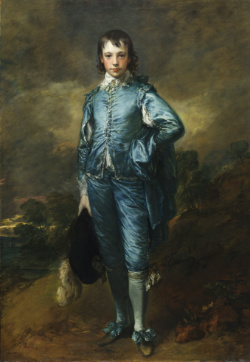
• A century after it last appeared in the UK, Thomas Gainsborough’s The Blue Boy returns to the National Gallery off Trafalgar Square from next Wednesday. The showing of the painting, which left for the United States in 1921 after it was purchased by rail and property businessman Henry E Huntington, marks the first (and possibly the last) time it has ever been lent out since that date. The full-length portrait, which was created in 1770 by Gainsborough during a period he spent in Bath, can usually be found at the Huntington Library, Art Museum, and Botanical Gardens in San Marino, California. The painting is being shown alongside four other works that, among other things, demonstrate Gainsborough’s interest in Flemish artist Sir Anthony van Dyck’s work from 100 years earlier. They include Van Dyck’s George Villiers, 2nd Duke of Buckingham and Lord Francis Villiers (1635) and Lord John Stuart and his Brother, Lord Bernard Stuart (about 1638) as Gainsborough’s works Elizabeth and Mary Linley (about 1772) and Mrs Siddons (1785). The display can be seen for free in Room 46 from 25th January until 15th May. For more, see nationalgallery.org.uk.
• An exhibition showcasing artwork from Heath Robinson’s children’s stories opened at the Heath Robinson Museum in Pinner last Saturday. Heath Robinson’s Children’s Stories features works from books including The Adventures of Uncle Lubin (1902), The Child’s Arabian Nights (1903), Bill the Minder (1912) and Peter Quip in Search of a Friend (1922). Entry is included in general admission charge. Runs until 15th May. For more, see www.heathrobinsonmuseum.org.
• Shortlisted and winning entries from The Architecture Drawing Prize 2020 and 2021 have gone on show at Sir John Soane’s Museum in Lincoln’s Inn Fields. The competition, run in partnership with Make Architects and the World Architecture Festival, is now in its fifth year with awards made across three categories – digital, hand-drawn and hybrid. Entry is free (pre booking required). Runs until 20th February. For more, see www.soane.org/exhibitions/architecture-drawing-prize-2021.
Send all items for inclusion to exploringlondon@gmail.com.
This small stone stairway which now sits in the midst of a grassy expanse at the back of the Ministry of Defence was once part of the Palace of Whitehall.
Named for Queen Mary II, wife of King William III, for whom they were designed, the stairs were part of a terrace built in 1691 abutting the Thames in front of an old river wall constructed for King Henry VIII.
Designed by Sir Christopher Wren, the stairs were one of a pair located at either end of the terrace which gave direct access to the river – and state barges – from the Royal Apartments.
Excavations in 1939 during construction of the MoD revealed the Tudor river wall, the terrace and the northern-most of the two flights of steps. The upper part of the steps have been repaired and the terrace and wall reconstructed.
The steps and palace fragments are now a Grade I listed monument.
• The largest collection of Spitfires gathered under one roof can be seen at the Imperial War Museum Duxford’s AirSpace hall. Twelve of the iconic planes have been gathered at the airfield, often referred to as the “home of the Spitfire”. Spitfire: Evolution of an Icon, which is being accompanied by a programme of tours, talks, events and family activities, shows how the plane evolved throughout World War II in order to keep pace with German aircraft development. As well as the IWM’s iconic Mk Ia Spitfire, the display also features Mk V, Mk IX and Mk XIV models. The Spitfires be seen until 20th February. Admission charge applies. For more including details of events, head to www.iwm.org.uk/events/spitfire-evolution-of-an-icon.
• A new exhibition focused on photographs of iconic 70s and early 80s band The Jam opens at the City of London Corporation’s Barbican Music Library tomorrow.True is the Dream features the photography of Derek D’Souza who has captured the band and frontman Paul Weller, who went on to found The Style Council, on film over several decades. D’Souza’s work include a career-defining shoot of the band at Chiswick House. The display is free to see until 16th May. For more, see www.barbican.org.uk/whats-on/2022/event/true-is-the-dream.
• The Waterloo & City line has reopened following a brief closure over Christmas. The London Underground line, which connects Waterloo to Bank, was temporarily closed by Transport for London in late December following increasing COVID cases in the capital and the impact on staff absence. Meanwhile, the Bank branch of the Northern line (between Moorgate and Kennington) for 17 weeks from 15th January to allow for upgrade works.







 Exploring London