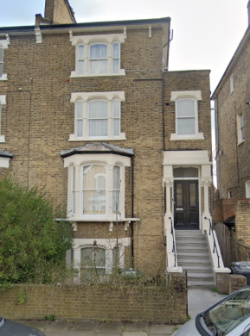
Astronomers Walter and Annie Maunder have been commemorated with an English Heritage Blue Plaque at their former home in Lewisham. The couple, known for their work on sunspots, solar photography and the debunking of a myth which suggested there were canals on Mars as well as their aim of making astronomy more accessible to women and amateurs, lived at 69 Tyrwhitt Road from 1907 to 1911 (having previously lived at number 86). It was during their period at the house that they published a sunspot article in 1904 containing a now-famous ‘butterfly diagram’ and wrote The Heavens and its Story, making frequent references to nearby park and favourite stargazing spot, Hilly Fields. For more, see https://www.english-heritage.org.uk/visit/blue-plaques/.
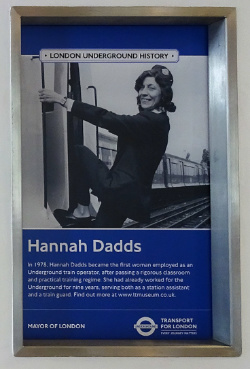
Hannah Dadds, seen in a London Underground poster in 2016. PICTURE: Kake (licensed under CC-BY-NC_SA 2.0)
As the first female driver on London’s Tube, Hannah Dadds broke new ground for working women.
Born on 16th October, 1941, Dadds grew up in the Forest Gate area of Newham. She left school when just 15 and worked in various jobs – including as a shop assistant and at the Bryant and May match factory – before in 1969 joining the London Underground to work as a “railwoman” at the Upton Park Underground Station, earning just over £13 a week.
Dadds went on to become a ticket collector at Tower Hill station and in 1976 became a train guard.
Following the passing of the 1975 the Sex Discrimination Act which opened up new jobs to women, in October, 1978, Dadds completed a seven week training course and, amid considerable fanfare, became the first female train driver on the Tube, driving her first train out of the Acton Depot to Ealing Broadway.
Initially assigned to the District line, she would go on to also drive trains on the Bakerloo and Jubilee lines. Dadds was also sometimes was paired with her sister, Edna, who joined the Underground after her sister and worked as a guard (they became the first all-female crew on the Underground).
Dadds, who retired in 1993, subsequently split her time between London and Spain. She died in 2011.
A plaque commemorating Dadds’ pioneering efforts was unveiled at Upton Park station in May, 2019, with her family and friends in attendance.
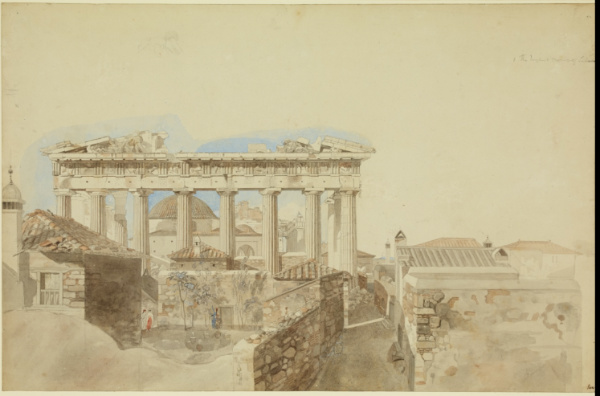
• A new display celebrating the influence of the ancient Greek architectural influence on the British Museum building is open at the museum. The Asahi Shimbun Displays Greek Revival: simplicity and splendour centres on a 200-year-old drawing of the west side of the Parthenon in Athens by British architect Robert Smirke. Smirke drew the Parthenon – still surrounded by medieval and later structures – when he was just 23-years-old and would go on, in the 1820s, to design the British Museum, one of the largest and most famous Greek Revival buildings in the world. Alongside the display is a online visitor trail which features 11 stops around the museum including the south facade and its colonnade and portico of 44 Ionic columns and the opulent Enlightenment Gallery. The free exhibition can be seen until 8th May in Room 3. For more, see britishmuseum.org/exhibitions/greek-revival-simplicity-and-splendour; for more on the trail head to britishmuseum.org/visit/object-trails/greek-revival-architecture-simplicity-and- splendour.
• The first major exhibition to celebrate “the power, artistry and diversity” of masculine attire and appearance opens at the V&A’s Sainsbury Gallery on Saturday.Fashioning Masculinities: The Art of Menswear features around 100 looks and 100 artworks displayed across three galleries – Undressed, Overdressed, and Redressed – and includes both contemporary looks and historic treasures. Fashion designers Harris Reed, Gucci, Grace Wales Bonner and Raf Simons will be represented along with paintings by Sofonisba Anguissola and Joshua Reynolds, contemporary artworks by Robert Longo and Omar Victor Diop, and an extract from an all-male dance performance by Matthew Bourne’s New Adventures. Interspersed will be outfits worn by such famous faces as Harry Styles, Billy Porter, Sam Smith, David Bowie and Marlene Dietrich. Runs until 6th November. Admission charge applies. For more, see vam.ac.uk/masculinities.
Send all items for inclusion to exploringlondon@gmail.com.
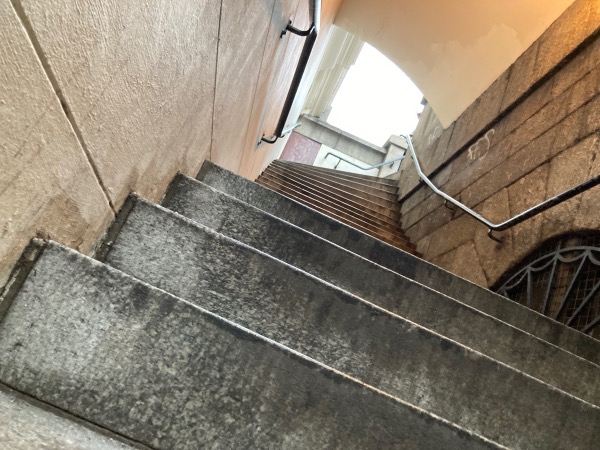
We close our series of historic London stairs with a stairway that has raised its share of controversy in recent years, largely due to the plaques associated with it.
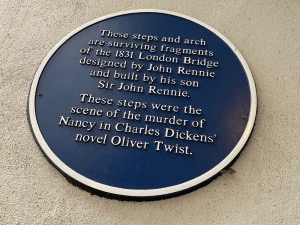
The steps, which are located in Southwark at the southern end of London Bridge and which lead down to Montague Close, are a remnant of the John Rennie-designed London Bridge which was completed in 1831 and which was replaced in the mid-20th century (and which was sold off and relocated to Lake Havasu in the US).
The controversy arises through the plaques associated with the steps which state that the steps where the scene of the murder of Nancy in Charles Dickens’ Oliver Twist. There’s a couple of problems with that claim.
The first is that Nancy wasn’t murdered here in the book – it is in their lodgings that Bill Sikes kills Nancy believing she has betrayed him. The confusion probably comes about because the musical Oliver! did set Nancy’s murder on the steps.
The bridge does, however, play a role in the book and have a connection to Nancy and its probably due to this connection that it has its name, Nancy’s Steps.
Because it was on steps located here – “on the Surrey bank, and on the same side of the bridge as Saint Saviour’s Church [now known as Southwark Cathedral]” that Nancy talks to Oliver’s benefactors while Noah Claypole eavesdropped on the conversation (which leads him reporting back to Sikes and eventually to her murder).
The second error made in the plaque is that Rennie’s bridge (and hence the steps) was completed in 1831 and with Oliver Twist published in serial form just a few years later can’t be the “ancient” bridge referred to in the text. The reference can only relate to the medieval bridge which occupied the site for hundreds of years until it was demolished following the completion of Rennie’s bridge.
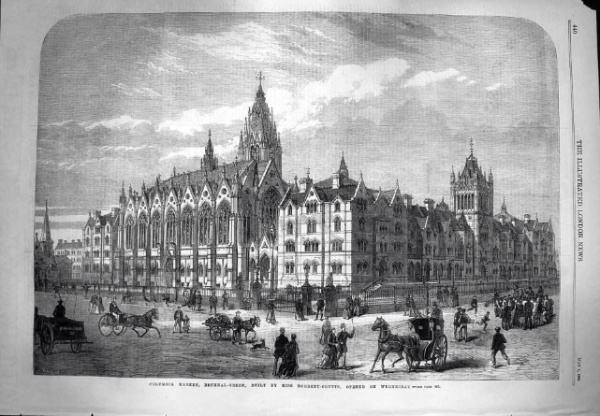
An image of the market in The Illustrated London News.
No, this is not the Columbia Road flower market we know today. This was a short-lived vast gothic market place built in the Bethnal Green in the mid-19th century to serve the East End.
The project was financed by philanthropist (and for a time Britain’s richest woman) Angela Burdett-Coutts and represented an attempt to get the costermongers off the streets.
The building, designed by Henry Darbyshire, was built in 1869, constructed of yellow brick with Portland stone cornices and a green slate roof.
It consisted of four blocks of buildings with arcades built around a central quadrangle which was open to the sky and featured some 400 stalls located under cover. There were also a series of shops with residences located above and a clock-tower which sounded every quarter hour.
The market, which sold fresh produce, was run by Burdett-Coutts’ secretary and future husband (they married in 1881) William Burdett-Coutts who built connections with a fishing fleet to supply its vendors.
He had planned a rail link with Bishopsgate to serve the market but that never happed and competition from Billingsgate and other markets – and the fact the costermongers preferred the streets – eventually saw it go out of business. It closed only a relatively few years later in 1886.
Taken over for a short time by the City of London Corporation, it was returned to the Baroness in 1874, briefly reopened 10 years later, then, according to The London Encyclopaedia, let out as workshops before finally being demolished in 1958.
A few remnants, including some rather grand iron railings and lion statues, remain.
Queen Anne Boleyn’s carved heraldic badge. PICTURE: Courtesy of Historic Royal Palaces.
• Five hundred years after Queen Anne Boleyn is recorded as first appearing before her future husband, King Henry VIII, her carved heraldic badge has gone on show at Hampton Court Palace. The blackened oak carving, which features a crowned falcon atop a tree stump flowering with Tudor roses, was discovered by antiques expert Paul Fitzsimmons. While it had been covered in centuries of soot, grime and wax, conservation saw the removal of a layer of black paint to reveal the original colouring of white, gold and red. Subsequent research revealed the carving’s similarity to the 43 surviving falcon badges with the ‘frieze’ above the windows and hammer beams in the palace’s Great Hall, leading researchers to believe that the carving is an element of the room’s original Tudor scheme. Records show one Michael Joyner was paid to create carvings of the King’s and Queen’s badges. Following Boleyn’s downfall and Henry VIII’s subsequent marriage to Jane Seymour, craftsmen were paid to overpaint the former Queen’s white falcons in black, severing their association with her. Boleyn, who first appeared before Henry playing the role of Perseverance in a court masque, first started using the white falcon as her device around the time she was created Marquess of Pembroke, shortly before her public marriage to Henry in 1533. After her marriage and coronation, new imperial falcon badge was created, featuring the crown and sceptre. The badge can be seen in the Great Hall (included in general admission). For more, see www.hrp.org.uk/hampton-court-palace/.
• St Patricks’ Day will be marked in London this weekend for the first time in three years with a parade through central London and festivities in Trafalgar Square. The annual parade of Irish marching bands and dancers will start at Green Park at noon on Sunday and wind its way through the streets to Whitehall. Trafalgar Square, meanwhile, will play host to a line-up of Irish talent from noon to 6pm on Sunday with family-friendly concerts, storytelling, children’s films and youth performances, as well community choirs, schools, dance troupes and children’s workshops featuring camogie games, medal-making and face painting as well as a food and drinks stalls. For the full programme, head to www.london.gov.uk/st-patricks.
The White Tower with external staircase – they’re not the stairs we’re talking about, a remnant of them is located in the niche you can see about half way up the external staircase. PICTURE: Amy-Leigh Barnard/Unsplash.
A truncated staircase – really just a few steps – located near the entrance to the White Tower is famous – or perhaps infamous is a better word – for its connection with the so-called ‘Princes in the Tower’ – the 12-year-old King Edward V and his nine-year-old brother, Richard, Duke of York, who disappeared after entering the Tower of London in the late 15th century.
While the princes are believed to have been held in the Bloody Tower, their connection with the staircase, which is located in a doorway niche halfway up the main outer stairway into the White Tower, dates to 1674.
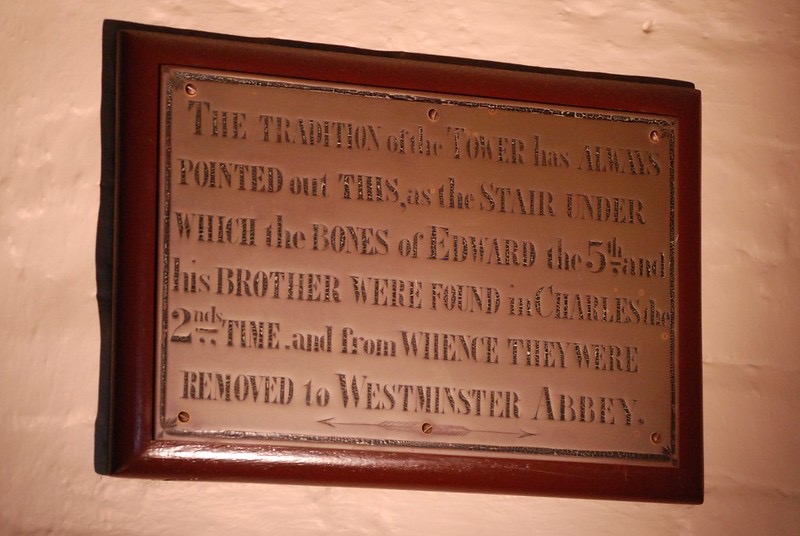
King Charles II had ordered the demolition of what was left of the royal palace to the south of the White Tower and during those works a wooden chest containing two skeletons was discovered beneath the foundations of a staircase which had led up to St John’s Chapel.
Many have subsequently believed the skeletons to be those of the two princes.
A plaque located near the staircase remnant at the Tower of London. PICTURE: Ian McKellar (licensed under CC BY-SA 2.0)
The princes had been taken to the tower in April, 1483, following the death of their father, King Edward IV, on the 9th of that month. Their uncle, Richard, Duke of Gloucester (and the Lord Protector of his nephews), had done so, ostensibly for their protection, while Edward’s coronation was initially scheduled for June.
The last recorded reference to them being in the tower dates from 16th June when they were seen “shooting [arrows] and playing in the garden of the Tower sundry times”.
There has since been much debate over their fate with many believing Richard, who in July of that year was crowned King Richard III, had them murdered to ensure his own ascension to the throne.
The two skeletons found almost 200 years later were put on display for several years following their discovery before King Charles II ordered that they be placed in an urn and reburied in the Henry VII Chapel in Westminster Abbey. In 1933, they were disinterred and forensically examined by LE Tannery and W Wright who concluded they were the skeletons of two boys, aged 10 and 13. They were subsequently reinterred and have remained buried since. They have never been tested for DNA.
Historic Royal Palaces Chief Curator Lucy Worsley and special guests will look at the question of whether the urn should be opened and the bones tested using modern forensic methods in an online event on 16th March at 7pm. Follow this link to register for this event.
WHERE: Tower of London (nearest Tube station Tower Hill); WHEN: 9am to 4.30pm (last admission), Tuesday to Saturday, 10am to 4.30pm (last admission) Sunday to Monday; COST: £29.90 adults; £14.90 children 5 to 15; £24 concessions (family tickets available; discounts for online purchases/memberships); WEBSITE: www.hrp.org.uk/toweroflondon/.
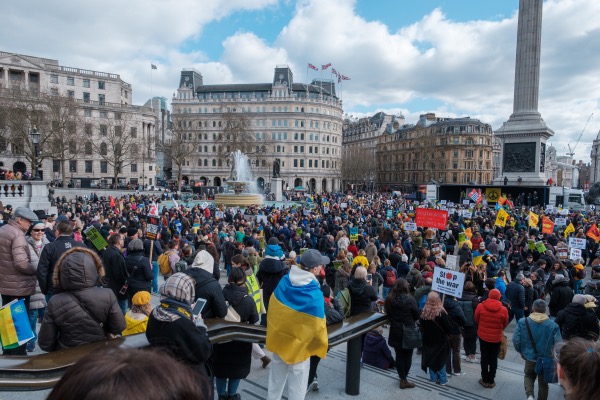
Demonstrations in support of Ukraine have taken place in numerous places in London since Russia launched its invasion on 24th February, including in Trafalgar Square.
The DLR, or Docklands Light Rail, is a driverless train network connected to the Tube system.
The DLR, which is located at the eastern end of the city, connects to the Tube network at numerous stations including Bank, Tower Gateway and Canary Wharf. It reaches as far south as Lewisham, east to Beckton and Woolwich Arsenal and north to Stratford International.
The 24 mile-long network, which first opened on 31st August 1987 and has since been extended numerous times, has 45 stations. It also provides connections to the Emirates Air Line and London City Airport.
The DLR trains run from around 5.30am to around 12.30am from Monday to Saturday with Sunday services starting later and finishing earlier.
The fares are the same as the Tube and you can use Oyster cards.
In the 2019/2020, the line hosted more than 115 million passenger journeys.
• Some of the most iconic images of the Royal Family can be seen in a new exhibition opening at Kensington Palace on Friday.Life Through A Royal Lens features images taken by renowned photographer Cecil Beaton, Norman Parkinson, Rankin and Annie Leibovitz as well as images taken by members of the Royal Family such as celebrated photographer Antony Armstrong-Jones – later Lord Snowdon, husband of Princess Margaret. The display includes an examination of Queen Victoria and Prince Albert’s patronage of photography during its infancy, how Beaton’s work helped create a fairytale-like image of the young Queen Elizabeth II as both a sovereign and modern mother, and how, with reference to iconic magazine photoshoots including the Duke of Cambridge’s cover of Attitude Magazine and the Duchess of Cambridge’s centenary issue of British Vogue in 2016, photography and image remain central to the public’s perception of the modern Royal Family today. Juxtaposed with these images will be select photos taken by members of the public as they captured members of the Royal Family performing their official duties. Runs until 30th October. Included in palace admission. For more, see www.hrp.org.uk/kensington-palace/whats-on/life-through-a-royal-lens/.
3D Capture Mesh Optimisation of the Chapel of Saint Nicholas in the Church of San Benedetto al Po, Mantua, Italy created by ScanLAB projects, commissioned by The National Gallery
• A 16th century altarpiece is being reunited with the Italian chapel for which it was originally created through a new digital experience at The National Gallery. Using virtual reality headsets, visitors will be able to see Veronese’s painting, The Consecration of Saint Nicholas, in its original setting in the Church of San Benedetto al Po, near Mantua, in 1562. There is a choice of two virtual guides – National Gallery curator, Dr Rebecca Gill, who explores the painting and frescoes, or the historical figure of Abbot Asola, who commissioned the painting from Veronese and in his discussion reveals the threat facing the monastery at the time. Admission is free but a ticket is required. Virtual Veronese until 3rd April. For more, see www.nationalgallery.org.uk/exhibitions/virtual-veronese.
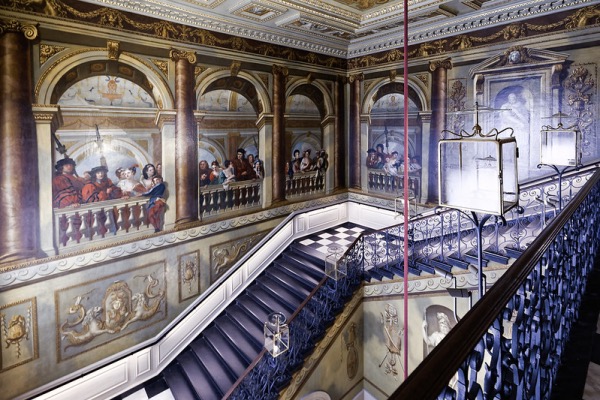
This staircase, a grand entrance to the King’s State Apartments at Kensington Palace, are famous for the paintings on the walls and ceiling which depict an 18th century court looking down on those who ascend.
The work of William Kent, the staircase paintings were complete in 1724 and replaced earlier wooden panelling.
The stairs were originally constructed as part of Sir Christopher Wren’s remodelling Nottingham House into Kensington Palace for King William III and Queen Mary II. Following a fire in 1691, they were rebuilt in marble.
There are 45 people in Kent’s painting and only about a dozen have been identified. As well as members of the Yeomen of the Guard, the images depict King George I’s Polish page Ulric, his Turkish servants Mahomet and Mustapha, Peter the ‘wild boy’, a child found in the woods in Germany, and Dr John Arbuthnot, a medical doctor and satirist who tried to teach Peter to speak.
Interestingly, Kent included a selfie on the ceiling – a depiction of himself, wearing a brown turban and carrying an artist’s palette, standing with his mistress by his side.
The trompe l’oeil (a technique which creates the optical illusion of 3D) work features architecture inspired by Rome where Kent had trained while there’s also a painted figure of Diana on the top landing which is based on an antique statue at Holkham Hall in Norfolk.
In 1734, Queen Caroline commissioned Kent to rework the stairs to the Queen’s State Apartments. His work there features a Roman-inspired scene again created as a trompe l’oeil. There is also a homage to Queen who is compared to Britannia. The staircase’s balustrade was another by Huguenot ironworker Jean Tijou.
WHERE: The Broad Walk, Kensington Gardens, Kensington (nearest tube stations are High Street Kensington or Queensway); WHEN: Daily 10am to 6pm (last admission 5pm); COST: £16 adult/£12.80 concession/£8 child (Historic Royal Palaces members free); WEBSITE: www.hrp.org.uk/KensingtonPalace.
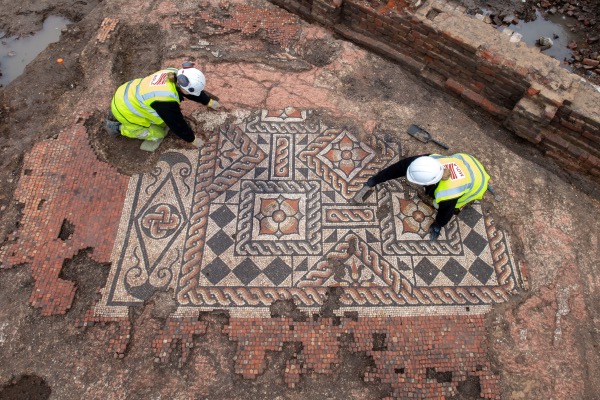
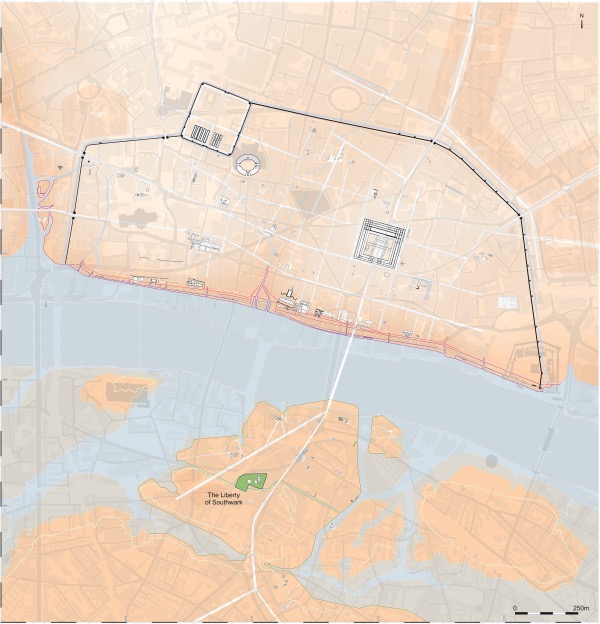
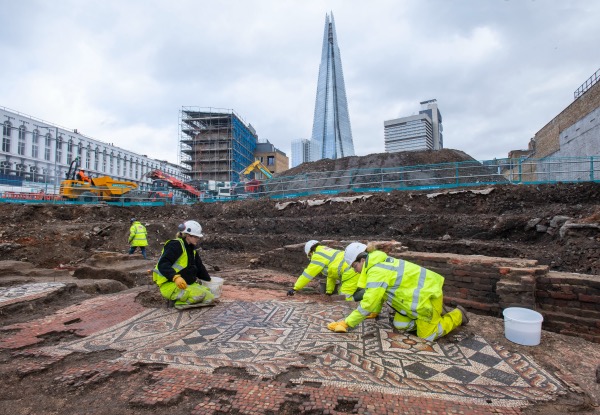
The largest Roman mosaic to be unearthed in London in 50 years has been found near The Shard in Southwark.
The well-preserved mosaic, parts of which are thought to be 1,800-years-old, features two highly decorated panels.
The largest of the two shows large, colourful flowers surrounded by bands of intertwining strands – a motif known as a guilloche – while the design also features lotus flowers and several different geometric elements, including a pattern known as Solomon’s knot which is made of two interlaced loops.
The smaller panel features a simpler design, with two Solomon’s knots, two stylised flowers and striking geometric motifs in red, white and black. Its design is the “almost exact parallel” of a mosaic found in the German city of Trier which suggests a travelling group of artists may have been responsible for both.
The mosaic is believed to be floor of a dining room or ‘triclinium’ of a Roman ‘mansio’, an “upmarket ‘motel'” which offered accommodation, stabling, and dining facilities to people of high rank. The room would have contained couches on which people would have reclined to eat and would have featured brightly painted walls. Fragments of colourful wall plaster have been found on the site as well as traces of an earlier mosaic underneath the one they discovered.
The discovery was made by archaeologists from Museum of London Archaeology (MOLA) during an excavation ahead of building work on a new mixed use development to be constructed on the site, which was previously used as a car park.
MOLA site supervisor, Antonietta Lerz, described the discovery in a statement as a “once-in-a-lifetime find in London”.
“It has been a privilege to work on such a large site where the Roman archaeology is largely undisturbed by later activity-when the first flashes of colour started to emerge through the soil everyone on site was very excited!”
The archaeologists have identified another large Roman building neighbouring the mansio which they believe is likely to have been the private residence of a wealthy individual or family.
Plans for the future display of the mosaic are currently under discussion.
Another ‘oldest’ question that’s not as simple as it might seem.
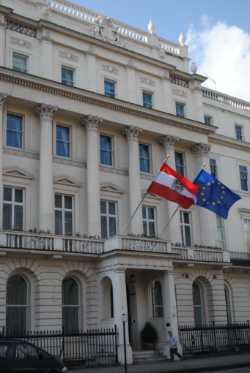
Austrian Embassy, Belgrave Square. PICTURE: David Adams
Austria has occupied a building at 18 Belgrave Square in Belgravia since it moved there from Chandos House in Queen Anne Street in 1866.
But the embassy was vacated with the outbreak of World War I and the building entrusted, firstly to the protection of the ambassador of the United States, and following the severing of their relations in 1917, to the Royal Swedish Legation.
The Austrians returned in 1920 but following Hitler’s incorporation of Austria into the German Reich in 1938, it was used as a department of the German Embassy.
Following the outbreak of World War II, the Swiss legation room over protection of the building and following the end of the war the damaged building fell under the care of Britain’s Ministry of Works.
The Austrians returned in September, 1948, with the new ambassador arriving in 1952. It continues today to serve as the residence of the Austrian Ambassador.
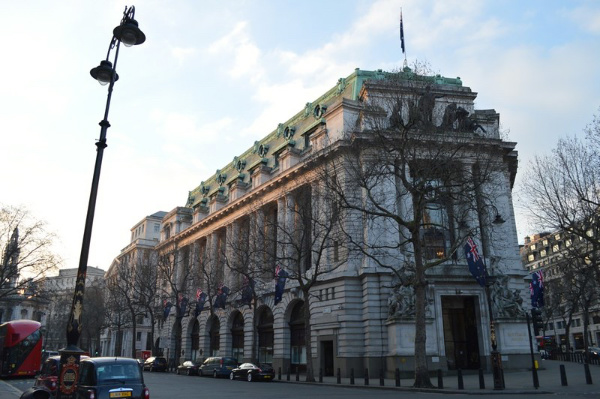
Not to be confused with the Austrians, the Australian High Commission resides in ‘Australia House’ which claims to be “the longest continuously occupied foreign mission in London”.
In 1912, the Australian Government bought the freehold of a site on the corner bounded by Strand, Aldwych and Melbourne Place. Following a design competition, Scottish architects A Marshal Mackenzie and Son were selected as the designers of the new Australia House with Commonwealth of Australia’s chief architect, Mr JS Murdoch, arriving in London to assist them.
Work began in 1913 – King George V laid the foundation stone – but was interrupted by World War I and in 1916, former Australian PM and now High Commissioner Andrew Fisher moved into temporary offices on the site even as the work continued around him. King George V officially opened Australia House on 3rd August, 1918, with then Australian Prime Minister, WM “Billy” Hughes, in attendance.
PICTURE: Simon Dawson / No 10 Downing Street (licensed under CC BY-NC-ND 2.0)
As the world reacts to the Russian attack on Ukraine, on 24th February, Number 10 Downing Street, home of the British Prime Minister, and, below, the Foreign, Commonwealth and Development Office, in Whitehall are lit in the colours of the Ukrainian flag as the UK “stands in solidarity with the people of Ukraine“.
PICTURE: Connor Matheson / No 10 Downing Street (licensed under CC BY-NC-ND 2.0)
• A 5,000-year-old chalk sculpture – described as “the most important piece of prehistoric art to be found in Britain in the last 100 years” – has gone on show at The British Museum as part of its The world of Stonehenge exhibition. The sculpture was unearthed by members of Allen Archaeology during a routine excavation on a country estate near the village of Burton Agnes in East Yorkshire in 2015. Uncovered alongside the burial of three children (it had been placed near the head of the eldest child and included three hastily added holes possibly to represent the children), the sculpture is decorated with elaborate motifs that the museum said “reaffirms a British and Irish artistic style that flourished at exactly the same time as Stonehenge was built”. The sculpture is similar to three barrel-shaped cylinders made of solid chalk – dubbed the ‘Folkton drums’ due to their shape – which have been in the museum’s collection since they were unearthed in the excavation of a child burial in North Yorkshire in 1889. It is thought the items are works of sculptural art rather than intended to serve a practical purpose and were perhaps intended as talismans to protect the children they accompanied. Radiocarbon dating of the Burton Agnes child’s bones identifies the burial as from 3005–2890 BC. The world of Stonehenge can be seen until 17th July. Admission charge applies. For more, see www.britishmuseum.org/stonehenge.
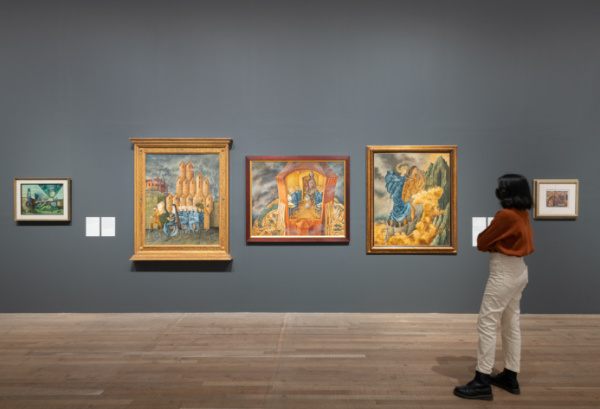
• Spanning 80 years and 50 countries, a new exhibition opening at the Tate Modern today takes an in-depth look at how Surrealism has inspired and united artists around the globe. Surrealism Beyond Borders, running at the Tate in partnership with New York’s Metropolitan Museum of Art, features more than 150 works ranging from painting and photography to sculpture and film, many of which have never been seen in the UK before. Among the highlights Cecilia Porras and Enrique Grau’s photographs, which defied the conservative social conventions of 1950s Colombia, and paintings by exiled Spanish artist Eugenio Granell, whose radical political commitments made him a target for censorship and persecution. There’s also iconic works such as Max Ernst’s Two Children are Threatened by a Nightingale (1924) and lesser known, but significant, pieces such as Antonio Berni’s Landru in the Hotel, Paris (1932), and Toshiko Okanoue’s Yobi-goe (The Call) (1954). Runs until 29th August in the Eyal Ofer Galleries. Admission charge applies. For more, see www.tate.org.uk/whats-on/tate-modern/exhibition/surrealism-beyond-borders.
• A “bold” new artwork by Nigerian-born artist, Victor Ehikhamenor, has gone on display in the crypt of St Paul’s Cathedral. The specially-commissioned mixed-media work is part of 50 Monuments in 50 Voices, a partnership between St Paul’s Cathedral and the Department of History of Art at the University of York which involves inviting contemporary artists, poets, musicians, theologians, performers and academics to respond to 50 historic monuments across the cathedral. Still Standing combines rosary beads and Benin bronze hip ornament masks to depict an Oba (King) of Benin and was made in response to a 1913 brass memorial panel commemorating Admiral Sir Harry Holdsworth Rawson (1843-1910) which is in the Nelson Chamber of the Cathedral’s Crypt. Rawson had a long career in the Royal Navy which culminated in his commanding the Benin Expedition of 1897. The work is on show until 14th May. Admission charge applies. For more, head to https://pantheons-st-pauls.york.ac.uk/50-monuments-in-50-voices/.
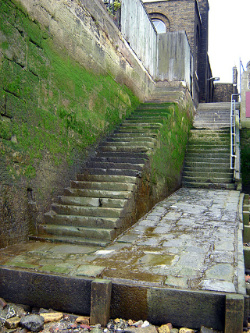
This Thames-side set of stairs gives access to the River Thames from Wapping High Street and is one of few survivors of what was once numerous “watermen’s stairs”.
The Grade II-listed stairs, which are accessed from the top via a narrow passage bearing their names which runs down the side of the Town of Ramsgate pub, were once used to reach boats to carry passengers across the Thames or offload cargo.
The worn stone stairs at Wapping Old Stairs, which the Historic England says may be of earlier origin than the 18th century, are unusual in that there’s two sets of stairs – one set back behind the other.
Many believe the stairs were the location of Execution Dock, where pirates, smugglers and mutineers were executed by hanging including the notorious Captain William Kidd (but there are alternate theories about where the stairs were located).
Other surviving watermen’s stairs go by the names of Alderman Stairs, Pelican Stairs and King Henry’s Stairs (also known as Execution Dock Stairs, thanks to its being another site posited as the location of Execution Dock.)
One of two fountains in Trafalgar Square, this one commemorates Admiral of the Fleet, Earl Beatty, and unveiled by the Duke of Gloucester along with its counterpart commemorating Admoral Earl Jellicoe in 1948. Busts of both admirals can be see in the north wall. The fountain’s bronze sculpture and its counterpart were designed by Sir Charles Wheeler.
Catherine, who it has been suggested may have been just 17-years-old when she died, was beheaded on the morning of 13th February, 1542, less than two years after her hastily arranged marriage to the King, just three weeks after his prior marriage to Anne of Cleves was annulled.
Catherine, also spelt as Katherine, was condemned to death after a young noble named Francis Dereham admitted, under torture, to having a sexual relationship with her prior to her marrying the king, and, more importantly, Thomas Culpeper, a Gentleman of the King’s Privy Chamber, who admitted to having an affair with her after her marriage.
Both men were executed at Tyburn following their admissions and their heads were displayed on London Bridge. Catherine sailed under it aboard a barge as she was taken to the Tower on 10th February, 1542.
She is said to have spent the night before her execution practising placing her head on the block – which was brought to her at her request.
Catherine was beheaded with the single stroke of a headsman’s axe on Tower Green – King Henry did not attend but some of her cousins, including the Earl of Surrey, were among the witnesses.
She was said to have been composed, although she needed help mounting the scaffold. It’s often said that her last words were “I die a Queen, but I would rather have died the wife of Culpeper” but there’s no eyewitness report which suggests this and instead she is believed to have stuck to a more traditional script, saying her punishment was just for her crimes and asking forgiveness.
Her maid – Jane Boleyn, Lady Rochford – followed her to the block for her role in facilitating the affair while Henry was away from court. Catherine had apparently spent the night before practising how to lay her head upon the block.
Catherine was buried in an unmarked grave at in the Chapel of St Peter ad Vincula next to Tower Green – there’s a memorial to her in the church. The Queen’s ghost is famously said to be present in what’s known as the ‘Haunted Gallery’ at Hampton Court Palace – it is here that, when she was arrested, she apparently broke free from her guards and ran to the doors of the Chapel Royal where she believed the king was at prayer. Needless to say, her cries for mercy went unanswered.
Memorial stone set in the floor of the Chapel of St Peter ad Vincula. PICTURE: VCR Giulio19/Wikipedia (licensed under CC BY-SA 4.0)
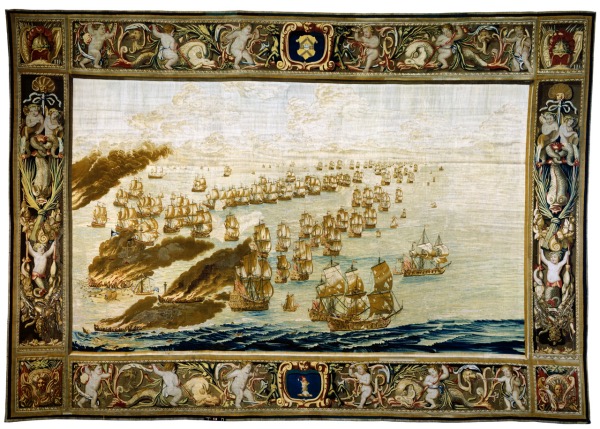
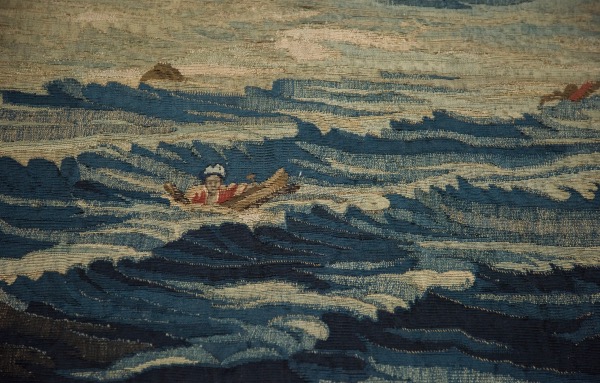
A monumental tapestry – and the only surviving one of its era depicting an English naval scene, the Solebay Tapestry was actually one a series of six designed by father and son team, Willem Van de Velde the Elder and Younger.
Commissioned by King Charles II and his brother, James, Duke of York (later King James II), the tapestry – known as The Burning of the Royal James at the Battle of Solebay, 28 May 1672 – commemorates the Battle of Solebay, a naval battle fought in Southwold Bay off the coast of Suffolk on 28th May, 1672. The first battle of the Third Anglo-Dutch War, it ended with both sides claiming victory and was the final naval battle in which James was engaged.
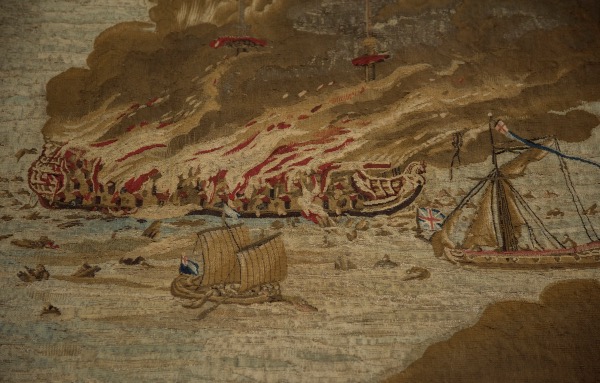
It depicts the dramatic climax of the battle and shows the Royal James engulfed in flames after it wasset alight by Dutch fireships. Edward Montagu, the first Earl of Sandwich whose was aboard the Royal James, died in the attack.
William Van de Veldes the Elder, who was a contemporary of Rembrandt and, along with his son, is considered the founder of English maritime painting, was present at the battle and made a series of sketches from a boat at the scene (he was actually there for the Dutch, not the English).
Subsequently commissioned to reimagine the battle from the English point-of-view, it was the studios of the Van de Velds in the Queen’s House in Greenwich that a series of ‘cartoons’ – large-scale paper designs – were produced using the sketches.
These were then presented to weavers who, once thought to have been based in Mortlake but now believed to have been based in either at Clerkenwell or Hatton Garden, used them to create the tapestries.
The tapestry in the collection of Royal Museums Greenwich was displayed behind King George VI during his speech at the opening of the National Maritime Museum in 1937 but hasn’t been able to be displayed for the past 22 years due to its fragile condition.
In urgent need of repair, the first phase of a conservation project was completed last year. Royal Museums Greenwich has now launched an urgent crowdfunding campaign through ‘Art Happens with Art Fund’ to raise £15,000 for the completion of the project. This will mean the tapestry can be included in an exhibition at the Queen’s House next February marking 350 years since the Van de Veldes’ arrival in England.










 Exploring London