This Week in London – RNLI’s first HQ commemorated; “weird and wonderful” birds; and, Princess Diana in photographs…

The City of London has unveiled a new blue plaque commemorating the Royal National Lifeboat Institution which is this year marking its 200th anniversary. The plaque is on the Furniture Makers’ Hall in Austin Friars which is where the organisation has its first headquarters from 1824 to 1826. The plaque was unveiled by the Lord Mayor of London, Professor Michael Mainelli. The RNLI, which today operates 238 lifeboat stations in the UK and Ireland including four on the River Thames, was founded by Sir William Hillary in the City of London Tavern in Bishopsgate on 4th March, 1824, and early meetings were held at various addresses until it moved into 12 Austin Friars. Meanwhile, ‘Ian Visits’ reports that a new plaque has also been installed at Limehouse Basin to commemorate Lifbåt 416 which was built there by Forrestt & Son’s boatyard in 1868 and sent as a gift to the King of Sweden, Karl XV. The Lifbåt 416, which has been restored, returned to Limehouse Basin this week after attending RNLI commemorations in Poole, Dorset (where it was the oldest lifeboat to take part in a mile-long flotilla).

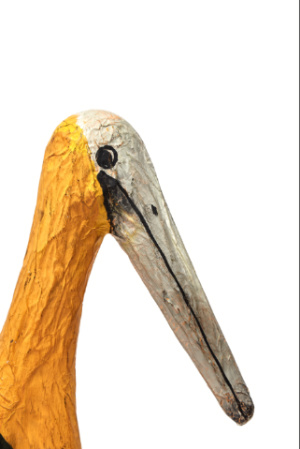
Hargila army papier-mache headdress close up. PICTURE: Courtesy of Natural History Museum

The “weird and wonderful” ways birds have adapted to survive are celebrated in a new exhibition at the Natural History Museum. Birds: Brilliant and Bizarre, which opens at the South Kensington institution on Friday, has been created in partnership with the Royal Society for the Protection of Birds and features installations and hands-on exhibits which allow visitors to feel how fast a hummingbird’s heart beats when in flight, smell the strange oil one bird uses to protect its eggs and listen to the sound of a dawn chorus of birds in the year 2050. Objects on show include the ‘Wonderchicken’ – the oldest known fossil of a modern bird, a replica of a stork that flew across the world from the African continent with a spear lodged in its neck, and a headdress of the ‘Hargila army’ (pictured), a group of women in the Indian state of Assam who work to protect one of the world’s rarest storks. Admission charge applies. Runs until 5th January. For more, see www.nhm.ac.uk/visit/exhibitions/birds-brilliant-bizarre.html.

A walk-through photographic exhibition featuring some of the most iconic photos of Princess Diana opens on Saturday. Princess Diana: Accredited Access features 75 life-sized photographs by her official royal photographer, Anwar Hussein, and his two sons – Samir and Zak – which include behind the scenes access. The exhibition at the Dockside Vaults, St Katharine Docks, runs until 2nd September. Admission charge applies. For more, see www.princessdianaexhibit.com.

Send all items to exploringlondon@gmail.com.

Lost London – Merton Priory…

Little remains of this priory which once stood on the banks of the River Wandle in Surrey (and is now encompassed in Greater London).

The priory, which was founded as an Augustinian house in the early 12th century, rose to become one of the most influential in all of southern Britain.

The institution was created thanks to Gilbert, the Sheriff of Surrey, Huntington and Cambridge, who was granted the village of Merton by King Henry I. Gilbert came to live in Merton and there established a priory, building a church and small huts on land thought to be located just to the west of where the priory was later located.

Gilbert had been impressed with what he’d seen of the Augustinians, also known as the Austin friars, at Huntington and so gave control of the new church to their sub-prior, Robert Bayle, along with the land and a mill.

It was based on Bayle’s advice that the site of the priory was then moved to its second location and a new, larger wooden chapel built with William Gifford, Bishop of Winchester, coming to bless the cemetery. The canons – there were now 17 – moved in on 3rd May, 1117.

Among the high profile people to visit the new priory was Queen Matilda, who brought her son William with her. In the early 1100s, a certain Thomas Becket (later the ill-fated Archbishop of Canterbury) received an education here as did Nicolas Breakspeare (later the first English Pope, Adrian IV).

The priory expanded considerably over the next century and in 1217 its chapter house was the location of a peace conference between King Henry III and Louis, the Dauphin of France. The Statutes of Merton – a series of legal codes relating to wills – were formulated here in 1236.

The connection with royalty continued – in the mid-1340s, King Edward III is thought to have passed the Feast of the Epiphany here while King Henry VI apparently had a crowning ceremony here – the first outside of Westminster Abbey for more than 300 years – in 1437.

The priory remained in use until the Dissolution of King Henry VIII. The demolition of the buildings apparently started even before the priory had been formally surrendered to the commissioners – stones from its building was used in the construction of Henry’s new palace – Nonsuch – as well as, later, in the construction of local buildings.

The site came to be referred to as ‘Merton Abbey’ and, passing through various hands, was used to garrison Parliamentarian troops during the Civil War. It later became a manufacturing facility, works for the dying and printing of textiles, one of which became the workshops of William Morris.

Some of the priory buildings survived for some years after but the only remains now left as sections of the perimeter wall (the arch which now stands over the entrance to Merton parish church is reconstructed – there’s another ornamental gateway in the outer court wall which was also replaced with a replica in the 1980s).

The foundations of the unusually large chapter house, meanwhile, have been excavated and are now preserved in a specially constructed enclosure under a roadway. Construction is now underway to build better public access to the remains.

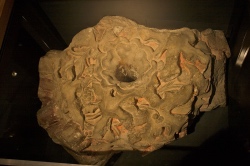
PICTURE: A ceiling boss from Merton Priory which still bears traces of its original red paint and guilding. It was found during excavations at Nonsuch Palace in 1959-60 is now on display in the Museum of London. Photograph by Mike Peel (www.mikepeel.net) (licensed under CC-BY-SA-4.0).

Famous Londoners – Dr Richard Mead…

Eighteenth century physician Dr Richard Mead is noted not only for his attendance on the rich and famous of his time – including royalty – but also for his philanthropy, his expansive collections and, importantly, his contributions in the field of medicine.

Born in Stepney, London, on the 11th August, 1673, as the 11th of 13 children of nonconforming minister Matthew Mead, Mead studied both Utrecht and Leiden before receiving his MD in Italy. Returning to England in 1696, he founded his own medical practice in Stepney.

He married Ruth Marsh in 1699 and together the couple had at least eight children, several of whom died young, before her death in 1720 (he subsequently married again, this time to Anne, daughter of a Bedfordshire knight, Sir Rowland Alston).

Having published the then seminal text – A Mechanical Account of Poisons – in 1702, the following year Mead was admitted to the Royal Society. He also took up a post as a physician at St Thomas’ Hospital, a job which saw him move to a property in Crutched Friars in the City – his home until 1711, when he relocated to Austin Friars.

It was after this that he become friends with eminent physician John Radcliffe who chose Mead as his successor and, on his death in 1714, bequeathed him his practice and his Bloomsbury home (not to mention his gold-topped cane, now on display at the Foundling Museum – see note below).

Following Radcliffe’s death, in August of that year Dr Mead attended Queen Anne on her deathbed. Other distinguished patients over his career included King George I, his son Prince George and daughter-in-law Princess Caroline – in fact he was appointed as official physician to the former prince when elevated to the throne as King George II – as well as Sir Isaac Newton, lexicographer Dr Samuel Johnson, Alexander Pope, Sir Robert Walpole and painter Antoine Watteau.

Mead, who had been named a governor of St Thomas’ in 1715 and elected a fellow of the Royal College of Physicians in 1716, was over the years recognised as an expert in a range of medical fields – including, as well as poisons, smallpox, scurvy and even the transmission of the plague.

Among the many more curious stories about Dr Mead is one concerning a ‘duel’ (or fistfight) he apparently fought with rival Dr John Woodward outside Gresham College in 1719 over their differences in tackling smallpox and others which concern experiments he conducted with venomous snakes to further his knowledge of venom before writing his text on poisons.

Dr Mead was also known for his philanthropy and became one of the founding governors of the Foundling Hospital (as well as being its medical advisor) – a portrait of him by artist Allan Ramsay (for whom he was a patron), currently hangs at the museum.

Dr Mead, who by this stage lived in Great Ormond Street in Bloomsbury (the property, which backed onto the grounds of the Foundling Museum and which Mead had moved into after his first wife’s death, later formed the basis of the Great Ormond Street Hospital for Children), is also noted for the large collection he gathered of paintings – including works by Dürer, Holbein, Rembrandt, and Canaletto, a library of more than 10,000 books, antiquities and classical sculpture as well as coins and jewels, all of which scholars and artists could access at his home (it took some 56 days to sell it all after his death).

While Dr Mead – who died on 16th February, 1754 – was buried in the Temple Church, there is a monument to him – including a bust by Peter Scheemakers – in the north aisle of Westminster Abbey.

Dr Mead is currently being honoured in an exhibition at the Foundling Museum – The Generous Georgian: Dr Richard Meadwhich runs until 4th January. There’s an accompanying blog here which provides more information on his life and legacy.