10 London locations related to Sir Christopher Wren…5. London coffee houses…

Sir Christopher Wren was apparently a frequent visitor to London’s burgeoning coffee houses in the late 17th and early 18th centuries.
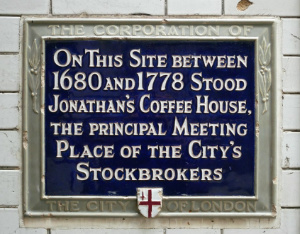
A plaque in the City of London marking the former site of Jonathan’s Coffee House in Exchange Alley. PICTURE: Ethan Doyle White (licensed under CC BY-SA 4.0)

Wren apparently started visiting coffee houses during his time in Oxford (the first in England is said to have opened there in 1652; the first in London – Pasqua Roseé’s premises st Michael’s Alley off Cornhill – opened late that same year) and continued to do so in London.

While it’s hard to pin down those he preferred, he reportedly met Robert Hooke at Man’s Coffee House in Charing Cross. The premises was apparently frequented by stockjobbers.

Wren was in good company attending such premises – other luminaries known to have done so at the time include diarist and naval administrator Samuel Pepys, John Locke, Edmund Halley, John Dryden and Alexander Pope.

Among other prominent coffee houses at the time was Jonathan’s – where in, 1698, the London Stock Exchange was born – and Garraway’s Coffee House, both of them located in Exchange Alley, as well as Button’s in Covent Garden.
Lost London – Button’s Coffee House…

This Covent Garden establishment was founded by Daniel Button, a former servant in the household of the Countess of Warwick, in about 1712.

Button was apparently set up in the Russell Street business, located close to the Covent Garden Market, by newspaper writer and publisher Joseph Addison (who would marry the countess, Charlotte, in 1716) who, setting the example by giving the new premises his personal patronage, ensured it attracted a clientele of “wits” and intellectuals.

These had apparently previously frequented Will’s Coffee House which was located across the street from it but after the death of John Dryden, who was at the centre of this cloud, in 1700, the reputation of Will’s dropped. Enter Button’s.

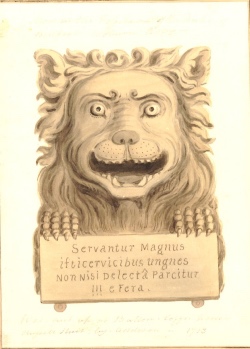
The coffee house was particularly famous for a white marble letterbox in the shape of a lion’s head, said to have been designed by William Hogarth, which was nailed to the wall.

The concept had been imported from Venice where stone letterboxes, often carved into the shape of grotesque heads, were used by the governing body known as the Council of Ten to gather intelligence (and which informers would use to accuse fellow citizens of misdeeds).

People were encouraged to throw letters, limericks and other witty ephemera into the lion’s mouth, the best of which were then selected and published in Addison’s Guardian newspaper each week (Addison was also, famously, co-founder of The Spectator).

Daniel Button died in 1730 and the coffee house closed in 1751 after which the lion’s head was taken to the Shakespeare Tavern before going on to grace several establishments before the Duke of Bedford apparently took it to his country house at Woburn.

PICTURE: A carved lion’s head, with a tablet on which is engraved “Servantur Magnus ifticerbicibus ungues non nisi Delectâ Parcitur !!! e Fera”; originally displayed at Button’s coffee house. c1850 Watercolour, possibly by Thomas Hosmer Shepherd © The Trustees of the British Museum (licensed under CC BY-NC-SA 4.0)