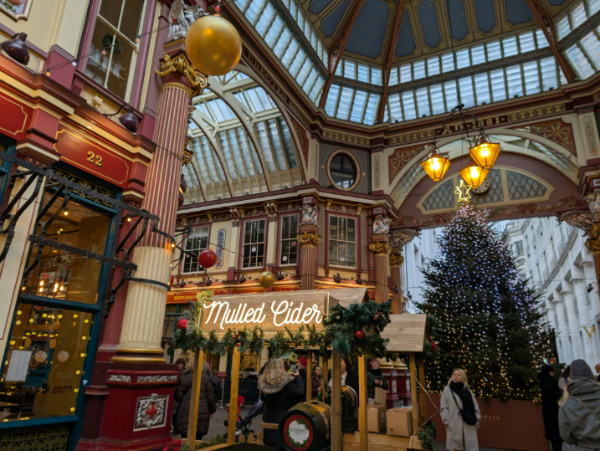
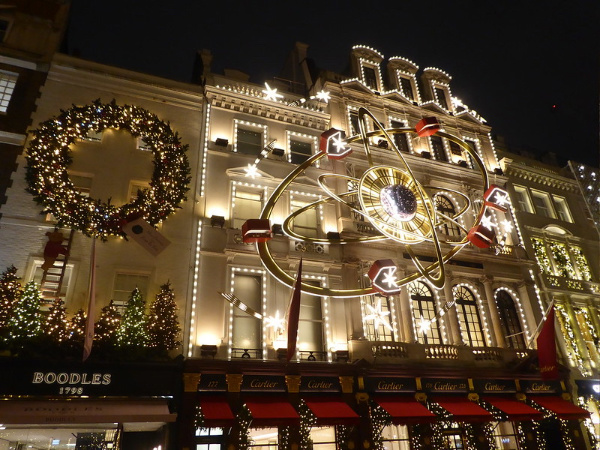
Cartier with a cosmic display in New Bond Street. PICTURE: JuliaC2006 (licensed under CC BY 2.0)
Cartier with a cosmic display in New Bond Street. PICTURE: JuliaC2006 (licensed under CC BY 2.0)

Said to be the largest collection of Merchant Navy ship figureheads in the world, the figurehead collection was that of Sydney Cumbers, nicknamed “Long John Silver” due to the eye-patch he wore after a childhood accident.
A successful businessman, Cumbers built up a significant collection of more than 100 figureheads – carved wooden figures which decorated the prows of sailing ships, which he and his wife – The Mate – kept along with a larger collection of maritime memorabilia at their residence in Kent nicknamed ‘The Look-Out’ (which features rooms named after parts of a ship).
In 1953, he donated the collection to the Cutty Sark a restoration of which had recently been completed so it could be opened to the public.
The figureheads, which are made from a variety of woods including oak and teak, date mostly from the 19th century. They depict a range of characters, some anonymous, and others taken from history and myth.
The latter include everyone from Sir Lancelot, the classical warrior Thermopylae and Hiawatha to Elizabeth Fry, Florence Nightingale and William Wilberforce. Others feature political figures such as Benjamin Disraeli, William Pitt and William Gladstone.
The collection is dedicated to the merchant seamen of Great Britain and the flotilla of small ships that rescued the British Expeditionary Force from Dunkirk in 1940.
Almost destroyed in a May, 2007, fire, the Cutty Sark, the world’s last surviving 19th century tea clipper, is now a major international tourist attraction (although no longer in the Thames but on a dry dock beside the river).
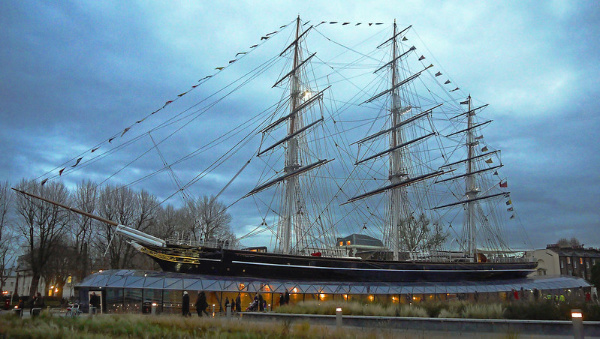
The Cutty Sark was built in Dumbarton, Scotland, in 1869, for shipping company Willis & Sons.
Designed by Hercules Linton specifically for the China tea trade (meaning with speed in mind), she cost some £16,150 and featured some 32,000 square feet of sails, a staggering 11 miles of rigging with a main mast standing 153 feet high and a hull sheathed in a copper and zinc alloy to prevent damage.
Her name was taken from a Robert Burns poem, Tam o’ Shanter, in which a witch is given the nick-name Cutty-sark because of the short undergarment – in 18th century Scots, a “cutty-sark” or “little shirt” – that she wore (the vessel’s figurehead is a representation of the witch).
On her maiden voyage, the Cutty Sark departed from London on 15th February, 1870, bound for Shanghai and carrying a general cargo including wine, spirits and beer and manufactured goods. Reaching its destination on 31st May, it then returned to London, arriving on 13th October laden with 1,305,812 lbs of tea.
It subsequently made another seven trips to China, collecting its last tea cargo in 1877. Unable to source further tea cargoes, the ship was then used to transport different cargoes to various destinations around the world including everything from coal and gunpowder, to jute, whiskey and buffalo horns.
There was a tragic episode aboard the ship in 1880 when the First Mate Sidney Smith killed seaman John Francis. Smith was confined by Captain James Wallace then helped him escape at Anger in Indonesia. The crew refused to work as a result and Wallace decided to continue the voyage with just six apprentices and four tradesmen but when the ship was becalmed in the Java Sea for three days, he committed suicide by jumping overboard. Wallaces was replaced by William Bruce but a later inquiry suspended him from service because of his incompetence.
While it was never the fastest ship on the tea trade (although it came close on return journey from Shanghai before a rudder mishap in 1872), it did establish itself between the mid-1880s and early 1890s as the fastest ship in the wool trade.
But with steamships starting to dominate the wool trade, in 1895, the Cutty Sark was sold to Portuguese firm J Ferreira & Co and, renamed the Ferreira, spent the next 20 years transporting cargoes between ports including Oporto, Rio, New Orleans and Lisbon.
Damaged during a storm in 1916, the clipper was subsequently converted into a barquentine in Cape Town, South Africa, and then sold in 1920 to Wilfred Dowman, a retired windjammer skipper and owner of the training ship Lady of Avenel.
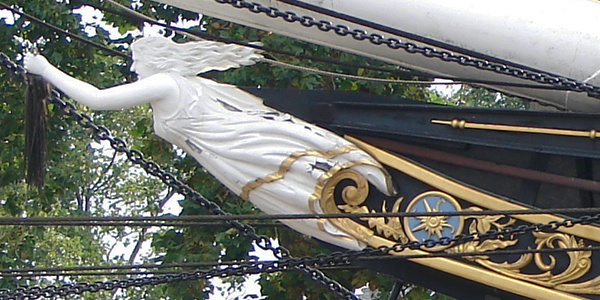
Her former name now restored, Dowman set about restoring the ship – now docked at Falmouth in Cornwell – back to being a tea clipper and using her as a cadet training ship.
Following Dowman’s death in 1936, the Cutty Sark was given to the Incorporated Thames Nautical Training College, Greenhithe, Kent, where she was used as an auxiliary vessel for the cadet training ship HMS Worcester.
The Cutty Sark was sent to London and moored in the Thames for the 1951 Festival of Britain before returning to Greenhithe.
The deteriorating state of the ship led to the formation of The Cutty Sark Society and in a ceremony held just before the coronation of Queen Elizabeth II, Prince Philip, patron of the society, took possession of the ship on its behalf.
In December, 1954, the ship was towed to a specially constructed dry dock at Greenwich and after three years of restoration work was opened to the public by Queen Elizabeth II in 1957.
The ship has remained there ever since. In November 2006, the ship’s rig was dismantled in preparation for a restoration project but a fire broke out aboard the ship on 21st May, 2007, and almost destroyed it.
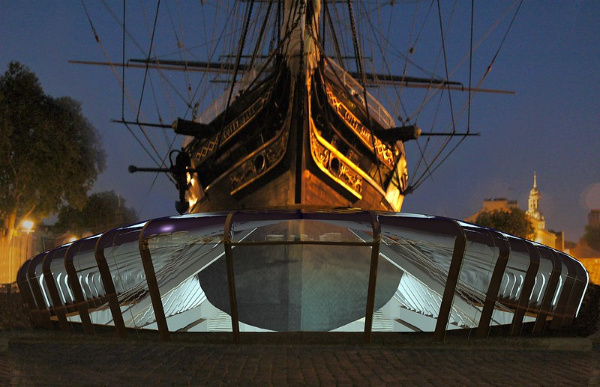
Following a major restoration and development project which saw the lower part of the ship, from the waterline down, encased in glass, it was officially reopened by Queen Elizabeth II and Prince Philip on 25th April, 2012. It is now under the operational management of Royal Museums Greenwich.
WHERE: The Cutty Sark, King William Walk, Greenwich (nearest DLR is Cutty Sark; nearest overground stations are Greenwich and Maze Hill); WHEN: Daily 10am to 5pm; COST: £18 adults; £9 children; WEBSITE: www.rmg.co.uk/cuttysark.
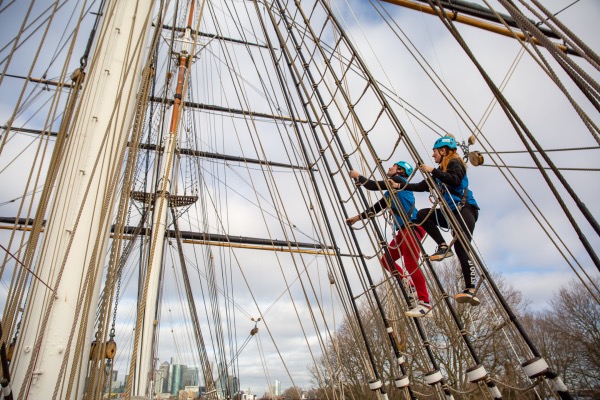

Visitors to the Cutty Sark now have the opportunity to climb the ship’s rigging for the first time since the ship arrived in Greenwich in 1954. The ‘Rig Climb Experience’, which was launched last weekend, sees those bold enough to do so stepping up from the main deck onto the ship’s ratlines, climbing up its shrouds and traversing one of the ship’s lower yardarms to reach the tops platform where they’ll be able to take in magnificent views over Greenwich and The Thames. One of the fastest tea clippers of its day, the Cutty Sark – which was built in Dumbarton in 1869 – had more than 11 miles of rigging, 32 sails with an original sail area of 32,000 square feet, and a 152 foot main mast. Prices start at £41 for adults and £26 for children for a ‘Standard Rig Climb’ and £51 for adults and £36 for children for the Rig Climb Experience Plus. For more, head to www.rmg.co.uk/cuttysark.

• London’s first new River Thames embankment in 150 years has been named after Joseph Bazalgette, the Victorian civil engineer who revolutionised London’s sewer system. The ‘Bazalgette Embankment’ is located alongside Victoria Embankment, to the west of Blackfriars Bridge, and includes a new City Walkway as well as open space for recreation and leisure activities. Bazalgette’s sewer design led to cleaner water in the Thames and was also responsible for helping to eliminate cholera outbreaks in the city. The embankment is one of seven new embankments which will be opened as part of the Thames Tideway Tunnel project due for completion in 2024.
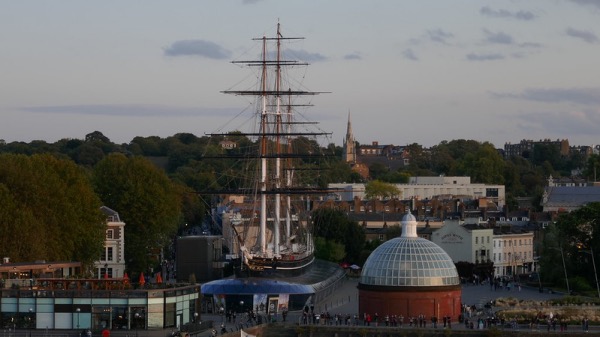
• Greenwich landmark, Cutty Sark, reopens to visitors on Monday, 20th July. Other reopened institutions include the Royal Academy of Arts, The Foundling Museum, The Wallace Collection and Somerset House.
PICTURE: Christine McIntosh (licensed under CC BY-ND 2.0)
Send all items for inclusion to exploringlondon@gmail.com.

• An autonomous flying car is among exhibits at a new exhibition focusing on the automobile at the V&A on Saturday. The flying car is one of 15 vehicles in Cars: Accelerating the Modern World which also features the first production car in existence – a 1925 Ford Model-T, a converted low-rider and a Firebird I concept car from 1953 (pictured). There’s also 250 associated objects to see – everything from a 1920s cloche hat designed for car travel to a series of hood ornaments produced by René Jules Lalique in the 1920s and a Michelin travel guide from 1900 – in an examination of how the car changed our relationship to speed, the way we make and sell, and the landscape around us. Runs until 19th April. Admission charge applies. For more, see www.vam.ac.uk. PICTURE: General Motors Firebird I (XP-21) © General Motors Company, LLC
• The 150th anniversary of the launch of tea clipper, Cutty Sark, is being celebrated in Greenwich this weekend. Along with family friendly events including face painting, storytelling and craft, there will be an after dark anniversary classical concert and bespoke birthday cupcakes in the cafe. Admission charge applies (except for the 150th visitor who will go free as well as residents of Greenwich and Dumbarton, where the ship was built in 1869 – provided they have ID). For more, see www.rmg.co.uk/cuttysark
• Artists, designers and architects from across the globe come together in a new exhibition at the Royal Academy addressing humanity’s ecological impact on the planet. Eco-Visionaries features works by 21 international practitioners in a range of media including film, sculpture, immersive installation, architectural models and full-scale prototypes. Highlights include the UK debut of the Rimini Protokol’s win > < win (2017) featuring a tank of live jellyfish, Alexandra Daisy Ginsberg’s The Substitute (2019) in which visitors come face-to-face with a life-size digital reproduction of the now extinct northern white rhinoceros, Danish-Icelandic artist Olafur Eliasson’s The ice melting series (2002), and New York-based architecture studio WORKac’s 3.C.City: Climate, Convention, Cruise (2015). Admission charge applies. Runs until 23rd February. For more, see www.royalacademy.org.uk.
Send all items for inclusion to exploringlondon@gmail.com.
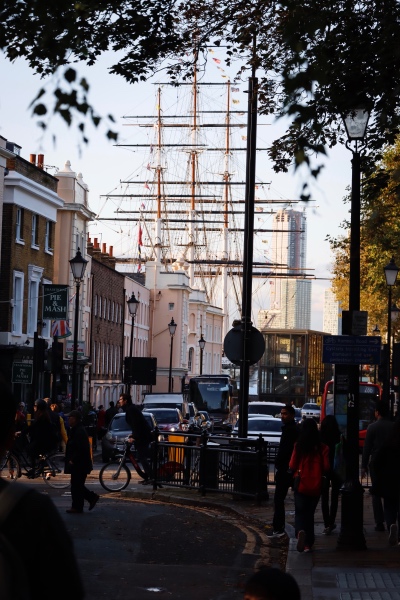
Greenwich with the masts of the Cutty Sark in the background. PICTURE: Robert Likovski/Unsplash
The boat on this iconic Greenwich pub’s sign probably gives the game away here – the Gipsy Moth is named after a yacht of the same name.
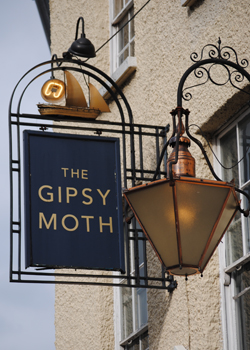 The Gipsy Moth IV was sailed single-handedly around the globe by Sir Francis Chichester, then aged in his 60s, in 1966-67, who broke numerous records as he did so including the fastest voyage around the world by any small vessel, the longest non-stop passage by a small vessel and what was then the longest single-handed passage.
Following the death of Sir Francis on 26th August, 1972 (he had been knighted by Queen Elizabeth II on the steps of the Old Royal Naval College using the same sword that had knighted Sir Francis Drake in the presence of Queen Elizabeth I in 1581), the boat was put on display in a Greenwich dry dock next to the Cutty Sark. Initially open to the public, it was later closed due to deterioration.
Following a restoration in the early Noughties, in 2006 the Gipsy Moth IV was again sailed around the world (on a trip that wasn’t always smooth sailing) to mark the 40th anniversary of Sir Francis’ journey. It is now owned by a charitable trust based in Cowes on the Isle of Wight.
The renovated pub, located at 60 Greenwich Church Street next to the Cutty Sark, is situated in a building which dates from the late 18th century. It apparently changed its name from the Wheatsheaf in the mid-1970s apparently to mark the arrival of the Gipsy Moth IV.
The pub features a beer garden with views of the Cutty Sark. For more information, see www.thegipsymothgreenwich.co.uk.
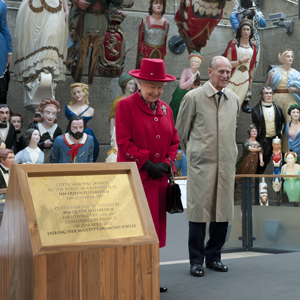 • The Cutty Sark, the world’s last surviving 19th century tea clipper, reopens to the public today following a £50 million, six year conservation project. The project to restore the Greenwich-docked ship has involved raising it more than three metres so visitors can walk underneath and see for themselves the sleek lines which helped the vessel set a then record-breaking speed of 17.5 knots or 20mph in sailing from Sydney to London. As well as raising the ship three metres, the project has involved encasing the ship’s hull in a glass casing to protect it from the weather – this area also contains the museum’s extensive collection of more than 80 ships’ figureheads, never been seen in its entirety on the site. The ship’s weather deck and rigging, meanwhile, have been restored to their original specification and new, interactive exhibitions on the vessel’s history have been installed below deck. Originally launched in 1869 in Dumbarton, Scotland, Cutty Sark visited most major ports around the world, carrying cargoes including tea, gunpowder, whiskey and buffalo horns and made its name as the fastest ship of the era when carrying wool between Australia and England. The ship became a training vessel in the 1920s and in 1954 took up her current position in the dry dock at Greenwich before opening to the public. In November 2006, the ship’s rig was dismantled in preparation for a restoration project – this received a setback on 21st May, 2007, when a fire broke out aboard the ship and almost destroyed it. The ship – which was officially reopened by Queen Elizabeth II and the Duke of Edinburgh (pictured) yesterday – is now under the operational management of the umbrella body, Royal Museums Greenwich. For more (including the online purchasing of tickets), see www.rmg.co.uk/cuttysark or www.cuttysark.org.uk. PICTURE: National Maritime Museum, London.
• A large statue of Genghis Khan has invaded Marble Arch. The 16 foot (five metre) tall sculpture of the Mongolian warlord, created by artist Dashi Namdakov, was erected by Westminster City Council as part of its ongoing City of Sculpture festival which is running in the lead-up to the Olympics. The statue has sparked some controversy – Labour councillors at Westminster have reportedly suggested Dambusters hero Guy Gibson would be a more suitable subject for a statue than the warlord Khan. The Russian artist, who has an exhibition opening at the Halcyon Gallery in Mayfair next month, told the Evening Standard he simply wanted to honor Khan on the 850th anniversary of his birth.
• Development of a new West End theatre, the first to be built in the area in 30 years, has been given the green light. The new 350 seat theatre will be part of a development project located between Charing Cross Road and Oxford Street which will also feature office and retail spaces. The site was occupied by a pickle factory in the 19th and 20th centuries and from 1927 was the home of the Astoria cinema, remodelled as a live venue in the 1980s. Live music was last presented there in 2009 when the site was compulsorily acquired for the Crossrail project.
• On Now: Crowns and Ducats: Shakespeare’s money and medals. This exhibition at the British Museum explores the role of money in Shakespeare’s world and looks at how coins – a frequently recurring motif in Shakespeare’s work – and medals were issued to mark major events. Objects in the display include Nich0las Hilliard’s ‘Dangers Averted’ medal of Elizabeth I and William Roper’s print of the Queen, the first to be signed and dated by a British artist, as well as a money box such as might have been used at the Globe and a hoard of coins, including a Venetian ducat, deposited in Essex around the time of Shakespeare’s birth. Almost every coin mentioned in Shakespeare’s plays will be on show – from ‘crack’d drachmas’ to ‘gilt twopences’. Runs until 28th October in room 69a. Entry is free. For more, see www.britishmuseum.org.
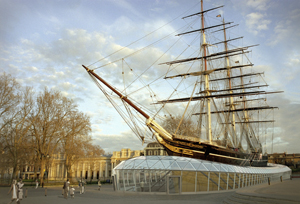 • London landmark, the 19th century tea clipper Cutty Sark, will reopen to the public on 26th April following a five year, £50 million conservation project. Visitors to the ship will now be able to explore the vessel as well as, for the first time, walk under the ship after it was raised three metres above the dry dock. A glass canopy has been designed to protect the base of the ship’s hull. The Cutty Sark was built in 1869 by ship-builders Scott & Linton at Dumbarton, Scotland, and, one of the last tea clippers built, was designed to move very fast through the water. After the tea trade was taken over by steamers, the Cutty Sark was used to carry more general trade including wool from Australia. Later sold to a Portuguese company and renamed Ferriera, in 1922 Captain Dowman of Falmouth bought the ship and used her in the floating nautical school. Following his death, the clipper was donated to the Thames Nautical Training School at Greenhithe. After the formation of the Cutty Sark Preservation Society in the early 1950s, the ship was moved to Greenwich and permanently installed in a stone dry-dock where the clipper’s appearance restored to that of an active sailing vessel. In November 2006, the ship rig was dismantled in preparation for a full restoration project – this received a set back the following 21st May a fire broke out aboard the ship. But with the restoration now complete, the ship will once again accommodate visitors wishing to explore its 140 year history. For more on the Cutty Sark, see www.cuttysark.org.uk. PICTURE: © Cutty Sark London
• A treasure of the V&A Museum, the 16th century Great Bed of Ware, is being loaned to the Ware Museum, located not surprisingly in the Hertfordshire town of Ware, for a year from early next month. Believed to date from around 1590 and to have been made in Ware, the bed is believed to have been created as a tourist attraction for people traveling the pilgrim route between London and Walsingham or Cambridge University. More than three metres wide, it was said to be able to sleep 12 people and was such an attraction that people apparently stopped in Ware for the night just to sleep in the bed. It’s even mentioned in Shakespeare’s Twelfth Night – the author has Sir Toby Belch describe a piece of paper as “big enough for the Bed of Ware”. The bed was acquired by the V&A in 1931 and hasn’t left the museum since. For more, see www.vam.ac.uk.
• Now On: Quentin Blake – As large as life. This exhibition at the Foundling Museum in Bloomsbury features more than 60 works by artist Quentin Blake, best known for his illustrations of Roald Dahl’s books and Britain’s first Children’s Laureate. The works – which are recent commissions by UK and French hospitals – are contained in four series of pictures which are displayed throughout the museum. They include Our Friends in the Circus – a 2009 series featuring circus performers, Ordinary Life – a 2o10 series celebrating the “pleasures of everyday life”, the 2007 work Planet Zog – a 2007 series in which aliens and young people swap doctor and patient roles, and Mothers and Babies Underwater – a 2011 series created for a French maternity ward. Admission charge applies. The event draws on the long history of artists’ aiding the work of hospitals and child welfare organisations – including William Hogarth who donated paintings to the Foundling Museum. Runs until 15th April. For more information, see www.foundlingmuseum.org.uk.

Former tea clipper Cutty Sark is finally nearing the end of £50 million restoration project in its dry dock at Greenwich. The ship, almost destroyed in a fire in May 2007 which broke out while the ship was undergoing conservation work, is expected to reopen to the public next year – just in time for the Olympics. The extensive restoration project recently marked the completion of the ship’s intricate gold leaf “gingerbread”, located on the upper hull on either side of the bow, and the figurehead (pictured). The Cutty Sark undertook her first voyage – to Shanghai – in 1870 and continued to ply the waters between China and the UK until 1878 when steamships took over the route. The ship continued, however, to operate as a cargo vessel (including hauling wool between Australia and the UK) until the early twentieth century when she was eventually restored and used as a training ship. The Cutty Sark, which last went to sea in 1938, came to London in 1951 as part of the Festival of Britain celebrations. She was saved from the scrapyard in 1954 when she took up her position in the drydock at Greenwich and was opened to the public in 1957. For more – including a diary of the restoration work – see www.cuttysark.org.uk.
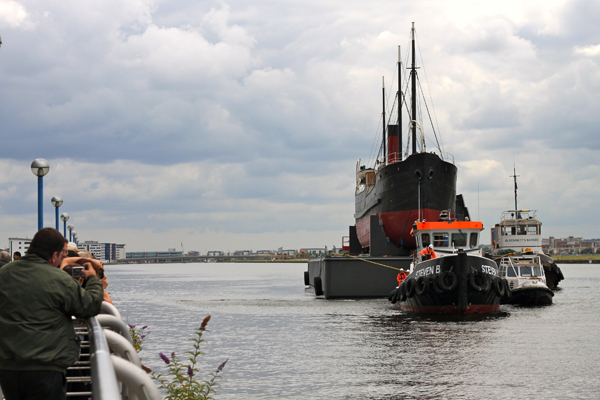
The SS Robin being towed to its new mooring in East London on a floating pontoon. PICTURE: James Spellane/SS Robin Trust.
The world’s oldest complete steamship, the SS Robin, made a dramatic return to the Royal Docks in East London earlier this month. Built in 1890 at the Thames Ironworks shipyard on the River Lea, the coastal cargo steamer was operational for more than 80 years, initially around the coast of Britain and the English Channel and later in Spain where it bore the name Maria. The 300 tonne vessel has just been through a three year restoration project spearheaded by the SS Robin Trust. It has now taken up a temporary mooring on a new floating pontoon while final conservation work is completed. It is anticipated that the steamship – which is listed on the ‘Core Collection’ of the UK National Historic Ships Register meaning it’s seen as historically significant as London’s two other maritime landmarks, the Cutty Sark and HMS Belfast – will be opened to the public. For more information, see www.ssrobin.com.
 Exploring London