Famous Londoners – Lancelot ‘Capability’ Brown…

This year marks 300 years since the birth of Lancelot “Capability” Brown, the most famed landscape designer of the Georgian age and a man who has been described as the “father of landscape architecture”.
Capability-BrownBrown is understood to have been born in 1716 in the village of Kirkharle in Northumberland, the fifth of six children of a land agent and a chambermaid (he was baptised in on 30th August so it is believed his birth happened sometime earlier that same year).

He attended the village school before he worked as apprentice or assistant to the head gardener in Sir William Loraine’s kitchen garden at Kirkharle Hall.

Having left home in 1741 he joined the gardening staff of Lord Cobham, as one of the gardeners at his property in Stowe, Buckinghamshire.

There he worked with William Kent, another famed landscape architect of the Georgian age and one of the founders of the new English style of gardens, until, at the age of 26, he was appointed head gardener.

He remained in Stowe until 1750 and while there, in 1744, married Bridget Wayet (with whom he went on to have nine children). During his time there, he also created the Grecian Valley and also took on freelance work from Lord Cobham’s noble friends, a fact which allowed him to produce a body of work that would start to make his reputation.

Having struck out on his own from Stowe, he settled with his family in Hammersmith, London, in the early 1750s, already widely known and considered by some the finest gardener in the kingdom.

The work continued to flow in and it’s believed that, over the span of his career, Brown was responsible for designing or contributing to the design of as many as 250 gardens at locations across the UK, – many of which can still be seen today. As well as Stowe, these included gardens at Blenheim Palace, Appuldurcombe House on the Isle of Wight, Warwick Castle, Harewood House and Petworth House in West Sussex.

Following on from the work of Kent, Brown was known for his naturalistic undulating landscapes, in particular their immense scale, flowing waterways and a feature known as a ‘ha-ha’, a ditch which blended seamlessly into the landscape but which was aimed at keeping animals away from the main house of the estate.

His style, which contrasted sharply with the more formalised, geometric gardens epitomised in the French style of gardening, did not, however, meet with universal praise. Criticisms levelled against him including that he had often erased the works of gardeners of previous generations to complete gardens which were, in the end, described by some as looking no different to “common fields”.

It’s worth noting that Brown also dabbled in architecture itself – his first country house project was the remodelling of Croome Court in Worcestershire and he went on to design and contribute to the design of several houses including Burghley House Northamptonshire as well as outbuildings including stable blocks.

The nickname ‘Capability’ apparently came from his habit of informing his client that their estates had great “capability” for improvement. It’s wasn’t apparently a name he used himself.

So established became his reputation that in 1764 Brown was appointed King George III’s Master Gardener at Hampton Court Palace (as well as Richmond and St James’ Palaces), taking up residence with his family at Wilderness House. He also worked on the gardens at Kew Palace.

Brown died on 6th February, 1783, in Hertford Street in London at the door of his daughter Bridget’s house (she had married architect Henry Holland with whom he Brown had, at times, collaborated). He was buried in the churchyard of St Peter and St Paul, the parish church of a small estate Brown owned at Fenstanton Manor in Cambridgeshire.

Brown impact on garden design in England is now undisputed although it wasn’t always the case – his contribution was largely dismissed in the 18th century and it was only in the later 20th century that he had become firmly established as a giant figure in the gardening world.

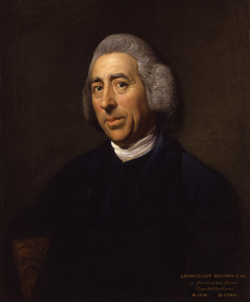
A celebrated portrait of Brown (pictured above) – painted by Nathaniel Dance in about 1773 – is in the collection of National Portrait Gallery.

For more on events surrounding the 300th anniversary of Brown’s birth, see www.capabilitybrown.org.

PICTURE: Capability Brown by Nathaniel Dance, circa 1773. © National Portrait Gallery, London
 

Famous Londoners – Joseph Grimaldi…

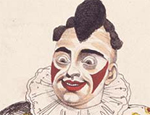
Grimaldi-memorialThe most renowned of English clowns, Joseph Grimaldi rose to the heights of fame in early 19th century London despite a private life characterised by hardships and pain.

Grimaldi was born in Clare Market, London on 18th December, 1778, the son of actor and clown Joseph Giuseppe Grimaldi (known simply as the “Signor”), and Londoner Rebecca Brooker, a dancer who was more than 50 years younger than Grimaldi when she become one of a string of mistresses.

Grimaldi-imageJoe was groomed for the stage by his father from an early age and made his debut at Sadler’s Wells Theatre in late 1780. He was soon also working at Drury Lane Theatre, running between the two to make performances (at the same time, he did attend a theatrical academy in Putney known for educating the children of performers).

Joe’s father died when he was just nine-years-old and he became the family’s main breadwinner and while he was still able to work at both Sadler’s Wells and Drury Lane, his pay was cut after his father’s death meaning the family had to move out of their home in Holborn and into the slum of St Giles where they took lodgings in Great Wild Street.

In 1799, having met three years before, he married Maria Hughes, the eldest daughter of Richard Hughes, the proprietor of Sadler’s Wells Theatre. The newlyweds moved to a home at 37 Penton Street in Pentonville. It was not to be a long-lasting marriage – Maria died during childbirth on 18th October, 1800.

Further hardship was to come soon after when, while performing at Drury Lane Theatre, he accidentally shot himself in his foot and was forced to bed to recover. But there was a silver lining – his mother employed a dancer, Mary Bristow, to look after him during his rehabilitation and they formed a bond which led to them being married on 24th December, 1801.

After recovering from his injury, meanwhile, he had resumed his hectic schedule at London theatres as well as country venues and it was during this period that he redesigned the way in which he painted his face – adopting a white face design still used by many clowns today – and created the iconic clown which he named simply ‘Joey’.

In 1802, his only child was born – Joseph Samuel, known simply as ‘JS’ – and from the age of 18 months, he was introduced to the theatre, making his own acting debut at Sadler’s Wells in 1814.

In 1806, Joe played what is arguably his most famous roles – as both Bugle and the Clown in Thomas Dibdin’s Harlequin and Mother Goose, which opened at the Covent Garden Theatre on 29th December, 1806, and ran for the next two years.

Financial need saw him continue to take on roles in London and elsewhere but finally, in 1823, ill health – the consequence of his many years of physically abusing his body for his act – forced him into retirement. In 1828, two farewell benefit performances were held in which he had a limited role, his last was at Drury Lane on 27th June.

The last years of his life were marked with tragedy – relations which his son were strained (and they spent years estranged) before JS died on 11th December, 1832, at just the age of 30 while his wife died in 1834.

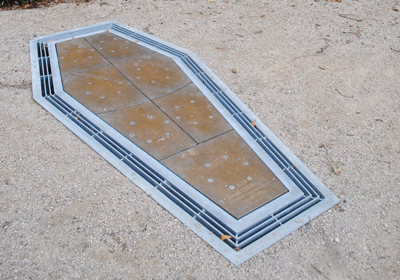
Grimaldi spent the last years of his life living alone in Southampton Street, Islington, before he was found dead in his bed by his housekeeper on 1st June, 1837. He was buried in St James’s churchyard, Pentonville, on 5th June, 1837 – the area is now Joseph Grimaldi Park and features, as well as his grave, a coffin-shaped memorial (pictured, top) that plays musical notes when danced upon (it’s apparently possible to play his signature song, Hot Codlins when “dancing upon his grave”).

Described as being the pre-eminent entertainer of his day, Grimaldi is credited with transforming the role of the Clown in pantomime and ushering in a whole new era in the art of clowning. His legacy – still remembered by clowns everywhere – received a boost when after his death, Charles Dickens edited his memoirs in 1838.

He is remembered in an annual service held on the first Sunday in February every year in Holy Trinity Church, Hackney (the Sunday just past), an event which is attended by clowns in full get-up.

For a detailed look at the life of Grimaldi, see Andrew McConnell Stott’s The Pantomime Life of Joseph Grimaldi: Laughter, Madness and the Story of Britain’s Greatest Comedian.

Famous Londoners – William Hewer…

The National Maritime Museum is hosting a new exhibition on the life of Samuel Pepys and, while we’ve looked at the life of the famous diarist before (see our earlier post here), we thought we’d take a look at his not-so-famous manservant and clerk William Hewer.

“Will” Hewer, who is mentioned several times in Pepys’ diary and, as well as being a business partner also became a fast friend of Pepys, is thought to have been born in about 1642.

He was first introduced to Pepys when still a young man – about 17 – by his uncle Robert Blackborne in 1660. They obviously hit it off because Hewer, who was the son of a stationer, was soon working as a manservant and clerk for Pepys in his role as Clerk of the Acts to the Navy Board.

Hewer, who was subjected to some bullying by Pepys who apparently could reduce him to tears (but at the same time Pepys also defended him at work from attacks from others), at first lived with Pepys at his Seething Lane home. However, by late 1663 – apparently thanks to his misbehaviour which included staying out late, drunkenness and corrupting maids – he was told to leave Pepys’ house and moved into his own lodgings.

Pepys moved to the Admiralty in 1673 and Hewer went with him, appointed Chief Clerk the following year. In 1677, he was appointed as Judge Advocate-General.

Hewer’s star continued to climb and in 1685, he was appointed MP for Yarmouth, on the Isle of Wight. The following year he was appointed to the Special Commission which replaced the Navy Board and had a special responsibility for accounts.

After King James II fled the country in 1688, Hewer, along with Pepys, lost their patronage from the Crown; both were briefly imprisoned, but were released without trial.

Thanks largely to his involvement in trading with his uncle Blackborne – who served as both Secretary to the Admiralty and Secretary to the British East India Company and to an inheritance he received from his father, Hewer became a wealthy man (as was the case with Pepys, there have been suggestions he may have made considerable illicit sums from people doing trade with the Navy thanks to his position, but these claims have not been substantiated).

Hewer, who never married (but he did apparently have a special attachment to Pepys wife Elizabeth who was of a similar age), owned a house near The Strand which became the Admiralty Office when he followed Pepys from the Navy Board. Pepys lived with him in the house when he was at the Admiralty.

He also owned other properties, including a country retreat on Clapham Common which he bought in 1688. It was here that Pepys lived in during his latter years (and where he died in 1703).

Hewer was the executor of Pepys’ will and kept his library – including, of course, his famous diary until his own death on 3rd December, 1715. He was buried in St Paul’s Church, Clapham. In an odd twist, his estate was left to his godson Hewer Edgeley but only on the condition that he change his surname to Hewer, becoming Hewer Edgeley-Hewer.

Hewer is depicted in a painting by Godfrey Kneller (1689) now in the National Maritime Museum’s collection. It was a pair with another painting by Kneller of Pepys.

WHERE: Samuel Pepys: Plague, Fire, Revolution is at the National Maritime Museum, Greenwich (nearest DLR station is Cutty Sark; nearest railway stations are Greenwich and Maze Hill; and nearest river pier is Greenwich); WHEN: 10am to 5pm daily; COST: £12 adults/£6 children WEBSITE: www.rmg.co.uk/see-do/exhibitions-events/samuel-pepys-plague-fire-revolution-exhibition.

For more on Pepys, see Margarette Lincoln’s book Samuel Pepys: Plague, Fire, Revolution.

Famous Londoners – Hans Holbein the Younger…

Famed as the court painter of King Henry VIII, Hans Holbein the Younger was one of the greatest portrait painters of the sixteenth century.

Born in Augsburg, in southern Germany, in 1497-98, Holbein was the son of painter and draughtsman Hans Holbein the Elder. Hans, like his brother Ambrosius, followed the family trade which he apparently learnt under the tutelage of his father and uncle until breaking away to make his own mark.

National-GalleryJourneying with Ambrosius to Basel in what is now Switzerland, the two brothers became apprenticed to the city’s leading painter Hans Herbster. In 1517, Holbein went with father to Lucerne where they worked painting murals for a leading merchant. It is thought while there, that he visited northern Italy where he studied Italian frescos.

Returning to Basel in 1519, he quickly re-established his business there, becoming a member of the artists’ guild, and married Elsbeth Schmid, their first son arriving in the first year of their marriage (the couple apparently had four children, two of whom are depicted in a portrait with his wife he painted in the late 1520s).

He was soon completing numerous major projects for the city – including painting internal murals for the Town Hall’s council chamber – and was also involved in creating illustrations for books – the most famous being the series of images known as the Dance of Death – and painting portraits, including his first portraits of the Renaissance scholar, Erasmus. It was these and other portraits that ensured his fame across Europe.

The decline in the production of religious art, thanks to the Reformation which was then sweeping over the continent, apparently led Holbein to look further afield for work and, having first gone to France, in 1526 he went to England.

There he was welcomed by Sir Thomas More, then a key figure in the regime of King Henry VIII, who soon found him some commissions. His works during this period included portraits of More, William Warham, Archbishop of Canterbury, astronomer Nicholas Kratzer and courtiers like Sir Henry Guildford.

He returned to Basel a wealthy and successful man in 1528 and remained there for four years before once again leaving his family and heading to England, this time finding favour with the Boleyn family and Thomas Cromwell.

It was early during this period – he remained in England until his death in 1543 – that he painted portraits of Hanseatic League merchants of the Steelyard (see our earlier post here) as well as The Ambassadors (see our earlier post here).

In 1536, he was employed as painter to King Henry VIII and the following year he painted what is arguably his most famous image – that of King Henry VIII in all his glory in the image known as the Whitehall Mural which pictured the king with his the wife, Queen Jane Seymour, his father, King Henry VII and his mother, Queen Elizabeth of York (the image was lost in the fire which destroyed Whitehall Palace in 1698 but copies were made and a copy is now at Hampton Court Palace).

King Henry VIII was to be his subject on numerous occasions as were other members of the Royal Family, courtiers and prospective wives including, famously, a portrait of Anne of Cleves which may have oversold her beauty to the king who was unimpressed with her in person (there is apparently no evidence the king blamed Holbein himself for this).

While he had successfully navigated his way past the downfall of Sir Thomas More and then the Boleyn family, the fall of Sir Thomas Cromwell did cause significant damage to his standing. Nonetheless he retained his official position at court and it was during this time that he painted some of his finest miniatures including those of the sons of Henry VIII’s friend, Charles Brandon, 1st Duke of Suffolk.

It is believed Holbein may have returned to visit his family in late 1540 before returning to London where he died sometime in October or November, 1543, having made his will on 7th October at his home in Aldgate (plague has been suggested as the cause of his death). The site of his grave is unknown.

Holbein’s legacy is such that the portraits he created in his two stints in London have become a key component in how we view Tudor England – and in particular, the Tudor court – today.

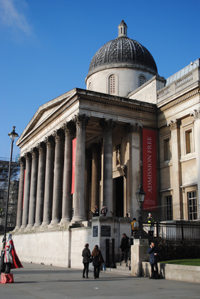
His works can be seen in key locations across London including the National Gallery (pictured above), the National Portrait Gallery (where his bust is one of a series of artists on the exterior) and Hampton Court Palace.

Famous Londoners – Judge Jeffreys…

The-Town-of-Ramsgate2

Best known as the “Hanging Judge” thanks to his role in the so-called Bloody Assizes of 1685, George Jeffreys climbed the heights of England’s legal profession before his ignominious downfall.

Born on 15th May, 1645, at the family home of Acton Hall in Wrexham, North Wales, Jeffreys was the sixth son in a prominent local family. In his early 20s, having been educated in Shrewsbury, Cambridge and London, he embarked on a legal career in the latter location and was admitted to the bar in 1668.

Town-of-RamsgateIn 1671, he was made a Common Serjeant of London, and despite having his eye on the  more senior role of Recorder of London, was passed over. But his star had certainly risen and, despite his Protestant faith, he was a few years later appointed to the position of solicitor general to James, brother of King Charles II and the Catholic Duke of York (later King James II), in 1677.

The same year he was knighted and became Recorder of London, a position he had long sought, the following year. Following revelations of the so-called the Popish Plot in 1678 – said to have been a Catholic plot aimed the overthrow of the government, Jeffreys – who was fast gaining a reputation for rudeness and the bullying of defendants – served as a prosecutor or judge in many of the trials and those implicated by what turned out to be the fabricated evidence of Titus Oates (Jeffreys later secured the conviction of Oates for perjury resulting in his flogging and imprisonment).

Having successfully fought against the Exclusion Bill aimed at preventing James from inheriting the throne, in 1681 King Charles II created him a baronet. In 1683 he was made Lord Chief Justice and a member of the Privy Council. Among cases he presided over was that of Algernon Sidney, implicated in the Rye House Plot to assassinate the king and his brother (he had earlier led the prosecution against Lord William Russell over the same plot). Both were executed.

It was following the accession of King James II in February, 1685, that Jeffreys earned the evil reputation that was to ensure his infamy. Following the failed attempt by James Scott, 1st Duke of Monmouth and illegitimate son of the late King Charles II, to overthrow King James II, Jeffreys was sent to conduct the trials of the captured rebels in West Country towns including Taunton, Wells and Dorchester – the ‘Bloody Assizes’.

Of the almost 1,400 people found guilty of treason in the trials, it’s estimated that between 150 and 200 people were executed and hundreds more sent into slavery in the colonies. Jeffreys’, meanwhile, was busy profiting financially by extorting money from the accused.

By now known for his corruption and brutality, that same year he was elevated to the peerage as Baron Jeffreys of Wem and named Lord Chancellor as well as president of the ecclesiastical commission charged with implementing James’ unpopular pro-Catholic religious policies.

His fall was to come only a couple of years later during Glorious Revolution which saw King James II overthrown by his niece, Mary, and her husband William of Orange (who become the joint monarchs Queen Mary II and King William III).

Offered the throne by a coalition of influential figures who feared the creation of a Catholic dynasty following the birth of King James II’s son, James Francis Edward Stuart, William and Mary arrived in England with a large invasion force. King James II’s rule collapsed and he eventually fled the country.

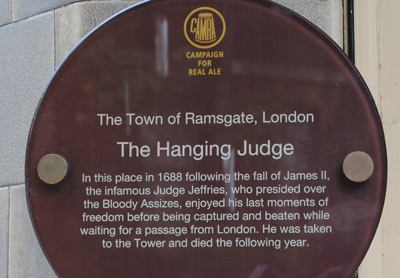
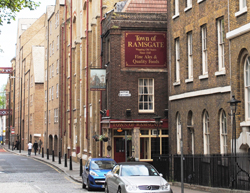
Remaining in London after the king had fled, Lord Jeffreys only attempted to flee as William’s forced approached the city. He made it as far as Wapping where, despite being disguised as a sailor, he was recognised in a pub, now The Town of Ramsgate (pictured above).

Placed in custody in the Tower of London, he died there of kidney problems on 18th April, 1689, and was buried in the Chapel Royal of Saint Peter ad Vincula (before, in 1692, his body was moved to the Church of St Mary Aldermanbury). All traces of his tomb were destroyed when the church was bombed during the Blitz (for more on the church, see our earlier post here).

Famous Londoners – Sir Hugh Myddelton…

The Welsh-born “merchant adventurer” Sir Hugh Myddelton (also spelt Myddleton or Middleton) is best remembered in London for the construction of the New River, a water engineering project which still provides some of city’s water.

Sir-Hugh-MyddeltonBorn about 1560, the sixth son (and one of 16 children) of Richard Myddelton, governor of Denbigh Castle in Wales, Hugh Myddelton travelled to London to seek his fortune and there became apprenticed to a goldsmith before himself becoming a member of the Goldsmith’s Company in 1592 (he later became warden of the company).

Operating out of premises in Bassishaw (now Basinghall Street), he gained a reputation among the wealthy and nobility for his work and was appointed Royal Jeweller to King James I (he had apparently also supplied jewellery to Queen Elizabeth I).

Myddelton became a wealthy merchant and banker, and, in 1603, he also succeeded his father as MP for Denbigh Borough, a post he held repeatedly until 1628.

Sir Hugh became one of the driving forces behind the New River project which aimed to address the strain on London’s water sources by bringing clean water from the River Lea in Hertfordshire via a 39 mile-long canal to New River Head in London.

After an aborted earlier attempt to build a canal from Hertfordshire to London (which had run into financial difficulties), Sir Hugh was granted authority to carry out the works for the New River in 1609 and employed mathematicians like Edward Pond and Edward Wright to direct the course with the man behind the earlier attempt, Edmund Colthurst, overseeing the works.

By 1611 it became clear to Myddelton that he wouldn’t have the necessary funds to complete the works so he obtained the financial aid of the king (in return the king was to get half of all profits).

The project was eventually completed in 1613 and a ceremony was held at the New River Head in Islington where the canal then terminated (just south of where Sadler’s Wells Theatre now stands).

Myddelton, who continued to diversify in business and made considerable sums from his ownership of lead and silver mines in Wales as well as from a land reclamation project on the Isle of Wight, became the first governor of the New River Company when it was created by royal charter in 1619 and remained a key figure in it until his death. He was created a baronet in 1622.

Myddelton, who married twice, had 15 or more children to his second wife – only about half of whom survived him. He died on 7th December, 1631, and was buried in the now demolished St Matthew Friday Street where he had been a church warden (some of his children were buried there as well). One of his brothers, Sir Thomas Myddelton, was a Lord Mayor of London.

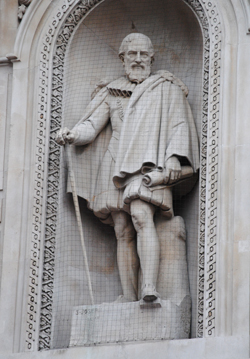
Among memorials to Sir Hugh in London is a statue of him on Islington Green which was unveiled in 1872 by William Gladstone, later PM. There is also a statue of him on the Royal Exchange (pictured) and a number of Islington streets have been named for him.

For more on London’s historic water sources, see London’s Lost Rivers: A Walker’s Guide.

Famous Londoners – Dr Richard Mead…

Eighteenth century physician Dr Richard Mead is noted not only for his attendance on the rich and famous of his time – including royalty – but also for his philanthropy, his expansive collections and, importantly, his contributions in the field of medicine.

Born in Stepney, London, on the 11th August, 1673, as the 11th of 13 children of nonconforming minister Matthew Mead, Mead studied both Utrecht and Leiden before receiving his MD in Italy. Returning to England in 1696, he founded his own medical practice in Stepney.

He married Ruth Marsh in 1699 and together the couple had at least eight children, several of whom died young, before her death in 1720 (he subsequently married again, this time to Anne, daughter of a Bedfordshire knight, Sir Rowland Alston).

Having published the then seminal text – A Mechanical Account of Poisons – in 1702, the following year Mead was admitted to the Royal Society. He also took up a post as a physician at St Thomas’ Hospital, a job which saw him move to a property in Crutched Friars in the City – his home until 1711, when he relocated to Austin Friars.

It was after this that he become friends with eminent physician John Radcliffe who chose Mead as his successor and, on his death in 1714, bequeathed him his practice and his Bloomsbury home (not to mention his gold-topped cane, now on display at the Foundling Museum – see note below).

Following Radcliffe’s death, in August of that year Dr Mead attended Queen Anne on her deathbed. Other distinguished patients over his career included King George I, his son Prince George and daughter-in-law Princess Caroline – in fact he was appointed as official physician to the former prince when elevated to the throne as King George II – as well as Sir Isaac Newton, lexicographer Dr Samuel Johnson, Alexander Pope, Sir Robert Walpole and painter Antoine Watteau.

Mead, who had been named a governor of St Thomas’ in 1715 and elected a fellow of the Royal College of Physicians in 1716, was over the years recognised as an expert in a range of medical fields – including, as well as poisons, smallpox, scurvy and even the transmission of the plague.

Among the many more curious stories about Dr Mead is one concerning a ‘duel’ (or fistfight) he apparently fought with rival Dr John Woodward outside Gresham College in 1719 over their differences in tackling smallpox and others which concern experiments he conducted with venomous snakes to further his knowledge of venom before writing his text on poisons.

Dr Mead was also known for his philanthropy and became one of the founding governors of the Foundling Hospital (as well as being its medical advisor) – a portrait of him by artist Allan Ramsay (for whom he was a patron), currently hangs at the museum.

Dr Mead, who by this stage lived in Great Ormond Street in Bloomsbury (the property, which backed onto the grounds of the Foundling Museum and which Mead had moved into after his first wife’s death, later formed the basis of the Great Ormond Street Hospital for Children), is also noted for the large collection he gathered of paintings – including works by Dürer, Holbein, Rembrandt, and Canaletto, a library of more than 10,000 books, antiquities and classical sculpture as well as coins and jewels, all of which scholars and artists could access at his home (it took some 56 days to sell it all after his death).

While Dr Mead – who died on 16th February, 1754 – was buried in the Temple Church, there is a monument to him – including a bust by Peter Scheemakers – in the north aisle of Westminster Abbey.

Dr Mead is currently being honoured in an exhibition at the Foundling Museum – The Generous Georgian: Dr Richard Meadwhich runs until 4th January. There’s an accompanying blog here which provides more information on his life and legacy.

Famous Londoners – Madame Tussaud…

Famed around the world for her London-based wax museum (and the chain of waxworks which now bears her name), French-born Madame Tussaud is a towering figure of the early 19th century.

Born Anna Maria Grosholtz in Strasbourg on 1st December, 1761, Marie Tussaud’s association with waxworks came early when, her father Joseph having apparently died from wounds sustained in the Seven Years War just before her birth, she accompanied her mother Anna Maria Walder to Berne in Switzerland where her mother took up a position as a housekeeper for a physician and anatomical wax sculptor and portraitist Dr Philippe Curtius.

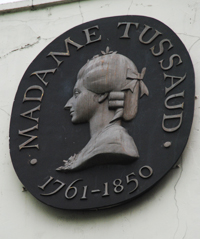
Madame-TussaudIn 1765, Dr Curtius moved to pre-Revolutionary Paris where he was soon to open a couple of establishments – at the Palais-Royal and the Boulevard du Temple (later consolidated at the latter site) – displaying his works in wax. Marie, whom Dr Curtius brought to Paris with her mother in 1768, started working with him on wax models and in 1777, at the age of just 16, produced her first wax figure, that of philosopher Voltaire. Other early works of Madame Tussaud’s depicted Rousseau and Benjamin Franklin.

The story goes that such was the renown of Tussaud and her “uncle” Dr Curtius, that their social circle came to include members of the Royal Family. Tussaud is widely believed to have been an art tutor to King Louis XVI’s sister Elizabeth and may have even taken up residence at Versailles.

Tussaud recounts that she was arrested during the French Revolution – the story goes that she was imprisoned and eventually released thanks to the intervention of family friend and revolutionary Jean-Marie Collot d’Herbois but whether this is true remains a matter of debate.

Tussaud claims she was then forced make death masks of those who ended their life on the scaffold including Louis XVI, Marie Antoinette, Marat and Robespierre. When Curtius died in 1794, she inherited his wax works and the following year married an engineer Francois Tussaud with whom she had two sons, Joseph and Francois (later known as Francis).

In 1802, Madame Tussaud accepted an invitation to go to London to exhibit her work at the Lyceum Theatre but thanks to the outbreak of the Napoleonic Wars, she and her four-year-old son Joseph were unable to return to France. Separated from her husband, she subsequently spent the next three decades travelling with her exhibition – which included relics from the Revolution and, like those of Curtius, was being constantly updated to reflect current affairs – around Britain and Ireland.

Her son Francois joined her in 1822 and Tussaud continued travelling until 1835 when she first established a permanent exhibition in Baker Street, London. Known as the Baker Street Bazaar, it apparently contained more than 400 wax figures. In 1846, Punch Magazine is credited with having invented the term ‘Chamber of Horrors’ for the room where the relics of the French Revolution were displayed.

Tussaud wrote her memoirs in 1838, and, in 1842, completed a wax model of herself. She died in her sleep on 16th April, 1850, in London. Her son Francois became chief artist for the exhibition after her retirement – he was succeeded by his son and then grandson. The exhibition moved to its current site in Marylebone Road in 1884.

Now owned by the Merlin Entertainments Group, Madame Tussauds has branches in cities in some 10 countries as well as its London base. Many of her original models still exist and are on display in the London museum along with the exhibition’s oldest attraction – known as ‘Sleeping Beauty’, it dates from 1863 – a breathing likeness of Louis XV’s sleeping mistress Madame du Barry.

For more on Madame Tussauds today, see www.madametussauds.com.

For more on the life of Madame Tussaud, see Kate Berridge’s book, Waxing Mythical: The Life and Legend of Madame Tussaud.