This Week in London – Open House London; Georges Seurat and the Neo-Impressionists; and, the Burma campaign remembered…

The week-long Open House London kicks off this Saturday and features a range of activities across all 33 London boroughs – from “drop-ins” at and guided tours of buildings to talks, exhibitions, workshops and, of course, walking tours. Highlights include architect guided tours of Rana Begum’s Little Citadel retreat compound in Stoke Newington, rare access to the Islip and Nurses’ Chapels in Westminster Abbey, tours of several facilities at Queen Elizabeth Olympic Park including the new Sadler’s Wells theatre, the Lee Valley VeloPark and the Hackney Wick Fish Island Creative Enterprise Zone, and walking tours exploring Roman London. For the full programme, head to https://programme.openhouse.org.uk/.
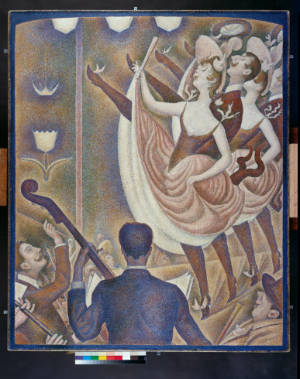
Georges Seurat, Le Chahut (1889-90), Oil on canvas, 141 x 170 cm © Collection Kröller-Müller Museum, Otterlo, the Netherlands

Georges Seurat’s painting of cancan dancers Let Chahut (1889-90) goes on display in the Sainsbury Wing of The National Gallery on Saturday. Radical Harmony: Helene Kröller-Müller’s Neo-Impressionists, which draws on the collection of the German art collector Helene Kröller-Müller (1869‒ 1939), at the Kröller-Müller Museum, Otterlo, in the Netherlands, also features several other works by Seurat as well as other radical works of French, Belgian and Dutch artists, painted from 1886 to the early 20th century. Among the highlights are Seurat’s Sunday at Port-en-Bessin (1888) and The Canal of Gravelines, in the Direction of the Sea (1890), Théo van Rysselberghe’s In July – before Noon (1890), Jan Toorop’s Sea (1899), Henry van de Velde’s Twilight (about 1889) and Paul Signac’s The Dining Room (1886-87). Runs until 8th February. Admission charge applies. For more, see www.nationalgallery.org.uk/exhibitions/radical-harmony-neo-impressionists

Marking 60 years since VJ (Victory over Japan) Day, the National Army Museum is hosting the first national museum exhibition on the Burma campaign during World War II in the 21st century. Beyond Burma: Forgotten Armies features more than 180 objects including artworks, weapons, uniforms and photographs and explores the retreat from Burma in 1942, the transformation and resurgence of British and Indian forces in India in 1943 and the campaign against the Imperial Japanese Army during 1944-45. Highlights include the abstract painting And the World was covered in darkness by Major Conrad ‘Dick’ Richardson Romyn who experienced intense fighting in Burma, a bottle of Army anti-mosquito cream and a vial of anti-malarial tablets representing the treatment of soldiers, a tin identity bracelet and food bowl used by Gunner Moss Simon, who spent three years as a prisoner of war, and a military medal awarded to Corporal Dogo Manga who served with 1st Battalion, the Nigeria Regiment, Royal West African Frontier Force. Opens on Tuesday and runs until 13th April next year. Admission is free. For more, see www.nam.ac.uk/whats-on/beyond-burma.

Send all items for inclusion to exploringlondon@gmail.com
This Week in London – Saxons camp out in Hyde Park on the way to battle; “ordinary punks” at Museum of London; and, Bridget Riley meets Seurat…

battle-of-hastings

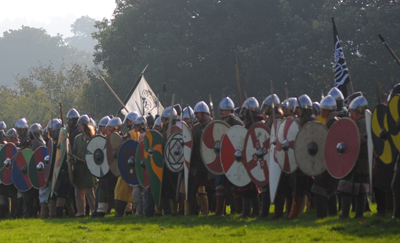
A temporary ‘Saxon’ camp will appear in Hyde Park this Saturday as Battle of Hastings’ re-enactors pause on their journey south to meet the forces of William, the Duke of Normandy, in an event marking the battle’s 950th anniversary. English Heritage is recreating the hurried march south of the Saxon King Harald and his followers following the Battle of Stamford Bridge in Yorkshire to Battle Abbey where they will join in an annual re-enactment of the world famous Battle of Hastings on 15th and 16th October. Having already visiting British landmarks like Lincoln’s Roman arch, Peterborough Cathedral, and Waltham Abbey, they will be found at a free “pop-up living history encampment” near Apsley House in Hyde Park between 11am and 3pm on Saturday. People are invited to visit the encampment and meet the re-enactors, learn how the armies lived and ate while on the march, discover which weapons they used and play some Norman games as well as see the Battle of Hastings recreated using vegetables. Later on Saturday, the re-enactors will head across London to the Jewel Tower in Westminster and then on, Sunday, on to Eltham Palace in the city’s south-east, before setting off for Battle to the south. For more – including a day-by-day calendar of the march – head to www.english-heritage.org.uk/learn/1066-and-the-norman-conquest/the-1066-march/. PICTURE: An earlier re-enactment of the Battle of Hastings/David Adams.

A free exhibition celebrating all things punk has opened at the Museum of London to mark the end of a year long festival commemorating 40 years of the movement’s influence. Punks, which tells the stories of “ordinary punks” living in London in the late 1970s, features artefacts like handmade mixtape sleeves, DIY fanzines and the radical clothes sold on the King’s Road. The exhibition, which runs until 15th January, is accompanied by what is promised to be a “no holds barred” debate centred on the punk phenomena in November. For more information, see www.museumoflondon.org.uk and for more about other events related to the 40th anniversary of punk, see www.punk.london.

On Now – Bridget Riley: Learning from Seurat. This exhibition at The Courtauld Gallery explores Riley’s breakthrough encounter with Georges Seurat’s 1887 work Bridge at Courbevoie. For the first time, it brings together a copy Riley made of the painting in 1959 with the original work as well as presenting a small group of Riley’s seminal works to show how her understanding of Seurat’s art led her to create what are described as “some of the most radical and original abstract works of the past five decades”. Part of the gallery’s ongoing series of displays focusing on major contemporary artists, it runs until 17th January. Admission charge applies. For more, see www.courtauld.ac.uk/gallery.

Send all items for inclusion to exploringlondon@gmail.com.