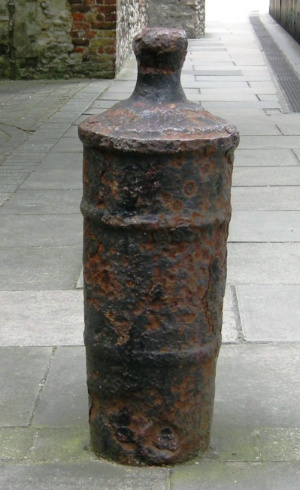
Where’s London’s oldest…bollard?

PICTURE: GrindtXX (licensed under CC BY-SA 4.0)

London is filled with bollards designed to prevent vehicles, old and new, from travelling where they shouldn’t. And, of course, there’s much debate over which is the oldest.

The oldest may well be a rather rusty looking one in the courtyard outside the Church of St Helen’s Bishopsgate.

In what was a practice replicated elsewhere in the City around the time, it’s apparently made out of the French naval cannon dating from the 18th century.

The cannon’s muzzle end has been embedded into the pavement with the non-loading end sticking up.

Legend says that another cannon bollard, located just outside the Globe Theatre on South Bank, comes from French ships captured at the Battle of Trafalgar. While it is indeed said to be a cannon, many have cast doubt on its origins as coming from Trafalgar.

Correction: We’ve correct the story to say it was the non-loading end sticking up.
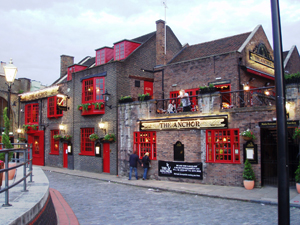
London Pub Signs – The Anchor…

While the first official records of this Bankside pub only date from 1822, the pub’s history goes back much further. Like many pubs in London, nailing down its exact origins is tough but the story goes that it was named The Anchor by seventeenth century merchant Josiah Child.

The-AnchorChild owned the brewhouse which had been established in 1616 by James Monger at a site known as Dead Man’s Place (close to where the original Globe Theatre had stood before burning down in 1613) and was also a merchant who supplied the navy with everything from masts and spars to stores and beer. Hence the name The Anchor.

It’s speculated that William Shakespeare himself might have had a drink here and it’s believed to be from this pub – “a little alehouse on Bankside” – that diarist Samuel Pepys witnessed the destructive power of the Great Fire of London in 1666.

Dr Samuel Johnson – apparently a close friend of later brewery owners, Henry and Hester Thrale – was among regular drinkers. Other patrons, according to the pub’s website, included the artist Joshua Reynolds, Irish poet Oliver Goldsmith, actor David Garrick and Irish statesmen Edmund Burke.

The pub was apparently rebuilt a couple of times after being destroyed by fire. The brewery, meanwhile, rose to become one of the largest in the world before it was finally demolished in 1981 leaving the pub, the brewery tap, still standing.

Refurbished in recent years, the pub today contains a room dedicated to The Clink prison, the Bishop of Winchester’s lock-up which was located in nearby Clink Street.

The waterside pub at 34 Park Street is now part of the Taylor Walker chain. You can find out more about it here.

PICTURE: Ewan Munro/Flickr