Where’s London’s oldest…international airport?

As is often the case with finding London’s oldest, this isn’t necessarily an easy question to answer.

Hounslow Heath Aerodrome in London’s west was the city’s first civil airfield. First used in 1910 and subsequently by the Royal Flying Corps during World War I, it properly entered service as a civil airfield in August, 1919, when on 25th of that month it became the origin point for the first international flight in the world – from Hounslow to Paris-Le Bourget. That flight, by a de Havilland DH.4A aircraft, was the first in what provider Air Transport and Travel Ltd offered as a daily service.

But despite that historic early role, the Hounslow Heath Aerodrome, which only had rudimentary facilities, had a relatively short-lived life as a civil airport. Croydon in London’s south, home to the RAF Station Croydon and the Waddon Aerodrome, was seen as a more suitable location for the city’s airport.
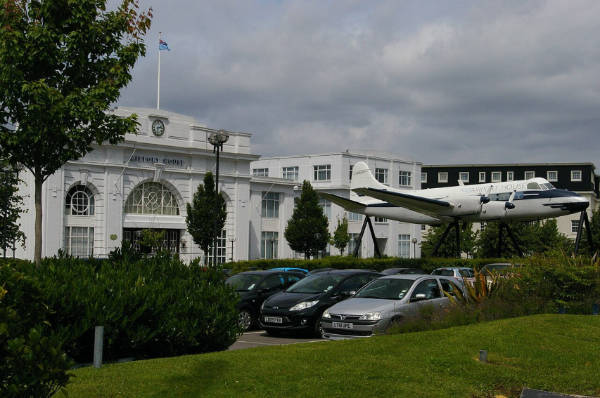
The former terminal building at Croydon Airport. PICTURE: © Christopher Hilton (licensed under CC BY-SA 2.0)

So, on 29th March, 1920, Croydon Airport opened. While it initially had temporary facilities on Plough Lane (planes apparently had to taxi across the lane to take off and after landing), a permanent terminal – the world’s first – opened near the Purley Way bypass in 1928, making it the city’s first purpose-built international airport (and the biggest and most advanced in the world at the time).

Croydon Airport is also famous for having the first air traffic control system in the world and also boasted the world’s first airport hotel which opened in 1928 (known then as Gate Lodge and today – it’s still in business – as the Croydon Aerodrome Hotel).

The airport was home to Britain’s first national carrier, Imperial Airways, which was founded when four airlines merged in 1924.

During World War II, the airport’s name changed to RAF Croydon – it served fighters taking part in the Battle of Britain – and in 1943 RAF Transport Command was founded at the site and used to ferry soldiers to and from Europe.

After the war, Croydon returned to its role as civilian passenger airport but lack of room for expansion saw Heathrow, founded in 1946 as London Airport and renamed in 1966, take over the role.
A Moment in London’s History…The Concorde takes off…


It’s 40 years ago this month since the Concorde – the ultimate in luxury plane travel – set off for the first flight on what would be – for almost three decades, at least – a regular service between London and New York.

The British Airways service between London’s Heathrow and New York’s JFK airports began on 22nd November, 1977 – the same date as regular services between Paris and New York – after a ban on the Concorde landing in New York was lifted by the US Supreme Court.

The flight came almost two years after the first commercial flights of the Concorde anywhere in the world had started in January, 1976, between London and Bahrain, and Paris and Rio via Dakar.

With the jets flying at a cruising speed of Mach 2 (twice the speed of sound), the journey from London to New York took an average of three-and-a-half hours (compared with seven to eight hours for a subsonic flight). Concorde still holds the record for the fastest crossing of the Atlantic Ocean by a civil aircraft – a flight from New York to London on 7th February, 1996, which took just two hours, 52 minutes and 59 seconds.

The aircraft – BA had seven in service – seated 100 passengers in two cabins – 40 in the front and 60 in the rear – and a crew of nine. The London to New York service (and the return trip) was particularly popular among celebrities.

The London to New York route hosted the last commercial flight of the Concorde on 24th October, 2003.

The decision to stop flying the Concorde followed a July, 2000, tragedy in which an Air France Concorde had crashed while taking off in Paris, killing 109 people on the plane and four on the ground. Safety concerns had seen the planes grounded for more than a year. And when they did finally take to the skies again in November, 2001, the world had witnessed the September 11 terror attacks – a fact which was said to have led a dramatic drop in passenger numbers.  In the end, it was said to be these declining passenger numbers along with the rising maintenance costs of ageing fleets which led to its demise.

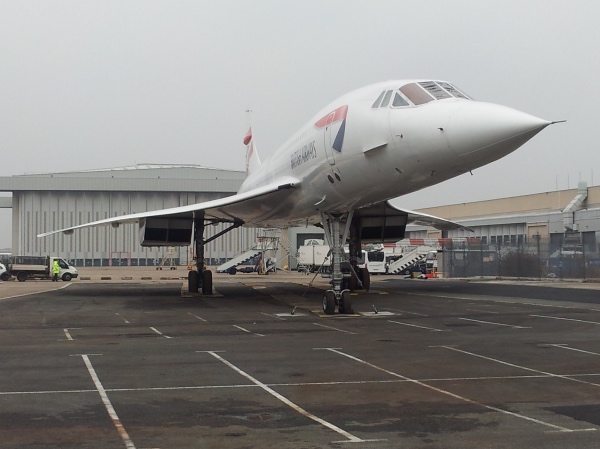
One of the retired British Airways Concordes – it was used for spare parts by BA and never used commercially – and the world’s only surviving Concorde simulator, built in 1974, can be found just outside London at the Brooklands Museum in Weybridge, Surrey.

There are apparently several supersonic jet passenger planes in development but when – or indeed if – they end up flying the New York to London route remains to be seen.

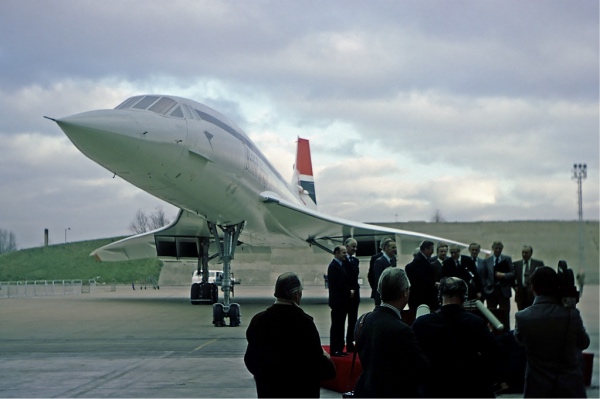
PICTURES – NOW AND THEN: Top – A Concorde in retirement (Simon Boddy, licensed under CC BY-NC SA 2.0); Below – The British Airways official handover ceremony in 1976 (Steve Fitzgerald under GNU Free Documentation License 1.2).

LondonLife – Heathrow gets greener…

heathrow-garden-gateThe UK’s first airport “garden gate” – featuring some 1,680 plants – has been planted at Heathrow’s Terminal 3 in a six month trial of the concept which could see the garden gates being implemented across the airport. Designed by urban greening specialists Biotecture, the installation at Gate 25 covers seven different sites in the gate room and features plants such as English native ivy and the Peace Lily and provides an “eco-sanctuary”, conveying a sense of calm to passengers as they embark on their journey.

LondonLife – The city illuminated…

London-at-night-(NASA)

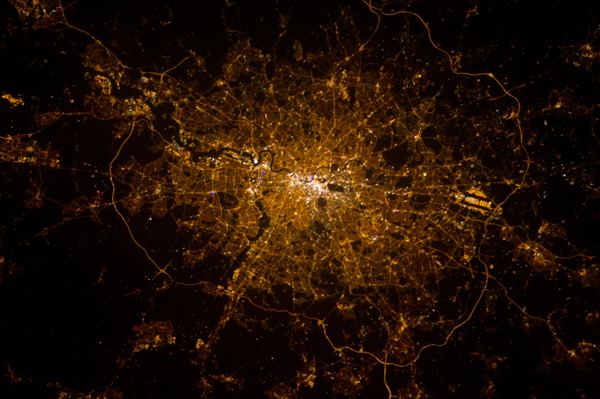
An image of London taken from the International Space Station, about 240 miles above the Earth, on 2nd February, 2013. Writes Expedition 34 flight engineer Chris Hadfield – an astronaut with the Canadian Space Agency: “London, on the Thames, from the city to the encircling motorway. Heathrow very visible on the (west).” North is at the bottom of the image, making west on the right in this image. As well as the M25, the winding River Thames can be clearly seen cutting through the city centre. PICTURE: NASA