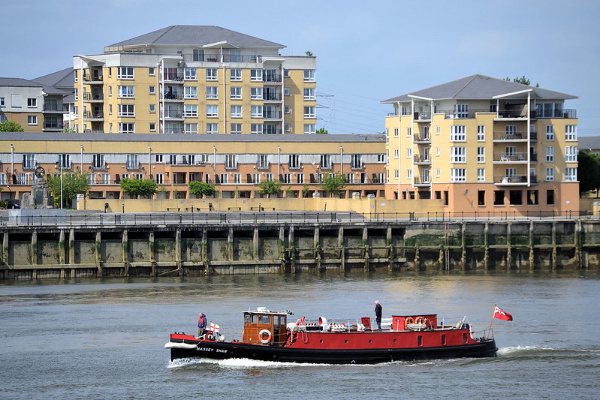
Moored at West India Dock, the Massey Shaw is a former London Fire Brigade fireboat.
The fireboat was constructed in 1935 for a cost of £18,000 by the J Samuel White company in Cowes on the Isle of Wight. Named for Sir Eyre Massey Shaw – the first Chief Officer of what was then named the Metropolitan Fire Brigade, the vessel was designed to London County Council specifications with a deliberately low profile so it could fit under the Thames bridges in all tides.
The vessel, which was was powered by two eight cylinder diesel engines and featured a main deck monitor as well as eight deck outlets (and a wheelhouse which was added later), soon proved its worth, playing an important role in saving what the press said was a million pounds worth of stock at a large warehouse fire on Colonial Wharf.
During World War II, the Massey Shaw took part in Operation Dynamo, forming part of the small boat flotilla which evacuated British troops from the beach at Dunkirk. She ferried more than 500 troops to a larger ship offshore and transported almost 100 back to England and it’s believed she was the last of the small boats to leave Dunkirk harbour (rescuing survivors from a French vessel which struck a mine along the way).
Back in London, Massey Shaw performed a critical role during the Blitz, pumping large quantities of Thames water to douse fires along the city’s waterfront.
It remained in service until the early 1970s, although it had operated as a reserve boat since 1960 with newer models taking over frontline duties.
Decommissioned in 1971, the Massey Shaw was found abandoned 10 years later at St Katharine Dock by a group who went on to found The Massey Shaw Fireboat Society with a view to preserving the vessel. They were granted a 50 year lease on the vessel.
In 1985, the Massey Shaw joined the Association of Dunkirk Little Ships on their return to Dunkirk for the first time since 1965 and two years later, she attended the centenary of Sir Eyre Massey Shaw’s review of 1000 firemen at Oxford.
In 1990 the Massey Shaw was sunk close to the London Fire Brigade headquarters at Lambeth but was subsequently salvaged and the following year, after restoration work, joined the 50th anniversary return trip to Dunkirk.
The society gained full ownership of Massey Shaw in 2002 and restoration work was carried out by the TV programme Salvage Squad (a second appearance on the show and more work followed two years later).
In 2008, a £500,000 Heritage Lottery Grant was used to fund the restoration of the vessel at Gloucester docks. She returned to London by road in 2013 where the restoration was completed and in 2015 was officially launched back on the River Thames with an event at the Westminster Boating Base.
Later that year she participated in another “little ships” armada to Dunkirk, this time commemorating the 75th anniversary of the evacuation. Massey Shaw has since taken part in other events including celebrations marking Queen Elizabeth II’s record as longest reigning monarch in 2015.
The vessel is now moored at the eastern end of West India Docks on the Isle of Dogs.
While Massey Shaw did appear in the 1958 film, Dunkirk, recapturing its role as one of the “little ships”, it did not appear in the 2017 film of the same name.
WHERE: Massey Shaw, West India Dock, Poplar (nearest DLR station is South Quay; nearest Tube station is Canary Wharf); WHEN: Between March and November, from 11am to 3pm daily (check website for details); WEBSITE: https://masseyshaw.org.

 Exploring London