Treasures of London – Marble Arch…

Originally installed as a grand entrance to Buckingham Palace, John Nash’s arch was moved to its current location, what is now effectively a traffic island not far from Speaker’s Corner in nearby Hyde Park, in 1851.

The story goes that this took place after it was discovered that the arch was too narrow for the widest of the new-fangled coaches but there are some doubts over this, particularly as the gold state coach passed under it during Queen Elizabeth II’s coronation in 1952. Another story says that it was moved after extensions to Buckingham Palace left insufficient space for it.

Work on the arch had started at Buckingham Palace in the mid 1820s and it was completed by 1833. It was originally moved to replace Cumberland Gate as the new entrance to Hyde Park and to complement Decimus Burton’s arch at Hyde Park Corner. Successive roadworks in the 20th century, however, left it in its current position.

Clad in Carrara marble, the design of the arch was inspired by Rome’s Arch of Constantine and the Arc do Carrousel in Paris. The sculptural ornamentation, which includes works by Sir Richard Westmacott and Edward Hodges Baily, however, was apparently never completed and an equestrian statue of King George IV, originally destined for the top of the arch, instead now stands in Trafalgar Square. The bronze gates – which bear the lion of England, cypher of King George IV and image of St George and the Dragon – were designed by Samuel Parker.

Only senior members of the Royal family and the King’s Troop Royal Horse Artillery are permitted to pass under the central arch of the monumental structure.

The arch stands close to where the Tyburn Tree once stood (for more on this, see our earlier post). It contains three small rooms which, up until the 1950s housed what has been described as “one of the smallest police stations in the world”.

There was some talk in 2005 that the arch would be moved to Speaker’s Corner but this obviously hasn’t eventuated.
Celebrating the Diamond Jubilee with 10 royal London locations – 2. The Queen’s childhood homes

Having spent the first few months of her life at 17 Bruton Street, the future Queen Elizabeth II moved into her parents’ new property at 145 Piccadilly.

The property, located close to Hyde Park Corner, was previously the townhouse of the Marquesses of Northampton (interestingly, it was while living here that her father the Duke of York first started visiting the Harley Street-based Australian speech therapist Lionel Logue, as depicted in The King’s Speech). The 25 bedroom house was later destroyed by a bomb during the war, long after the Yorks had moved out.

As well as the house at 145 Piccadilly, the young Princess Elizabeth (and from 1930 her younger sister and only sibling Princess Margaret) also lived at White Lodge in the centre of Richmond Park in the city’s south-west. The Lodge, a Georgian property built as a hunting lodge for King George II, now houses part of the Royal Ballet School.

She also considerable time outside the city, staying in places including Scotland with her grandparents at either Balmoral Castle (owned by the Royal Family) or at Glamis Castle (owned by the parents of her mother, the Earl and Countess of Strathmore) as well as, from the age of six, at Royal Lodge in Windsor Great Park, the country home of the Yorks. The princess apparently had her own small house, known as Y Bwthyn Bach (the Little Cottage), in the grounds  – a gift from the people of Wales in 1932.

Following the death of King George V and subsequent abdication of King Edward VIII in 1936, new King George VI and his family moved from 145 Piccadilly to Buckingham Palace. Following the outbreak of World War II in 1939, the princesses lived in Balmoral, Scotland, and Sandringham but spent most of the war at Windsor Castle.

Princess Elizabeth, meanwhile, had met Prince Philip of Greece during the 1930s and in 1947, he asked for permission to marry her.

Famous Londoners – Arthur Wellesley, the Duke of Wellington

Best known for his defeat of Napeleon at the Battle of Waterloo, Arthur Wellesley, the Duke of Wellington, was not a native Londoner. But his involvement in the military and politics meant he went on to have a significant impact on the city.

Wellesley (whose surname was actually Wesley until his family changed it in 1798) was born in Ireland in early May, 1769, and, following his schooling – including time spent at Eton and in France, he entered the British Army as an ensign in 1787, subsequently serving as an aide-de-camp to two Lords Lieutenant of Ireland. While in Ireland, he was also elected an MP in the Irish Parliament.

His military career took him to the Netherlands and then India, where he was later appointed Governor of Seringapatam and Mysore.

Returning to Europe, Wellesley took a leave of absence from the army and, having been knighted, again entered politics becoming the Tory MP for Rye in 1806, then MP for Newport on the Isle of Wight before being appointed Chief Secretary for Ireland.

He left these tasks to fight in the Napoleonic Wars – most notably in the Peninsular War where he led the allied armies to victory at the 1813 Battle of Vitoria (and was subsequently promoted to the rank of field marshal).

Following Napoleon’s exile, Wellington was created the Duke of Wellington. He served briefly as ambassador to France before Napoleon’s return in 1815. It was for his subsequent role at the Battle of Waterloo, in which Napoleon was finally and totally defeated, that Wellington is mostly remembered now.

Entering politics after his return to England in 1819, he was named Commander-in-Chief of the British Army in 1827 and was twice elected Prime Minister, from 1828-30 and again in 1834, before his death in 1852 after which he received a state funeral.

It’s not hard to find reference to the duke in today’s London and countless pubs testify to his one-time popularity.

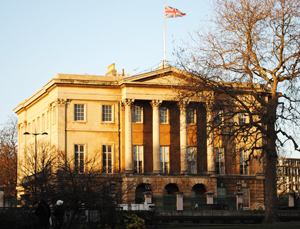
He purchased his most famous residence, Apsley House (which attracted the nickname of Number 1 London, thanks to it being the first house one encountered in London after passing through the toll gate) in 1817. Indeed, it was the installation of iron shutters at this property – a measure taken to prevent a mob demanding electoral reform from destroying it – that led to him being given the nickname, the “Iron Duke”.

These days Apsley House is managed by English Heritage and contains the Duke’s collection of artworks and furnishings.

Opposite Apsley House, close to Hyde Park Corner, stands an equestrian statue of Wellington and behind it Wellington Arch, which dates from between 1826-30, and originally stood parallel to the Hyde Park Screen. In 1846, a vast statue of the Duke was mounted on top of the arch but this was replaced with a sculpture of Peace in her Quadriga when the arch was relocated to its present site in 1882 due to a need to widen the road. There are great views from the top.

At Hyde Park Corner, close to Park Lane, stands another memorial to Wellington, this time a massive statue of the Greek hero Achilles. It was put there in 1822 (and incidentally sparked considerable controversy – it was London’s first nude public sculpture in centuries and despite the careful placing of a fig leaf, didn’t please everybody).

Wellington was buried in St Paul’s Cathedral and his huge block-like tomb in the crypt is given a level of prominence only equaled by that of Admiral Nelson.

The National Portrait Gallery this week launches an exhibition, Thomas Lawrence: Regency Power and Brilliance, which features the Duke’s favorite painting of himself (not the one above). The painting, by Sir Thomas Lawrence, hasn’t been on public exhibition for 60 years. From 21st October.

PICTURES: Image of the Duke of Wellington is by Sir Thomas Lawrence (1814). Source: Wikipedia.

The return of the Temple Bar

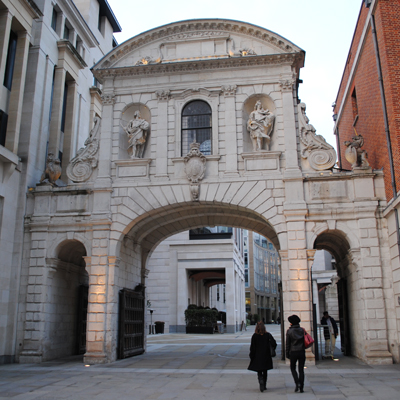
Temple Bar, LondonIt’s been a while since I was in London so I was delighted to find that the Temple Bar had been restored (not to its original site, but to the city as a whole!). The only surviving gateway into the city of London, it was constructed in 1672 to replace a crumbling wooden predecessor and was designed by Sir Christopher Wren (he of St Paul’s fame). The Temple Bar stood at the junction of Fleet Street and the Strand until 1878 when, to help traffic flow, it was removed. Apparently it was intended that it would be rebuilt somewhere else in the city, but time passed and no suitable site was found, so it eventually ended up on an estate in Hertfordshire. Where it remained until 2004 when – thanks to the work of the Temple Bar Trust – it was able to be returned to the city – it is now located between St Paul’s and Paternoster Square – for all to now enjoy.

WHERE: Between Paternoster Square and St Paul’s Cathedral. Nearest tube station is St Paul’s. COST: Free to see (actual building not open to public). WEBSITE: www.thetemplebar.info.

The Temple Bar isn’t the only ‘monument’, for want of a better word, which has been relocated in London. Another is the Wellington Arch, a magnificent structure which was originally finished (though not really completed) in 1830. Then known as the Green Park Arch, it stood parallel with the Hyde Park Screen (it was created to be seen in conjunction with it) and was later adorned with a huge – and controversial – statue of Wellington. But by the 1880s, traffic flow was again a problem and so it was decided to move the arch to its current location, perpendicular to the Hyde Park Screen. As a footnote, when the arch was moved in 1883, the statue of Wellington was not placed back on top but moved to a new site – Aldershot, where it is now.

WHERE: Grosvenor Place, Westminster, SW1X 7. Nearest tube station is Hyde Park Corner. COST: Adults £3.70/child £1.90 (English Heritage members free – there is a joint offer for others combined with Apsley House). WEBSITE: www.english-heritage.org.uk/daysout/properties/wellington-arch/.