American-born George Peabody, widely considered the “father of modern philanthropy”, spent the last almost 30 years of his life in London where he financed the building of thousands of homes for the poor.
Peabody was one of seven children born into a poor family in Danvers, Massachusetts, on 18th February, 1795, and only attended school for part of his childhood before leaving at age 11 to take up an apprenticeship with the owner of the local general store. His father died when he was 14 and Peabody started work in his brother’s shop to help support the family.
In 1816, he moved to Baltimore and established himself as a businessman importing dry goods from the UK with a reputation for working long hours. His work had taken him to London on numerous occasions and in 1837, he moved to London where he undertook work as a financier.
While he had something of a rocky start in the city – having marketed securities for US states, he suffered considerable reputational damage when they defaulted on their debt, he would become one of the City’s most successful investment bankers (he founded George Peabody & Co in 1851, taking on Junius Spencer Morgan as a partner in 1854 and following his retirement in 1864, it later became the global financial services firm JP Morgan & Co).
Interestingly, as well as honouring visiting American diplomats with banquets, he also had a key role in the United States’ contribution to the Great Exhibition of 1851 when, with no support from US Congress, he paid for exhibits to be shipped and displayed on the site in Hyde Park.
But it’s in the field of philanthropy, his ventures spurred on by his own childhood experiences, that he’s often remembered for today. This spanned both the US – where he founded the Peabody Education Fund to help destitute children living in the South and funded numerous cultural and educational institutions – and the UK where in London he founded the Peabody Donation Fund, now known as the Peabody Trust, to provide decent housing for the “laboring poor” of the city.
The trust’s first dwellings opened in Commercial Street in Spitalfields in February, 1864, and thousands more were to follow. In total, Peabody donated some £500,000 to build affordable housing (today’s Peabody Group said that equates to about £33 million in today’s money) and as much as half of his total fortune – some $US8 million – to charitable causes.
Peabody never married though he was at one stage briefly engaged. He died in London on 4th November, 1869, at the age of 74 at the house of his friend Sir Curtis Miranda Lampson at 80 Eaton Square. He was initially buried in Westminster Abbey before his remains were shipped back to Massachusetts on the Royal Navy ship HMS Monarch with an escort provided by the US ship USS Plymouth. There, he was reburied in the place of his birth the following February.
Peabody is widely seen as one of the early models for the millionaire philanthropists of today. Thanks to his philanthropic efforts, he was the first American to be made a Freeman of the City of London and was awarded a Congressional Gold medal (he was even offered the title of baron by Queen Victoria which he turned down).
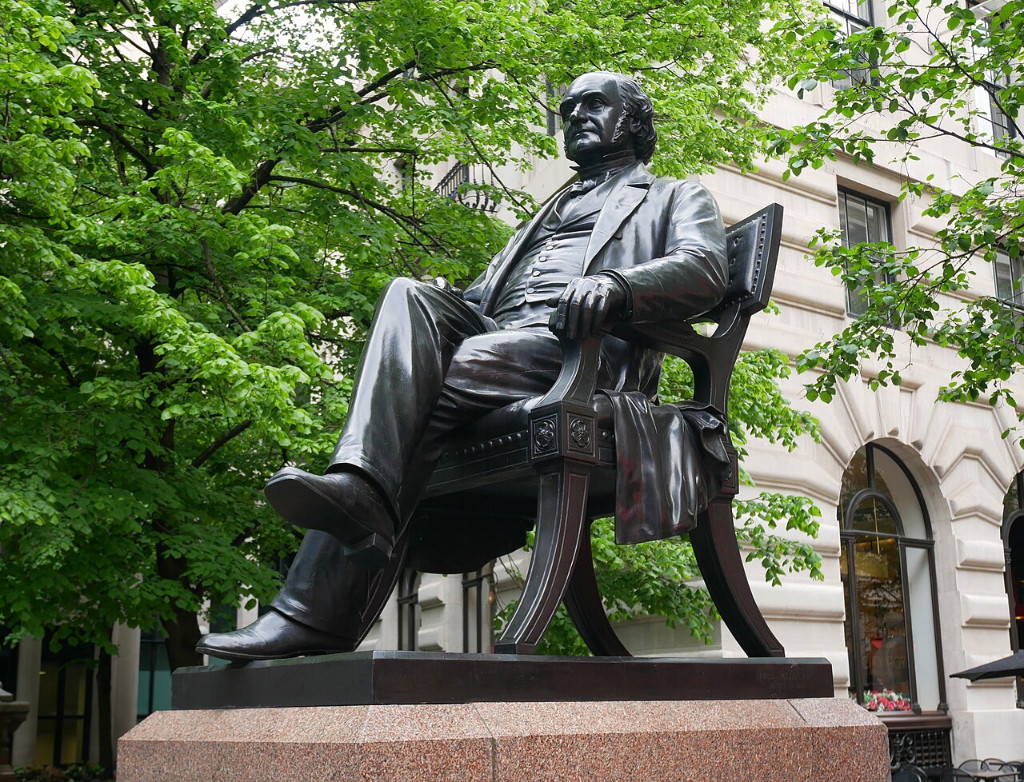
A statue commemorates Peabody outside the Royal Exchange in the City. Sculpted by William Wetmore Story, it was unveiled while he was still alive by the Prince of Wales in July, 1869 (Peabody was unfortunately too unwell to attend). There is a replica of the statue in Baltimore and his birthplace, South Danvers, has been renamed Peabody in his honour. Numerous institutions and schools in the US are named in his honour.
A Blue Plaque commemorating Peabody can also be seen on the property at 80 Eaton Square.

