This Week in London – Kew’s Christmas light trail returns; ‘Time’ at the Old Royal Naval College; and, a royal Christmas shop…

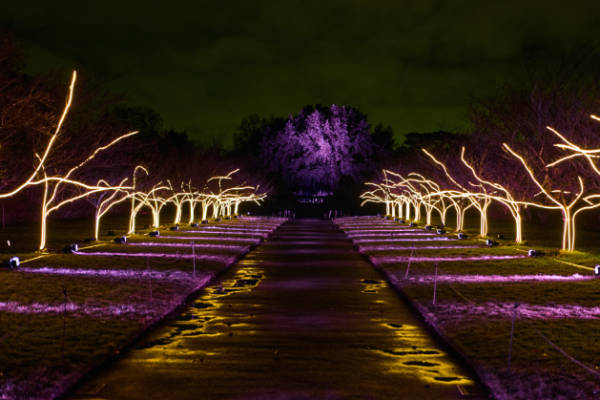
A scene from last year’s light show. PICTURE: James Carter-Johnson/iStockphoto

• Kew Garden’s famous light trail opens tomorrow and this year the three kilometres features eight new world premiere installations, interactive dance floors with giant headphones and, for the first time, the illumination of the Great Pagada. Christmas at Kew will also feature seasonal staples such as illuminated trees, a festive funfair and the ever-popular Christmas Cathedral. Among the new installations are Creative Culture’s Christmas Orchestra featuring festive music coordinated with lights and In Bloom, an installation by Netherlands’ multidisciplinary artist Wilhelmsusvlug said to evoke “delicate petals dancing through the air”. There will be a newly created projection at the Palm House while the Palm House Pond will feature a light display of 100 lillies and the trail concludes with a music and light show at the Temperate House. Runs until 4th January. Admission charge applies. For more, see www.kew.org/christmas.

Time, a sound and light show by Luxmuralis, has transformed the Old Royal Naval College after dark with an “unforgettable journey through history and science”. Visitors start in the Painted Hall where they’s see Peter Walker’s Connection & Identity illuminated after which they’ll move through the Ripley Tunnel, Queen Mary Undercroft and chapel before heading outside across the colonnades and into the courtyard. Runs until 22nd November. Admission charge applies. For more, see https://ornc.org/whats-on/time-by-luxmuralis/.

The Royal Shop in the Royal Mews at Buckingham Palace has been transformed into a Christmas pop-up shop for the first time. The Royal Mews Christmas Shop, which opens tomorrow, features a range of official royal gifts as well as food and drink from the Royal Collection Trust, a department of the Royal Household. Among the new offerings this year are mini 20cl bottles of gins infused with botanicals hand-picked from the grounds of royal residences including Buckingham Palace and Windsor Castle as well as a Property of the Royal Kitchen range of kitchen accessories, which takes its inspiration from the Great Kitchen at Windsor Castle, and wine accessories including crystal wine glasses, delicately etched with a pattern of knotted vines and grape leaves inspired by the Grand Punch Bowl, a majestic wine cistern in the Royal Collection known to have been used by Queen Victoria. To visit the shop online, head to www.royalcollectionshop.co.uk.

Send all items to exploringlondon@gmail.com
10 places to encounter London’s animal life…7. Kew Gardens…

Famous for it’s flora, Kew Gardens is also home to some unusual animal life including Chinese water dragons who live in the warm environments of the glasshouses.

See all of our content (and support our work) for just £3 a month…

Other animals in the gardens include foxes, hedgehogs and birds including green and great-spotted woodpeckers, mute swans, Canada geese, mallards, ring-necked parakeets, kingfishers, tawny owls, moorhens, and stock doves.

And, of course, the gardens are home to a myriad of insects including bees, butterflies and dragonflies as well as aquatic life including frogs, newts and fish.

WHERE: Kew Gardens (nearest Tube station is Kew Gardens); WHEN: 10am to 7pm (last entry 6pm) daily; COST: £25 adults/£8 children 16 and under (children under four free) (cheaper tickets for online bookings and during off-peak period from 1st November to 31st January); WEBSITE: www.kew.org.

Lost London – Kew Gardens’ flagpole(s)…

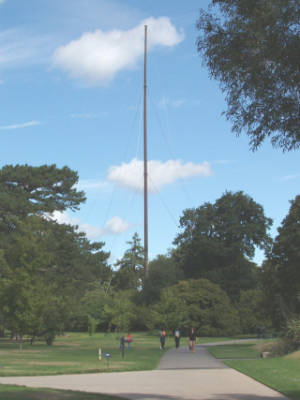
Once the tallest wooden flagpole in the world at 68 (225 feet) tall, the Kew Gardens flagpole stood for almost 50 years before it was dismantled in 2007.

The Kew Gardens flagpole shortly before it was removed. PICTURE: © Copyright David Hawgood (licensed under CC BY-SA 2.0)

The flagpole, a Douglas fir from Copper Canyon on Vancouver Island, was erected on 5th November, 1959, as a gift from the the British Columbia Loggers Association in Canada to mark both the centenary of the Canadian province of British Columbia (1958) and the bicentenary of Kew Gardens (1959).

The tree, which was around 370-years-old when cut, had originally weighed 37 tonnes, but after it was floated up the Thames to Kew and there underwent shaping, this was reduced to 15 tonnes.

Sadly, in 2006, it unfortunately failed its safety inspection – thanks to decay and woodpeckers – and was taken down the following year.

The flagpole was apparently the third (strictly the fourth) erected on the same site at the gardens which had originally been occupied by the ‘Temple of Victory’, a structure which had been built on the orders of King George III to commemorate the Anglo-German victory over the French at the 1759 Battle of Minden during the Seven Years’ War and which was removed in the mid 19th century.

The first flagpole on the site, which stood more than 31 metres (100 feet) tall. was erected in 1861. It had also come from Vancouver Island in British Columbia and replaced one which had snapped when it was in the process of being erected.

The pole was finally taken down in 1913 after being found to be suffering from dry rot.

A replacement, again from British Columbia, was erected in 1919 (its raising having been somewhat delayed by factors related to World War I). It was removed some time before 1959.

After the third giant flagpole was removed (the concrete footing can still be seen), the gardens decided not to erect another as that would mean cutting down another large tree. While far less of a spectacle, there is now a lesser flagpole near Victoria Gate where the flag is flown on special occasions.

LondonLife – Kew Gardens’ new Carbon Garden…

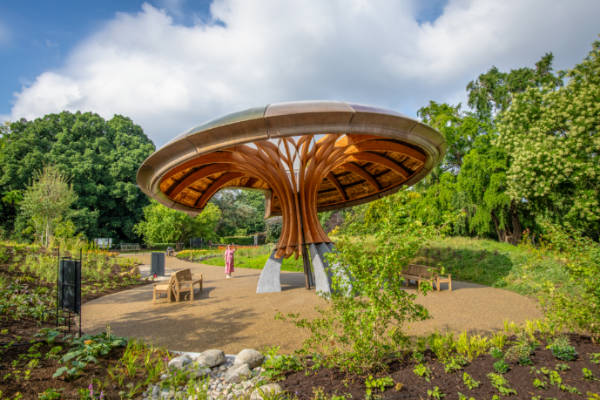
The Carbon Garden at Kew Gardens. PICTURES: Ines Stuart-Davidson © RBG Kew

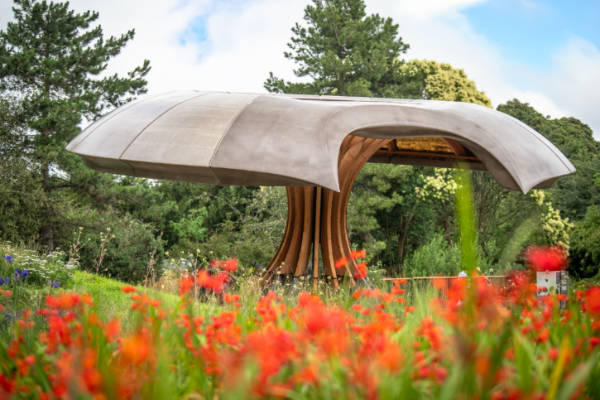
A cutting edge ‘Carbon Garden’ opened at Kew Gardens on 25th July with the aim of revealing the critical role carbon plays in sustaining life on Earth, the scale of the climate crisis, and the “extraordinary potential of the natural world to combat it”. The permanent new garden features a selection of herbaceous perennials which illustrate the dramatic rise in global average temperatures over time, a dry garden which showcases how we can work with plants to adapt to a changing climate, more than 20 new trees selected for their resilience to projected future climate conditions, a rain garden and bioswale which, among other things, illustrate the ways we can manage waterflow, prevent soil erosion, and reduce flooding, and carbon storage. and grasslands, wildflower meadows and native hedgerows which aim to boost biodiversity. At the centre of the garden is a pavilion designed by Mizzi Studio which is inspired by the symbiotic relationship between the plant and fungal kingdoms, and is created using low-carbon, natural materials. Admission charges apply. For more, see www.kew.org/kew-gardens/whats-in-the-gardens/carbon-garden

This Week in London – New room for Turner at Tate Britain; slavery and Caribbean post ships; and, ‘The Power of Trees’ at Kew…

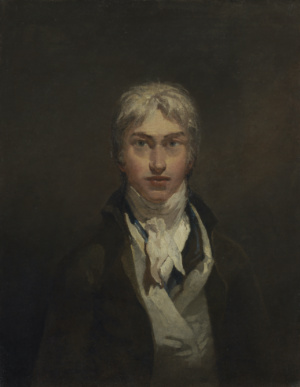
JMW Turner, ‘Self-Portrait’, c1799, PICTURE: Courtesy of Tate

A new room dedicated to the watercolours and drawings of painter JMW Turner has opened at the Tate Britain to mark the 250th anniversary of his birth. The new room at the Millbank gallery, whichfeatures some of the more than 100 works by Turner on display in the gallery, includes the earliest Turner in Tate’s collection, made when he was only 12-years-old, as well as a dramatic image of a building on fire, long thought to be the Houses of Parliament but now revealed to in fact be the Tower of London. The display draws on the latest research developed in preparing a new catalogue of Turner’s 37,500 works on paper which, to be completed this year, will be freely accessible on Tate’s website from November and offers a news insight into the artist’s ideas and methods. Further events related to Turner are planned for later this year. The new room can be seen daily. Entry is free. For more on how the Tate is marking the Turner anniversary, see tate.org.uk/turner-250.

The stories of enslaved people – whose labour fuelled 19th century postal ships between the UK and the Caribbean – are explored in an exhibition at the Postal Museum in Clerkenwell. Voices of Resistance: Slavery and Post in the Caribbean draws on letters between plantation owners and managers to provide glimpses into the lives of enslaved people who worked on the plantations and celebrates their courageous acts of resistance. The display also features a movie by filmmaker Emmanual Phillips which honours the Caribbean coal workers involved in refuelling postal ships on the island of St Thomas (and which was created in partnership with Dollar fo’ Dollar, St Thomas-based organisation that works to ensure the legacies of the coal workers live on to inspire people). Entry is included in the museum ticket. Runs until 5th January. For more, see www.postalmuseum.org.

On Now: The Power of Trees. This exhibition at Kew Garden’s Shirley Sherwood Gallery of Botanical Art celebrates trees and their use as a source of artistic inspiration across cultures and time. The display features a variety of botanical works including 20 newly commissioned botanical artworks created by the artists of the Bedgebury Florilegium Society and Horizontal – Vaakasuora, a spectacular cinematic installation from Finnish artist Eija-Liisa Ahtila. Entry is free with Kew Gardens admission. Runs until 14th September. For more, see www.kew.org.

Send all items to exploringlondon@gmail.com.

London Explained – London’s UNESCO World Heritage Sites…

UNESCO’s World Heritage List includes as many as 1223 properties right across the globe which the World Heritage Committee considers as having “outstanding universal value”.

Most of them are cultural sites (952) but they also include some 231 natural sites and 40 which have both qualities.

The UK is actually home to 35 sites on the list, ranging from Stonehenge and the English Lake District to neolithic Orkney and the City of Bath.

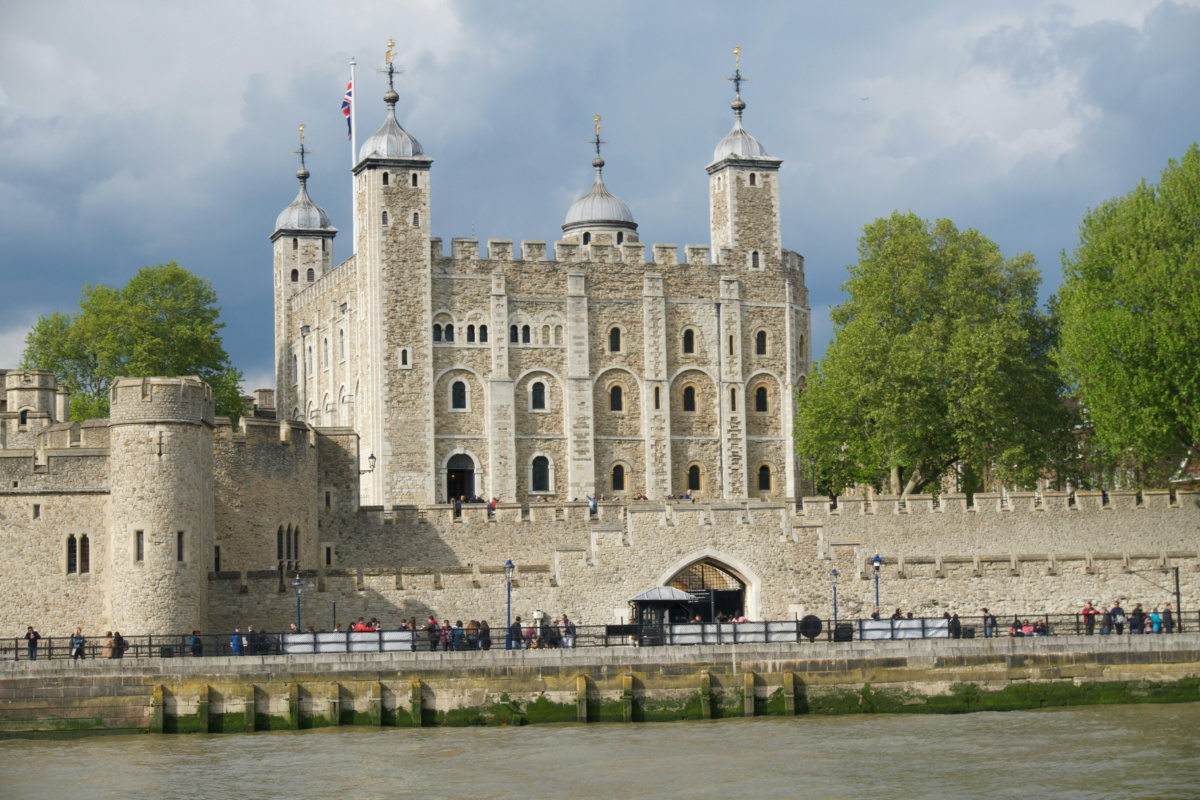
The Tower of London: PICTURE: Gavin Allanwood/Unsplash

London itself is home to four internationally recognised UNESCO World Heritage Sites. These include the Tower of London, the Royal Botanic Gardens in Kew, the Palace of Westminster and Westminster Abbey (including the neighbouring St Margaret’s Church), and maritime Greenwich.

The first of the four to be added to the list was the 10 hectare site of Palace of Westminster and Westminster Abbey in 1987 (described as being of “great historic and symbolic significance”). It was followed by the Tower of London in 1988, and the 109 hectare area covering the Queen’s House, Old Royal Naval College and Royal Observatory known as maritime Greenwich in 1997.

The 132 hectare site of the Royal Botanic Gardens at Kew was the most recent addition to the list in 2003.

As well as being added to the list, sites can also be removed as happened when Liverpool became the third site to be removed from the list in 2021 due to what the World Heritage Committee said was “the irreversible loss of attributes conveying the outstanding universal value of the property”.

Concerns have been raised over the Tower of London’s future on the list due to surrounding development and, of course, there are always other sites that can be added (we vote for Hampton Court Palace, among others).

This Week in London – Peru’s orchids celebrated at Kew; Brazilian Modernism at the Royal Academy; and a tribute to The Clash’s Joe Strummer…

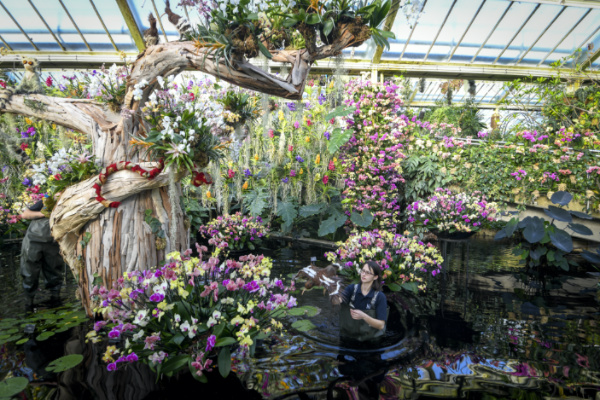
From a previous Orchid Festival at Kew Gardens which celebrated the biodiversity of Madagascar. PICTURE: © RBG Kew

• Kew Garden’s iconic orchid festival returns this Saturday with a Peruvian twist. The gardens’ 29th orchid festival explores some of the 3,000 species of orchids found in Peru’s varied landscapes. Inside the Princess of Wales Conservatory will be a floral recreation of the scenery of Peru including a cornucopia sitting on a grass island in the central pond which was inspired by Lake Titicaca and, in a smaller pond, floral parihuanas (flamingoes) stand proud in front of the iconic Machu Picchu. The display also includes the world’s largest bromeliad – Puya raimondii (commonly known as the Queen of the Andes) – which will be shown alongside floral sculptures inspired by the plant. The country’s diverse wildlife, meanwhile, is celebrated with an orchid aviary that brings to life the diverse bird populations of Peru, and visitors are welcomed by an alpaca bedecked in orchids. Visitors can also wander under a starry night sky adorned with dazzling allium flower heads, which will be recycled from Kew’s outdoor garden displays. There is also large-scale photography taken by celebrated Peruvian photographer Mariano Vivanco and new artworks created for the exhibition of Lima-born artist Gisella Stapleton. Runs until 2nd March. Admission charge applies (advance booking required). For more, see www.kew.org.

The diversity of 20th century Brazilian art is being celebrated in a new exhibition which opened at the Royal Academy this week. Brasil! Brasil! The Birth of Modernism features more than 130 works by 10 important Brazilian artists and spans the period from the 1910s to the 1970s. The artists include pioneers of Brazilian modernism such as Anita Malfatti, Vicente do Rego Monteiro, Jewish Lithuanian emigré Lasar Segall, Candido Portinari and Tarsilo do Amaral as well as self-taught artists such as Alfredo Volpu, Djaniro da Motta e Silva, Rupert Valentim, Geraldo de Barros, and the artist and architect Flávio de Carvalho. The exhibition also features a section dedicated to the historic Exhibition of Modern Brazilian Paintings, which took place at the Royal Academy in 1944 and was the first exhibition of modern Brazilian art in the UK. Runs until 21st April. Admission charge applies. For more, see www.royalacademy.org.uk.

A “legacy stone” commemorating the former residence of musician and former lead singer of The Clash, Joe Strummer, has been unveiled in North Paddington. The stone was installed in the newly refurbished Maida Hill Market on the corner of Walterton Road, a location where Strummer, who died in 2002, squatted during the 1970s ( in fact, his address of 101 Walterton Road inspired the name for the band the 101ers). The stone is inscribed with lyrics sung by Strummer in the song Clampdown from The Clash’s 1979 album London Calling including “the future is unwritten” and “No man born with a living soul can be working for the clampdown”. The stone was installed as part of Westminster City Council project to revitalise the market and Market Hill Area.

Send items to exploringlondon@gmail.com for inclusion.

Lost London – Richmond Lodge…

Located close to the River Thames, Richmond Lodge was a royal hunting lodge before becoming a favoured residence for Hanoverian royals for several decades in the 18th century.

Subscribe for just £3 a month – that’s less than the cost of a cup of coffee – to access all of Exploring London’s content!

This Week in London – Christmas at Kew; Picasso’s prints; and, the T rex dons its Christmas jumper…

World premiere installations Ombre by TILT – which takes the “form of a series of giant plants in bloom springing up from the landscape in a spectrum of vibrant shades” – and Threshold by Studio Vertigo – an “illuminated helix-like shape, bathed in golden yellow light to evoke the warmth and joy of the festive season” are at the centre of this year’s Christmas light trail at Kew Gardens. Other highlights at this year’s festive showing include Camellia Walk, which has been transformed into a snowy lane which showcases the spectacular tree canopy and evoking a wintery wonderland, Fish are Jumping by Dutch artists TOER and Mist Arches by Culture Creative which create “an atmospheric ambience across Kew’s Lake Crossing”. Annual favourites such as the light show on the Temperate House, the Fire Garden and Christmas Cathedral have also returned along with the Palm House finale. The trail can be visited on selected dates until 5th January. Admission charge applies. For more, see
www.kew.org/christmas.

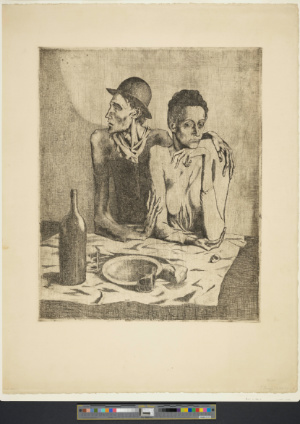
The frugal meal, 1904 © Succession Picasso/DACS, London 2024

Around 100 prints by Pablo Picasso – including some from his 347 Suite which have never been displayed before – are on show in a new exhibition at the British Museum. Picasso: Printmaker charts the artist’s engagement with printmaking (he produced around 2,400 in total) and centres on some of the more than 500 now in the British Museum’s collection (the largest in the UK). Highlights include his first professional print – The Frugal Meal (1904 – pictured) – as well as prints from the Vollard Suite (1930-1937) such as the aquatint Faun Uncovering a Woman (1936), and, the 347 Suite‘s Tree in the Storm, with Flight Towards a Church (1968). The exhibition can be seen in Room 90 until 30th March. Admission charges apply. For more, see www.britishmuseum.org/picasso.

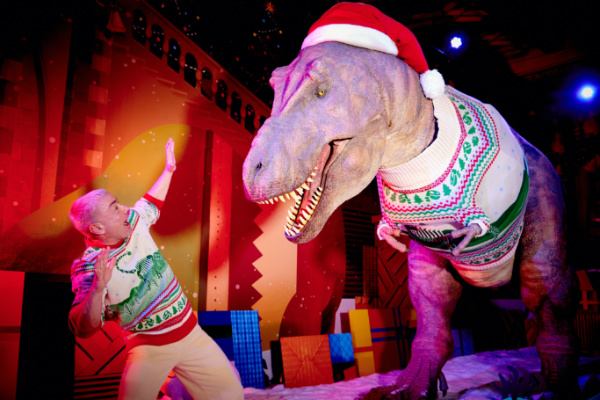
The T rex’s new Christmas jumper has been unveiled at the Natural History Museum. This year’s design – which can be seen modelled by the T rex – features festive colours of red, blue, green and white and an image of the museum’s latest prehistoric resident, Fern the Diplodocus, who took up residence in the redesigned gardens earlier this year. The jumper can be seen in the Dinosaur’s Gallery until January. Human-sizxed versions can be bought in the museum shop (www.nhmshop.co.uk). For more, see nhm.ac.uk.

The Natural History Museum unveils its 2024 Christmas jumper on its famous animatronic T rex in annual festive display. PICTURE: © Trustees of the Natural History Museu

Send all items to exploringlondon@gmail.com.

This Week in London – ‘The World of Tim Burton’; Halloween at Hampton Court, the Tower, and Kew Gardens; and, Diwali celebrations…

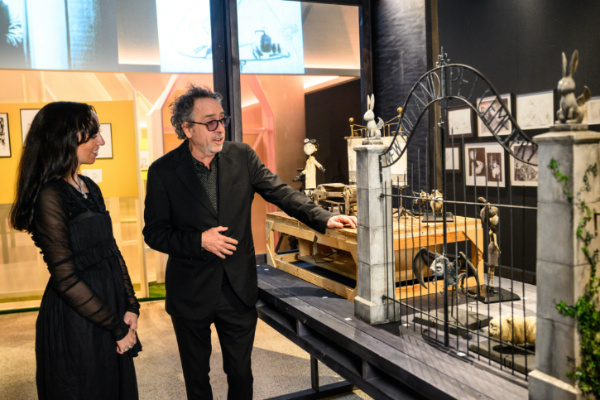
Tim Burton and curator Maria McLintock visit ‘The World of Tim Burton’ , on 23rd October. PICTURE: Matt Crossick/PA Media A (courtesy of the Design Museum)
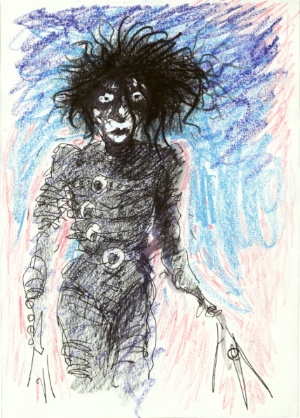
Tim Burton, Untitled (Edward Scissorhands), 1990. EDWARD SCISSORHANDS ©1990. 20th Century Studios, Inc. All Rights Reserved.

The fantastical world of celebrated film-maker Tim Burton is on display in a touring exhibition opening at the Design Museum on Friday. The World of Tim Burton, making its final stop after a decade-long world tour, showcases his 50 years of creative output and looks at not only his role as film-maker but as illustrator, painter, photographer and author. Drawn from Tim Burton’s personal archive as well as film studio collections and other private holdings, the more than 600 objects include film props, drawings, paintings, photographs, sketchbooks, moving-image works, sculptural installations, set and costume design. Highlights include the Catwoman suit from 1992’s Batman Returns, Wednesday Addams’ viral Rave’N dance dress from the recent Netflix series and the Edward Scissorhands costume worn by actor Johnny Depp in the 1990 film. There’s also early drawings of the Martians from Mars Attacks! (1996), the Mad Hatter from Alice in Wonderland (2010), and Emily in Tim Burton’s Corpse Bride (2005) and a specially created cinema experience which gives voice to some of Burton’s key collaborators and is being shown in a bespoke art-deco space reminiscent of the theatres Burton frequented as a child growing up in Hollywood. Runs until 21st April. Admission charge applies. For more, see https://designmuseum.org/exhibitions/the-world-of-tim-burton.

Hampton Court Palace and the Tower of London are marking Halloween with a series of spine-tingling events which delve into the mysterious past of the royal residences. From Saturday, visitors to Hampton Court Palace can, among other things, discover the ‘Alchemist’s Apothecary’ and meet the ghost of a long-departed alchemist, venture into the ‘Spider’s Lair’ in the depths of the palace’s wine cellar, catch a glimpse the frantic ghost of Catherine Howard in the Haunted Gallery, and encounter the spirit of Sybil Penn, a former nurse to Henry VIII’s son Edward, who has haunted the palace hallways ever since her tomb was disturbed. At the the Tower of London, meanwhile, the grounds have been transformed, hosting everything from a haunted chess game on the South Lawn to a glimpse into the tower’s astronomical past, complete with celestial maps and scientific instruments. Events take place until 3rd November. Admission charge applies. For more, see www.hrp.org.uk/hampton-court-palace/ or www.hrp.org.uk/tower-of-london/.

The first Halloween-themed light trail has opened at Kew Gardens with eerie illuminated trees, ghoulish installations and fire performers. Visitors can wander through an illuminated spiders web or discover a neon Carnivorous Tree feeding on unsuspecting skeletons by choosing one of three sessions to attend (daylight, twilight and moonlight) with things getting scarier as the evening progresses. Runs until 3rd November. Admission charge applies. For more, see www.kew.org/kew-gardens/whats-on/halloween-at-kew.

Diwali is being celebrated on Trafalgar Square this Sunday in a free, family-friendly festival. Delivered in partnership with the volunteer-led Diwali in London committee, the event – which showcases the culture of London’s Hindu, Sikh and Jain communities – features a programme of dance, music, activities and food. Highlights include dance workshops, sari and turban tying and the new Bhajan singing space where groups will perform throughout the day. The day runs from 1pm to 7pm. For more, see www.london.gov.uk/events/diwali-square-2024.

Send all items to exploringlondon@gmail.com
This Week in London – ‘Lucky Jim’ reunited with historic plane; Banksy work related to Guildhall Yard; and, a new Kew audio tour…

‘Lucky Jim’, a toy cat mascot belong to Jim Alcock – pilot of the first trans-Atlantic flight, has been reunited with the Vickers Vimy biplane aircraft that made the flight for the first time since 1919. The cat accompanied the famous aviator and his navigator Arthur Whitten Brown on their historic 17 hour, 1,880 mile journey. Following preservation efforts is now displayed alongside the aircraft in the Flight gallery at the Science Museum in South Kensington. Lucky Jim was previously displayed at the Science and Industry Museum in Manchester until 2019. A cartoon version of the cat is also the star of a new family trail around the gallery. For more, see https://www.sciencemuseum.org.uk/see-and-do/flight.

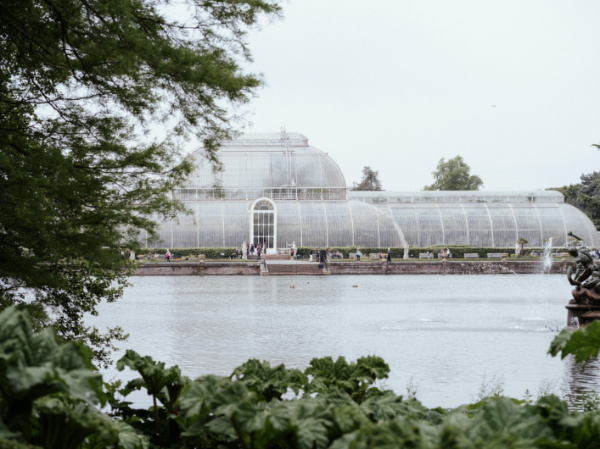
The Palm House at Kew Gardens. PICTURE: Annie Spratt/Unsplash

Explore the plants of Kew Gardens’ historic Palm House with a new audio tour. Created by Kew’s Community Horticulture Programme in collaboration with outreach participants, Pollinators of the Palm House puts a spotlight on some of the remarkable stories and pollination tricks of incredible plants inside the 175-year-old structure. These include the giant cycad (Encephalartos altensteinii) – officially the oldest pot plant in the world, and the traveller’s palm (Ravenala madagascariensis), which is pollinated by lemurs in the wild on Madagascar. For more, see www.kew.org.

An artwork by Banksy has been relocated to Guildhall Yard for its protection. The work, which depicts swimming piranhas, appeared on a sentry box near Ludgate Hill earlier this month. A City of London Corporation spokesperson saying a permanent home would be found “in due course”.

Send all items for inclusion to exploringlondon@gmail.com.

This Week in London – West Ham Park celebrates its 150th; rare examples of 17th century paper-cutting; King Henry VIII jousts at Hampton Court; the collection of Elizabeth Legh; and, ‘Horrible Science’…

West Ham Park celebrates its 150th anniversary this weekend with a festival of music, food, sport, and other activities. On Saturday there will be a free, family-friendly festival with music – including appearances by Australian-born singer-songwriter Celina Sharma and singer-songwriter, Fiaa Hamilton, as well as a DJ set from Ellis – along with arts and crafts, a children’s fun fair and local food stalls. On Sunday, activities are based around the theme of ‘give it a go’ with visitors able try out various sports and health activities, including football, cricket, tennis, athletics, Tai Chi, and long-boarding. There will also be free taster sessions and opportunities to meet local sporting legends. An outdoor exhibition about the park’s history can be seen in Guildhall Yard in the City leading-up to the event after which it will be moved to Aldgate Square. West Ham Park is the largest green space in the London Borough of Newham and has been managed by the City of London Corporation since 1874. Activities on both days start at 12pm. For more, see www.cityoflondon.gov.uk/westhampark150.

To see the rest of this post (and all of our coverage), subscribe for just £3 a month. This small contribution – less than the cost of a cup of coffee – will help us continue and grow our coverage. We appreciate your support!

10 significant (and historic) London trees – A recap…

We’ll kick off a new series next week, but, in the meantime, here’s a recap…

1. Queen Elizabeth’s Oak, Greenwich…

2. The Cheapside Plane…

3. Charter Oak of Bexley…

4. The Royal Oak, Richmond Park…

5. Black mulberry trees, Middle Temple Gardens…

6. Mendelssohn’s Tree…

7. D-Day Tree…

8. The Old Lions…

9. The Fulham Palace Oak…

10. Berkeley Square Plane Tree…

10 significant (and historic) London trees…8. The Old Lions…

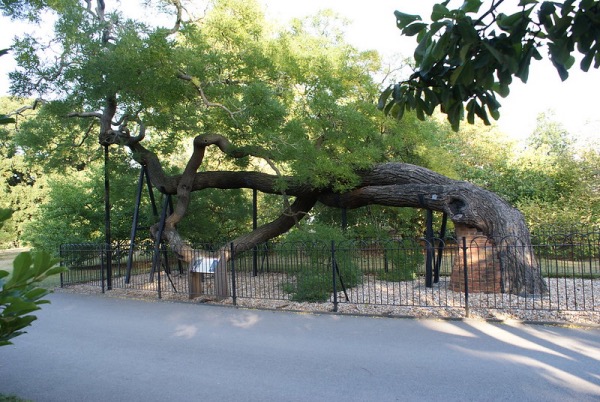
Not one but five trees located in Kew Gardens, the “Old Lions” are five of the oldest trees in the garden.

Kew’s first curator, John Smith, is credited with first using the term to describe the trees.

The Japanese pagoda tree. PICTURE: Michelle Bartsch (licensed under CC-BY-NC-ND-2.0)

They include a Japanese pagoda tree (Styphnolobium japonicum) which was planted in 1762 after having been brought back to London from China by London nurseryman James Gorden.

There’s also the oldest of the maidenhair trees (Ginkgo biloba) in the garden, one of several grown by Gorden in 1758. Originally planted in the Duke of Argyll’s Garden at Whitton, it was transferred to Kew in 1762 following his death by his nephew Lord Bute, and is thought to be one of the first of its species to be grown in the country.

The Oriental plane (Platanus orientalis), located next to the Orangery, also apparently come from Whitton, brought to Kew in 1762, while the Caucasian elm (Zelkova carpinifolia) was planted in 1760 and is the only survivor of a group of three, the other two lost in storms in 1987 and 1990.

The last of the five trees is a Black locust (Robinia pseudoacacia) tree, also known as the false acacia tree. It was planted in the gardens in 1762 and was also transplanted from the Duke of Argyll’s Garden at Whitton.

WHERE: Kew Gardens (nearest Tube station is Kew Gardens); WHEN: 10am to 7pm (see website for seasonal changes); COST: From £20 for adults; from £18 concessions; from £9 young person (16 to 29 years); from £5 for children (4 to 15 years); see website for ticket categories WEBSITE: www.kew.org.

This Week in London – Hampton Court’s bunny hunt returns; vintage prints at the National Portrait Gallery; and, ‘Sounds of Blossom’ at Kew…

Gardens at Hampton Court Palace. PICTURE: edwin.11 (licensed under CC BY 2.0)

The Lindt Gold Bunny hunt returns to Hampton Court Palace this Saturday with families once again invited to search the gardens for those elusive Gold Bunny statues. Each statue offers a chance to match the names of influential characters from Hampton Court Palace’s history to the distinctive red ribbons and a small Lindt bunny chocolate awaits those who succeed in finding the bunnies. Visitors will also have the chance to encounter a selection of the characters roaming the palace over the Easter period. The Gold Bunny hunt is included in general admission. Until 14th March. For more, see www.hrp.org.uk/hampton-court-palace/whats-on/easter-lindt-gold-bunny-hunt/.

Rare vintage prints by two of art history’s most influential photographers – Francesca Woodman (1958-1981) and Julia Margaret Cameron (1815-1879) – go on show at the National Portrait Gallery today. Francesca Woodman and Julia Margaret Cameron: Portraits to Dream In showcases more than 160 rare vintage prints including 97 by Woodman and 71 by Cameron as well as artist’s books by Woodman which have never been exhibited before in the UK. Key works include Cameron’s self-declared “first success” – a portrait of Annie Wilhemina Philpot taken in 1864, Woodman’s Self-portrait at thirteen, taken during a summer holiday in Italy in 1972, images from Woodman’s Angel series and Cameron’s ethereal portraits of actor Ellen Terry taken in 1864. Also featured are Woodman’s Caryatid pieces and Cameron’s portraits of her niece and favorite model Julia Jackson, Alice Liddell as the goddess Pomona, a portrait of John Frederick William Herschel called The Astronomer (1867), and those of her frequent muses, May Prinsep and Mary Ann Hillier. Runs until 16th June. Admission charge applies. For more, see www.npg.org.uk.

A new collaboration with the Royal College of Music blends music with spring blooms at Kew Gardens. Sounds of Blossom: Awaken your senses, the first ever spring festival to be held at the gardens, features six bespoke commissions that celebrate Kew’s unique landscape in the spring emerging from locations such as Cherry Walk, Asano Avenue and the Japanese Landscape. And on weekends during the festival, visitors can enjoy live musical performances from the Royal College of Music as they showcase a varied repertoire from classical favourites to jazz melodies. Included in general admission. Runs until 14th April. For more, see www.kew.org/kew-gardens/whats-on/sounds-of-blossom.

Send all items to exploringlondon@gmail.com
This Week in London – Life in the Roman army explored; clockwork treasures from China; and, Kew Gardens’ Orchid Festival…

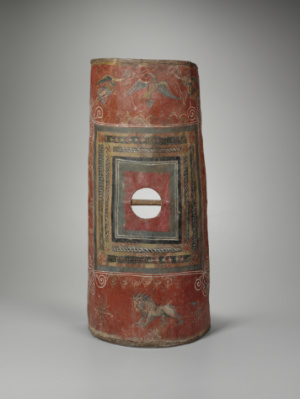
A major new exhibition on life as a Roman legionary opens at the British Museum today. Legion: Life in the Roman army shares stories of real legionaries and shows how the army was as much an “engine of social change” as it was a war machine. More than 200 objects, many of which are on display in the UK for the first time, are on show including the world’s only intact legionary shield, on loan from Yale (pictured), and the oldest and most complete classic Roman segmental body armour, found in Kalkriese, Germany, in 2018. There are also the remains of a soldier found at Herculaneum, reunited with his belt and equipment for the first time outside of Italy, as well as the Crosby Garrett mask helmet – found in Cumbria in 2010, and a unique dragon standard found in Germany. The exhibition, which can be seen in the Sainsbury Exhibitions Gallery until 23rd June, also features a specially designed Horrible Histories themed trail of the exhibition with interactive family stations. Admission charge applies. For more, see www.britishmuseum.org.

More than 20 mechanical clocks collected by Chinese emperors are being displayed together for the first time in the UK in a new exhibition opening today at the Science Museum. Among those on display in Zimingzhong 凝时聚珍Clockwork Treasures from China’s Forbidden City is the ‘Pagoda Zimingzhong’ which, was made in London in the 1700s during the Qing Dynasty in China, ‘Zimingzhong with Turbaned Figure’ which mixes imagery associated with China, Japan and India to present a generalised European view of an imagined East, and the Zimingzhong with mechanical lotus flowers’, which, when wound, reveals a flock of miniature birds swimming on a glistening pond as potted lotus flowers open. Runs until 2nd June. Visitors are invited to pay what they can to visit the exhibition, with a minimum ticket cost of £1 per person. For more, see www.sciencemuseum.org.uk/see-and-do/zimingzhong.

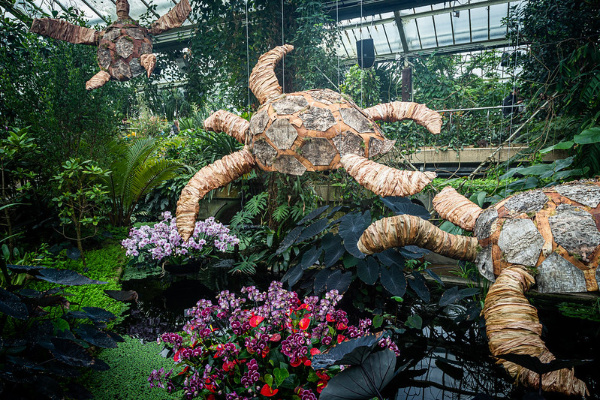
Kew Gardens’ Orchid Festival returns from this Saturday, this year drawing inspiration from the unique flora and fauna of Madagascar. The display features a specially commissioned film showcasing the beauty of Madagascar – the world’s fourth largest island – as well as themed floral displays and living installations in the Princess of Wales Conservatory. The latter include ‘Lovers Baobab’ on the waterlily pond, floral sculptures recreating some of Madagascar’s most iconic wildlife, including ring-tailed lemurs, chameleons and the aye-aye, the world’s largest nocturnal primate, and a small selection of Madagascan orchids including Angraecum sesquipedale (also known as Darwin’s orchid). Visitors will also hear Malagasy music composed by the Boriza Borothers and be able to purchase food made according to a range of authentic Malagasy recipes, thanks to a menu curated by Malagasy chef Lilia Andrianovy of Lilia’s Kitchen. Orchids After Hours will also return for this year’s festival. Runs until 3rd March. Admission charge applies. For more, see www.kew.org.

Send all items for inclusion to exploringlondon@gmail.com
This Week in London – Hans Holbein at The Queen’s Gallery; ‘Crown and Coronation’ at the Tower; Christmas at Kew; and, Charles Dickens’ friendship with Wilkie Collins explored…

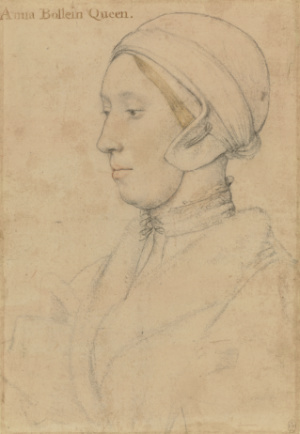
Hans Holbein the Younger, 
Anne Boleyn (1532)/Royal Collection Trust / © His Majesty King Charles III 2023.

The largest exhibition of the work of Tudor-era artist Hans Holbein the Younger has opened at The Queen’s Gallery, Buckingham Palace. Holbein at the Tudor Court features more than 50 works by Holbein including intimate portrait drawings of the royal family and the Tudor nobility including one of few surviving drawings of Anne Boleyn made during her lifetime, drawings of Jane Seymour and Sir Thomas More, and an unfinished portrait of King Henry VIII’s son Prince Edward. Other portraits include that of Derich Born, a 23-year-old Steelyard merchant, and one of Richard Southwell, a convicted murderer who was one of King Henry VIII’s closest advisors. The exhibition also features objects including a Brussels tapestry, jewel-like miniatures and Henry VIII’s magnificent armour, usually on show at Windsor and in London for the first time in a decade. Runs until 14th April. Admission charge applies. For more, see www.rct.uk/collection/themes/exhibitions/holbein-at-the-tudor-court/the-queens-gallery-buckingham-palace

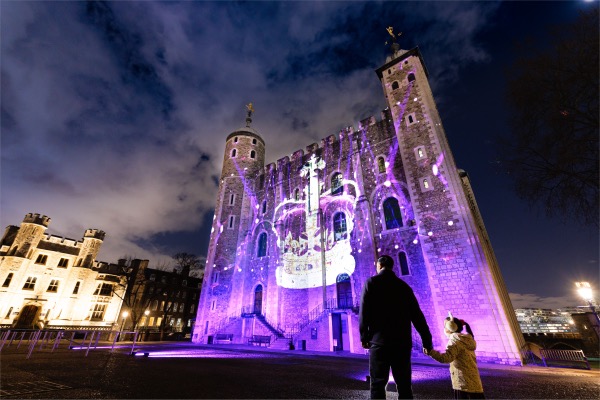
The White Tower looking south-east, showing a coloured light projection of St Edward’s Crown, the crown used at the moment of Coronation. PICTURE: © His Majesty King Charles III 2023 -Royal Collection Trust – Historic Royal Palaces

The magnificence of coronations and the Crown Jewels will be on show at the Tower of London from tomorrow night in a new light and sound show. Crown and Coronation – which has been created by Historic Royal Palaces in partnership with Luxmuralis as part of an artistic collaboration between artist Peter Walker and composer David Harper – brings the “spectacle, significance and shared experience” of coronations to life and demonstrates the pivotal role of the Crown Jewels in the ceremony as it takes visitors on a journey through the past 1,000 years. Images of the jewels will be projected on the White Tower in the show with visitors then able to view the actual jewels themselves in a special after hours opening. But you’ll have to be quick – the show can only be seen for nine days, ending on 25th November before it embarks on a two year UK-wide tour. Admission charge applies. For more, see www.hrp.org.uk/tower-of-london/.

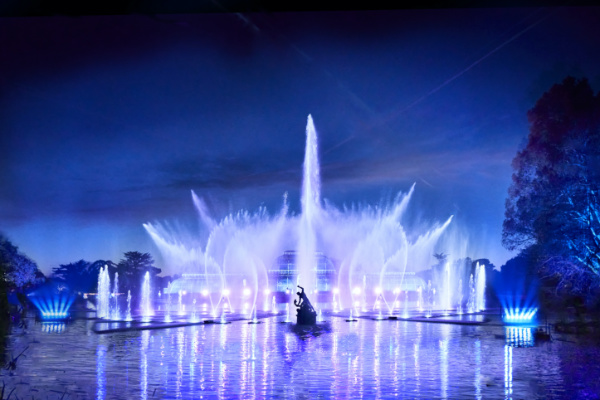
The Palm House light show, part of Christmas at Kew. PICTURE: © Raymond Gubbay Ltd, Richard Haughton

Christmas returned to Kew this week with the launch of it’s new festive light trail featuring seven new installations. Highlights of this year’s trail include three metre tall illuminated flowers, cascading lights suspended from the tree canopy, one of the longest light tunnels to ever feature in Kew’s Christmas celebrations and the Hive – which recreates life inside a beehive – as well as the iconic Palm House light show, the twinkling tunnel of light inspired by arched church windows known as the ‘Christmas Cathedral’, and a ‘Fire Garden’ at the Temperate House. There’s also festive treats to sample and visitors can experience a traditional Christmas dinner at The Botanical Brasserie. Admission charges applies. Runs until 7th January (advance bookings only). For more, see www.kew.org/christmas.

Charles Dickens’ friendship and collaboration with writer Wilkie Collins is explored in a new exhibition at The Charles Dickens Museum in Bloomsbury. Dickens met Collins, who would become one of his most significant friends, in 1851 as they performed together in a play at the house of John Forster and their personal and professional relationship lasted more than 15 years. The display features works produced as a result of the friendship – everything from articles in Dickens’s Household Words through to novellas and plays such as The Lazy Tour of Two Idle Apprentices and The Frozen Deep – and features original letters, historic objects, and interactive displays focusing on everything from the pair’s moustache-growing contests and cruising international entertainment districts to co-writing side by side, discussing writer’s block and plot devices. Admission is included with general admission. Runs until 25th February. For more, see https://dickensmuseum.com.

Send all items to exploringlondon@gmail.com.

This Week in London – London’s transport posters on show; a musical exploration at the Science Museum; and, ‘Petrichor’ at Kew…

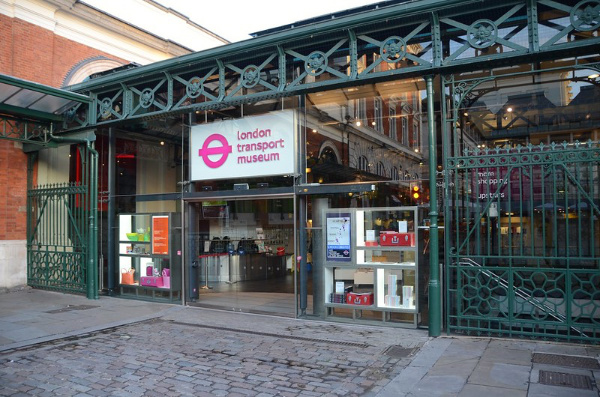
London Transport Museum in Covent Garden. PICTURE: Marcus Meissner (licensed under CC BY 2.0)

The first permanent gallery dedicated to the history of poster art and design at the London Transport Museum in Covent Garden opens tomorrow. The new Global Poster Gallery, sponsored by Global, the Media & Entertainment Group, showcases the museum’s collection of 20th century graphic art and design – one of the world’s largest. The new gallery, which is set over two floors, launches with the exhibition, How to Make a Poster, and an accompanying programme of events. The exhibition visually explores the process of creating posters from the pre-digital age from 1900 and features more than 110 poster artworks and posters including the Underground’s very first pictorial poster titled No need to ask a p’liceman by John Hassall, dating from 1908. Admission charge applies. The exhibition runs until 2025. For more, see www.ltmuseum.co.uk.

A new interactive exhibition exploring the mysterious hold music can have over us opens at the Science Museum today. Turn It Up: The power of music features historic music players, inventions and unusual instruments. Among the inventions on show are the MiMU gloves invented by Imogen Heap and used by Ariana Grande and Kris Halpin which use gestures to control electronic music-making software, and a virtual instrument called Headspace, created by professional trumpeter Clarence Adoo and inventor Rolf Gelhar after Adoo was paralysed from the shoulders down in a car accident while among the unusual instruments are the pyrophone organ powered by flames to the Anarchestra satellite dish which can be played in multiple new ways to make music. The exhibition can be seen until 6th May at the South Kensington premises. Admission charges apply. For more, see www.sciencemuseum.org.uk.

The work of acclaimed contemporary artist Mat Collishaw goes on show tomorrow at Kew Garden’s Shirley Sherwood Gallery of Botanical Art on Saturday. Highlights of the exhibition – Petrichor – include the UK premieres of Alluvion, a series of six new AI artworks inspired by Dutch Old Masters, and the large-scale projected work Even to the End. Other works include Heterosis – a collection of dynamic NFT’s which combine genetic algorithms with blockchain technology to facilitate the hybridisation of mutable digital flowers, The Centrifugal Soul – a zoetrope which creates a stunning illusion of motion, and Albion – a large-scale piece in the form of an intricate 19th-century ‘Pepper’s Ghost’ illusion which depicts the Major Oak in Sherwood Forest. Runs until 7th April. Admission charge applies. For more, see www.kew.org.

Send all items for inclusion to exploringlondon@gmail.com.

10 historic London homes that are now museums…8. Queen Charlotte’s Cottage…

PICTURE: Maureen Barlin (licensed under CC BY-NC-ND 2.0)

A confession to begin – this property, located in Kew Gardens, was never actually a residence but instead was built as a country day retreat for the family of King George III at the behest of his wife Queen Charlotte.

The cottage, which features a thatched roof and half-timbered walls and dates from around 1772, is known as a cottage orné (decorated cottage).

Located in what’s described as “one of London’s finest bluebell woods” with parts of it more than 300-years-old, it was designed to be a place where the Queen and her growing family (the King and Queen would have 15 children) could enjoy picnics or take tea while on walks through the gardens during their summers at Kew.

Inside, the ground floor of the premises features two halls – one for the royal family on the left and another for servants on the right, each of which features a staircase leading to the first floor. In the centre of the ground floor is the Print Room, a small room hung with more than 150 satirical engravings including works by the famed James Gillray. There’s also a small kitchen.

On the upper floor is the Picnic Room which features two expansive recycled 17th century windows looking out to the garden and wall and roof paintings featuring trailing nasturtiums and convolvulus to give the appearance of a bower. The latter are thought to have been the work of Princess Elizabeth, generally viewed as the most artistic of King George III’s children.

Behind the cottage was a large paddock which was used to contain a growing menagerie of animals, no doubt to the delight of the royal children. Initially the occupants were Tartarian pheasants and oriental cattle but later it also housed a now extinct quagga (an animal similar to a zebra) and some of the first kangaroos to arrive in Britain (these were bred by the early 19th century, there were up to 18 of them). In 1806, the gardener was instructed to turn the paddock into a flower garden.

King George III was apparently fond of the cottage but he was last at Kew in 1806. It was used in 1818 following the double wedding of his sons, the Duke of Clarence (who became King William IV) and Edward, the Duke of Kent (father of Queen Victoria).

Queen Victoria rarely visited the cottage but had it maintained by a housekeeper. In 1889, the Queen gave the cottage to the public to commemorate her Diamond Jubilee.

The Grade II* cottage is these days managed by Historic Royal Palaces.

WHERE: Queen Charlotte’s Cottage, the south-west corner of, Kew Gardens (nearest Tube station is Kew Gardens); WHEN: Cottage is open from 4th April from 11.30am to 3.30pm on weekends and bank holidays; COST: (entry to Kew Gardens) £21.50 adults/£10 students/children £5 (discounts apply for advance bookings); WEBSITE: www.kew.org.

This Week in London – Cameroon celebrated at Kew’s Orchid Festival; anti-racist activist and suffragettes among this year’s Blue Plaque honourees; and, images of Ukraine at IWM…

Part of the orchids display at Kew Gardens in February, 2022. PICTURE: Adrian Scottow (licensed under CC BY-SA 2.0)

Kew Garden’s iconic Orchid Festival returns to the Princess of Wales Conservatory this Saturday. This year’s display takes its inspiration from the biodiversity of Cameroon – the first time it has celebrated the flora of an African nation. Highlights include giraffe sculptures and a troop of gorillas as well as arrangements featuring lions and hippos. The festival also includes ‘Orchids After Hours’ with music, food and drink. Runs until 5th March. Admission charge applies. For more, see www.kew.org.

English Heritage Blue Plaques honouring anti-racist activist Claudia Jones, suffragette Emily Wilding Davison and Ada Salter, the first female mayor of a London borough, will be among those unveiled in London this year. English Heritage announced this year’s plaques will also honour 20th century violinist Yehudi Menuhin, Princess Sophia Duleep Singh – a god-daughter of Queen Victoria and also a suffragette, and Marie Spartali Stillman, a Pre-Raphaelite model who appeared in paintings by the likes of Dante Gabriel Rossetti and Edward Burne-Jones. For more on the Blue Plaques scheme, see www.english-heritage.org.uk/visit/blue-plaques/.

Images of Ukraine during its conflict with Russia go on show at the Imperial War Museum in Lambeth on Friday. Ukraine: Photographs from the Frontline features images taken by renowned photojournalist Anastasia Taylor-Lind which were taken during her time in Ukraine between 2014 and June, 2022. The exhibition is presented in three sections – the first focusing on the 2014 protests in Kyiv, the second on the ongoing conflict in eastern Ukraine and the third on Russia’s invasion in February last year. Runs until 8th May. Admission is free. For more, see www.iwm.org.uk/events/iwm-london-ukraine-exhibition.

Send items for inclusion to exploringlondon@gmail.com.