We finish our series on Christopher Wren by providing a quick recap…
1. The Old Court House, Hampton Court Palace Green…
9. St James’s Street, Piccadilly…
We’ll start a new series in the New Year!
We finish our series on Christopher Wren by providing a quick recap…
1. The Old Court House, Hampton Court Palace Green…
9. St James’s Street, Piccadilly…
We’ll start a new series in the New Year!
Sir Christopher Wren was apparently a frequent visitor to London’s burgeoning coffee houses in the late 17th and early 18th centuries.
Wren apparently started visiting coffee houses during his time in Oxford (the first in England is said to have opened there in 1652; the first in London – Pasqua Roseé’s premises st Michael’s Alley off Cornhill – opened late that same year) and continued to do so in London.
While it’s hard to pin down those he preferred, he reportedly met Robert Hooke at Man’s Coffee House in Charing Cross. The premises was apparently frequented by stockjobbers.
Wren was in good company attending such premises – other luminaries known to have done so at the time include diarist and naval administrator Samuel Pepys, John Locke, Edmund Halley, John Dryden and Alexander Pope.
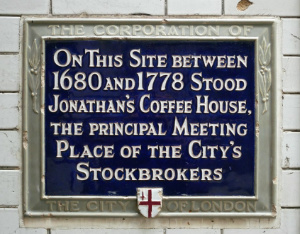
Among other prominent coffee houses at the time was Jonathan’s – where in, 1698, the London Stock Exchange was born – and Garraway’s Coffee House, both of them located in Exchange Alley, as well as Button’s in Covent Garden.
A Turkish bath located off Newgate Street, the Royal Bagnio was a London fixture for almost 200 years.
Said by some to be the first Turkish bath in London, it opened in 1679 in what became known as Bagnio Court (among other names, the alley which led northward off Newgate Street was also at one stage called Roman Bath Street) and was apparently built by Turkish merchants in an eastern style with a cupola roof over the main bath hall as well as Dutch tales and marble steps.
The facilities offered patrons a range of treatments including, according to one 17th century commentator, “sweating, rubbing, shaving, cupping and bathing” (cupping being a reference to using heated glasses to create blood-blisters and so extract blood) . And there were separate days (naturally!) for ladies and men.
The baths apparently later changed its name to the Old Royal Baths – by this time it had a cold bath only – and continued to be used until 1876 when the building was demolished for offices.
The bath was one of a number of Turkish bathhouses which appeared in the late-Stuart and Georgian eras and not a few of them bore the same or similar names (and carried a somewhat seedy reputation). And like some of the others, this particular one was also associated with a nearby coffee house enabling patrons to attend the baths and find refreshment at the same time.
Once located in Cowper’s Court, just off Cornhill, this City of London establishment was in the 1770s said to be a favoured place to gather of members of the East India Company.
 Along with other coffee houses like the more famous Lloyds, it was one of those locations where shipping news would first be broken. As well as attracting those associated with the East India Company, it had also been popular with traders connected to the South Sea Company.
Most famously, this was where, in 1845, John Tawell was apparently apprehended for murdering his mistress Sarah Hart by giving her prussic acid, apparently to prevent his affair becoming known.
His arrest became famous thanks to the fact the telegraph system was used by police for the first time to help apprehend a suspect. In this case it was used to send a message from Slough, where a person matching Tawell’s description had been seen boarding a train to Paddington.
Police were hence waiting when Tawell arrived at Paddington. He was subsequently tailed and eventually arrested the next morning in the Jerusalem Coffee House.
Tawell was hanged in Aylesbury on 28th March that year following his conviction (he’d put forward a somewhat implausible defence that Hart had been killed after eating apples and accidentally ingesting the pips which contained the acid).
Meanwhile, the Jerusalem went into decline in the mid-19th century and eventually disappeared from the fabric of the city.
PICTURE: The entrance to Cowper’s Court today (Google Maps).
 Exploring London