• The most complete Roman pottery kiln found in Greater London is going on public display in Highgate Wood in what is the first public showing since its discovery in 1968. The kiln has been restored thanks to a £243,550 National Lottery Heritage Fund grant and will be unveiled at 11am on Sunday as part of the annual Highgate Wood Community Heritage Day. The day, which runs until 4pm, will see the firing of a replica kiln and there will also be guided walks, a children’s Roman-themed woodland adventure workshop, arts, crafts, and other activities. The kiln will be on show in the Information Hut. For more, see www.cityoflondon.gov.uk/events/highgate-wood-community-heritage-day.
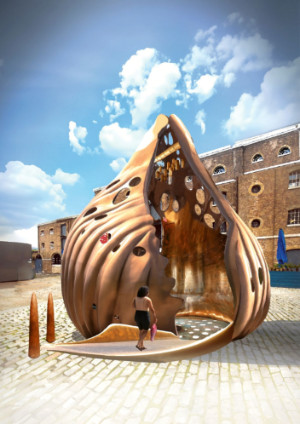
Concept image of Khaled Brooks’ ‘The Wake’. Courtesy of Mayor of London
• Khaleb Brooks’ sculpture The Wake has been selected as the new Memorial to Victims of Transatlantic Slavery to be located at West India Quay. The design, which features a seven metre tall cowrie shell in recognition of the shell’s role as symbol of slavery. A number of smaller shells will also be installed at other locations in London that have connections to the trade of enslaved people. Khaleb’s work was selected from a shortlist of six proposals by an artistic advisory panel of experts following a public consultation period. The memorial will be unveiled in 2026.
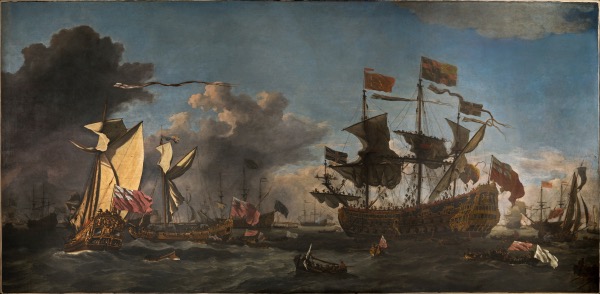
• The work of 17th century marine painters Willem van de Velde the Elder and Willem van de Velde the Younger is the subject of a new exhibition at the Queen’s House in Greenwich – the location of a studio King Charles II granted to them.The Van de Veldes: Greenwich, Art and the Sea features the newly conserved painting, A Royal Visit to the Fleet, which they worked on in their studio at the Queen’s House in the 1670s and which, at almost four metres across, was the largest seascape Van de Velde the Younger had painted to date (pictured after conservation above). Also on show is the The Burning of the Royal James at the Battle of Solebay, 28 May 1672, otherwise known as The Solebay Tapestry and originally one of six, along with a selection of some of the more than 1,400 drawings from the National Maritime Museum’s collection. The exhibition, which is free to visit, runs until 14th January, 2024. For more, see www.rmg.co.uk/van-de-velde.
• The Young V&A will open on 1st July following a three year transformation project, it was announced this week. Formerly known as the V&A Museum of Childhood, the Bethnal Green institution will display “remarkable and optimistic stories of children’s ingenuity” alongside 2,000 works from the V&A’s collection of art, design, and performance. Features will include an interactive Minecraftinstallation, murals by street artist Mark Malarko, tech solutions created for Raspberry Pi’s Coolest Projects, and, a display of portraits by photographer Rehan Jamil capturing young people expressing what creativity means to them and set alongside self-portraits by the likes of Chila Kumari Singh Burman, Quentin Blake, Kenneth Branagh, Dapo Adeola, and Linda McCartney. Also announced was the first exhibition at the new facility – Japan: Myths to Manga – which will open on 14th October. For more, see vam.ac.uk/young.
•The most complete Roman pottery kiln ever found in Greater London is going on display in a visitor centre at Highgate Wood from September next year. The kiln, which was excavated from the wood in Haringey in the 1960s and 1970s, has been in storage beneath Bruce Castle Museum. But thanks to a £243,550 grant by The National Lottery Heritage Fund to charity Friends of Highgate Roman Kiln, it will be returned for public display. The kiln is said to be one of the best-preserved Roman pottery kilns found in the UK and is thought to be the last one built by Roman potters who worked in Highgate Wood between 50CE to 160CE to supply Londinium and south-east England with distinctive ‘Highgate Ware’ pottery.
• A small section of Bayswater Road has been renamed Kyiv Road to mark the first anniversary of the invasion of Ukraine by Russia. The new road name was installed last Friday on the road which runs from Palace Court to Ossington Street and is located not far from the Russian Embassy. Councillor Adam Hug, leader of Westminster City Council, said the request for the new name came from the Ukrainian community. “Westminster is home to Ukrainians displaced by the war, and our residents have opened their hearts and their doors to those fleeing Putin’s war machine,” he said in a statement. “As the centre of an international capital, it seemed to us entirely fitting that part of our City should carry a torch for the unbowed defenders of Ukraine. It’s a small stretch of road, but we want to show the people of Ukraine that their struggle has a visible place in our city.”
 Exploring London