• Kenwood House in north London is being reopened to the public today following a £5.95 million restoration project which has seen the library returned to what Scottish architect Robert Adam had intended it to be. The project, which saw the Hampstead property closed since March last year, has also seen the restoration of three other Robert Adam-designed rooms – the entrance hall, Great Stairs and antechamber or entrance to the library – as well as the redecoration of four rooms in 18th century style, repainting of the exterior and the repair of the home’s roof – a job aimed at protecting the rooms and its stellar
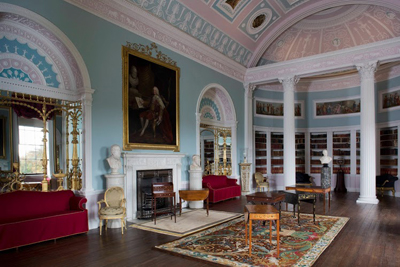 collection of artworks by the likes of Rembrandt and Vermeer. English Heritage has also endeavoured to make the property more homely, replacing ticket desks and rope barriers with an open fire, warm rugs and leather couches on which visitors can relax. The library (pictured) was built and decorated to Adam’s designs between 1767 and 1770 as part of a wider remodelling of the villa for its owner Lord Chief Justice William Murray, 1st Earl of Mansfield. Redecorated many times since, it was restored in the 1960s but this redecoration was later found to be inaccurate. The Caring for Kenwood restoration project, which has also seen restoration of the Kenwood Dairy, was funded by a £3.89 million grant from the Heritage Lottery Fund as well as support from the Wolfson Foundation and other donors. To coincide with the reopening, a new app exploring Kenwood House has been released which can be downloaded for free from the iTunes store. For more, see www.english-heritage.org.uk/daysout/properties/kenwood/. PICTURE: English Heritage/Patricia Payne.
• Head out on a “robot safari” this weekend with a special free event at Science Museum in South Kensington. Robot SafariEU, part of Eurobotics week, features 13 biometric robots from across Europe including an underwater turtle robot, a shoal of luminous fish robots, a robotic cheetah cub and Pleurobot, a robotic salamander. Roboticists from across Europe will be on hand to help visitors interact with the bots. Suitable for all ages, the event kicked off on Wednesday night and runs again on the weekend. Admission is free but timed tickets are required. For more, see www.sciencemuseum.org.uk/RobotSafari.
• A memorial to author, scholar and apologist CS Lewis was dedicated at Westminster Abbey last Friday – the 50th anniversary of his death. Conducting the service, the Dean of Westminster, the Very Reverend Dr John Hall, said Lewis was “one of the most significant Christian apologists of the 20th century” and the author of stories that had “inspired the imagination and faith of countless readers and film-goers”. Douglas Gresham, younger stepson of Lewis, read from the author’s book, The Last Battle, at the service. The memorial is located in Poet’s Corner in the abbey’s south transept. For more see www.westminster-abbey.org.
• A Blue Plaque commemorating Al Bowlly – described as “Europe’s most popular crooner and famous radio and record star” – will be unveiled at his home in Charing Cross Road this week. Bowlly, who lived between 1899 and 1941, was the voice beyond songs like Goodnight Sweetheart and The Very Thought Of You. The English Heritage Blue Plaque will be unveiled at Charing Cross Mansions, 26 Charing Cross Road – his home during the pinnacle of his career. For more, see www.english-heritage.co.uk/discover/blue-plaques/.
• Kew Gardens has opened its gates after dark for the first time with a “captivating show of lights, sound and landscape” this festive season. A mile long illuminated trail, created in partnership with entertainment promoter Raymond Gubbay, will take visitors’ through the garden’s unique tree collections, kicking off at Victoria Gate where a Christmas village (and Santa’s Woodland Grotto) is located. The gardens will be open every Thursday to Sunday until 23rd December and then be open every night from 26th December to 4th January from 4.45pm to 10pm. Admission charge applies. For more, see www.kew.org/Christmas.
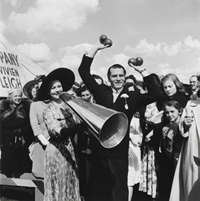 • Actress Vivien Leigh is the star of a new exhibition opening on Saturday at the National Portrait Gallery. Starring Vivien Leigh: A Centenary Celebration tells her story with a focus on her Academy Award-winning role in 1939’s Gone With The Wind. The display features more than 50 portraits of Leigh by the likes of Cecil Beaton, Angus McBean and Madame Yevonde – many of which have never been exhibited in the gallery before – and a selection of memorabilia including magazine covers, vintage film stills and press books. Among the photos will be a newly acquired image of Leigh and her husband, Laurence Olivier, taken by British photojournalist Larry Burrows at a garden party in 1949 (pictured), along with two rarely seen portraits of Leigh – one taken on the set of The School for Scandal by Vivienne in 1949 and the other by Paul Tanqueray in 1942. The exhibition will be held in Room 33 and runs until 20th July. Admission is free. For more, see www.npg.org.uk. PICTURE: Copyright – Larry Burrows Collection 2013.


 Exploring London