Treasures of London – The first (commercial) Christmas card…

Christmas cards have been a staple of Christmases (although a declining one these days) since at least as far back as 1843.

It was then that Sir Henry Cole, a civil servant, inventor and the first director of the Victoria & Albert Museum, came up with the idea of sending out a card bearing Christmas greetings to a large number of people as a means of coping with the substantial volume of correspondence he was receiving (and would have to send to greet family and friends at Christmas).

Sir Henry commissioned his friend, painter John Callcott Horsley, to design the card and an initial run of 1,000 cards were printed by Jobbins of Warwick Court in Holborn (a further thousands cards were printed in a second run).

Having sent the cards he required, Sir Henry sold the rest for a shilling each under his literary pseudonym of Felix Summerly from the premises of his publisher Joseph Cundall in Old Bond Street (the introduction of the uniform Penny Post in 1840 having made sending them affordable – Cole had been an important figure in its establishment as assistant to the idea’s main instigator Rowland Hill).

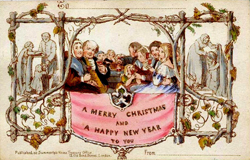
The card, which were hand-coloured by professional colourer Mason, depicts a family gathered for Christmas and imbibing wine with side panels depicting two acts of charity – “feeding the hungry” and “clothing the naked”. On it were printed the words “A Merry Christmas and a Happy New Year to You”.

The card was apparently controversial for its depiction of drinking wine (temperance advocates argued it promoted drunkenness) and particularly for its images of children drinking wine.

The idea didn’t also catch on immediately – the cost of a shilling was rather steep. But new designs soon began to appear in the following years and by the mid-1850s, the idea had finally taken hold.

WHERE: The Postal Museum, 15-20 Phoenix Place (nearest Tube stations are Farringdon, Russell Square, King’s Cross St Pancras and Chancery Lane); WHEN: 10am to 5pm Wednesday to Sunday (booking in advance suggested); COST: Adult £17/Young person (16-24) £12/Child (3-15) £10 (discounts apply for booking online/other ticket types available; WEBSITE: www.postalmuseum.org
10 (lesser known) monuments featuring animals in London – 7. Jim and Tycho…

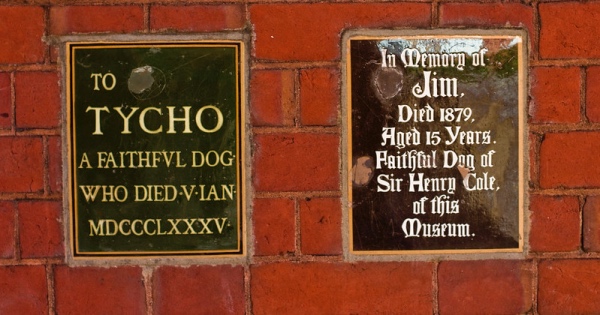
Set into a wall of the V&A’s John Madejski Garden in South Kensington are two small plaques – one dedicated to “Jim” and another to “Tycho”. Both, as one of the plaques records, were dogs, at least one of which belonged to the museum’s first director, Sir Henry Cole.

Jim was a Yorkshire terrier who died at Sir Henry’s home on 30th January, 1879, at the age of (as the plaque records) 15 years.

Sir Henry wrote in his diary on that day that “Jimmy”, who died very quietly apparently of “asthma and cold”, had been portrayed in Punch with him (although it was actually in Vanity Fair in 1871) and “was a character in the Museum”.

While Jim’s story is fairly well known, there’s a little more mystery surrounding the identity of Tycho, which the plaques records as a “faithful dog” who who died in 1885.

But according to Nicholas Smith, an archivist based at the V&A Archive and his meticulously researched blog post on the matter, Tycho is also mentioned in Cole’s diary – not as his own dog but as that of his son Alan. Indeed, one diary entry records Tycho fighting with another dog (presumably Cole senior’s) named Pickle. Which as Smith points out, begs the question of why no plaque for Pickle?

Both Jim and Tycho are believed to be buried in the garden where the plaques can be seen (which may explain the lack of a plaque for Pickle).

PICTURE: Steve and Sara Emry (licensed under CC BY-NC-SA 2.0)


A Moment in London’s History – Sir Henry Cole sends Christmas cards…

The practice of sending Christmas cards really began in the Victoria era and it was in London, in 1843, that the first commercial Christmas cards are widely said to have been designed and printed.

first-christmas-cardThe idea had come from Sir Henry Cole, the first director of the Victoria and Albert Museum, who, overwhelmed with the volume of correspondence he was receiving, conceived it as answer to his problem, allowing him to send Christmas greetings to a wide group of people – all at once.

He asked his friend, artist John Callcott Horsley, to design the card and an edition of 1,000 were printed by Jobbins of Warwick Court in Holborn.

The hand-coloured card, published by Summerley’s Home Treasury Office in Old Bond Street, showed a family gathered for a Christmas celebration with two side images showing people engaged in charitable acts and a message, ‘A Merry Christmas and a Happy New Year to You’. Designed as a single flat card (not foldable like they are today), it came complete with ‘To’ and ‘From’ spaces for the sender to fill in.

The cards which Sir Henry didn’t need for his personal use were placed on sale for a shilling each but it was a fairly steep price and that – and the fact that the image of people drinking at the festive season apparently roused the ire of temperance campaigners, helped to ensure the cards weren’t an immediate success.

Nonetheless, further cards were produced in the following years and within a couple of decades, they were being mass produced.

One of Sir Henry’s original cards was reportedly sold at an auction in 2013 for £22,000.

This Week in London – Alice in Wonderland’s 150th; Remembering Julia Margaret Cameron; and, Imperial Britain’s artistic influence…

John-Tennial-illustrationA new exhibition has opened at the British Library in Kings Cross to mark the 150th anniversary of the publication of Alice’s Adventures in Wonderland. The free exhibition explores the story of how the tale came to be written and features Lewis Carroll’s handwritten manuscript of Alice’s Adventures Under Ground (complete with 37 illustrations by Carroll) as well as an entry from Carroll’s diary in which he relates how he first came to tell the story to Alice Liddell and her sisters on the “golden afternoon” of 4th July, 1862. Other highlights include two first editions of Alice’s Adventures in Wonderland with illustrations by Sir John Tenniel (including the suppressed first edition; suppressed because Carroll and Tenniel were unhappy with the quality of the illustrations), the first movie adaption of the story – a 1903 silent film, early Alice memorabilia, and three new computer game concepts. The exhibition, which runs until 17th April, is accompanied by a series of events and a pop-up shop. For more, see www.bl.uk/events/alice-in-wonderland-exhibition. PICTURE: Sir John Tenniel’s illustration of Alice and the Cheshire Cat from the 1866 edition of Alice’s Adventures in Wonderland by Lewis Carroll © The British Library Board.

An exhibition featuring more than 100 photographs by celebrated 19th century photographer Julia Margaret Cameron opens at the V&A on Saturday to mark the bicentenary of her birth. The display at the South Kensington museum offers a retrospective of her work and looks at her relationship with the V&A’s founding director Sir Henry Cole who presented the only exhibition of her work during her lifetime in 1865. Her relationship with the museum goes back to the very start of her work – within two years of being given a camera by her daughter she was selling and giving photographs to what was then the South Kensington Museum while, in 1868 she was granted the use of two rooms at the institution to use as a portrait studio, becoming the museum’s first artist-in-residence. The exhibition features original prints acquired from Cameron as well as a selection of her letters to Cole, his 1865 diary, the first photograph identified as being of her studio and a variety of her portraits in which family, friends and servants posed as characters from Biblical, historical and allegorical stories. The free exhibition runs until 21st February. For more, see www.vam.ac.uk/juliamargaretcameron.

The influence of the British Empire on art over the past 400 years is the subject of a new exhibition which opened in Tate Britain’s Linbury Galleries yesterday. Artist and Empire will showcase art from across the empire – including the British Isles, North America, the Caribbean, the Pacific, Asia and Africa – and features some 200 paintings, drawings, photographs, sculptures and artefacts. These include paintings by the likes of George Stubbs and Anthony Van Dyck through to Indian miniatures, Maori objects, and the works of contemporary artists such as Sonia Boyce and Judy Watson. Runs until 10th April at the Milbank gallery. The exhibition is free. For more, see www.tate.org.uk.

Send all items for inclusion to exploringlondon@gmail.com.