Around London – Website to showcase UK’s oil paintings; Arctic explorer John Rae gets Blue Plaque; sharing experiences of kindness; and Toulouse-Lautrec and Jane Avril hit the Courtauld…

• A new website has been launched to showcase the UK’s vast national collection of oil paintings. While the website, which is a partnership between the BBC, the Public Catalogue Foundation, and participating collections and museums, currently hosts around 60,000 works, it is envisaged that by the end of 2012 it will carry digitised images of all 200,000 oil paintings in the UK (in an indicator of how many there are, the National Gallery currently has around 2,300 oil paintings, about one hundredth of all those in the nation). The works on the site will eventually include almost 40,000 by British artists. The 850 galleries and organisations participating so far include 11 in London – among them the National Gallery, the Tate Gallery, the Victoria and Albert Museum, the Bank of England, the Imperial War Museum and Dr Johnson’s House. For more, see www.bbc.co.uk/arts/yourpaintings/

• Arctic explorer John Rae has had a Blue Plaque unveiled in his honor at his former home in Holland Park. Although his feats were relatively unsung in his lifetime, the explorer’s expeditions in the Canadian Arctic saw him travel 13,000 miles by boat and foot and survey more than 1,700 miles of coastline. He is also credited with having “signposted” the only north-west passage around America that is navigable without icebreakers. Rae, who died in 1893, lived at the property at 4 Lower Addison Gardens in Holland Park for the last 24 years of his life.

Transport For London is calling on Londoners to share experiences of “kindness” that they have witnessed or participated in while travelling on the Underground. Artist Michael Landy has created a series of posters which are calling on people to submit their stories. Some of the stories will then be shown at Central Line stations (the first four posters go up on 23rd July at stations including Hollard Park, Holborn and Liverpool Street). For more, go to www.tfl.gov.uk/art.

On the Olympic front, the City of London Corporation has announced Tower Bridge will be bedecked with a set of giant Olympic Rings and the Paralympic Agitos during the 45 days of next year’s Games. Meanwhile, the Corporation has also unveiled it will host next week the launch of a London-wide campaign to get people involved in sport and activity in the lead-up to the Games. More to come on that.

On Now: Toulouse-Lautrec and Jane Avril Beyond the Moulin Rouge. The Courtauld Gallery, based at Somerset House, is running an exhibition celebrating the “remarkable creative partnership” between Jane Avril, a star of the Moulin Rouge in Paris during the 1890s, and artist Henri de Toulouse-Lautrec. Lautrec created a series of posters featuring Avril which ensured she became a symbol of Lautrec’s world of “dancers, cabaret singers, musicians and prostitutes”. Runs until 18th September. See www.courtauld.ac.uk for more.


King James I’s London – 10. Westminster Abbey’s Lady Chapel

And so we come to the final instalment in our series on King James I’s London. This week we’re looking at Westminster Abbey’s Lady Chapel where King James I – who was crowned in Westminster Abbey in 1603 – was laid to rest after his death in 1625.

But before we turn to James himself, it’s worth noting that several members of his immediate family are also buried in the abbey’s Lady Chapel (pictured). These include his eldest son, Henry Fredrick, Prince of Wales, who died in 1612 at the age of 18 (and thus opened the way for his younger brother Charles to become King Charles I). He is buried in the south aisle of the magnificent Lady Chapel which had been added at the behest of King Henry VII between 1503 and 1519 and replaced a 13th century chapel.

Three of James’ daughters are also buried in the Lady Chapel – Mary, who died in 1607, aged two, and Sophia, who died in 1606, aged just three days old. Both of them have monuments in the north aisle while their sister Elizabeth, wife of King Fredrick V of Bohemia, who died much later in 1662, is buried near her brother Henry Fitzpatrick.

As we’ve previously mentioned, King James I also outlived his wife, Queen Anne of Denmark, who died of dropsy at Hampton Court Palace on 2nd March, 1619, at the age of 43. She lay in state at Somerset House until her funeral on 13th May and was then buried in the south-eastern area of the Lady Chapel where her gravesite is marked by a modern stone bearing her name. Her wooden funeral effigy is one of a collection which can still be seen in the Abbey’s Museum.

After James himself died on 27th March, 1625, he was laid in the vault beneath King Henry VII’s monument beside Elizabeth of York, Henry’s wife. No monument was erected to mark his passing save for a modern inscription placed nearby (in fact Queen Elizabeth I was the last monarch to be buried with a monument above the site – see below).

It’s also worth noting that in 1612 – nine years into his reign – James arranged for the body of his mother – Mary, Queen of Scots, who was executed in 1587 on the orders of Queen Elizabeth I – to be transferred from its resting place in Peterborough Cathedral to the south aisle of the Lady Chapel where he had an elaborate tomb erected featuring an elegant white marble effigy showing her wearing a coif, ruff and long mantle.

In the north aisle, James had previously erected a marble monument to his predecessor, Queen Elizabeth I and had her body moved from where it had lain in the vault of her grandfather, King Henry VIII, to a place beneath the new monument. Her half-sister, Queen Mary I, is also buried beneath the monument.

That’s the final in our series on King James I’s London – it’s by no means a comprehensive look at significant sites in the early Stuart period and we shall be looking at more from the period down the track, but it’s a good start. Our new special series starts next week. 

WHERE: Westminster Abbey, Westminster (nearest Tube station is Westminster or St James’s Park); WHEN: Open to tourists everyday except Sunday  (times vary so check the website); COST: £16 an adult/£13 concessions/£6 schoolchildren (11-18 years), free for children aged under 11/£38 for a family (two adults, two children); WEBSITE: www.westminster-abbey.org

Lost London – York Watergate

There’s several places along Victoria Embankment where it’s possible to see where the River Thames bank stood before the massive mid-19th century project to reclaim land. Not the least of them is located in the downstairs foyer to Somerset House, where looking through the glass floor, you can see the pebbles of the original riverbank.

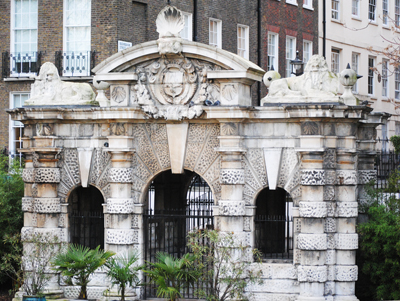
Another is York Watergate, once the river entrance to the Duke of Buckingham’s London mansion, and now stranded some distance from the water in Victoria Embankment Gardens.

The mansion, known as York House, was originally located on the southside of the Strand. Originally built in the 13th century, it was later acquired by King Henry VIII and granted to the Archbishop of York, Nicholas Heath, in 1556 (hence its name). The house became the home of George Villiers, the first Duke of Buckingham and somewhat sycophantic favorite of King James I, in the early 1620s.

When the duke was stabbed to death in 1628, the property passed to his son, the second Duke of Buckingham (also George), who later sold it to a land developer. It was apparently as a condition of the sale that the streets there now include the duke’s full name – hence George Court, Villiers Street, Duke Street, the slightly ludicrous Of Alley, and Buckingham Street.

The impressive Italianate watergate, which stands below the junction of Buckingham Street and Watergate Walk just a short walk into the gardens from Embankment tube station, was designed by the irrepressible Inigo Jones and built in 1626. Though weathered, it still bears the coat of arms of the Duke of Buckingham on the front.

Around London – Skating at a palace or a tower?; British Military Tournament; and, new blue plaques

Christmas is looming and snow and ice have been besieging London. But there’s plenty you can do to keep warm, including visiting one of the many ice skating venues about the city. Among those with a particularly historic location are rinks at Hampton Court (located against the backdrop of the palace’s west front, it’s open until 9th January – see website for ticket prices and times), in the moat of the Tower of London (also open until 9th January, see website for ticket prices and times), and at Somerset House (open until 23rd January, see website for ticket prices and times).

The British Military Tournament 2010 will be held at Earl’s Court this weekend. The programme features 500 troops, 145 horses, military bands, the field gun run and will include a re-enactment of a combat incident in Afghanistan involving recently returned troops. Presented by ABF The Soldiers’ Charity, with performances on both Saturday and Sunday. For more information – including booking information, see www.britishmilitarytournament.com.

New blue plaques have been unveiled in London marking the former homes of speed daredevils Sir Malcolm Campbell and his son Donald, and ground-breaking photographer Bill Brandt. The plaque for the Campbells, who between them set 10 land speed records and 11 water speed records, is located at Canbury School in Kingston-upon-Thames – Sir Malcolm moved here in 1919, married to Dorothy Whittall the following year, and, Donald was born here in 1921. The family moved in 1922 to Surrey. The plaque for German-born Brandt, meanwhile, was unveiled at 4 Airlie Gardens in Campden Hill. He lived here with his second wife Marjorie Beckett from 1958 and family members still live in the home. Some of his nudes were taken inside. For more information, visit www.english-heritage.org.uk.