Lost London – Old Slaughter’s Coffee House…

This rather macabre monikered institution, which was located in St Martin’s Lane in Covent Garden, dates back to 1682 when it was founded by Thomas Slaughter as Slaughter’s (the “old” apparently added at a later date after another coffee house opened with the name “New Slaughters” following Thomas Slaughter’s death in 1740).
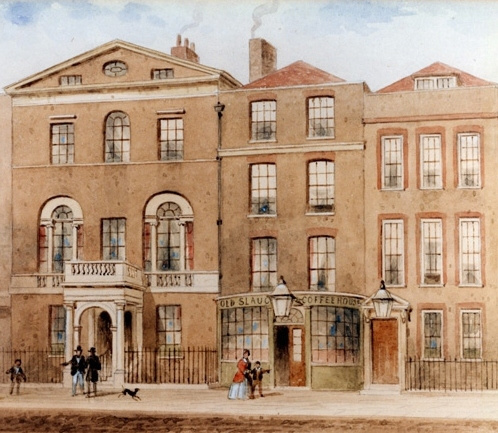
An image of Old Slaughter’s Coffee House from Ralph Rylance’s The Epicure’s Almanack (1815). PICTURE: Public Domain via Wikipedia.

Known as a location for games, particularly chess and whist, it attracted the likes of French mathematician and exile Abraham de Moivre, Benjamin Franklin and the chess player Andre Philidor.

Henry Fielding was another who frequented the coffee house early on – he nick-named the head waiter ‘Sock’ but he also became known as “Punch Spiller” for having spilled punch on his way to the guest’s table. Biographer James Boswell also attended and records Samuel Johnson as having visited.

The Green Plaque at the site of Old Slaughters. PICTURE:
Spudgun67
(licensed under CC BY-SA 4.0)

It also become something of a haven for artists with William Hogarth, Thomas Gainsborough, architect Robert Adam and sculptor Louis-Francis Rubiliac among those all cited as being patrons. Artistic gatherings at the storied establishment served as a forerunner to the creation of the Royal Academy.

The RSPCA was founded – initially as the Society for the Prevention Cruelty to Animals – at a meeting in the coffee house on 16th June 1824. A City of Westminster plaque marks the site of coffee house thanks to this connection.

The property survived until 1843 when it was demolished to allow for the widening of Cranbourn Street.
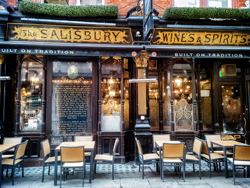
London Pub Signs – The Salisbury, St Martin’s Lane…

This popular Covent Garden pub lies in the heart of London’s Theatreland and is noted for its popularity with actors.

SalisburyLocated at 90 St Martin’s Lane, the pub was built in the late 1800s on the site of an earlier public house which had been known under various different names including The Coach & Horses and Ben Caunt’s head (the latter after the famed bare knuckle fighter when the pub apparently hosted such bouts).

It was first named the Salisbury Stores – an ‘SS’ motif can still be seen in some of the glasswork, with the origins of the name coming from the fact that the site was leased from Robert Cecil, Lord Salisbury, who was thrice PM in the late 19th and early 20th century, in about 1899.

The Cecil family’s coat-of-arms can be seen above the door on the corner of St Martin’s Lane and St Martin’s Court (Cecil Court is located nearby).

The now Grade II-listed Taylor Walker pub, which dropped the ‘Stores’ off its name in the 1960s, was restored in the mid-20th century and again at the end. It features original etched glass, hand-carved mahogany woodwork and art nouveau candelabra.

The pub, which, as well as its association with actors, has also long had an association with the gay community in London, has appeared in numerous films including Dirk Bogarde vehicle Victim and Travels With My Aunt as well as, in more recent times, The Boat That Rocked.

For more, see www.taylor-walker.co.uk/pub/salisbury-covent-garden/c3111/.

PICTURE: Garry Knight – Flickr/CC BY 2.0